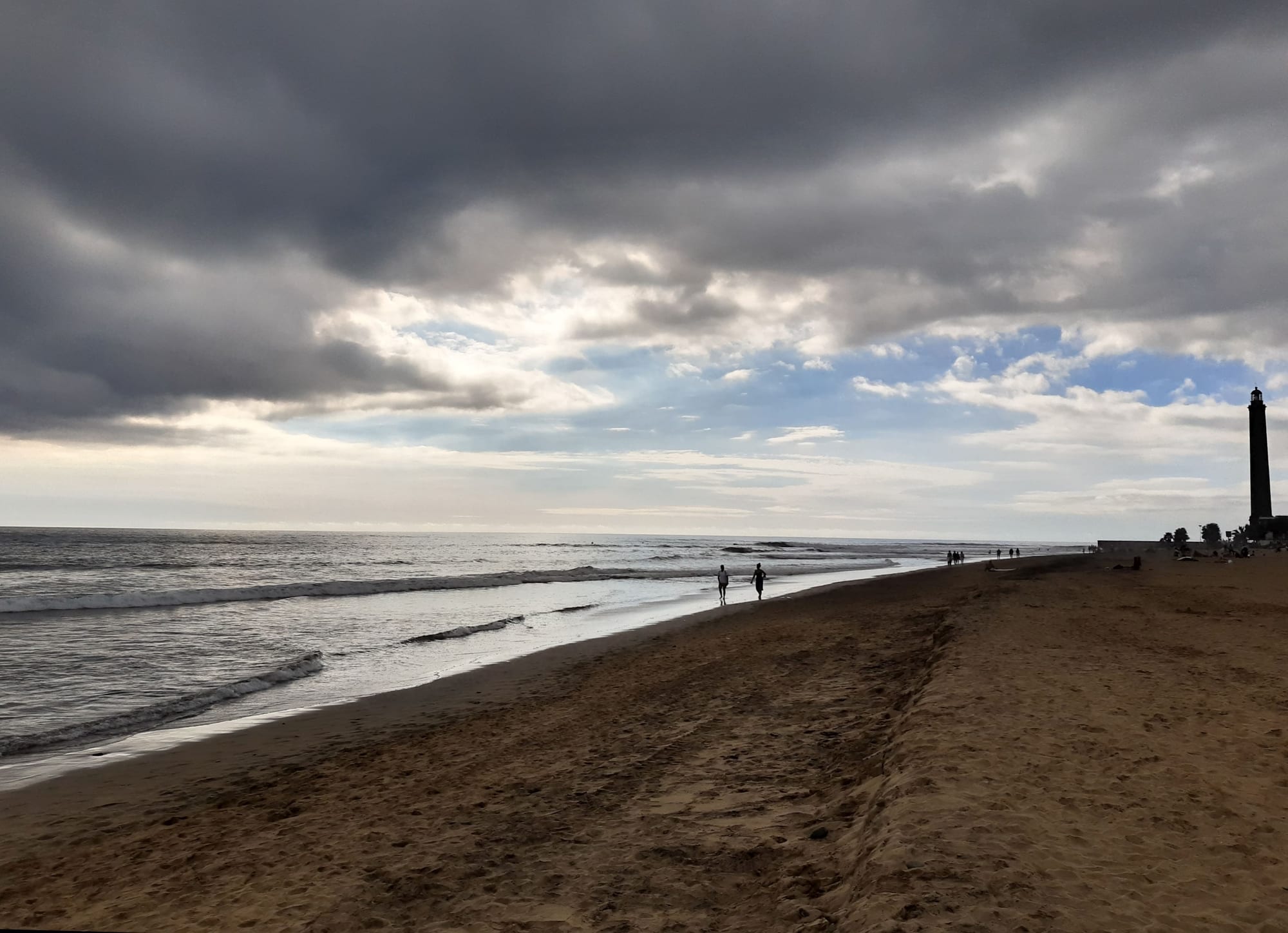
A wide sandy beach under heavy grey cloud, with small figures at the water's edge and the tall lighthouse tower at the far end

The Canary Islands, Spain

Maspalomas

Maspalomas beach looking west towards the lighthouse at Punta de Maspalomas. (Gerda Arendt / Wikimedia Commons · CC BY-SA 4.0)

The resort strip at the southern tip of Gran Canaria, running from Bahía Feliz to Meloneras and taking in San Agustín and Playa del Inglés. Planned from 1961 on a coast of empty land, it grew around a protected field of sand dunes and an 1890 lighthouse, and is now the largest tourist destination in the Canary Islands, busiest in the northern European winter.

Neighbourhoods

  • Playa del Inglés
    • Nightlife
    • Beaches
    • LGBT travellers

    The densest and best-known part of the resort, built up from the 1960s behind the beach and the dunes. Large shopping centres such as the Yumbo and the Kasbah hold bars, clubs and restaurants, and the Yumbo area is the centre of the island's gay scene.

    Open in Maps
  • Meloneras and the lighthouse
    • First-time visitors
    • Beaches
    • Promenade walks

    The western end of the resort around the Faro de Maspalomas, mostly hotels, some of them in a revived Canarian colonial style. A seafront promenade lined with restaurants runs past the lighthouse to the beach and the dunes, and the main bus station is close by.

    Open in Maps
  • San Agustín
    • Quiet and residential
    • Families

    The eastern end of the resort strip, beyond Playa del Inglés, with a lower-key feel than the centre.

    Open in Maps
  • San Fernando
    • Local life

    The inland district on the site of the original hamlet of Maspalomas, built up for people working in the tourist industry. It is where much of the resident population lives.

    Open in Maps

Things to do

Dunes and the coast

  • Maspalomas Dunespark

    A nature reserve of about 400 hectares of shifting sand between the lighthouse and Playa del Inglés, formed from sand blown ashore from the sea shelf exposed during the last ice age; parts are fenced off to protect the habitat.

    Open in Maps
  • Maspalomas Lighthouselandmark

    The 56-metre blue-grey masonry tower at Punta de Maspalomas, first lit in 1890 to guide ships between Europe and the Americas, and reopened to visitors in 2019 with an exhibition of island crafts.

    Open in Maps
  • Maspalomas beachbeach

    The long sandy beach that runs from the lighthouse along the edge of the dunes and turns north-east to become Playa del Inglés, with a naturist section and a popular gay beach along its length.

    Open in Maps
  • El Charcopark

    A natural lagoon at the edge of the dunes near the lighthouse, which attracts many species of birds.

    Open in Maps

Gardens and parks

  • Palmitos Parkattraction

    A 20-hectare botanical garden, aviary and zoo in a valley in the hills above the resort.

    Open in Maps
  • Parque Botánico de Maspalomaspark

    A botanical garden near the golf course with more than 500 species of plants.

    Open in Maps

Short trips from the resort

  • Puerto de Mogánattraction

    A fishing village and marina at the mouth of a steep valley, nicknamed 'Little Venice' for the canals linking its harbours, where new buildings are kept to two storeys.

    Open in Maps
  • Roque Nubloviewpoint

    An 80-metre volcanic rock pinnacle, the third-highest point on the island, its top 1,813 metres above sea level, formed by an eruption about 4.5 million years ago.

    Open in Maps
  • Tejedaattraction

    A mountain village and municipality in the high centre of the island, whose summits include Roque Nublo and Roque Bentayga.

    Open in Maps
  • Las Palmas de Gran Canariaattraction

    The island capital, with the old Vegueta quarter and Las Canteras beach, reached by direct bus from the resort.

    Open in Maps

Seasonal events

  • CarnivalFebruary

    The resort's main festival of the year, with parades and street parties, part of the carnival season that fills the Canary Islands each winter.

  • Maspalomas PrideMay

    One of the largest Pride festivals in Europe, held in and around the Yumbo Centrum in Playa del Inglés; the 2011 event drew more than 100,000 people.

Eat and drink

Long-standing places and food districts in Maspalomas. Hours, ratings and directions come from your maps app, always current.

Food districts and markets

  • Mercado Maspalomasmarket

    The resort's market on Avenida Alejandro del Castillo, held on Wednesdays and Saturdays and turning into a flea market on Sundays.

    Open in Maps
  • Meloneras promenadeneighborhood

    The seafront walk from the lighthouse westwards, lined with restaurants and terraces facing the sea.

    Open in Maps
  • Yumbo Centrumneighborhood

    The shopping centre at the heart of Playa del Inglés and the main area for its gay and gay-friendly bars, clubs and cabarets.

    Open in Maps
  • Puerto de Mogán harbourneighborhood

    Restaurants and bars around the marina and beach of the fishing village up the coast.

    Open in Maps

Experience Maspalomas

History

Before tourism, Maspalomas was the name of a small hamlet on the site of today's San Fernando de Maspalomas, at the dry southern tip of Gran Canaria. The origin of the name is uncertain: it may come from Rodrigo Mas de Palomar, a soldier and settler from Mallorca, or from Francisco Palomar, a Genoese friend of the conqueror Alonso Fernández de Lugo who settled in the area. For centuries the coast here was empty, and its main landmark was the lighthouse built at Punta de Maspalomas. Planned from 1861 and designed by the engineer Juan León y Castillo, it was first lit on 1 February 1890 to guide ships sailing between Europe and the Americas.

The modern resort was invented on paper. In 1961 the landowner Alejandro del Castillo, who owned most of the land, held an international ideas competition open to architects worldwide; it was won by the French firm SETAP, whose plan covered 1,060 hectares and 19 kilometres of coast. Large-scale building began in the 1960s, and through the 1960s and 1970s hotels began to encroach on the dunes, damaging their habitat, until they were protected as a nature reserve. In the same decade a satellite tracking station was built on a hill nearby to support NASA's early human spaceflight programme.

The model of tourist town planning tried here was copied on other islands. Later decades added luxury hotels in Meloneras, two hospitals, schools and shopping centres, and in 2012 the World Tourism Organization held its World Tourism Day in Maspalomas to mark the resort's fifty years. The lighthouse reopened to the public in 2019 after ten years closed.

Culture & Customs

Maspalomas is a holiday town first, and much of its culture is shaped by the visitors who return to it each winter. Many come from Sweden, Norway, Finland, Germany and the Netherlands, and the resort has foreign schools, an English-language newspaper and a mixed community of long-staying residents alongside the Canarians who work there.

It is also one of the best-known LGBT destinations in Europe. Playa del Inglés has been associated with gay travellers for decades; the Yumbo Centrum and the streets around it hold dozens of bars, clubs and cabarets, and the annual Maspalomas Pride in May has been described as one of the largest Pride events in Europe, with more than 100,000 people attending in 2011. A stretch of the beach by the dunes is a popular gay beach, and the locals, in a largely Catholic island, have embraced this side of the resort.

Carnival, in February, is the other great festival, part of a season that fills the Canary Islands with parades and costume parties every winter. Outside the festivals, life revolves around the beach, the promenade and the shopping centres, which come alive after dark. Inland the older Canarian identity is closer at hand: the mountain villages of the island keep their own festivals and crafts, some of which are displayed inside the lighthouse.

Daily Life

About 13,500 people were registered as residents of the Maspalomas enclave in 2019, against more than 87,000 beds offered to visitors, so the population present at any time is many times larger than the census figure. The resort makes up the southern part of the municipality of San Bartolomé de Tirajana, the largest in area in the Canary Islands, whose old village capital lies in the mountains inland.

Tourism is almost the whole economy. The districts of San Fernando and El Tablero were built for people working in hotels, restaurants and shops, while Sonnenland was built for foreign residents. The resort has its own hospitals, private clinics, Spanish, English and Swedish schools, casinos and convention centres, which makes it a working town as much as a holiday strip.

The rhythm follows the seasons rather than the week: busiest from late autumn to Easter, with a second rush of Spanish families in summer. Mornings belong to the beach and the promenades, evenings to the terraces of Meloneras and the bars of Playa del Inglés. A railway linking the south to the airport and Las Palmas has been planned for years but not confirmed, and most residents depend on buses and cars.

Food

The food of Maspalomas is international, cooked for visitors from all over Europe, but Canarian dishes are easy to find. Papas arrugadas, wrinkly potatoes, are the signature: small local potatoes boiled unpeeled in heavily salted water and left to dry in the pot until a fine salt crust forms, eaten by hand and dipped in mojo. Mojo is a family of sauces of olive oil, local peppers, garlic, paprika and cumin or coriander; mojo rojo is red and spicy, mojo verde green. Papas arrugadas are sometimes served with conejo en salmorejo, a rabbit stew.

Gofio, a flour made from roasted grain such as wheat or maize, is an old staple of the islands and holds a European protected designation. Bienmesabe, a sweet of honey, egg yolk and ground almonds, is a common dessert, and ron miel, honey rum, is drunk as a shot, often with a little lime juice. Goats supply the islands' meat and cheese.

The resort's own market on Avenida Alejandro del Castillo is held on Wednesdays and Saturdays and turns into a flea market on Sundays. For eating out, the Meloneras promenade and the beach end near the lighthouse have the sea-view terraces, Playa del Inglés has the broadest choice at every price, and many visitors drive along the coast to the harbour restaurants of Puerto de Mogán.

Planning tools

Budget

Maspalomas covers the whole range, from older bungalow complexes and apartments in Playa del Inglés to large hotels in Meloneras. Winter is the high season, with prices at their peak over Christmas and Easter, and Pride week in May also fills the resort. Buses are cheap and frequent along the coast; a hire car is the main extra cost for trips inland.

Daily Budget Midrange
USD 130–250 (mid-range hotel, restaurant meals, a day of car hire or excursions)
Daily Budget Shoestring
USD 55–100 (apartment or simple bungalow, supermarket and market food, local bars, buses)

The beach, the dunes and the lighthouse promenade cost nothing; book early for the winter peaks and Pride week.

Best Time to Visit

Any time of year. Winter is the main season, when visitors from Scandinavia, Germany and the Netherlands come for the warmth; February brings carnival and May brings Pride, the two busiest festival weeks. Summer is hot and very dry, and is the season for Spanish holidaymakers.

Suggested Number of Days

Three or four days cover the resort itself, and most people come for a beach week or longer. Allow six or seven days to add the mountains, the west coast and the island capital, which need a hire car or long bus rides.

First Visit
3–4 days
With Surroundings
6–7 days

Transportation

The resort spreads for about 19 kilometres along the coast, and Maspalomas, Playa del Inglés and San Agustín run into one another. Buses run from the Faro de Maspalomas bus station near the lighthouse to the other southern resorts, the east coast towns and Las Palmas, and taxis are common for short trips within the resort. There are almost no cycle lanes, though bikes can be hired. A hire car is the practical way to reach the mountains.

A proposed railway to the airport and Las Palmas has not been built, so allow for buses or a car.

Airport & Station Connections

Gran Canaria Airport lies on the Bay of Gando on the east coast, about 25 kilometres from the resort areas of the south. Direct buses take about half an hour to reach Maspalomas, with several stops in the resort, and taxis and hire cars are available at the airport. Most visitors arrive on direct flights from mainland Spain and northern Europe.

Walkability

Within each part of the resort, walking is easy and flat: the promenade from Meloneras past the lighthouse to the beach is a popular stroll, and the beach itself can be walked to Playa del Inglés. The whole strip is too long to cover comfortably on foot, roads are wide and kerbs high, and buses or taxis link the districts.

Safety

Spain is a safe country with low violent crime. In Maspalomas the common problems are small scams on the promenades and outside shopping centres — sleight-of-hand tricks when giving change, shell games and pushy sellers of fake designer goods. The summer sun is intense.

Avoid street shell games, count change carefully, keep to the marked paths in the fenced parts of the dunes and swim only where it is guarded when the sea is rough. Check current official travel advice before travelling.

Climate

A hot desert climate close to tropical, among the warmest in Spain, with average temperatures above 18°C in every month and less than 100 millimetres of rain a year. Dust carried from the Sahara, called calima, occasionally reaches the islands.

Summer
hot and very dry; in the island capital, Las Palmas, August and September days typically reach 27–30°C
Winter
very mild to warm and dry; nights rarely drop below 13°C

Local Customs

Maspalomas has long been one of Europe's best-known gay-friendly resorts, and same-sex couples are a normal sight on the beaches and in the bars. Part of the beach is a designated naturist area. Canarians speak their own variety of Spanish, in which a bus is a guagua.

Keep swimwear and nudity to the beach and the naturist area, respect the fenced zones in the dunes, and greet staff in shops and bars with a 'hola' or 'buenos días'.

Common Payment Methods

The currency is the euro. Cards and contactless are accepted almost everywhere, including small bars, and cash machines are easy to find in the shopping centres; a little cash is useful for markets.