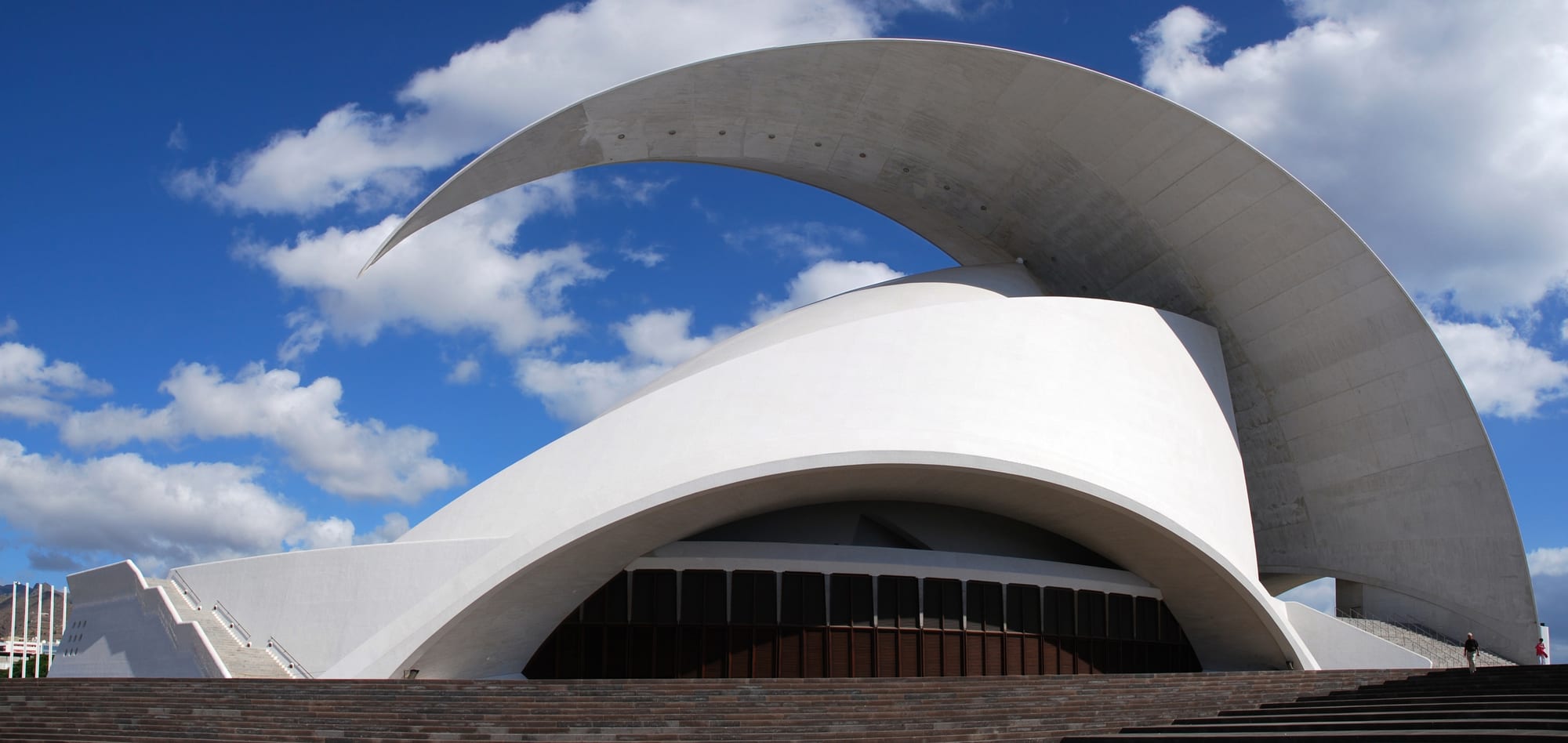
The white curved concrete shell and soaring wing-like roof of the Auditorio de Tenerife against a blue sky with clouds

The Canary Islands, Spain

Santa Cruz de Tenerife

The Auditorio de Tenerife, Santiago Calatrava's concert hall on the Santa Cruz waterfront. (Wladyslaw, derivative work: Nikopol / Wikimedia Commons · CC BY-SA 3.0)

Tenerife's capital and port on the island's north-east coast, founded as a Castilian army camp in 1494 and later the sole capital of the Canary Islands, a role it now shares with Las Palmas. It is a working, modern city of government offices, shops and a busy harbour, known for its huge carnival, Calatrava's auditorium and the wild Anaga mountains on its doorstep.

Neighbourhoods

  • The historic centre
    • First-time visitors
    • Shopping
    • Close to public transport

    The streets behind the port around Plaza de España, the city's main square, with its lake-like fountain over the remains of the old San Cristóbal castle. Shopping streets, the Teatro Guimerá, the Museum of Nature and Archaeology and the main church are all within a short walk.

    Open in Maps
  • La Noria and La Concepción
    • Best for food
    • Nightlife
    • Historic district

    The street of Antonio Domínguez Alfonso, known as Calle La Noria, beside the Church of the Conception, which has become one of the city's main places to go out, with bars and restaurants.

    Open in Maps
  • The Ramblas and García Sanabria
    • Parks
    • Quiet and residential
    • Public art

    The broad tree-lined Rambla, lined with outdoor sculptures and leading to the García Sanabria park, the largest urban park in the Canaries. A greener, calmer residential part of the city.

    Open in Maps
  • Cabo-Llanos
    • Modern architecture
    • Waterfront

    The newer district south of the centre, built from the 1980s on land gained towards the old refinery, with tall buildings and a grid of streets nicknamed the city's 'Manhattanization'.

    Open in Maps
  • San Andrés
    • Beaches
    • Fish restaurants

    A fishing village on the coast north-east of the city, at the foot of the Anaga mountains, beside the long artificial beach of Las Teresitas.

    Open in Maps

Things to do

Famous landmarks

  • Auditorio de Tenerifelandmark

    Santiago Calatrava's concert hall on the waterfront, built between 1997 and 2003, whose curling concrete wing has become a symbol of the city and the islands; it is home to the Tenerife Symphony Orchestra.

    Open in Maps
  • Plaza de Españalandmark

    The city's main square and the largest in the Canary Islands, built in 1929 on the site of the San Cristóbal castle, with an artificial lake fountain by Herzog & de Meuron; a few walls of the castle are on display in a tunnel under the square.

    Open in Maps
  • Church of the Immaculate Conceptionlandmark

    The city's main church, built over the first chapel raised by the conquerors, the only church in the Canaries with five naves; it keeps the cross that gave the city its name.

    Open in Maps
  • Torres de Santa Cruzlandmark

    Twin residential towers 120 metres high, the tallest twin towers in Spain and, with the Auditorio, a symbol of the city.

    Open in Maps
  • Masonic Templelandmark

    A Masonic temple whose symbolism draws mostly on the architecture of ancient Egypt, the first in the Canary Islands and considered the finest in Spain.

    Open in Maps
  • Teatro Guimeráattraction

    The oldest theatre in the Canary Islands, built in 1849 in the city centre.

    Open in Maps

Museums

  • Museum of Nature and Archaeologymuseum

    The largest collection on the culture of the Guanches, the islands' first inhabitants, best known for its Guanche mummies, in the neoclassical former Civil Hospital; it covers biology as well as archaeology.

    Open in Maps
  • Tenerife Espacio de las Artesmuseum

    An arts centre opened in 2008, designed by Herzog & de Meuron, with a permanent display of works by the surrealist Óscar Domínguez and a photography centre.

    Open in Maps
  • Castle of St John the Baptistlandmark

    The 'Black Castle', a fort of the 1640s with a round seaward tower added in 1765, standing behind the Auditorio; Nelson's failed attack of 1797 is re-enacted here.

    Open in Maps

Parks and the waterfront

  • Parque García Sanabriapark

    The largest urban park in the Canaries, opened in 1926, with fountains, sculptures and a floral clock.

    Open in Maps
  • Palmetumpark

    A botanical garden of about 600 palm species on an artificial hill above the sea, built on a former landfill and opened in 2014.

    Open in Maps
  • Parque Marítimo César Manriquepark

    A seawater lido designed by César Manrique and opened in 1995, with three pools set among volcanic rock and palms beside the ocean.

    Open in Maps

Markets

  • Mercado de Nuestra Señora de Áfricamarket

    The municipal market, known as La Recova, a neocolonial building opened in 1944 around three large courtyards, selling fruit, vegetables and flowers.

    Open in Maps

Beaches and short trips

  • Playa de Las Teresitasbeach

    An artificial beach of pale sand north of San Andrés, created where there had been rocks and a strip of black sand, sheltered by a breakwater built in 1968.

    Open in Maps
  • Anaga massifpark

    The oldest part of Tenerife, formed by volcanic activity some 7 to 9 million years ago, a UNESCO Biosphere Reserve since 2015 and described as having the greatest concentration of endemic species in Europe.

    Open in Maps
  • Taganananeighborhood

    A village in the Anaga massif, in a valley inhabited since Guanche times, whose name is of Guanche origin.

    Open in Maps
  • San Cristóbal de La Lagunaneighborhood

    The island's first capital and university town, whose historic centre, a model for colonial cities in the Americas, is a UNESCO World Heritage Site; the tram runs there from Santa Cruz.

    Open in Maps

Seasonal events

  • Carnival of Santa Cruz de TenerifeFebruary or early March

    One of the world's largest carnivals, with more than a hundred murgas, comparsas and other groups, the election of the carnival queen and night after night of street parties ending with the burial of the sardine on Ash Wednesday.

  • Día de la Cruzearly May

    The Day of the Cross, recalling the wooden cross planted when the conquerors landed on 3 May 1494 and gave the city its name.

  • Re-enactment of the 1797 battle25 July

    A re-enactment at the Castle of St John the Baptist of the defeat of Nelson's attack on the city on Saint James's day.

Eat and drink

Long-standing places and food districts in Santa Cruz de Tenerife. Hours, ratings and directions come from your maps app, always current.

Santa Cruz classics

  • La Recovamarket

    The municipal market, selling fruit, vegetables and flowers.

    Open in Maps
  • Tascas of the centreneighborhood

    Small traditional bars serving typical Canarian food.

    Open in Maps

Food districts

  • Calle La Norianeighborhood

    The street by the Church of the Conception, now one of the city's main areas for eating and drinking out.

    Open in Maps
  • Avenida de Anaganeighborhood

    The avenues along the port, a classic place for dinner and first drinks.

    Open in Maps
  • San Andrés fish restaurantsneighborhood

    Restaurants in the village near Las Teresitas, whose residents live mainly from fishing.

    Open in Maps

Experience Santa Cruz de Tenerife

History

Before the conquest the area belonged to Anaga, the easternmost of the nine Guanche kingdoms of Tenerife, and the Guanches called it Añaza; the area has yielded remains such as the Mummy of San Andrés. On 3 May 1494 Castilian troops under Alonso Fernández de Lugo landed on the beach here and set up the military camp from which they conquered the island, planting a large wooden cross that gave the city its name. The island's capital was placed inland at La Laguna, and Santa Cruz long remained its fishing village and port.

It grew in importance after a volcanic eruption destroyed the rival port of Garachico in the 18th century, and in the first half of that century it was the leading corsair base of Macaronesia. Its position on the route to the Americas brought attacks: in the 1650s Robert Blake destroyed a Spanish silver fleet in the bay, John Jennings failed in 1706, and on 25 July 1797 Horatio Nelson's assault was beaten off and he lost his right arm. Santa Cruz broke away from La Laguna and, from 1833 to 1927, was the sole capital of the Canary Islands; since 1927 it has shared that status with Las Palmas.

A cholera outbreak in 1893 killed 382 people. In 1936, at the start of the Civil War, the Republican mayor José Carlos Schwartz was arrested and murdered. The 1980s and 1990s brought a boom and a district of towers to the south; in 2002 a flash flood killed eight people, and in 2018 the closure of the oil refinery was announced, opening land for the city to grow.

Culture & Customs

Carnival defines the city. Each February or early March thousands of people fill the streets in costume, with more than a hundred official groups — murgas, comparsas, rondallas and other musical groups — and the election of a carnival queen. Comparsas are recorded here as early as 1778, the first murga performed in 1954, during the years of a government ban, and in 1980 the festival was declared a Fiesta of International Tourist Interest. In 1987 a Celia Cruz concert drew about 250,000 people into one square and entered the Guinness Book of Records; in 2019 more than 400,000 danced to Juan Luis Guerra. It all ends on Ash Wednesday with the burial of the sardine.

The rest of the year is quieter than in La Laguna, the student town up the hill, but the city has a strong cultural life. The Auditorio hosts the Tenerife Symphony Orchestra and festivals of opera, jazz and dance; the Teatro Guimerá, built in 1849, is the oldest theatre in the islands; and the Ramblas and García Sanabria park hold an open-air sculpture collection with works by Henry Moore, Joan Miró and Óscar Domínguez. Freemasonry left a mark on the city's buildings and even its plan, from the Añaza Lodge founded in 1895 to the neo-Egyptian temple. Football follows CD Tenerife at the Heliodoro Rodríguez López stadium, and the city's people take pride in the name chicharreros.

Daily Life

About 211,000 people lived in the municipality in 2024, and the city runs without a break into La Laguna, forming an urban area of more than 380,000 — nearly half the island's population lives in or around Santa Cruz. Most residents are of Spanish or Portuguese descent with some Guanche ancestry, with communities from Cuba and Venezuela, North and sub-Saharan Africa, long-established Sindhi Indian and Korean minorities and, more recently, Russians.

The economy runs on services: government, trade, the port — one of the busiest in Spain and a stopover for cruise ships crossing to the Caribbean — and the highest concentration of shops in the Canaries. The city shares the islands' institutions with Las Palmas, housing the Canary Parliament and half of the regional ministries, and several faculties of the University of La Laguna. More than four-fifths of the municipality is natural land, mostly in the Anaga mountains.

Homelessness is a current concern: Caritas counted more than 2,800 homeless people on the island in May 2026, and Santa Cruz has the most of any Canarian municipality. The arrival of migrants by boat in the 2020s has also brought camps to Tenerife. Daily life is outdoor and sociable, with evenings in the bars of La Noria and weekends at Las Teresitas.

Food

Santa Cruz eats the cooking of the Canaries. Papas arrugadas, 'wrinkly potatoes', are small unskinned potatoes boiled in salt water and served with mojo — red mojo, often served with meat and called mojo picón in its spicy form, or green mojo, often served with fish. Gofio, a flour ground from roasted grain that was the islanders' staple for centuries, is stirred into fish broth with onions to make escaldón, and it turns up in desserts too. Canarian ropa vieja mixes chicken and beef with potatoes and chickpeas, and conejo en salmorejo is rabbit marinated in a sauce with coriander.

The port gave the city its nickname: chicharro was the cheap fish its people were teased for eating. Fish soup and sancocho, boiled fish with potatoes, sweet potatoes, gofio and mojo, use local species such as grouper, dentex and wreckfish. Goats supply much of the islands' meat and cheese, and queso tierno is a soft local cheese; La Recova, the municipal market, sells fruit, vegetables and flowers.

For something sweet there is bienmesabe, a paste of almonds, honey and sugar, and the barraquito, said to have appeared in Santa Cruz in the mid-20th century, is a layered coffee drink with condensed milk, frothed milk and Licor 43. The islands' Malvasía wines were exported from the 17th century, and the islands still make wines under several denominations of origin.

Planning tools

Budget

Santa Cruz is a working capital rather than a resort, and day-to-day prices in its tascas, market and buses are moderate. Rooms fill and prices rise sharply during carnival. A hire car adds to the cost but is the easiest way to explore Anaga and the rest of the island.

Daily Budget Midrange
USD 130–240 (mid-range hotel, restaurant meals, museum tickets, a hire car for a day)
Daily Budget Shoestring
USD 55–100 (hostel or simple apartment, tascas and market food, buses and the tram)

Book well ahead for carnival; Plaza de España, the parks, the Ramblas sculptures and Las Teresitas cost nothing.

Best Time to Visit

Any time of year: the city is warm in every month. February or early March brings the carnival, the biggest event of the year. May to October is the sunniest and driest season for the beach, while November to March sees most of the little rain the city gets and is a good time for walking in Anaga.

Suggested Number of Days

Two days are enough for the city itself. Allow four or five to add the Anaga mountains, La Laguna and the beach at Las Teresitas, or more to use the city as a base for the rest of the island. Carnival week needs extra time on its own.

First Visit
2 days
With Surroundings
4–5 days

Transportation

The centre is walkable, and buses (guaguas) run by TITSA cover the city and the island from the main bus interchange. A tram line of about 12.5 km links the interchange with La Laguna through the metropolitan area. Streets in the centre can be narrow and parking is difficult, so a car is most useful for trips outside the city.

A rechargeable travel card gives cheaper fares on buses and the tram; the main motorways to the north and south of the island meet just south of the city.

Airport & Station Connections

Tenerife North Airport, in La Laguna about 11 km away, handles inter-island, national and some international flights. Tenerife South Airport, the island's larger airport, is about 60 km away in the south and is linked to the city by motorway and bus. Ferries connect the port with Gran Canaria and the other islands, and a long ferry crossing links it with Cádiz on the Spanish mainland.

Walkability

The centre is compact and pleasant on foot: Plaza de España, the main shopping streets, La Noria and the museums are all close together, and the waterfront leads south to the Auditorio and the Palmetum. Las Teresitas and Anaga need a bus or a car.

Safety

Spain is a safe country with low violent crime. Crime in Santa Cruz has fallen in recent years, and the city has a reputation for tolerance. Pickpockets are a risk at busy places such as the seawater lido and in the carnival crowds, and homelessness has grown in recent years.

Keep valuables out of sight at the lido and the beach, take care in the carnival crowds, and carry water and warm layers in the Anaga mountains. Check current official travel advice before travelling.

Climate

Between hot semi-arid and hot desert, with influences of a tropical climate: warm all year, with about 2,900 hours of sunshine and only about 226 mm of rain, most of it between November and March. The mountains of Anaga are cooler and wetter. Occasionally the calima, a hot dusty wind from the Sahara, brings haze and higher temperatures.

Summer
warm to hot — in August typical days reach 26–32°C, and nights stay above 21°C
Winter
mild — in January typical days reach 19–23°C, with nights around 15–16°C

Local Customs

People from Santa Cruz are known as chicharreros, a nickname first given by their neighbours in La Laguna for the cheap fish, chicharro, that they ate; it is now worn with pride. Canarian Spanish has its own accent and words — buses are guaguas. The city is proud of its carnival, and in 2008 it was the first in the Canaries to fly the rainbow flag at the town hall.

Dress modestly in churches, keep swimwear for the beach and the lido, and remember that the islands are an hour behind mainland Spain.

Common Payment Methods

The currency is the euro. Cards and contactless payment are accepted almost everywhere, and there are plenty of ATMs in the centre. Small tascas and market stalls may prefer cash for small amounts.