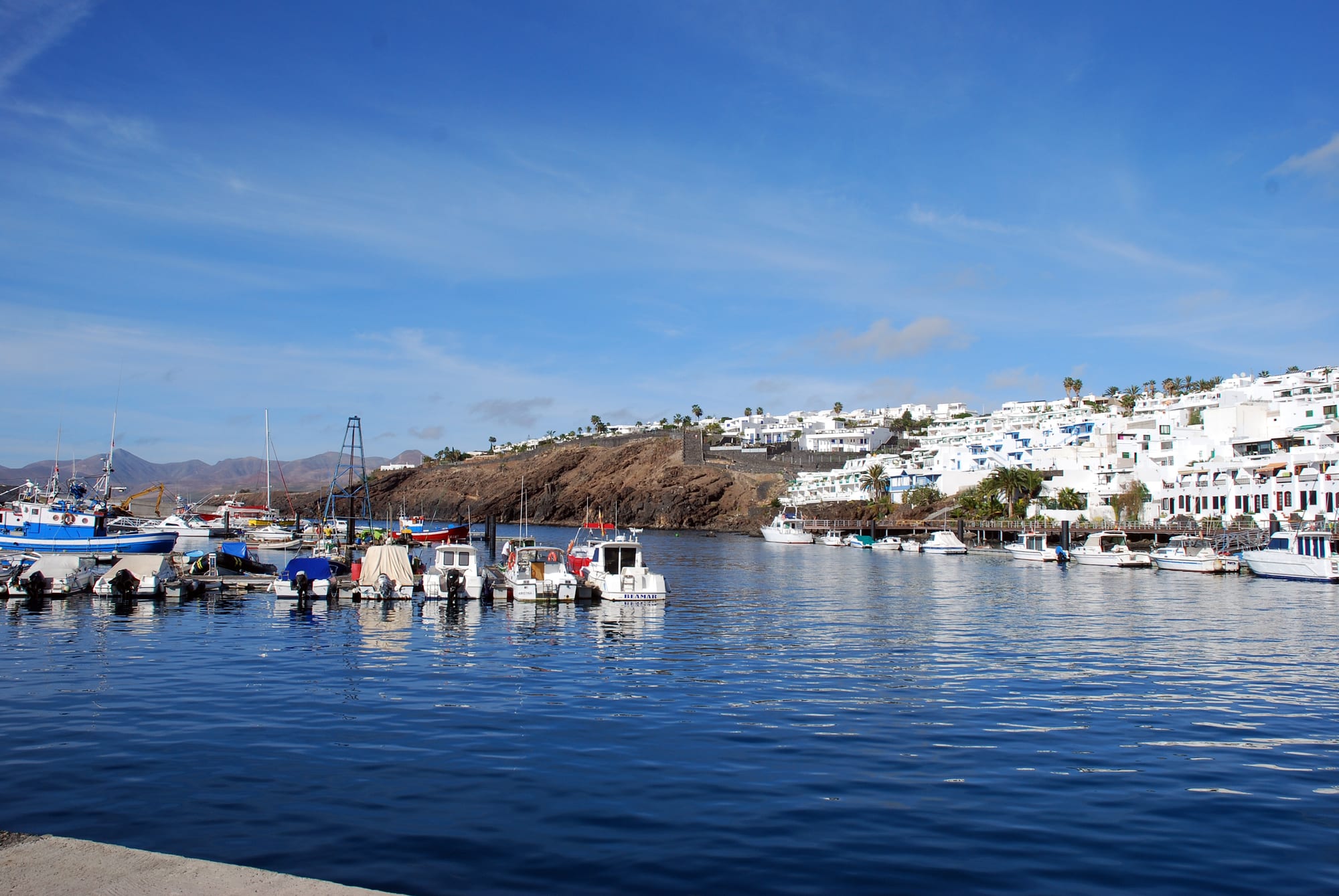
Small fishing and pleasure boats moored in a calm blue harbour, with white low-rise buildings climbing a hillside behind

The Canary Islands, Spain

Puerto del Carmen

The old harbour of Puerto del Carmen, with the white buildings of the old town above it. (allen watkin from London, UK / Wikimedia Commons · CC BY-SA 2.0)

Lanzarote's main tourist town, on the sheltered south coast west of Arrecife. A fishing hamlet called La Tiñosa until 1957, it saw its first hotel open in 1967 and has since grown into a resort of low white buildings stretched along sandy beaches, with its old harbour at the western end and volcanic hills rising behind.

Neighbourhoods

  • The old town and harbour
    • First-time visitors
    • Best for food
    • Historic district

    The original fishing village of La Tiñosa at the western end of town, with whitewashed low-rise buildings around the harbour and docks. Restaurants and bars with terraces look over the boats towards the volcanic hills of Papagayo and, on clear days, Fuerteventura.

    Open in Maps
  • Avenida de las Playas
    • Beaches
    • Nightlife
    • Close to public transport

    The main street of the resort, running for several kilometres along the south coast with beaches on one side and restaurants, bars, shops and hotels on the other. Apartments and villas spread about a kilometre inland before the buildings give way to bare black hills.

    Open in Maps
  • Los Pocillos and Matagorda
    • Beaches
    • Quiet and residential

    The eastern end of the strip, where the broad beach of Los Pocillos runs into Matagorda towards the airport, with a calmer feel than the centre.

    Open in Maps

Things to do

Beaches and the harbour

  • Playa Grandebeach

    The main beach of the resort, also called Playa Blanca, a long stretch of sand in the centre of town backed by the Avenida de las Playas.

    Open in Maps
  • Playa Chicabeach

    A small sandy beach east of the old harbour, sheltered between two arms of rock and the starting point for more than ten dive sites.

    Open in Maps
  • Playa de los Pocillosbeach

    A broad beach about a kilometre long at the eastern edge of town, continuing as Playa de Matagorda.

    Open in Maps
  • Old town harbourlandmark

    The historic core of Puerto del Carmen, the sheltered natural harbour that made the place a port long before tourism.

    Open in Maps
  • A Casa José Saramagomuseum

    In Tías, just inland, the house where the Portuguese Nobel Prize-winning writer José Saramago and his wife Pilar del Río lived until his death in 2010, open to visitors.

    Open in Maps

Short trips around Lanzarote

  • Timanfaya National Parkpark

    A national park of 51 square kilometres made up entirely of volcanic ground, largely shaped by the eruptions of 1730 to 1736, with more than 25 volcanoes.

    Open in Maps
  • La Geriaattraction

    The protected wine landscape inland, where vines grow in hollows in black volcanic ash that catches rain and overnight dew and shelters the plants from the wind.

    Open in Maps
  • Teguiseattraction

    The old village at the head of the municipality of Teguise, known for the market held in its streets on Sunday mornings.

    Open in Maps
  • Jameos del Aguaattraction

    A series of lava caves turned by César Manrique into an art and culture centre, with an underground salt lake, gardens, a pool and an auditorium.

    Open in Maps
  • Mirador del Ríoviewpoint

    A viewpoint built into an escarpment about 475 metres high at the northern end of the island.

    Open in Maps

Seasonal events

  • Carnival paradeFebruary

    The town's carnival procession, the main event of the winter festival season.

  • Ironman LanzaroteMay

    The island's Ironman long-distance triathlon — a swim, a cycle ride and a full marathon in one day — one of the main sporting events in the town's year.

  • Fiestas de Nuestra Señora del Carmenlate July

    The festival of the town's patron, the Virgin of Carmen, after whom the village was renamed in 1957.

Eat and drink

Long-standing places and food districts in Puerto del Carmen. Hours, ratings and directions come from your maps app, always current.

Food districts

  • Old town harbour restaurantsneighborhood

    Restaurants with outdoor terraces overlooking the marina and the distant volcanic peaks, the most traditional setting in town for fish and tapas.

    Open in Maps
  • Avenida de las Playasneighborhood

    The seafront strip, lined with bars and restaurants for its whole length, from Spanish tapas and paella to British breakfasts.

    Open in Maps

Markets and wine

  • Teguise Sunday marketmarket

    A popular market held on Sunday mornings in the streets of Teguise village.

    Open in Maps
  • La Geria wineriesneighborhood

    Wineries in the volcanic vineyard district inland, part of the Lanzarote wine region.

    Open in Maps

Experience Puerto del Carmen

History

The bay where Puerto del Carmen stands was inhabited before the Normans reached Lanzarote, and from at least the 16th century it appears on maps as Tiñosa or La Tiñosa, a name probably of indigenous origin related to place names on El Hierro and Tenerife. After the Castilian conquest it became an anchorage: in 1591 the engineer Leonardo Torriani described its natural harbour, the best on this rocky coast, and the port later grew through trade with the other islands and the mainland.

In 1900 La Tiñosa was declared a Port of General Interest, but larger ships needed deeper docks, and in 1928 the title passed to Arrecife, which became the island's chief port. In 1904 the settlement counted 194 inhabitants, most of them fishermen. In 1957 the village was renamed Puerto del Carmen in honour of Nuestra Señora del Carmen.

Tourism changed everything. Its first hotel opened in 1967, and as cheap flights brought northern Europe within easy reach the village became a resort, its beaches lined by the Avenida de las Playas and its low white apartment blocks spreading about a kilometre inland. It is now the island's main tourist town, chosen by most of Lanzarote's visitors, while the old harbour keeps something of the fishing village it replaced.

Culture & Customs

Puerto del Carmen is a resort town, and much of its character comes from the visitors who return year after year, above all from Ireland, Britain and Germany, along with Scandinavians and mainland Spaniards. The seafront has many Irish and British bars, some with live music and sport on television, while the old town around the harbour keeps a more Canarian feel, with whitewashed houses and terraces over the boats.

The local calendar follows the Catholic year and the sea. The town's patron is the Virgin of Carmen, and her festival at the end of July is the main local celebration. Carnival brings a parade in February, and sport has become part of the town's identity: the Ironman triathlon is held in May, and a national-qualifying triathlon follows in June. Diving is one of the most popular activities, with clear water and dive sites close to shore.

The wider island's culture is shaped by the artist and architect César Manrique, in recognition of whose conservation work UNESCO declared the island a biosphere reserve in 1993; his works, from the Jameos del Agua to the Mirador del Río, are within reach of the town. The Portuguese writer José Saramago lived in nearby Tías until his death in 2010, and his house is open to visitors.

Daily Life

About 11,300 people were registered in Puerto del Carmen in 2022, making it the second-largest town on Lanzarote after Arrecife, the capital. It belongs to the municipality of Tías, whose small old centre lies a few kilometres inland, and the whole island had about 163,000 inhabitants at the start of 2024.

Almost the entire local economy revolves around tourism. Lanzarote receives more than a million visitors a year, and most of them stay in this town, so work means hotels, apartments, restaurants, bars, shops, dive centres and car hire. The population present on any winter day is far larger than the census figure.

The rhythm of the town follows the visitors: busiest in winter and at Easter, with Spanish families in summer. Daytime life centres on the beaches and the seafront, evenings on the restaurants and bars, a few of which stay open until early morning. Tap water on the island is desalinated and tastes brackish, so many people drink bottled water. Shopping for residents centres on a mall built into a hollow in the volcanic rock above the old town.

Food

Canarian cooking appears beside the international menus of the seafront. Papas arrugadas, wrinkly potatoes, are small local potatoes boiled in their skins in heavily salted water until a fine salt crust forms, eaten with mojo, a sauce of olive oil, local peppers, garlic, paprika and cumin or coriander, either red and spicy or green. Gofio, a flour of roasted wheat or maize, is an old island staple, and goats supply much of the meat and cheese. Paella and seafood appear on many menus in town.

The island's best-known product is its wine. In La Geria, inland from the town, vines are planted in hollows dug into the black volcanic ash, called picón, which helps them catch rainfall and overnight dew and keeps the water from evaporating; the method also protects the plants from the wind. The vineyards are a protected area and part of the Lanzarote wine region. Ron miel, a honey rum made in the Canaries, is drunk as a shot, often with a little lime.

The seafront strip is lined with bars and restaurants from end to end, serving everything from tapas and paella to steaks, pizza and British breakfasts. The old harbour has the restaurants with terraces over the water, and the Sunday morning market at Teguise, inland, draws visitors from across the island.

Planning tools

Budget

Puerto del Carmen offers everything from simple apartments to large beach hotels, and package holidays keep prices moderate. Winter is the high season, with peaks at Christmas and Easter. Eating along the seafront is good value; the main extra cost is a hire car or excursions to see the rest of the island.

Daily Budget Midrange
USD 130–250 (mid-range hotel, restaurant meals, hire car for island trips)
Daily Budget Shoestring
USD 55–100 (apartment, supermarket and tapas meals, buses)

Book early for the winter peaks and Ironman week; the beaches and the harbour cost nothing.

Best Time to Visit

Any time of year. Winter is the main season for visitors from Ireland, Britain, Germany and Scandinavia, when the coast is still mild. After winter rain the island's vegetation blooms in February and March. Summer is dry and busy with Spanish holidaymakers.

Suggested Number of Days

Three or four days are enough for the town and its beaches, though most visitors come for a week. Allow six or seven days to see the volcanic parks, the vineyards and the north of the island, which needs a hire car or organised excursions.

First Visit
3–4 days
With Surroundings
6–7 days

Transportation

Buses run the length of the resort and link it with the airport, Arrecife, Costa Teguise and Playa Blanca, and a Sunday bus runs to the Teguise market. Taxis are easy to find. Cars, mopeds and electric bikes can be hired in town, and a shared e-scooter system covers Puerto del Carmen and the towns along the coast to Costa Teguise. A hire car is the practical way to explore the island's interior.

The land rises steeply behind the seafront, so check the gradient to any accommodation set back from the beach.

Airport & Station Connections

César Manrique-Lanzarote Airport lies 5 kilometres south-west of Arrecife, just beyond the eastern end of the resort strip, so the transfer is short by taxi or bus. It handles flights from many European airports and from the other Canary Islands. Ferries to Fuerteventura leave from Playa Blanca in the south of the island.

Walkability

The seafront is easy and flat on foot, and the Avenida de las Playas can be walked from the harbour towards Los Pocillos, though the whole strip is long and buses run along it. Streets inland climb steeply. A coastal path leads west to the marina of Puerto Calero; stout shoes and sun protection are needed.

Safety

Spain is a safe country with low violent crime. In Puerto del Carmen the usual problems are minor: some small electronics and camera shops have a reputation for poor goods and sharp dealing, and beach hawkers are best avoided. The sun is strong all year.

Buy electronics from established shops, and swim on guarded beaches when the sea is rough. Check current official travel advice before travelling.

Climate

A dry climate with little difference between the seasons and very little rain; summers are often completely dry. Hot dust-laden winds from the Sahara, called calima, sometimes bring haze and sharp heat.

Summer
warm and dry; at sea level on Lanzarote August averages about 25°C, and highs rarely pass 29°C
Winter
mild; at sea level on Lanzarote January averages about 17°C, and temperatures rarely fall below 14°C

Local Customs

The town takes its name from Nuestra Señora del Carmen, the Virgin Mary as patron of the Carmelites, and its July festival is the main local celebration. Canarians speak their own variety of Spanish, in which a bus is a guagua, and many bars along the seafront cater to Irish and British visitors.

Cover up away from the beach, ask before photographing people at the harbour, and greet shop and bar staff with a 'hola' or 'buenos días'.

Common Payment Methods

The currency is the euro. Cards and contactless are accepted almost everywhere, including small bars, and cash machines are easy to find on the seafront; a little cash is useful for markets.