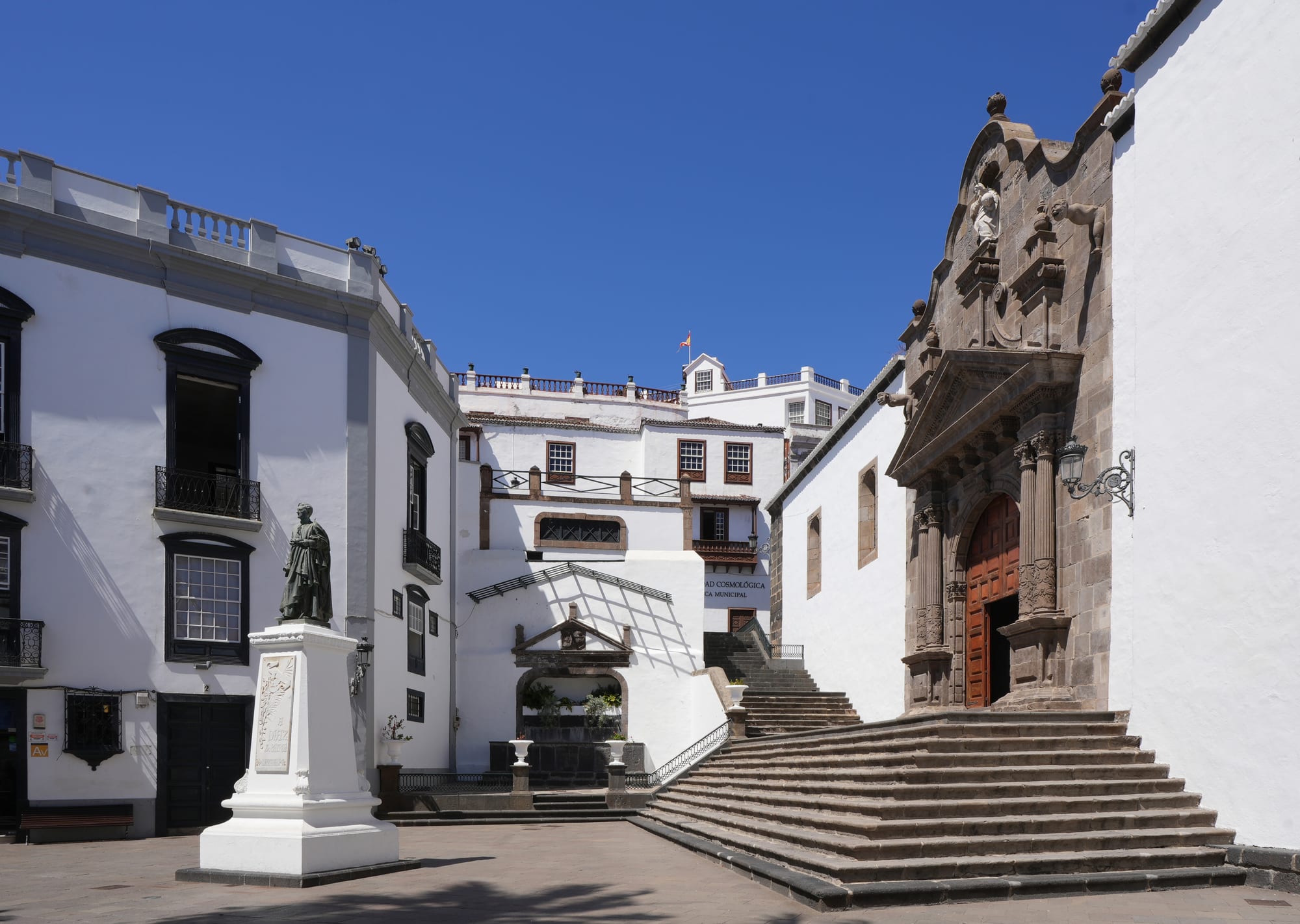
A sunny square of white buildings with dark balconies, a statue on a white pedestal and broad steps up to a carved stone church doorway

The Canary Islands, Spain

Santa Cruz de La Palma

Plaza de España in Santa Cruz de La Palma, with the doorway of the Iglesia de El Salvador on the right. (Ingo Mehling / Wikimedia Commons · CC BY-SA 4.0)

The capital of La Palma, on the island's east coast, built on an old lava flow below the rim of a small volcanic caldera. Founded in 1493 as a port on the routes to the Americas, it was burned by pirates in 1553 and rebuilt with Renaissance squares, a castle and streets of balconied houses, and it remains the island's administrative centre and main port.

Neighbourhoods

  • The old town and Calle Real
    • First-time visitors
    • Historic district
    • Architecture

    The historic centre along the main street formed by Calle O'Daly and Calle Anselmo Pérez de Brito, known together as the Calle Real. Plaza de España, the town hall, stone palaces, small squares and churches lie along it, and most of the town's sights are a few minutes apart.

    Open in Maps
  • Avenida Marítima
    • Promenade walks
    • Best for food
    • Photography

    The seafront avenue, whose row of houses with painted wooden balconies gives the town its best-known view. Restaurants and bars line the street.

    Open in Maps
  • La Alameda and the north end
    • Local life

    The area around the Plaza de La Alameda, where one of the two parallel shopping streets of the centre ends.

    Open in Maps
  • Las Nieves
    • Quiet and residential
    • Pilgrimage

    An outlying district of the municipality, home to the sanctuary of the Virgin of the Snows, patron of the island, from which her image is carried down to the city every five years.

    Open in Maps

Things to do

Historic landmarks

  • Plaza de Españalandmark

    The main square, with the parish church, the town hall, a stone fountain and noble houses, considered the main example of Renaissance architecture in the Canary Islands.

    Open in Maps
  • Iglesia de El Salvadorlandmark

    The mother church of the town, built around 1500 and modified and enlarged several times, on Plaza de España.

    Open in Maps
  • Castillo de Santa Catalinalandmark

    A seafront fortress first built in 1554–1560 after the pirate attack of 1553; the present castle dates from 1685–1692 and is open to the public.

    Open in Maps
  • Balconies of the Avenida Marítimalandmark

    The row of old houses on the seafront with carved and painted wooden balconies, the town's most characteristic sight.

    Open in Maps
  • Palacio Sotomayor and the Calle Real houseslandmark

    The mansions along the main street, among them the Palacio Sotomayor with its basalt stone front and the Casa Principal de Salazar with four floors of balconies.

    Open in Maps

Museums

  • Museo Insularmuseum

    The island museum, housed in the former convent of the church of San Francisco.

    Open in Maps

Short trips into the island

  • Caldera de Taburiente National Parkpark

    The great caldera that dominates the north of the island, a national park since 1954.

    Open in Maps
  • Roque de los Muchachos Observatoryattraction

    Established in 1985 and home to the Gran Telescopio Canarias, a site with the second-best conditions for optical astronomy in the Northern Hemisphere.

    Open in Maps
  • Cumbre Viejatrail

    The active volcanic ridge forming the southern half of the island, dotted with craters and cones, scene of eruptions in 1949, 1971 and 2021.

    Open in Maps

Seasonal events

  • Los IndianosCarnival, February or March

    The high point of the town's carnival, when crowds dressed in white period clothes throw clouds of talcum powder, parodying emigrants who came home from the Americas showing off their wealth.

  • Holy WeekMarch or April

    Processions marking the Passion, Death and Resurrection, one of the oldest festivities on the island.

  • Bajada de la Virgen de las NievesJuly and early August, every five years

    The town's best-known festival, when the image of the Virgin of the Snows is brought down from her sanctuary to the city, with a parade of thousands of candlelit paper lanterns, giant figures and dances; she returns to Las Nieves on 5 August.

Eat and drink

Long-standing places and food districts in Santa Cruz de La Palma. Hours, ratings and directions come from your maps app, always current.

Food districts

  • Avenida Marítimaneighborhood

    The seafront avenue with its row of balconied houses, where many of the town's restaurants and bars face the sea.

    Open in Maps
  • Calle Real and Plaza de Borreroneighborhood

    Small restaurants and tascas in the streets and squares of the old town behind the seafront.

    Open in Maps

Local produce

  • Hoyo de Mazo wine zoneneighborhood

    The central sub-zone of the La Palma wine designation, which includes Santa Cruz de La Palma and its neighbouring municipalities.

    Open in Maps

Experience Santa Cruz de La Palma

History

Santa Cruz de La Palma was founded on 3 May 1493 by the conqueror Alonso Fernández de Lugo, near a cave called Tedote, now the Cueva de Carías, north of today's town. The town, first called Villa del Apurón, grew as a port on the routes to the Americas, exporting the island's sugar cane. The main church, El Salvador, is recorded from 1512.

In 1553 the French pirate François Le Clerc, known as Pata de Palo, sacked and burned the town. It was rebuilt and fortified: the Castillo de Santa Catalina was first raised in 1554–1560 and rebuilt in its present form in 1685–1692. In 1773 a lawsuit by the merchant Dionisio O'Daly, of Irish descent, and Anselmo Pérez de Brito against the town's hereditary councillors won a ruling from the Crown, and Santa Cruz held the first popular elections to a town council in Spain.

The streets these men gave their names to became the main street, called the Calle Real after King Alfonso XIII visited in 1906. A crisis in agriculture brought the largest population loss in the town's history, and around 1900 it had about 11,000 people. It has remained the island's capital. In 2021 an 85-day eruption on the Cumbre Vieja ridge, in the south of the island, destroyed more than 3,000 buildings and forced around 7,000 people from their homes.

Culture & Customs

The town's heritage is mostly Renaissance, Baroque and Neoclassical. Plaza de España, with the church of El Salvador, the town hall, a stone fountain and several noble houses, is considered the main example of Renaissance architecture in the Canary Islands, while the row of wooden balconies on the Avenida Marítima has become the image of the town.

Festivals define the year. Carnival culminates in Los Indianos, when the streets fill with people dressed in white period clothes and clouds of talcum powder, parodying the islanders who emigrated to the Americas and came home showing off their wealth. Holy Week, with its processions, is one of the oldest festivities on the island. Every five years the Fiestas Lustrales of the Bajada de la Virgen de las Nieves, declared of national tourist interest, bring the island's patron down from her sanctuary on a silver throne, with a parade of thousands of coloured paper lanterns lit by candles, dances of giant figures, and almost three weeks in El Salvador before she returns on 5 August. The Virgin is also the town's honorary mayor.

Sport has its own passions: the football derby between SD Tenisca and CD Mensajero is the island's biggest, and a 1983 match between them is remembered as one of the most violent in Spanish football history.

Daily Life

The municipality had about 15,700 people in 2025, most of them living in the town itself, which makes it the second most populous on La Palma after Los Llanos de Aridane. Together with neighbouring Breña Alta it forms an urban area of more than 30,000 people that also holds the island's airport and university hospital.

As the island capital, Santa Cruz lives on administration, commerce and the port. It is the seat of the island council, has La Palma's only major port, with ferries and cruise ships, and a busy shopping street. The old centre is made up of small districts such as La Luz, San Telmo, San Sebastián, El Puente, La Alameda and El Pilar, with residential neighbourhoods such as Las Nieves and La Dehesa in the hills above.

Life moves at an island pace. Mornings are busy with shoppers and office workers on the Calle Real, evenings bring people out to the seafront, and much of the social calendar follows the religious festivals. The 2021 eruption on the other side of the island, which cut the coastal highway and destroyed more than 3,000 buildings, left a long task of rebuilding across La Palma.

Food

La Palma shares the cooking of the other Canary Islands. Papas arrugadas, small potatoes boiled in their skins in heavily salted water until a fine salt crust forms, are eaten with mojo, a sauce of olive oil, local peppers, garlic and paprika with cumin or coriander, red and spicy or green. Gofio, a flour made from roasted grain, is an old staple, and bienmesabe, a sweet of honey, egg yolk and ground almonds, is a common dessert.

The island's own products stand out. Palmero cheese is made from unpasteurised goat's milk, sold plain or lightly smoked in cylinders of up to 15 kilos, and protected by a designation of origin; the goats graze on wild plants all year. La Palma's wines have their own protected designation, granted in 1994, with around 600 hectares of vineyards planted in a strip along the coast at heights between 200 and 1,500 metres; Santa Cruz falls in the Hoyo de Mazo sub-zone. Bananas are grown across the island, alongside avocados, and water tunnels carry water from the highlands to the towns and farms.

In town, the restaurants and bars of the Avenida Marítima face the sea, and small tascas fill the old streets around Plaza de Borrero and the Calle Real.

Planning tools

Budget

La Palma is quieter and less commercial than the big resort islands, with smaller hotels, apartments and rural houses rather than large complexes. Prices in the capital are moderate, and they rise during carnival and in the years of the Bajada. A hire car for the mountains and the observatory is the main extra cost.

Daily Budget Midrange
USD 130–250 (mid-range hotel or rural house, restaurant meals, hire car)
Daily Budget Shoestring
USD 55–100 (apartment or guesthouse, tascas and markets, island buses)

Book well ahead for Los Indianos and for the Bajada years; the old town and seafront cost nothing to explore.

Best Time to Visit

Any time of year. Summers are very warm and almost rainless; the winters are warm but rainier. Carnival brings Los Indianos, Holy Week has its processions, and every five years the Bajada fills the town in summer. Spring and autumn are good for hiking the island's mountains.

Suggested Number of Days

Two days are enough for the old town itself. The island is the reason to come, though, and five to seven days leave time for the national park, the observatory and the volcanic south, all of which need a hire car or tours.

First Visit
2 days
With Surroundings
5–7 days

Transportation

The old town is compact and walkable. Buses link the capital with the airport and the island's other towns, but the mountain roads are steep and winding, and a hire car is the practical way to reach the national park, the observatory and the volcanic south. Taxis are available in town.

Allow extra time on mountain roads, and carry warm clothes for the summits, which are far colder than the coast.

Airport & Station Connections

La Palma Airport is 8 kilometres south of the city, at Breña Baja and Villa de Mazo, with island-hopping flights from Tenerife and Gran Canaria and flights from mainland Spain and other European cities; a bus links it with the city in about 35 minutes. The port of Santa Cruz, the island's only major one, has ferries to Tenerife, Gran Canaria, Lanzarote and Cádiz, and is a regular cruise stop.

Walkability

The historic centre is compact and best seen on foot: the Calle Real runs parallel to the seafront Avenida Marítima, and the squares, churches and museums are a few minutes apart. The town climbs steeply inland, so side streets and the districts above the centre involve stairs and slopes.

Safety

Spain is a safe country with low violent crime. Santa Cruz de La Palma is a quiet island capital. The main hazards are natural: steep and exposed mountain paths, sudden cloud at altitude, and an island that is volcanically active and monitored after the 2021 eruption on the Cumbre Vieja.

Carry water and warm clothing in the mountains, follow any trail or volcano-area closures, and swim only where it is guarded when the sea is rough. Check current official travel advice before travelling.

Climate

A hot semi-arid climate, with very warm, almost rainless summers from April to September and warm, rainier winters from October to March. The island's mountains are much cooler and cloudier than the coast.

Summer
very warm and almost rainless; on La Palma's coast August and September average about 24°C
Winter
warm with more rain; on La Palma's coast January and February average about 18°C

Local Customs

Palmeros are proud of their capital's past: the first democratically elected town council in Spain, chosen in 1773, and a long tradition of emigration to the Americas remembered in the Indianos carnival. The Virgin of the Snows, the island's patron, is honorary mayor of the town, and her festival is the centre of local life.

Dress modestly in churches and keep quiet during services and processions; carnival talcum powder gets everywhere, so wear clothes that can be washed.

Common Payment Methods

The currency is the euro. Cards and contactless are accepted almost everywhere, including small bars, and cash machines are easy to find in the centre; a little cash is useful for markets and rural bars.