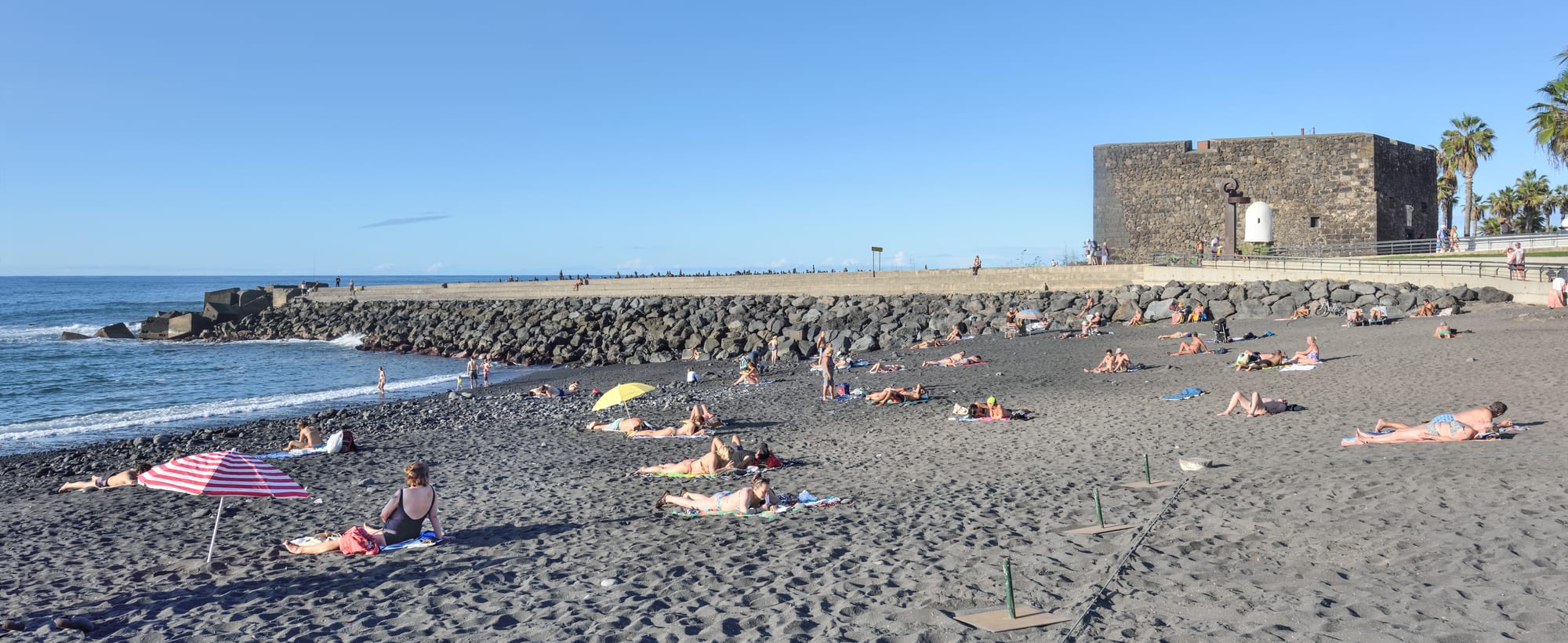
Black-sand Playa Jardín with sunbathers, a rock breakwater and the square stone Castillo de San Felipe under a clear sky

The Canary Islands, Spain

Puerto de la Cruz

Playa Jardín and the Castillo de San Felipe on the western side of Puerto de la Cruz. (Cayambe / Wikimedia Commons · CC BY-SA 4.0)

A town on Tenerife's north coast at the foot of the Orotava Valley, once the port that shipped the valley's sugar and wine. Nineteenth-century scientists and invalids made it the birthplace of tourism in the Canaries, and since the 1950s it has been a resort of black-sand beaches, César Manrique's seawater pools and an old fishing quarter that still works.

Neighbourhoods

  • The old town and Plaza del Charco
    • First-time visitors
    • Historic district
    • Best for food

    The centre around Plaza del Charco, the town's main square, and the little fishing harbour, with narrow streets of old houses, the church of the Peña de Francia, the old customs house and plenty of bars and restaurants. Fishermen still go out from the harbour.

    Open in Maps
  • La Ranilla
    • Local life
    • Historic district

    The old fishermen's quarter west of the centre, recently renovated, whose people gave the town's residents the nickname ranilleros. Small streets lead down towards the harbour and Playa Jardín.

    Open in Maps
  • Martiánez
    • Beaches
    • Seawater pools
    • Shopping

    The eastern seafront, where César Manrique's Lago Martiánez pool complex and the beach of Martiánez sit below the cliffs, backed by the larger hotels and shopping streets of the resort.

    Open in Maps
  • Playa Jardín and Punta Brava
    • Beaches
    • Families

    The western side of town around the long black-sand Playa Jardín and its gardens, with the Castillo de San Felipe and, further west, Punta Brava and the Loro Parque.

    Open in Maps

Things to do

Beaches and seawater pools

  • Lago Martiánezattraction

    César Manrique's complex of seawater pools and a lake set among volcanic rock and his own sculptures, opened in 1977 on a stretch of coast once known for its natural pools.

    Open in Maps
  • Playa Jardínbeach

    A black-sand beach remodelled to a design by César Manrique, with extensive gardens, a breakwater, bars and restaurants, made up of several smaller beaches.

    Open in Maps

Gardens, churches and museums

  • Jardín de Aclimatación de La Orotavapark

    The town's botanical garden, founded in 1788 to acclimatise tropical plants, and protected as a historic garden since 1994.

    Open in Maps
  • Sitio Litrepark

    An 18th-century house and garden of tropical and subtropical plants, where Alexander von Humboldt and Agatha Christie were among the guests.

    Open in Maps
  • Iglesia de Nuestra Señora de la Peña de Francialandmark

    The town's mother parish church, first built in 1697 and enlarged later, in the centre.

    Open in Maps
  • Casa de la Aduanamuseum

    The royal customs house founded in 1620, now holding a craft shop and the Eduardo Westerdahl museum of contemporary art.

    Open in Maps
  • Castillo de San Felipelandmark

    A small stone fort built in the 17th century to defend the town from pirates, now a venue for concerts, poetry readings and exhibitions beside Playa Jardín.

    Open in Maps
  • Archaeological Museum of Puerto de la Cruzmuseum

    A collection from the island's prehistory, whose emblem is the Guanche idol known as Guatimac.

    Open in Maps
  • Loro Parqueattraction

    A large zoo on the edge of town, founded in 1972 with 150 parrots and now home to thousands of parrots of hundreds of species as well as other animals.

    Open in Maps

Short trips from the town

  • La Orotavaneighborhood

    The old valley town 4 km inland, at about 400 metres up the Orotava Valley, of which Puerto de la Cruz was once the port.

    Open in Maps
  • Teide National Parkpark

    The high volcanic landscape around Mount Teide, at 3,718 metres the highest mountain in Spain, a UNESCO World Heritage Site since 2007, reached by road up through the valley.

    Open in Maps

Seasonal events

  • CarnivalFebruary or March

    The International Carnival, with the election of the carnival queen, a grand parade and the burial of the sardine, when a huge papier-mâché sardine is set alight by the waterfront; a delegation from twin town Düsseldorf often takes part.

  • Día de la Cruz3 May

    A local holiday for the Exaltation of the Holy Cross, also marking the town's foundation.

  • Fiestas del Carmenmid-July

    Fishermen carry the images of the Virgen del Carmen and San Telmo to the harbour and take them on a procession by sea, watched by more than 30,000 people, after a night of grilled sardines on the San Telmo beach.

Eat and drink

Long-standing places and food districts in Puerto de la Cruz. Hours, ratings and directions come from your maps app, always current.

Food districts and markets

  • Plaza del Charconeighborhood

    The town's central square and the streets around it, lined with bars and restaurants.

    Open in Maps
  • The fishing harbour and La Ranillaneighborhood

    Bars and small restaurants near the harbour where fishermen still land their catch.

    Open in Maps
  • Mercado Municipal El Tejarmarket

    The municipal market, in a functionalist building opened in 1986.

    Open in Maps

Experience Puerto de la Cruz

History

Before the conquest the area belonged to Taoro, one of the Guanche kingdoms of Tenerife, and its people lived in the natural caves of the Martiánez cliffs. By 1502 there was port activity on this coast, with the settlement dependent on La Orotava up the valley, and in 1603 a site was set aside for a church and square. The fishing village grew with trade: sugar gave way to wine, whose export boomed from the second half of the 16th century, and when an eruption destroyed the port of Garachico in 1706 this became the most important port on the island.

The townspeople wanted their own government early. A royal decree of Philip IV in 1651 let them appoint a head of the village, a council was elected in 1772, and in 1808 the town, until then known as Puerto de La Orotava, won full independence from La Orotava and took its present name.

The 19th century brought scientists and writers, drawn by the climate and plants of the Orotava Valley — Alexander von Humboldt among them — and in 1886 the archipelago's first sanatorium for sick visitors opened here, beginning tourism in the Canaries. Old family houses were turned into the first hotels, and a British colony settled. Mass tourism arrived in the 1950s and has driven the economy ever since. In 1983 the town's ecological film festival saw the announcement of the Tenerife Manifesto, a precursor of political ecology in Spain.

Culture & Customs

The town's identity is split between its old port and its resort. Around Plaza del Charco and the harbour, fishermen still land their catch, and the Fiestas del Carmen in July are their festival: the images of the Virgen del Carmen and San Telmo are carried by fishermen and taken out on a procession by sea, the fishermen sing the Salve Reina de los Mares, and people jump into the harbour to cool off. More than 30,000 people come from across the islands, making it the most crowded sea procession of the Virgen del Carmen in the Canaries. The night before, the Sardinada brings crowds to San Telmo beach for grilled sardines and dancing.

Carnival is the other high point, with the election of a queen, a grand parade and the burial of the sardine, when a giant sardine is 'blessed' by a mock bishop, set alight by the waterfront and mourned by men in drag. A delegation from Düsseldorf, the town's German twin, often joins in.

The British left a lasting mark: the Anglican church of All Saints in the Taoro park, the oldest Anglican cemetery in the Canaries, and gardens such as Sitio Litre, where Agatha Christie stayed. César Manrique reshaped the seafront with Lago Martiánez and Playa Jardín, and the Castillo de San Felipe has hosted a young artists' competition every year since 1993.

Daily Life

About 31,100 people lived in the municipality in 2025. It is the smallest municipality on Tenerife, only about 8.7 square kilometres, and in 2014 it was the most densely populated on the island. With neighbouring La Orotava and Los Realejos it forms the metropolitan area of the Orotava Valley, home to about 112,000 people.

Tourism is by far the largest part of the economy, with large hotels visible across the skyline. The visitors change with the seasons: mostly older northern European couples in winter, especially at Christmas and New Year, and Spanish families in August, when the mainland is too hot. Compared with resorts such as Playa de las Américas, the town draws more mature couples.

Behind the seafront, everyday life carries on in the old streets of the centre and La Ranilla, at the harbour where boats are lifted in and out by crane, and in the residential districts that climb the slopes of the valley.

Food

The town eats the cooking of the Canaries. Papas arrugadas, 'wrinkly potatoes', are small unskinned potatoes boiled in salt water and served with mojo, the sauce of oil, garlic, vinegar, peppers and spices that comes red with meat — mojo picón in its spicy form — or green with fish. Gofio, a flour of roasted grain that was the islanders' staple for centuries, is stirred with fish broth and onion to make escaldón and used in desserts such as pella de gofio.

Fish is central in an old fishing port. Sancocho canario is boiled fish with potatoes, sweet potatoes, gofio and mojo, and fish soups use local species such as grouper, dentex and wreckfish. On the evening of 29 November, when the town's children 'run the cacharro', people traditionally eat salted fish with mojo and gofio, and roasted chestnuts, and the Sardinada on the eve of the Carmen festival is a feast of grilled sardines. Meat dishes include puchero canario, a meat-rich soup, and conejo en salmorejo, rabbit marinated in a coriander sauce; bienmesabe, a paste of almonds, honey and sugar, is a classic dessert.

The Orotava Valley has long made wine — the north of Tenerife's wines were praised as early as the 16th century, when Shakespeare's characters mentioned them — and the wine trade once built the town. The municipal market, El Tejar, sells local produce.

Planning tools

Budget

One of the longest-established resorts in the Canaries, with accommodation for most budgets. Prices peak over Christmas and New Year, when the town is popular with northern Europeans, and in August with Spanish holidaymakers. Meals in the old town and the harbour area are generally good value.

Daily Budget Midrange
USD 120–230 (mid-range hotel, restaurant meals, the pools and a garden or zoo ticket, a hire car for a day)
Daily Budget Shoestring
USD 55–100 (simple apartment or guesthouse, bars and market food, island buses)

Parking is easiest at the large free car park near the harbour; much of the town's appeal — the old streets, the harbour and Playa Jardín — costs nothing.

Best Time to Visit

All year. Winter is the main season for northern European visitors, above all at Christmas and New Year, while August brings Spanish visitors escaping the heat of the mainland. Carnival falls in February or March and the Carmen festival in mid-July.

Suggested Number of Days

Two or three days cover the town, its pools, gardens and beaches. Allow five to seven to use it as a base for the Orotava Valley, the mountains and other parts of the north coast; a hire car shortens the time needed.

First Visit
2–3 days
With Surroundings
5–7 days

Transportation

The town is compact enough to walk, though it climbs steeply away from the seafront. TITSA buses link the bus station with the rest of the island — the direct line to Santa Cruz runs by motorway in about 45 minutes — and a small free road train runs from the centre to Loro Parque. The TF-5 motorway runs east and west along the coast, and the TF-21 climbs from the valley towards Teide.

The old centre has many narrow one-way streets; take the main TF-21 road up towards Teide rather than the steep lanes a navigation app may suggest.

Airport & Station Connections

Tenerife North Airport, at La Laguna, is the nearer of the island's two airports; most international package flights use Tenerife South Airport in the south. An express bus links the town with both airports a few times a day, and taxis and hire cars are the alternatives. Santa Cruz de Tenerife is about 30 km to the east by motorway.

Walkability

Good along the seafront: a promenade runs from Martiánez past the centre and the harbour towards Playa Jardín, and the old town is easy on foot. Away from the coast the streets rise steeply, so walks up to the botanical garden or the Taoro area involve a real climb.

Safety

Spain is a safe country with low violent crime. The town is a relaxed, long-established resort. The main dangers are natural: the Atlantic waves and currents on the north coast can be strong, and the seawater pools offer an alternative to the open sea.

Swim in the pools or on guarded beaches when the sea is rough, keep clear of boats when bathing near the harbour, and leave nothing visible in parked cars. Check current official travel advice before travelling.

Climate

Hot semi-arid, bordering on a tropical wet and dry climate, with warm winters and dry summers and an average annual temperature of about 21.9°C. The mild climate of the Orotava Valley is what first drew foreign visitors in the 19th century.

Summer
warm and dry — in nearby Santa Cruz de Tenerife, August days typically reach 26–32°C
Winter
mild — in nearby Santa Cruz de Tenerife, January days typically reach 19–23°C, with nights around 15–16°C

Local Customs

Residents are portuenses, and are sometimes called ranilleros after the old fishermen's quarter. The town has a long British connection: an Anglican church stands in the Taoro park, and the oldest Anglican cemetery in the Canaries is here. The islands are an hour behind mainland Spain.

Dress modestly in churches, keep swimwear for the beaches and pools, and join in the July festival only if happy to get wet.

Common Payment Methods

The currency is the euro. Cards are widely accepted in hotels, shops and restaurants, and ATMs are easy to find in the centre. Cash is useful for small bars and buses.