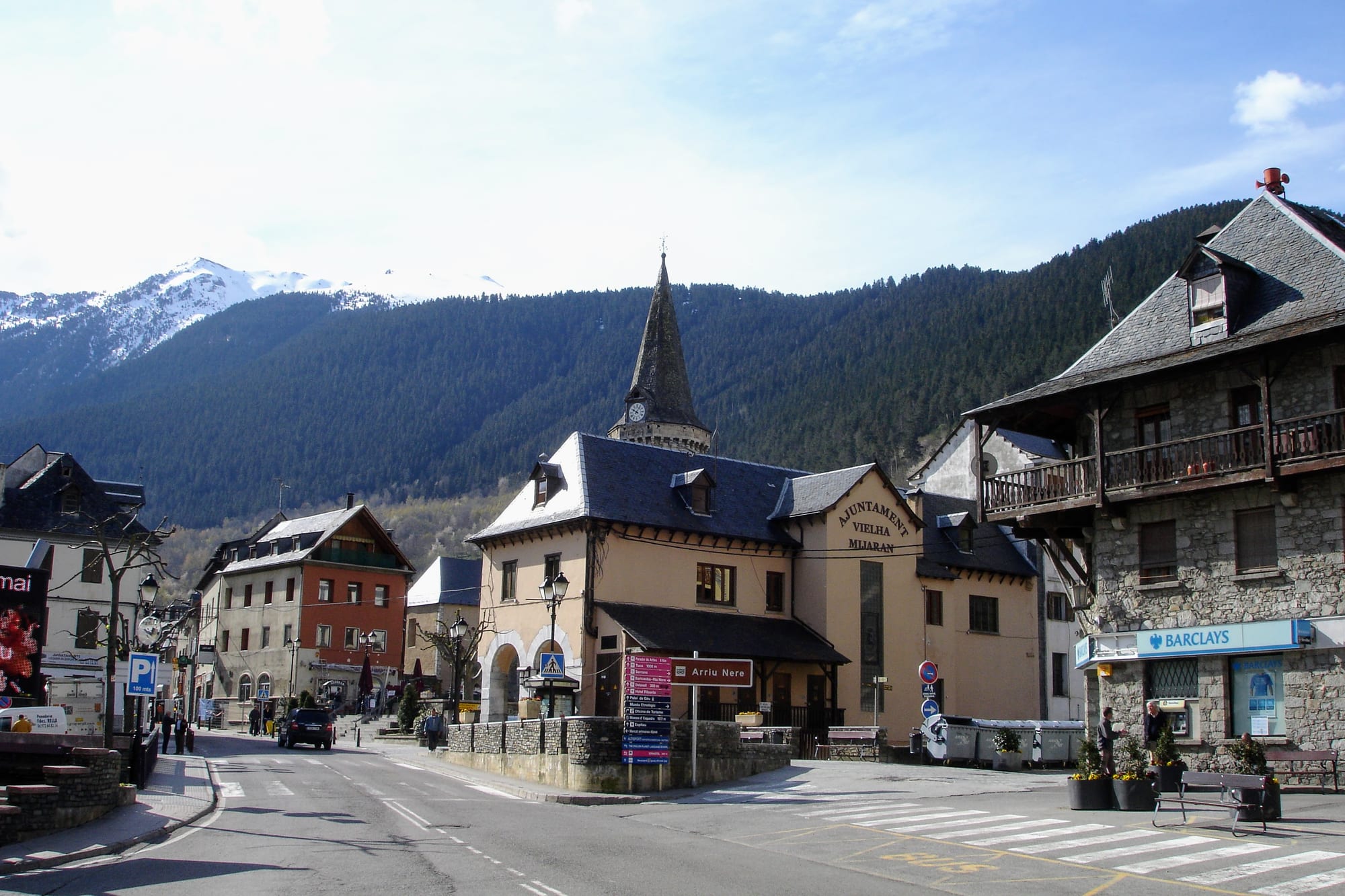
Stone and slate-roofed buildings around Vielha's town hall, with forested slopes and a snow-capped peak behind

Catalonia, Spain

Vielha

Plaça Sant Antoni beside the Nere river, opposite Vielha's town hall. (LoveStallion / Wikimedia Commons · CC BY-SA 4.0)

The capital of the Val d'Aran, a Pyrenean valley in the far north-west of Catalonia that drains to the Atlantic rather than the Mediterranean. Set at about 980 m where the Nere meets the Garonne, the town was cut off in winter until its road tunnel opened in 1948. It now lives from tourism, as the base for Baqueira-Beret skiing and summer walking.

Neighbourhoods

  • Vielha town centre
    • First-time visitors
    • Close to public transport
    • Best for food

    The small town at the meeting of the Nere and the Garonne, with the church of Sant Miquèu, the town hall facing Plaça Sant Antoni by the Nere, the valley museum, shops, restaurants and the seat of Aran's own government. The bus stop is here too.

    Open in Maps
  • Betren and Escunhau
    • Quiet and residential
    • Village atmosphere

    Villages along the Garonne, two of the thirteen settlements of Vielha e Mijaran, the municipality formed by a merger in 1970.

    Open in Maps
  • Gausac and Casau
    • Quiet and residential
    • Walks

    Two more of the municipality's villages; Casau was already inhabited in Roman times, and Gausac is the largest of the municipality's settlements after Vielha itself.

    Open in Maps

Things to do

In the town

  • Church of Sant Miquèulandmark

    The parish church, with Romanesque and Gothic parts and a notable carved portal, which houses the Crist de Mijaran, a Romanesque wooden carving considered the finest sculpture in Aran.

    Open in Maps
  • Musèu dera Val d'Aranmuseum

    The valley museum, opened in 1984 in a 17th-century manor house, the Tor deth Generau Martinhon, covering Aran's geology, wildlife, history, art, language and traditions.

    Open in Maps
  • Fabrica dera Lanmuseum

    A 19th-century building that shows the valley's former wool industry.

    Open in Maps
  • Palai de Gèuattraction

    The town's sports centre and ice rink, built in 1994.

    Open in Maps

Short trips from the town

  • Baqueira-Beretattraction

    Spain's best-known ski resort, up the valley towards the Port de la Bonaigua, with slopes from 1,500 to 2,610 m and a reputation for reliable snow.

    Open in Maps
  • Port de la Bonaiguaviewpoint

    The 2,072 m pass at the head of the valley, the only route out of Aran in winter before the tunnel was built, whose upper road is often closed by snow.

    Open in Maps
  • Aigüestortes i Estany de Sant Maurici National Parkpark

    Catalonia's only national park, created in 1955: a wild high-mountain area with peaks above 3,000 m and nearly 200 lakes, many of glacial origin.

    Open in Maps
  • Bossòstattraction

    A village on the Garonne down the valley towards France, whose football club plays in the French minor leagues.

    Open in Maps
  • Salardúattraction

    The main village of Naut Aran, the upper valley, between Vielha and the ski slopes.

    Open in Maps

Seasonal events

  • Hèsta d'AranJune

    The national day of the Val d'Aran, held on 17 June.

  • Craft fair of the Val d'Aran and the Pyreneesmid-July

    A two-day fair of artisans from the valley and across the Pyrenees.

  • Festa Majorearly September

    The town's main festival, lasting several days.

  • Livestock fairOctober

    A commercial and farming fair of cattle and other livestock, a reminder of the valley's farming past.

  • AnticVielhalate December to early January

    A fair of antiques, second-hand dealers and collectors held over the New Year.

Eat and drink

Long-standing places and food districts in Vielha. Hours, ratings and directions come from your maps app, always current.

Aranese classics

  • Olha aranesarestaurant

    A beef stew, the most emblematic traditional dish of Aranese cooking.

    Open in Maps
  • Trout and gamerestaurant

    Trout, smoked, fried or baked, and game such as duck, wild boar, rabbit, hare and chamois are the backbone of the valley's cooking, along with caulets, meatballs wrapped in cabbage leaves.

    Open in Maps

Food districts

  • Vielha centreneighborhood

    The streets around the church and the river hold most of the town's restaurants and bars, busiest in the ski season and in summer.

    Open in Maps

Experience Vielha

History

The name Aran comes from the Basque haran, "valley", a sign that Basque was once spoken this far east along the Pyrenees, and Casau, one of the villages of the municipality, was inhabited in Roman times. In 1313 James II of Aragon granted the valley administrative and political autonomy, set down in a Latin charter called the Querimonia, as a reward for its loyalty in a dispute with France and Mallorca; in 1411 it was confirmed as part of Catalonia. Vielha, in the middle of the valley, is its traditional capital.

That autonomy lasted until 1834, when Aran was absorbed into the new province of Lleida. In October 1944 guerrillas of the Communist Party of Spain crossed from France and held several villages for a week, in an attempt to bring down Franco's dictatorship, before reinforcements sent to defend Vielha drove them back. The town's isolation ended in 1948 with the opening of the Vielha tunnel: until then there was no direct winter link with the south side of the mountains. A second tunnel opened in 2007.

In 1970 Vielha absorbed several neighbouring municipalities to form Vielha e Mijaran. Ski tourism transformed the economy, and in 1990 the Catalan Parliament restored Aran's special status, re-established the Conselh Generau and made Occitan official; a 2015 law recognised Aran as an "Occitan national reality". In 2024 UNESCO designated a biosphere reserve in the valley.

Culture & Customs

Language is the heart of Aranese identity. Aranese, the local form of the Gascon variety of Occitan, has been taught in schools since 1984. In 2001 Spanish was the most common first language in the valley, followed by Aranese and Catalan, but nearly two-thirds of those born in the valley have Aranese as their mother tongue. Place names appear in their Aranese forms, and road signs call the valley "era Val d'Aran", with the Aranese feminine article.

Aran's separate history gives it a distinct sense of itself within Catalonia, and the valley's population has generally been opposed to the Catalan independence movement. The year's high point is the Hèsta d'Aran on 17 June, the valley's national day; Vielha's own Festa Major comes in early September, and fairs of crafts, livestock and antiques mark the summer, the autumn and the New Year.

The church of Sant Miquèu holds Aran's most prized work of art, the Crist de Mijaran, a Romanesque wooden carving of Christ. The valley museum, opened in 1984, covers its geology, history, art, language and traditions, and the Fabrica dera Lan recalls its old wool industry. Programmes protect or reintroduce native animals such as the brown bear, the bearded vulture, the rock ptarmigan and the Aran rock lizard.

Daily Life

About 5,900 people were registered in the municipality of Vielha e Mijaran in 2025, spread across the town and twelve villages; the whole valley has about 10,000. Vielha is the administrative centre of Aran, home to the Conselh Generau d'Aran and the town hall.

Tourism is the main economic activity, from the ski resorts in winter and from walking and other outdoor tourism in summer. Forestry, cattle raising and farming, once the valley's living, have become steadily less important since the ski resorts opened. The year therefore runs in seasons: crowded in winter, when Baqueira-Beret fills the valley, busy again in high summer, and quiet in between.

Mountain weather shapes daily life. Snow is common in winter, and the Port de la Bonaigua road can close; the tunnel keeps the link with the rest of Catalonia open. The N-230 links the town both with France to the north and, through the tunnel, with the rest of Catalonia, while the C-28 climbs the valley towards the ski slopes and the villages of Naut Aran.

Food

Aranese cooking is mountain food, built on meat, game and river fish. Olha aranesa, a beef stew, is the most emblematic traditional dish of the valley. Caulets are meatballs wrapped in cabbage leaves, served on their own or as a side dish, and trout from the valley's rivers is smoked, fried or baked. Game — duck, wild boar, rabbit, hare and chamois — appears on many menus.

Aran shares some dishes with the rest of rural Occitania. Sanganhèta, the Aranese name for a dish known in French as sanquette, is made from fresh blood collected at the slaughter of an animal and cooked straight away, typically as a kind of pancake. Duck, pork, wild boar, rabbit, hare, chamois and trout are the main ingredients of the valley's cooking as a whole.

The most typical drink is cassis liqueur, and the valley has several local beers and wines of its own.

Planning tools

Budget

Prices follow the seasons. Rooms are dearest and scarcest in the ski season, when the valley is at its busiest. Ski passes and equipment hire are the largest extra costs in winter, and a car adds to the bill but makes the valley far easier to explore.

Daily Budget Midrange
USD 170–310 (mid-range hotel, restaurant dinners, a hire car, ski passes in winter)
Daily Budget Shoestring
USD 80–130 (guesthouse or apartment, set lunches, buses along the valley)

Book accommodation well ahead for the ski season; without a reservation it can be hard to find a bed.

Best Time to Visit

December to April for skiing at Baqueira-Beret, and June to September for walking, when the high passes are clear of snow and the valley holds its national day, craft fair and town festival. Spring and autumn are quiet.

Suggested Number of Days

Two or three days are enough to see the town and the nearest villages. A skiing holiday usually lasts a week, and walkers who want to explore the high mountains and lakes beyond the valley need four days or more.

First Visit
2–3 days
With Surroundings
4–7 days

Transportation

The town centre is small and walkable. ALSA buses link the villages of the valley and run to Lleida and Barcelona. Most visitors use a car, which makes the side valleys, the ski resort and the trailheads much easier to reach. The C-28 runs up the valley to the ski area and over the Port de la Bonaigua; the N-230 runs north to France and south through the Vielha tunnel.

Carry snow chains or winter tyres in the cold months; the upper part of the Bonaigua road can be closed by snow.

Airport & Station Connections

There is no railway. From the south, the N-230 reaches Vielha through the Vielha tunnel, about 5 km long, from the Alta Ribagorça. The nearest airports are Lleida, about 145 km away, and Tarbes, Pau and Toulouse in France, all a little over 150 km; Barcelona's airport is about 350 km away. Direct buses run from Barcelona and Lleida.

Walkability

Easy on foot within the town, which is compact and largely flat along the river. The villages of the municipality are a short drive or a longer walk away up the slopes, and paths lead out of the valley into the mountains. Pavements can be snowy and icy in winter.

Safety

Spain is a safe country with low violent crime. Crime is rare in Vielha; the real hazards are the mountains — weather that turns quickly, snow and ice on roads and paths in winter, and afternoon storms in summer.

Check mountain forecasts before walking or skiing off the marked slopes, and carry winter equipment for driving. Check current official travel advice before travelling.

Climate

Being on the northern side of the Pyrenees, the valley has an Atlantic rather than a Mediterranean climate: cold winters, cool summers and plentiful rain or snow all year, with precipitation on about 125 days.

Summer
cool and fresh; July, the warmest month, averages highs of about 25°C
Winter
cold and snowy; January, the coldest month, averages lows of about −2°C, and snow cover peaks in December

Local Customs

Aran has its own language, Aranese, a form of Occitan, official alongside Catalan and Spanish and used on all road signs and place names — Vielha rather than Viella. Spanish is the most common first language, followed by Aranese and Catalan. Aran has its own government, the Conselh Generau, and many people identify first with the valley.

Use the Aranese place names, which are the ones on maps and signs; a word of Aranese or Catalan is appreciated.

Common Payment Methods

The currency is the euro. Cards and contactless payment are widely accepted, and the town has cash machines. A little cash is useful in small villages and mountain refuges.