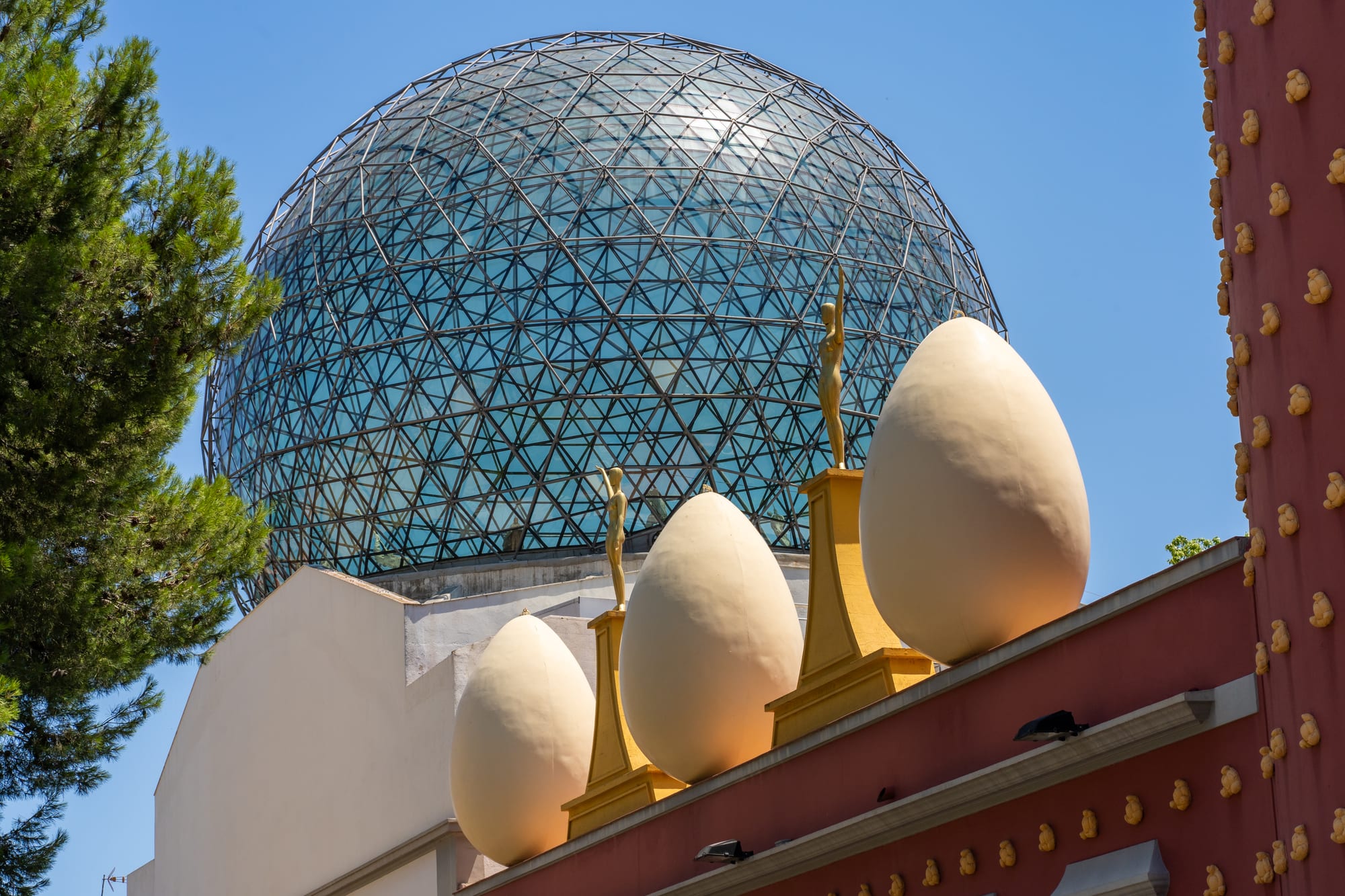
The glass geodesic dome of the Dalí Theatre-Museum above a red wall topped with giant white eggs and gold figures

Catalonia, Spain

Figueres

The dome and egg-topped walls of the Dalí Theatre-Museum in Figueres. (Maksim Sokolov (maxergon.com) / Wikimedia Commons · CC BY-SA 4.0)

The capital of the Alt Empordà county in the far north-east of Catalonia, close to the French border. A royal market town since the 13th century, it grew around an enormous 18th-century fortress and was heavily bombed in the Civil War. Today it is known above all as Salvador Dalí's birthplace and home of the theatre-museum he designed, where he is buried.

Neighbourhoods

  • Old town and the Rambla
    • First-time visitors
    • Historic district
    • Cafés

    The compact centre around the Rambla, a tree-lined promenade laid out in the 19th century over a covered stream bed. Pedestrian streets to the north and south hold the Gothic church of Sant Pere, the regional museum, small squares and the remains of the medieval Jewish quarter.

    Open in Maps
  • Dalí museum and the castle hill
    • Museums
    • Walks

    The streets around the Dalí Theatre-Museum, just above the old town, are the busiest in Figueres by day. From there the Pujada del Castell climbs to the walls of Sant Ferran Castle, where a flat circuit around the fortress looks out over the Empordà plain.

    Open in Maps
  • Plaça del Sol and Plaça de les Patates
    • Nightlife
    • Local life

    Two squares where the town goes out in the evening: Plaça del Sol, with its row of bars, and the quieter pedestrian Plaça de les Patates, named after the vegetable market held there until the 1950s.

    Open in Maps
  • Station quarter
    • Close to public transport
    • Shopping

    The area around the local railway station and the bus station opposite it, a short walk from the Rambla, with shops and everyday streets.

    Open in Maps

Things to do

Famous landmarks

  • Dalí Theatre-Museummuseum

    The museum Dalí designed in the shell of the town's old theatre, ruined in the Civil War; he lived there from 1984 until his death in 1989 and is buried in a crypt beneath the stage.

    Open in Maps
  • Sant Ferran Castlelandmark

    A huge fortress begun in 1753, with a perimeter of about 3.1 km — the largest man-made monument in Catalonia, where the Republican government held its last meeting of the Civil War in February 1939.

    Open in Maps
  • Church of Sant Perelandmark

    The town's Gothic parish church, partly rebuilt after the Civil War, standing where the old Sant Pere monastery was recorded in the 10th century.

    Open in Maps
  • La Ramblalandmark

    The town's main promenade, created over a covered stream bed and shaded by plane trees planted in 1862, with a monument to the submarine pioneer Narcís Monturiol.

    Open in Maps
  • Plaça de les Patateslandmark

    A small historic square in the pedestrian centre, once the vegetable market, now lined with terraces.

    Open in Maps

Museums

  • Museu de l'Empordàmuseum

    The regional museum on the Rambla, with archaeology, medieval art and Catalan painting by artists such as Sorolla, Casas, Nonell and Tàpies, some of it first sent from the Prado in the 1880s.

    Open in Maps
  • Toy Museummuseum

    The Museu del Joguet, beside the Rambla, with a collection of more than 4,500 toys from many periods.

    Open in Maps
  • Museu de la Tècnica de l'Empordàmuseum

    A museum of technology grown from a private collection begun in 1979, known for its rows of antique typewriters.

    Open in Maps

Short trips from the town

  • Peraladaattraction

    A village of winemaking and dairy farming just east of Figueres, once the seat of the Counts of Peralada and home since 1987 to the Castell de Peralada international music festival, focused on opera.

    Open in Maps
  • Castelló d'Empúriesattraction

    A town about 9 km east of Figueres, once the capital of the Counts of Empúries, rivals of the medieval royal town.

    Open in Maps
  • Aiguamolls de l'Empordàpark

    A natural park of marshes and dunes between the Fluvià and Muga rivers, the second-largest wetland in Catalonia, with bird hides linked by an accessible track.

    Open in Maps
  • Empúrieslandmark

    The ruins of a Greek trading city founded in 575 BC and later Roman, on the coast between L'Escala and Sant Martí d'Empúries.

    Open in Maps
  • Sant Pere de Rodeslandmark

    A former Benedictine monastery in the Alt Empordà county, north-east of Figueres.

    Open in Maps
  • Cadaquésattraction

    The whitewashed fishing town on the Cap de Creus peninsula, beside Dalí's house at Portlligat.

    Open in Maps

Seasonal events

  • Festa Major de la Santa Creuearly May

    The town's main festival and fair, centred on the feast of the Holy Cross on 3 May, a tradition established by King Alfonso the Magnanimous in 1419.

  • Festival Acústicalate August

    A mostly free acoustic music festival on stages in squares and streets around the centre.

Eat and drink

Long-standing places and food districts in Figueres. Hours, ratings and directions come from your maps app, always current.

Food districts and markets

  • Thursday marketmarket

    The weekly market that has drawn people from across the Alt Empordà to Figueres on Thursdays for generations, a reminder of the market rights granted to the royal town in the 13th century.

    Open in Maps
  • Plaça de les Patatesneighborhood

    A relaxed pedestrian square with bar terraces, a favourite meeting place for an evening drink and tapas.

    Open in Maps
  • Plaça del Solneighborhood

    The square with the town's liveliest row of bars, busiest on summer nights.

    Open in Maps

Empordà wine

  • Empordà wineriesneighborhood

    The Empordà wine region runs north from Figueres to the French border; Peralada, a few kilometres east, is one of its winemaking villages.

    Open in Maps

Experience Figueres

History

The name Figueres comes from Ficaris, and the town grew from a small settlement around the church of Sant Pere; in the 13th century it was a village of perhaps 100 people. In 1267 King James I of Aragon made it a royal town with its own charter, a weekly market and an annual fair. Four years later Count Ponç IV of Empúries, whose capital was at nearby Castelló d'Empúries, set it on fire. In 1269 the future King Peter the Great encouraged Jewish families to settle there, and a small Jewish quarter survives from the community that lived in the town until the expulsion of 1492.

The decisive change came in the 18th century, when the hill above the town was chosen for Sant Ferran Castle, begun in 1753. Figueres became the fortress's supply base and grew quickly, spreading beyond its medieval walls. It changed hands repeatedly in wars with France: surrendered in 1794 and regained in 1795, then taken by Napoleon's forces in 1808, recaptured in 1811 and lost again the same year. In the 19th century the stream through the town was covered over to make the Rambla, and the railway arrived in 1877.

During the Civil War the town stayed loyal to the Republic and was one of the most heavily bombed in Catalonia, above all in early 1939, when thousands of refugees passed through on their way into exile; the Republican government held its last meeting in the castle's dungeons on 1 February 1939. Figueres recovered from the late 1950s on tourism, and from the 1960s Dalí turned the ruined municipal theatre into his museum.

Culture & Customs

Figueres is Dalí's town. The painter was born there in 1904, returned to turn the burned-out theatre into a museum he called a great surrealist object, lived in it from 1984 and was buried beneath its stage in 1989. The museum ranks among the most visited in Spain, and the town plays along: a distorted portrait of Dalí, corrected by a convex mirror, greets visitors at the foot of the Rambla, and shops sell surrealist souvenirs. The town's other famous son is Narcís Monturiol, the 19th-century inventor of the first successful machine-powered submarine, whose monument stands on the Rambla; the singer Mónica Naranjo and the motorcycle racer Maverick Viñales were also born here.

Catalan identity is strong. The local speech is Northern Catalan, with a French influence from across the border, and older people sometimes mix Catalan into their Spanish. The year turns on the Festa Major de la Santa Creu in early May, the town's main festival and fair since 1419, and on summer music: the Festival Acústica fills the squares in late August, and nearby Peralada has held an international music festival focused on opera since 1987. Evenings out mean a terrace in Plaça de les Patates or a bar in Plaça del Sol.

Daily Life

About 50,000 people lived in Figueres in 2025, making it the capital and main town of the Alt Empordà, a county of farms, wine villages and coastal resorts. The town grew steadily through the 20th century, from about 10,700 people in 1900 to some 28,000 in 1975, and has kept growing since, most quickly in the first decade of this century.

Tourism has been the backbone of the economy since the late 1950s, and the Dalí museum brings a steady flow of day visitors from the coast and from Barcelona. Figueres is also the county's market and shopping town: people from across the Alt Empordà come in for the Thursday market, and shoppers from southern France cross the border for lower prices. The high-speed line to Barcelona and France, opened in stages from 2010, has brought both cities within an hour or so.

Daily life follows the Catalan rhythm, with shops closing in the early afternoon, lunch from about half past one and the squares filling in the evening. Locals walk or run the circuit around the castle walls, and the tramuntana wind shapes the day on its strongest days.

Food

Figueres eats the food of Catalonia and of the Empordà plain. Pa amb tomàquet — bread rubbed with fresh tomato, seasoned with olive oil and salt — comes with most meals, often topped with cured ham or cheese. Botifarra, a pork sausage and one of the most important foods of Catalan cooking, is served grilled, and fuet, a thin dry-cured pork sausage with a white mould coat, is the everyday snack. Catalan cooks like to pair meat and seafood in mar i muntanya, "sea and mountain", dishes such as chicken with lobster or crayfish.

For dessert there is crema catalana, a custard flavoured with lemon zest or cinnamon under a layer of caramelised sugar. During Lent, bunyols de l'Empordà, the county's fried pastries, are eaten on Wednesdays and Fridays.

The Empordà is one of Catalonia's wine regions, stretching from Figueres north to the French border, and it is known for reds, whites and a sweet Moscatell. Wineries around Peralada and other villages of the plain can be visited by car. In town, the Thursday market and the bars of Plaça de les Patates and Plaça del Sol are the places to see what locals eat and drink.

Planning tools

Budget

Figueres is noticeably cheaper than Barcelona or the Costa Brava resorts for rooms and meals, and many visitors come for the day from the coast or from Barcelona. The main expense is the Dalí Theatre-Museum ticket; the Rambla, the old town and the walk around the castle walls cost nothing. A hire car adds to the bill for wineries and coastal villages.

Daily Budget Midrange
USD 150–260 (mid-range hotel, restaurant dinners, museum tickets, a hire car for the Empordà)
Daily Budget Shoestring
USD 70–120 (guesthouse or budget room, market food and set lunches, trains and buses)

Dalí museum tickets are best bought online at least a day ahead, as same-day tickets are not sold online; weekends and cloudy beach days are the most crowded.

Best Time to Visit

Spring and early autumn are the most comfortable seasons, with mild weather and smaller crowds at the museum. Early May brings the Santa Creu festival and fair. July and August are hot and very busy with day-trippers from the coast. Winter is quiet and can be cold when the tramuntana wind blows.

Suggested Number of Days

The town itself needs a day or two. Allow three or four to take in the Empordà plain, its wine villages, the coast and the Cap de Creus as well; having a car makes the surroundings far easier to reach.

First Visit
1–2 days
With Surroundings
3–4 days

Transportation

The sights of Figueres are close together and easily covered on foot. Buses from the bus station opposite the local railway station serve towns across the Alt Empordà and the Costa Brava, and regional trains run south to Girona and north to the French border at Portbou. Car hire offices sit next to the railway station; a car is the easy way to reach wineries and small villages.

High-speed trains use Figueres–Vilafant station on the western edge of town, not the central local station; a bus links the two.

Airport & Station Connections

Figueres lies north of Girona on the main line from Barcelona to France. High-speed trains from Barcelona Sants take a little under an hour via Girona to Figueres–Vilafant, and continue across the border into France; slower regional trains run to the central station. The nearest airport is Girona–Costa Brava, south of Girona; Barcelona El Prat has a wider choice of flights and direct buses to Figueres.

Walkability

Very walkable. The Rambla, the old town, the Dalí museum and the local railway and bus stations are all within a few minutes of each other, much of the centre is pedestrianised, and the castle is a short uphill walk from the museum. The circuit around the castle walls is a flat walk of about 3 km.

Safety

Spain is a safe country with low violent crime. Figueres is a quiet provincial town; the busiest place is the area around the Dalí museum in summer, where queues and crowds call for the usual care with bags and phones. The strong tramuntana wind and summer heat are the main natural hazards.

Keep bags closed in museum queues and do not leave valuables visible in parked cars. Check current official travel advice before travelling.

Climate

Mediterranean, shaped above all by the tramuntana, a dry, cold north wind that can blow in any season and is strongest from November to March. It also leaves the Empordà plain in a rain shadow. Summer afternoons often bring storms off the eastern Pyrenees, which the wind soon pushes out to sea.

Summer
hot, with afternoon storms; the town's record high of 45.3°C was set in July 2023
Winter
cool, and much colder in the wind when the tramuntana blows; snow falls on about three days a year on average, and the record low is −16°C, set in February 1956

Local Customs

Catalan is the everyday language of the town, alongside Spanish; the local speech is Northern Catalan, influenced by French from across the border. Many younger people speak some English and French. Meals follow Catalan hours, with lunch from about half past one, and the town empties in the early afternoon.

A few words of Catalan are appreciated; dress modestly to enter Sant Pere church.

Common Payment Methods

The currency is the euro. Cards and contactless payment are widely accepted in shops, restaurants and at the museum, and cash machines are easy to find in the centre. Some small bars and market stalls prefer cash.