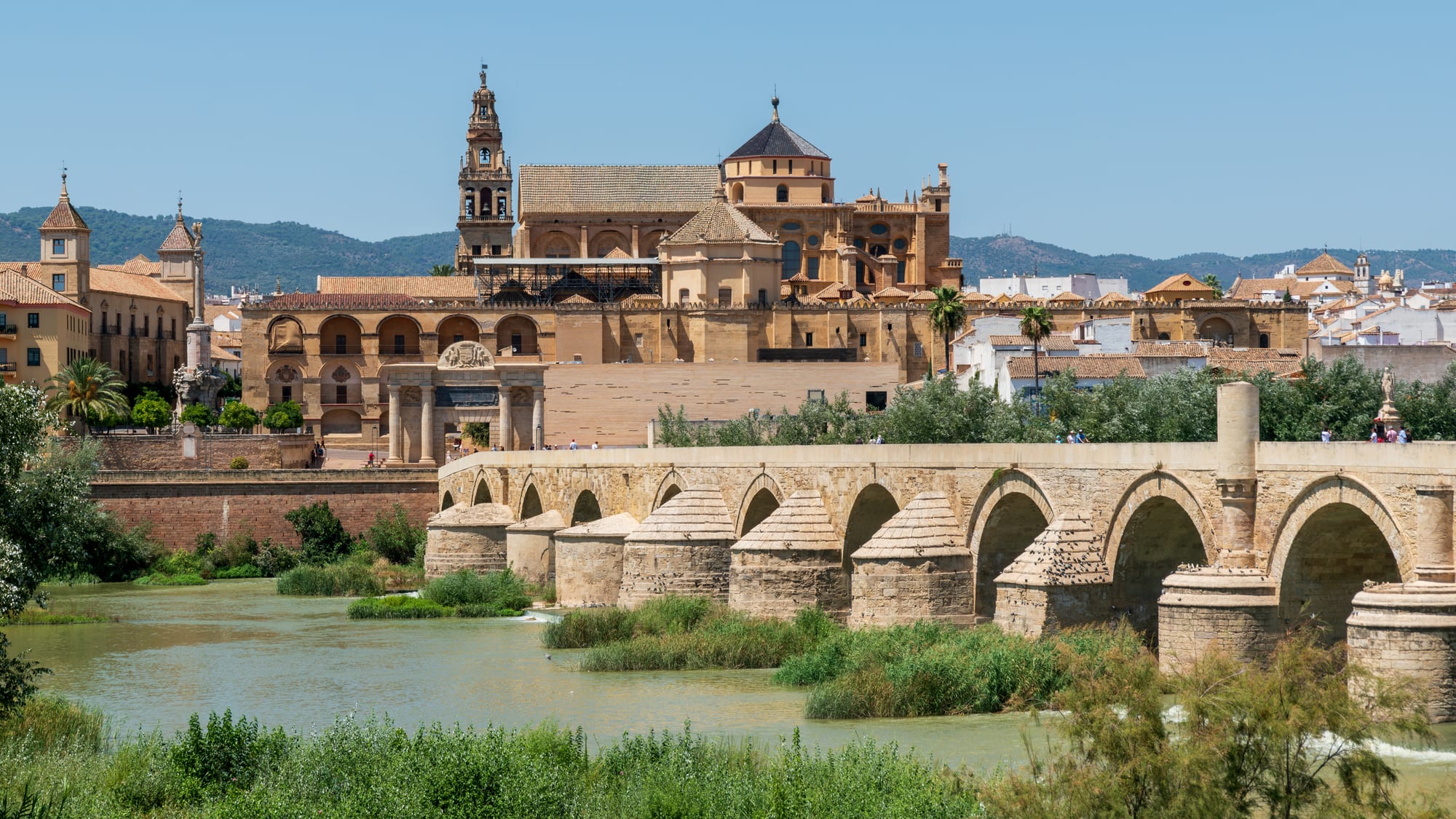
The Roman bridge's stone arches crossing the green Guadalquivir towards the golden walls and bell tower of the Mosque–Cathedral

Andalusia, Spain

Córdoba

The Roman bridge and the Mosque–Cathedral of Córdoba seen across the Guadalquivir. (Jose María Ligero Loarte / Wikimedia Commons · CC BY-SA 4.0)

A city of about 325,000 on the right bank of the Guadalquivir, capital of Roman Baetica and then of the Umayyad emirate and caliphate of al-Andalus. Its Mosque–Cathedral, Roman bridge and lanes of whitewashed houses with flower-filled courtyards make up one of the largest historic centres in Europe, a World Heritage Site, in the city with the highest summer temperatures in Spain and Europe.

Neighbourhoods

  • Judería and the Mezquita
    • First-time visitors
    • Historic district

    The old Jewish quarter north and west of the Mosque–Cathedral, where Jews lived from the 10th to the 15th centuries. Its tiny streets hold the synagogue of 1315, the Sepharad House museum and a municipal craft market.

    Open in Maps
  • Plaza de las Tendillas and the modern centre
    • Shopping
    • Close to public transport
    • Best for food

    The main square at the northern edge of the old town and the more modern streets beyond it towards Avenida de América, with the main shopping area and the joint train and bus station. The gardens of Paseo de la Victoria run along the west side.

    Open in Maps
  • Plaza de la Corredera and Plaza del Potro
    • Local life
    • Bars
    • Museums

    The eastern part of the old town, below the Mezquita's crowds. La Corredera is the only enclosed main square of its kind in Andalusia and a place for drinks, while the small Plaza del Potro, with its colt fountain, holds the inn mentioned in Don Quixote and two art museums.

    Open in Maps
  • Campo de la Verdad
    • Quiet and residential
    • River views

    The district on the south bank of the Guadalquivir, reached across the Roman bridge from the cathedral quarter, with the Calahorra Tower at the bridgehead and the classic view back across the river to the old city.

    Open in Maps

Things to do

Famous landmarks

  • Mosque–Cathedral of Córdobalandmark

    The Great Mosque begun on the orders of Abd al-Rahman I in 785 and enlarged by his successors, for centuries one of the largest mosques in the world and a cathedral since the 13th century, with its forest of striped arches.

    Open in Maps
  • Roman bridgelandmark

    Built by the Romans and largely reconstructed in the 8th century, for two thousand years the city's only bridge over the Guadalquivir.

    Open in Maps
  • Calahorra Towerlandmark

    A fortified gate of Islamic origin guarding the southern end of the Roman bridge.

    Open in Maps
  • Alcázar de los Reyes Cristianoslandmark

    A fortress-palace ordered by Alfonso XI in 1328 on the site of the Umayyad palace, a residence of Isabella I and later the seat of the Inquisition, with gardens and courtyards of Mudéjar inspiration.

    Open in Maps
  • Córdoba Synagoguelandmark

    A small Mudéjar synagogue completed in 1315 in the Jewish quarter, used for other purposes after 1492 and restored as a museum in 1985.

    Open in Maps
  • Plaza del Potrolandmark

    A small square with a Renaissance fountain of 1577 topped by a rearing colt, overlooked by the Posada del Potro inn mentioned by Cervantes.

    Open in Maps

Museums and Roman Córdoba

  • Caliphal Bathsmuseum

    A 10th-century bathhouse that served the caliphs' palace beside the Alcázar, partly reconstructed and open as a museum.

    Open in Maps
  • Roman templelandmark

    The columns of a Corinthian temple, probably dedicated to the imperial cult, begun under Claudius and discovered in the 1950s during the extension of the city hall.

    Open in Maps
  • Archaeological and Ethnological Museummuseum

    The city's archaeology museum, with collections from prehistory through Roman and Visigothic times to Islamic and Mudéjar art, built over the remains of the Roman theatre.

    Open in Maps
  • Julio Romero de Torres Museummuseum

    The largest collection of the Cordoban painter Julio Romero de Torres, in the old Hospital of la Caridad on Plaza del Potro, which also houses the Museum of Fine Arts.

    Open in Maps

Markets and squares

  • Plaza de la Correderalandmark

    An enclosed, arcaded main square in the east of the old town, the only one of its kind in Andalusia, lined with bars.

    Open in Maps
  • Mercado Victoriamarket

    A food market in the Jardines de la Victoria, on the western edge of the old town.

    Open in Maps

Short trips from the city

  • Medina Azaharalandmark

    The ruins of the fortified palace-city built in the 10th century by Abd ar-Rahman III on the western outskirts, a World Heritage Site since 2018.

    Open in Maps
  • Castle of Almodóvar del Ríolandmark

    A castle of Umayyad origin above the Guadalquivir west of the city, restored in the early 20th century and used as a filming location for Game of Thrones.

    Open in Maps
  • Sierra de Hornachuelos Natural Parkpark

    A natural park of some 60,000 hectares of hills and woodland in the west of the province, declared in 1989.

    Open in Maps

Seasonal events

  • Holy WeekMarch or April

    Brotherhoods process through the old town to the Mosque–Cathedral, including a silent candlelit procession through the Jewish quarter in the small hours of Good Friday.

  • May Crossesearly May

    Crosses decorated with flowers are set up in squares across the city — the first of three May festivals.

  • Courtyards Festivalfirst and second weeks of May

    Held since 1921 and recognised by UNESCO as intangible heritage in 2012, when residents decorate their courtyards with flowers and open them to visitors for free in a competition.

  • Córdoba FairMay

    The city's fair, the third of its big May festivals.

Eat and drink

Long-standing places and food districts in Córdoba. Hours, ratings and directions come from your maps app, always current.

Food districts and markets

  • Mercado Victoriamarket

    A food market in the Jardines de la Victoria, by the gardens of Paseo de la Victoria.

    Open in Maps
  • Tabernas of the old townneighborhood

    Traditional tabernas around Plaza de las Tendillas, Plaza de San Miguel and the Judería serve salmorejo, rabo de toro and Montilla wine.

    Open in Maps
  • Plaza de la Correderaneighborhood

    The arcaded square in the east of the old town, a long-standing place for drinks on its terraces.

    Open in Maps

Experience Córdoba

History

People lived near the Guadalquivir long before the Romans, learning to work copper and silver, and the name Córdoba is probably Old Iberian. Rome took the town in 206 BC, and a new settlement was founded beside it around 169 or 152 BC. As Corduba it became the capital of the province of Baetica and the main centre of Roman intellectual life in the south, the home town of Seneca the Elder, his son the philosopher Seneca and the poet Lucan.

Muslim forces took the city in the 8th century, and in 756 the Umayyad prince Abd ar-Rahman, escaping the fall of his dynasty in Damascus, made himself emir here. He began the Great Mosque in 785. In 929 Abd ar-Rahman III declared himself caliph and built the palace-city of Madinat al-Zahra to the west. In the 10th century Córdoba was one of the most advanced cities in the world, making leather, metalwork, tiles and textiles; estimates of its population around the year 1000 vary from 100,000 to a million. A revolution in 1009 began the collapse of the caliphate, which ended in 1031.

Ferdinand III of Castile entered the city on 29 June 1236 after a siege of several months, and the mosque became a cathedral. Córdoba enjoyed a golden age between 1530 and 1580, trading in farm produce and cloth, but declined afterwards, and its population and economy began to grow again only in the early 20th century. Francoist repression during and after the Civil War cost around 9,600 lives in the province. The Mosque–Cathedral was declared a World Heritage Site in 1984, extended to the whole historic centre in 1994.

Culture & Customs

Córdoba claims more UNESCO listings than anywhere else in the world: the Mosque–Cathedral, the historic centre, Madinat al-Zahra, added in 2018, and the Courtyards Festival, recognised as intangible heritage in 2012. The city honours its scholars of every faith with statues in the old town — Seneca by the Puerta de Almodóvar, the Muslim philosopher Averroes by the Puerta de la Luna and the Jewish philosopher Maimonides in Plaza de Tiberiades — as well as the poets Ibn Zaydun and Ibn Hazm.

May is the city's great month. The May Crosses, the Courtyards Festival and the Fair follow one another, and tourism is at its most intense. In the courtyard competition, held since 1921, families fill their patios with flowers and open them to visitors; monumental courtyards in palaces and religious buildings open alongside them. Holy Week before it brings processions of brotherhoods to the Mosque–Cathedral, the most intense moment being a silent candlelit procession through the Jewish quarter in the early hours of Good Friday.

Columns to the Archangel Raphael, the Triumphs of Saint Raphael, stand by the Roman bridge, the Puerta del Puente and Plaza del Potro. Crafts with deep roots continue: guadamecí, decorated leather, which emerged here in the 10th century under the caliphate, and jewellery, made in Córdoba since the 16th century.

Daily Life

About 325,000 people lived in the city in 2024, making it the third largest in Andalusia, and some 6 per cent of them were born abroad. The municipality is the largest in Andalusia by area, stretching far beyond the city into the surrounding countryside. The modern city spreads north of the old town, with districts such as Zoco and the area around the railway station.

Jewellery is the city's distinctive industry: Córdoba is Spain's third-largest exporter of jewellery, after Madrid and Barcelona, and its jewellery park, created in 2005, holds some 170 firms. The city has two universities, the University of Córdoba and Loyola Andalucía, and tourism is concentrated in the old town and the spring festivals.

Life follows the heat. With highs averaging 37°C in July and August and about 16 days a year above 40°C, summer is the hardest season, while the flower-filled courtyards of the old houses are at their best in May. Winters are mild but damp.

Food

Córdoba's best-known dish is salmorejo, a cold soup of tomato, bread, extra virgin olive oil and garlic that originated in the city; it is thicker than gazpacho and is often garnished with diced ibérico ham and hard-boiled egg. Flamenquín, another Cordoban dish, is made of slices of jamón serrano wrapped in pork loin, coated in breadcrumbs and deep-fried, and can range from a small ball to a roll 40 centimetres long; it is often served with chips and mayonnaise, and is popular among Gitanos. Rabo de toro, a stew of oxtail or bull's tail typical of Córdoba, is served in the city's tabernas.

The wines of Montilla-Moriles, from the south of the province, are made with methods similar to sherry, aged under a veil of flor yeast and in soleras, and are poured in the tabernas; a wine-tasting fair celebrates them. The old town's traditional tabernas, around Plaza de las Tendillas, Plaza de San Miguel and the Judería, are the places to try these dishes, and the Mercado Victoria, in the gardens on the western edge of the old town, is another place to eat.

Planning tools

Budget

Córdoba is compact: nearly everything of interest is within walking distance, so transport costs are low. Rooms are in most demand during Holy Week and the May festivals, when tourism is at its most intense.

Daily Budget Midrange
USD 130–240 (mid-range hotel in the old town, restaurant dinners, Mezquita, Alcázar and Medina Azahara tickets)
Daily Budget Shoestring
USD 55–100 (hostel or pension, tapas in tabernas, walking and city buses)

Book rooms early for May, when the crosses, the courtyards and the fair follow one another.

Best Time to Visit

Spring, and above all May, when the courtyards are in flower and the city holds its three big festivals. Late September to November is also pleasant. July and August are the hottest in Europe, with highs averaging 37°C and many days over 40°C. Winters are mild but damp.

Suggested Number of Days

Two days cover a first visit to a compact old town. Three or four allow time for the caliphal city outside town, a castle along the river and a slower pace in the summer heat.

First Visit
2 days
With Surroundings
3–4 days

Transportation

Almost everything of interest is within easy walking distance, the exception being Medina Azahara, about 5 km west, which is reached by a dedicated bus from the city or by car. City buses serve the wider city, and a rechargeable green travel card covers city and regional buses and regional trains.

Leave a car outside the old town, whose medieval lanes are narrow and tangled.

Airport & Station Connections

Most visitors arrive by high-speed train: Córdoba station has direct services to Madrid, Barcelona, Seville, Málaga and Zaragoza, and Málaga is under an hour away. The bus station is next to the train station, with buses from most Andalusian towns and Madrid. The small airport, 6 km south-west, has few flights; Seville (110 km) and Málaga (136 km) airports are the usual gateways.

Walkability

Very good. The old town is a tangle of medieval streets roughly bounded by the river, Plaza de las Tendillas and Paseo de la Victoria. In summer, with highs averaging 37°C, the heat makes walking hard going.

Safety

Spain is a safe country with low violent crime. In Córdoba the common nuisance is around the Mezquita, where beggars try to get money from visitors and often work in teams.

Keep bags close around the Mezquita and in festival crowds, and avoid walking in the midday heat in summer. Check current official travel advice before travelling.

Climate

A hot-summer Mediterranean climate. Córdoba has the highest summer temperatures of any city in Spain and Europe, because of its position in the Guadalquivir valley. Summers are very dry; winters are mild but cooler than in other low-lying cities of southern Spain, with frequent rain and occasional frosts.

Summer
very hot — highs average 37°C in July and August, with about 16 days a year over 40°C
Winter
mild and damp, with occasional frosts; the record low is −8.2°C

Local Customs

The courtyards are private homes: during the May festival they are opened free to visitors, who are expected to respect them. The Mezquita is a working cathedral, and processions during Holy Week fill the lanes of the old town at night.

Dress modestly for the Mosque–Cathedral and keep quiet during services and processions.

Common Payment Methods

The currency is the euro. Cards and contactless payment are widely accepted, and cash machines are easy to find in the centre; a little cash is useful for small tabernas.