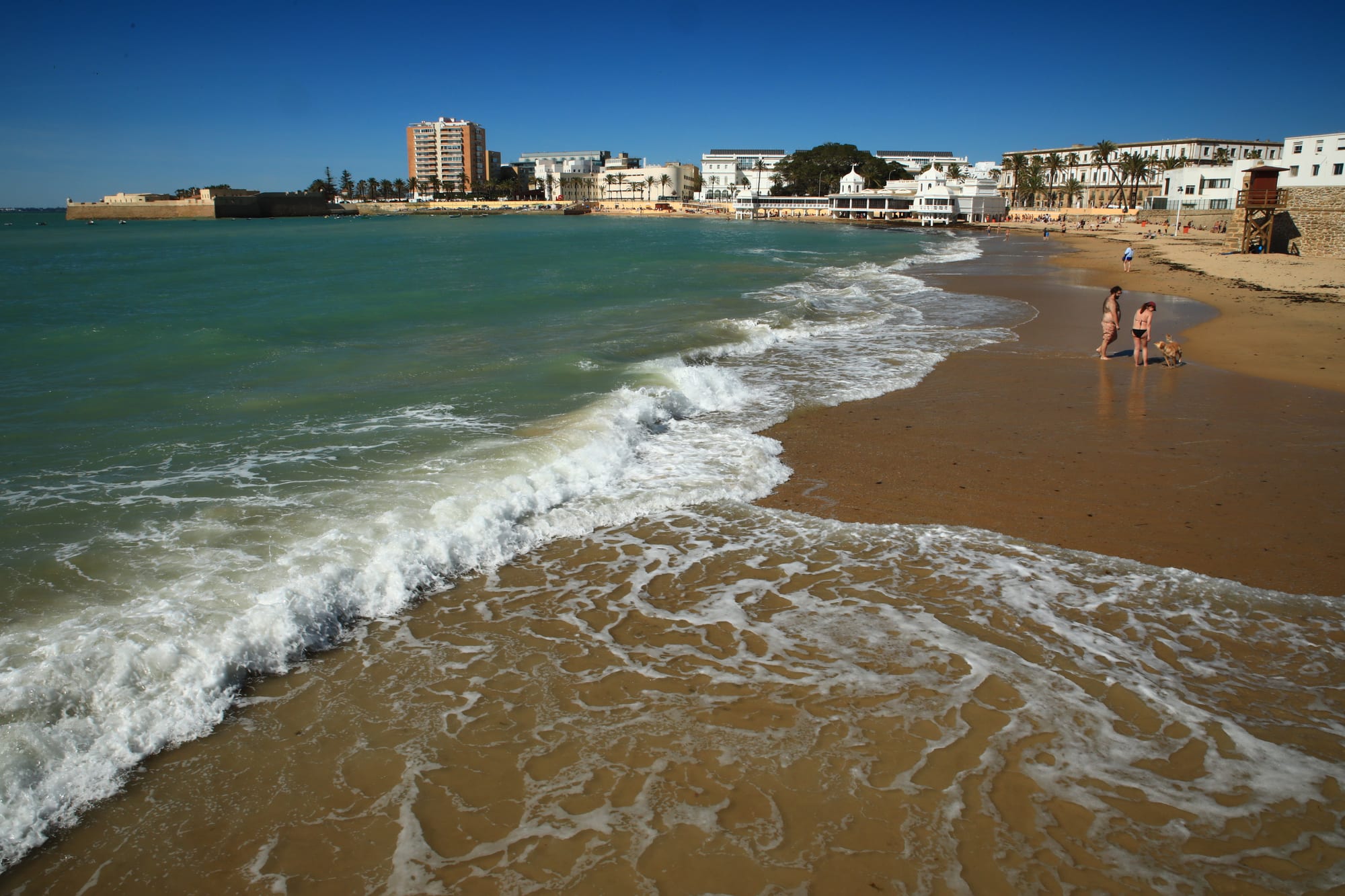
Waves breaking on the golden sand of a curved city beach, with a white domed spa building and a sea fort in the distance

Andalusia, Spain

Cádiz

La Caleta beach in the old town of Cádiz, with the former spa building and a sea fort beyond. (Benjamin Smith / Wikimedia Commons · CC BY-SA 4.0)

A port city of about 110,000 on a narrow spit of land in the Atlantic, often regarded as the oldest city still standing in Western Europe. Founded by Phoenicians as Gadir, it grew rich on the 18th-century trade with the Americas, proclaimed the liberal Constitution of 1812, and is known today for its sea walls, watchtowers, beaches and satirical carnival.

Neighbourhoods

  • El Pópulo and the cathedral quarter
    • First-time visitors
    • Historic district

    One of the oldest quarters of the old town, around the cathedral and the Plaza de la Catedral, where the Roman theatre was uncovered in 1980 and the Admiral's House of 1690 recalls the wealth of the trade with the Americas.

    Open in Maps
  • La Viña
    • Local life
    • Carnival
    • Beaches

    The quarter on the west side of the old town, which grew in the city's 18th-century expansion, beside La Caleta, the beach that recurs in carnival songs.

    Open in Maps
  • Mentidero and Santa María
    • Historic district
    • Quiet and residential

    Two historic districts of the old town: Mentidero to the north, towards the Punta de San Felipe and the Roman fish-salting factory, and Santa María, one of the antique quarters that contrast with the newer city.

    Open in Maps
  • Playa de la Victoria and the new town
    • Beaches
    • Close to public transport

    The newer city stretching south down the spit beyond the old walls, with hotels and cafés behind the 3 km Playa de la Victoria, the beach most used by visitors and locals alike.

    Open in Maps

Things to do

Famous landmarks

  • Cádiz Cathedrallandmark

    The 'Cathedral of the Americas', built between 1722 and 1838 with money from the trade with America, begun as a Baroque church and finished in Neoclassical style; Manuel de Falla is buried in the crypt and the Levante Tower is open for views.

    Open in Maps
  • Torre Taviraviewpoint

    The tallest of the merchants' watchtowers that still dot the skyline, designated the port's official lookout in 1778, with a panoramic view of the city and the bay.

    Open in Maps
  • Roman Theatrelandmark

    A theatre of the 1st century BC, one of the largest in the Roman Empire with room for some 10,000 people, discovered in El Pópulo in 1980 and only partly excavated.

    Open in Maps
  • Gran Teatro Fallalandmark

    A red-brick Neo-Mudéjar theatre with three horseshoe-arch doorways, begun in 1884 and named after Manuel de Falla, where the carnival's singing competitions are held every February.

    Open in Maps
  • Oratorio de San Felipe Nerilandmark

    A church built between 1685 and 1719 in the old town.

    Open in Maps
  • Monument to the Constitution of 1812landmark

    The monument on Plaza de España, built on the site of demolished city walls to mark the hundredth anniversary of the constitution proclaimed in the city.

    Open in Maps

Museums

  • Museum of Cádizmuseum

    The provincial museum, with archaeology on the ground floor, fine art including paintings by Zurbarán, Murillo and Rubens on the first, and puppets on the second.

    Open in Maps
  • Roman fish-salting factorymuseum

    The exposed foundations of a Roman fish-salting factory in the Mentidero district.

    Open in Maps

Beaches, walls and gardens

  • La Caletabeach

    The smallest beach in the city, a natural harbour on the old town's west edge used by Phoenicians, Carthaginians and Romans, set between two castles.

    Open in Maps
  • Castle of San Sebastiánlandmark

    A fortress on a small island at the end of La Caleta, reached by a causeway.

    Open in Maps
  • Castle of Santa Catalinalandmark

    A castle built in the late 16th and early 17th centuries at the end of La Caleta.

    Open in Maps
  • Parque Genovéspark

    An 18th-century seaside garden with tropical plants that thrive in the city's humid, mild air, statues of Celestino Mutis and Manuel de Falla, and an artificial waterfall with sea views.

    Open in Maps
  • Playa de la Victoriabeach

    A clean 3 km beach down the west side of the new town, backed by cafés and on several bus routes.

    Open in Maps

Markets

  • Mercado Centralmarket

    The busy covered food market on Plaza de la Libertad, about 100 metres south of Torre Tavira, known for its fish stalls.

    Open in Maps

Short trips from the city

  • La Pepa Bridgeviewpoint

    The 5 km cable-stayed bridge across the bay to Puerto Real, opened in 2015 and one of the highest bridges in Europe.

    Open in Maps
  • El Puerto de Santa Maríaneighborhood

    A town on the Guadalete across the bay, one of the three sherry towns.

    Open in Maps
  • Jerez de la Fronteraneighborhood

    The largest city in the province, home of sherry, with a Grand Prix motorcycle circuit.

    Open in Maps
  • Sanlúcar de Barramedaneighborhood

    A town at the mouth of the Guadalquivir known for manzanilla sherry, prawns and horse races on the beach.

    Open in Maps
  • Vejer de la Fronteraneighborhood

    A hilltop town on the right bank of the river Barbate, surrounded by orchards and orange groves.

    Open in Maps

Seasonal events

  • Carnival of CádizFebruary

    One of the best-known carnivals in Spain, famous for its humour and for the chirigotas, small groups that sing satirical songs about the year's news; the official contest at the Gran Teatro Falla is its climax.

  • Trofeo Carranzaearly August

    A summer football tournament held in the city since 1955.

Eat and drink

Long-standing places and food districts in Cádiz. Hours, ratings and directions come from your maps app, always current.

Food districts and markets

  • Mercado Centralmarket

    The covered central market on Plaza de la Libertad, where the fish stalls are the main attraction.

    Open in Maps
  • Tapas bars of the old townneighborhood

    Bars across the old town serve the city's fried fish, tortillitas de camarones and seafood stews as tapas.

    Open in Maps

Experience Cádiz

History

Cádiz is often regarded as the oldest city still standing in Western Europe. Phoenicians from Tyre founded it as Gadir, meaning "wall" or "stronghold", traditionally around 1100 BC, although nothing excavated on the site is older than the 9th century BC. The ancient town occupied two small islands near the mouth of the Guadalete, traded with Tartessos, and was known for its temple of Melqart, whom Greeks and Romans called Hercules. After the fall of Tyre in 573 BC Carthage took over, and later Rome, under which Gades built one of the largest theatres in the empire.

The city was incorporated into Castile in 1264, and its links with Genoa prepared it for the age of discovery: Columbus sailed from Cádiz on his second voyage in 1493 and his fourth in 1502. Wealth brought enemies. Barbary corsairs raided, fire destroyed much of the old town in 1569, Francis Drake occupied the harbour in 1587, and an Anglo-Dutch fleet captured the city in 1596. In 1717 the Casa de Contratación, the agency that ran the trade with the Americas, moved here from Seville, and the 18th century became a golden age: merchants built more than 160 watchtowers to watch for ships, and the new cathedral was begun.

During the Peninsular War, Cádiz was the seat of Spain's high command and of the Cortes, and on 19 March 1812 the liberal Constitution of 1812, "La Pepa", was proclaimed on the present Plaza San Antonio. In 1820 the city revolted to restore it. The Carranza bridge linked Cádiz with the mainland in 1969, and La Pepa bridge followed in 2015, while the city's population has fallen in recent decades.

Culture & Customs

The Carnival of Cádiz is the city's great expression of itself. Its hallmark is humour: sarcasm, wordplay and parody aimed at the most pressing problems of the day. Its stars are the chirigotas, groups of seven to twelve performers who sing comic songs to guitars, kazoos and a bass drum, alongside choirs, close-harmony comparsas and cuartetos. Groups rehearse and compete throughout the year, the official contest is held each February in the Gran Teatro Falla, and on carnival Saturday almost everyone wears a costume, often mocking the news.

The city remembers 1812 everywhere: the monument on Plaza de España, the bridge nicknamed La Pepa and the many squares, gardens and churches tied to the constitution. Its musical heritage runs through Manuel de Falla, born in Cádiz and buried in the cathedral crypt beside the poet José María Pemán, also a native, and the theatre that bears Falla's name.

La Caleta, wedged between two castles, has always featured in carnival songs, and its seafront is often compared to the Malecón of Havana. People of Cádiz are called gaditanos, from the Latin Gaditanus.

Daily Life

About 110,000 people lived in the city in 2025, making it the most populous town on the Bay of Cádiz and the third in the province after Jerez de la Frontera and Algeciras. It is the only municipality on the bay whose population has been falling. The spit leaves almost no room to grow: nearly everyone lives on about 4.4 square kilometres at a density close to 30,000 people per square kilometre, and the sandy ground makes high-rise building costly, so the skyline is not much different from that of the Middle Ages.

The economy rests on commerce linked to the shipyards, the port and the free-trade zone, and on tourism drawn by the beaches, the fiestas and the old town. Fishing has been in serious crisis for decades, and the shipyards are underused. Cádiz has had the highest unemployment rate of any Spanish provincial capital, and its population is one of the oldest in Spain, with more people over 65 than under 20 in the recent count.

Life is lived close to the sea, on La Caleta and Playa de la Victoria in summer and along the walls all year, and the carnival groups keep rehearsing through the year. The University of Cádiz has one of its campuses in the city.

Food

Cádiz cooks from the sea. Pescaíto frito, an assortment of fish coated in flour and fried in plenty of olive oil, is eaten all year, along with bienmesabe, dogfish in an adobo marinade, grilled mackerel and boiled, griddled or fried shellfish. Tortillitas de camarones are fritters of wheat and chickpea flour, water, onion, parsley and tiny whole shrimp; the dish comes from Cádiz or neighbouring San Fernando and may owe its invention to the old Genoese colony.

Stews combine sea and land: atún encebollao, tuna with onions; papas con chocos, potatoes with cuttlefish; and fish balls. In summer people turn to fresher dishes such as papas aliñás, boiled potatoes dressed with seasonings. Like everywhere in Andalusia, tapas are central to eating out.

Traditional sweets include tocino de cielo, pestiños and pan de Cádiz. The covered Mercado Central on Plaza de la Libertad, just south of Torre Tavira, supplies the city's kitchens, and its fish stalls announce themselves from the street. Across the bay, the sherry towns of Jerez, El Puerto de Santa María and Sanlúcar supply the wine.

Planning tools

Budget

Cádiz is a compact, walkable city where most sights are close together and the beaches are free. Carnival in February and the summer beach season are the busiest times.

Daily Budget Midrange
USD 140–250 (mid-range hotel, restaurant dinners, cathedral and museum tickets, train trips to Jerez)
Daily Budget Shoestring
USD 55–100 (hostel or guesthouse, market food and fried fish, city buses)

The beaches, the sea walls and Parque Genovés cost nothing.

Best Time to Visit

Cádiz is mild all year, with one of the warmest winters in Europe and more than 3,000 hours of sunshine. February brings carnival; summer is the beach season, warm but less hot than inland Andalusia; spring and autumn are comfortable for walking.

Suggested Number of Days

Two days suit the compact old town and its beaches. Four or five allow time for the sherry towns and the white villages along the coast and inland.

First Visit
2 days
With Surroundings
4–5 days

Transportation

The old town is best seen on foot. City buses run the length of the spit from Plaza de España, linking the old town with Playa de la Victoria, and the same operator runs trams and ferries across the bay. Cercanías trains run along the bay to San Fernando, Puerto Real, El Puerto de Santa María and Jerez, and a tram-train terminates in the city.

Use the bay ferries or Cercanías for El Puerto and Jerez rather than driving across the bridges.

Airport & Station Connections

Jerez Airport is about 40 km north, with flights from Madrid and Barcelona and seasonal flights from the UK and Germany; Cercanías trains link it with Cádiz in about an hour. The railway station, just outside the old town, has trains from Seville and Alvia high-speed services from Madrid, and the bus station is beside it. Ferries to the Canary Islands and cruise ships use the port opposite.

Walkability

Excellent. The old town is flat, compact and almost surrounded by the sea, and sea walls, castles and gardens line much of its edge. The new town and Playa de la Victoria are a longer walk south, or a bus ride.

Safety

Spain is a safe country with low violent crime. In Cádiz the main precautions are those of any beach city: care in the sea and with belongings in the carnival crowds.

Respect the beach flags and keep bags close in carnival crowds. Check current official travel advice before travelling.

Climate

A hot-summer Mediterranean climate tempered by the Atlantic, with very mild winters and warm summers. The average annual temperature is 18.8°C, among the highest of Spain's provincial capitals, and summer nights stay warm while days are less hot than inland around Jerez.

Summer
warm — August highs average about 28°C, with warm nights
Winter
very mild — the coldest month averages 12.9°C, with January nights around 9.5°C

Local Customs

The people of Cádiz, gaditanos, show their humour above all in carnival, when the city's groups sing biting satire about politics and current events, and rehearsals go on through the year. Tapas are central to eating out.

On carnival Saturday nearly everyone in the streets wears a costume, often poking fun at the news.

Common Payment Methods

The currency is the euro. Cards and contactless payment are widely accepted, and cash machines are easy to find; a little cash is useful in the market and small bars.