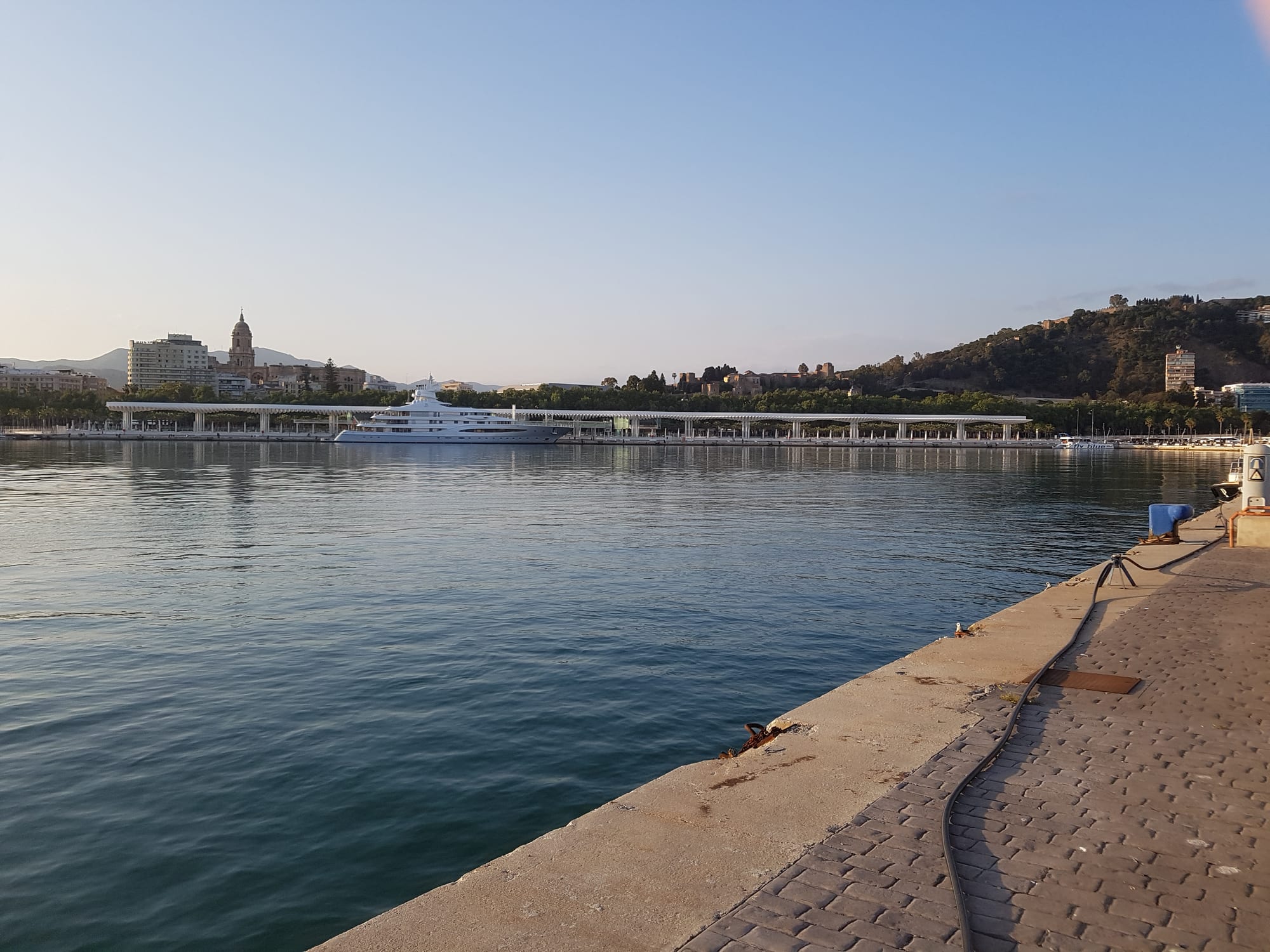
Calm harbour water in early light, with a long white pergola on the quay, the cathedral tower and a wooded castle hill behind

Andalusia, Spain

Málaga

Muelle Uno and the harbour of Málaga, with the cathedral tower on the left and Gibralfaro hill on the right. (Mirokado / Wikimedia Commons · CC BY-SA 4.0)

Andalusia's second city, with about 592,000 people, on the Costa del Sol where the Guadalmedina meets the Mediterranean. Founded by Phoenicians about 770 BC and the main port of Nasrid Granada, it is Picasso's birthplace, guarded by the Alcazaba and Gibralfaro castle, and today a busy airport city of beaches, museums and a growing technology sector.

Neighbourhoods

  • Historic centre
    • First-time visitors
    • Museums
    • Shopping

    The old city between the Gibralfaro hill and the Guadalmedina, largely closed to motor traffic, with the cathedral, the Roman theatre, the Picasso museums and Calle Larios, the pedestrian main shopping street opened in 1891. Plaza de la Merced, where Picasso was born, is also in the old city.

    Open in Maps
  • La Malagueta and the port
    • Beaches
    • Waterfront
    • Close to the centre

    The district east of the centre around the bullring of 1876, with the nearest beach to the old town. Below it the remodelled port area of Muelle Uno and the palm-lined Paseo del Parque link the waterfront with the centre.

    Open in Maps
  • Pedregalejo and El Palo
    • Beaches
    • Best for food
    • Local life

    Twin traditional fishing villages along the coast east of the centre, now part of the city, with quieter beaches and a line of chiringuitos — beach restaurants — grilling fish on the sand. City buses run out from near the bullring.

    Open in Maps

Things to do

Fortresses and landmarks

  • Alcazabalandmark

    A palatial fortress of al-Andalus on the hillside above the port, begun in the 11th century, with double walls, a central courtyard and a triple-arched gateway.

    Open in Maps
  • Gibralfaro Castleviewpoint

    The castle on the 130-metre hill above the city, linked to the Alcazaba by a walled corridor and reached by a steep walk or a bus, with wide views of the city from its ramparts.

    Open in Maps
  • Roman theatrelandmark

    A theatre of the 1st century BC at the foot of the Alcazaba, rediscovered in 1951.

    Open in Maps
  • Málaga Cathedrallandmark

    A Renaissance cathedral built between 1528 and 1782, with a Baroque façade and a south tower left unfinished for lack of funds, standing within the line of the old Moorish walls.

    Open in Maps
  • Calle Larioslandmark

    The pedestrian main shopping street of the city, opened in 1891 and the most expensive street to live on in Málaga.

    Open in Maps

Museums

  • Museo Picasso Málagamuseum

    Opened in 2003 in the Buenavista Palace with works donated by Picasso's family; Phoenician walls, the oldest remains in the city, are visible in its cellar.

    Open in Maps
  • Picasso's birthplacemuseum

    The house on Plaza de la Merced where Picasso was born, now the Museo Casa Natal and the seat of the Picasso Foundation.

    Open in Maps
  • Carmen Thyssen Museummuseum

    A museum of mainly Andalusian 19th-century Spanish painting from the collection of Carmen Cervera, opened in 2011 in a converted 16th-century building.

    Open in Maps
  • Centre Pompidou Málagamuseum

    A branch of the Paris modern art centre, opened in 2015 in the glass cube known as El Cubo on the port.

    Open in Maps

Parks, beaches and the waterfront

  • Muelle Uno and the Paseo del Parquepark

    The remodelled port quay with its palm grove, and the promenade beside a park of palms and statues that leads from the harbour towards Calle Larios.

    Open in Maps
  • La Malagueta beachbeach

    The nearest beach to the centre, in the district around the bullring.

    Open in Maps
  • La Malagueta bullringlandmark

    The city's bullring, which held its first event in 1876 and hosts bullfights during the August fair.

    Open in Maps
  • La Concepción Botanical Gardenpark

    A landscape garden of more than 150 years at the northern entrance to the city, one of the few subtropical gardens in Europe, with more than fifty thousand plants.

    Open in Maps

Markets

  • Atarazanas Marketmarket

    The central market on Calle Atarazanas, just north of the Alameda Principal.

    Open in Maps

Short trips from the city

  • Caminito del Reytrail

    A walkway pinned along the walls of the narrow gorge of El Chorro, near Ardales, first built in the early 20th century.

    Open in Maps
  • Caves of Nerjaattraction

    Caverns stretching for almost 5 km near the town of Nerja, rediscovered in 1959, with concerts held in a chamber that forms a natural amphitheatre.

    Open in Maps

Seasonal events

  • Holy WeekMarch or April

    Forty-two brotherhoods make 45 processions with carved images of the Passion; some of their tronos are so large they are kept outside the churches, taller than the doors.

  • Carnivalthe week before Ash Wednesday, February or March

    A week of street carnival that ends on Malagueta beach with the burial of the sardine.

  • Málaga FestivalMarch

    One of the most important film festivals in Spain, devoted to Spanish and, since 2017, Ibero-American cinema.

  • Feria de AgostoAugust

    The August fair: by day, sweet wine, flamenco and verdiales music in the centre and bullfights at La Malagueta; by night, a fairground with rides, clubs and restaurants.

Eat and drink

Long-standing places and food districts in Málaga. Hours, ratings and directions come from your maps app, always current.

Málaga classics

  • Chiringuitos of Pedregalejo and El Paloneighborhood

    Beach restaurants along the eastern shore serving espetos — sardines skewered and grilled over a wood fire on the sand — and pescaíto frito.

    Open in Maps
  • Old-town tavernsneighborhood

    Traditional taverns in the historic centre pour Málaga's local sweet Moscatel wine alongside the classic tapas.

    Open in Maps

Markets and cafés

  • Atarazanas Marketmarket

    The city's central market on Calle Atarazanas, just north of the Alameda Principal.

    Open in Maps
  • Churros con chocolatecafe

    Fried dough with thick hot chocolate is a favourite stop in the cafés of the old town.

    Open in Maps

Experience Málaga

History

Phoenicians from Tyre founded Malaka about 770 BC at the mouth of the Guadalmedina, a waypoint on the trade routes to the Strait of Gibraltar, and the town later fell under Carthage and, from 218 BC, Rome, which built the theatre below the hill. In the 10th century Málaga became the capital of the Islamic province of Rayya, and after the caliphate broke up the Hammudids ruled a taifa kingdom from the city. Ibn Battuta, passing about 1325, called it one of the largest and most beautiful towns of al-Andalus and praised its figs, almonds and gilded pottery; its harbour exported silk, dried fruit, wine and lustreware.

In the 15th century Málaga was the main port of Nasrid Granada, with a notable community of Genoese merchants. Christian forces took it on 18 August 1487 after a siege of more than three months, the most violent episode of the Granada War: hunger forced the surrender, and almost the entire remaining population, around 11,000 people, was sold into slavery. The city was repopulated by settlers from across the peninsula and remained a trading port linked with Antequera and Córdoba.

The economy profited from early industrialisation in the first third of the 19th century and the population grew steadily, until an economic crisis brought on by the phylloxera vine pest made it fall between 1887 and 1897. Tourism later became a growing source of income. A technology park opened in 1992, high-speed trains arrived in 2007, and new museums and a remodelled port have reshaped the city since.

Culture & Customs

Pablo Picasso was born on Plaza de la Merced, and the city has built much of its modern image around museums: the Museo Picasso Málaga, opened in 2003; the Carmen Thyssen Museum of Andalusian painting, opened in 2011; and a branch of the Centre Pompidou, opened in 2015 on the port. Tourists come for Picasso, the museums, the old town and the beaches, and the city calls itself the capital of the Costa del Sol.

Holy Week has been observed for five centuries and is the city's great religious event, a Fiesta of International Tourist Interest since 1965: 42 brotherhoods carry their images through the streets on huge tronos, some too tall to fit through church doors, and a museum of brotherhood art displays Baroque church treasures. The August fair fills the centre by day with sweet wine, flamenco and verdiales, Málaga's own traditional music, and moves at night to the fairground. The Málaga Festival of Spanish-language cinema, held each March, is among the most important in Spain.

Málaga CF play football in the Segunda División, and the Martín Carpena arena holds up to 14,000 spectators. The climate and the sea shape leisure, from swimming, surfing and windsurfing to running, cycling and golf.

Daily Life

About 592,000 people lived in the city in 2024, making it the second largest in Andalusia and the sixth in Spain; nearly 16 per cent were born abroad. About 1.3 million people live in the metropolitan area, and its population grows every year.

Tourism, construction and technology services are the main sectors. The Andalusia Technology Park, opened in 1992, ended 2025 with about 29,000 employees, and the city is the headquarters of Unicaja, the largest bank in Andalusia. The airport handled a record 26.8 million passengers in 2025, the fourth busiest in Spain, and the port is the second busiest for cruises in the Iberian Peninsula.

Daily movement depends on buses, a two-line metro that carried more than 19 million passengers in 2025 and commuter trains along the coast. Most residents are Catholic, though few practise, and life is lived outdoors for much of the year thanks to about 300 days of sunshine. Francisco de la Torre has been mayor since 2000.

Food

Málaga's signature is the espeto: fish, traditionally sardines, threaded on long thin rods and roasted over firewood on the beach sand, served in the chiringuitos along the shore. The dish has been proposed for UNESCO recognition as intangible heritage. Pescaíto frito, fish coated in flour and deep-fried in olive oil, seasoned only with salt and served hot with lemon, is the other coastal staple.

Ajoblanco, a cold soup typical of Málaga and Granada, is made from bread, crushed almonds, garlic, water, olive oil and salt, and is usually served with grapes or slices of melon; it is sometimes called white gazpacho. Churros dipped in thick hot chocolate are a favourite stop in the cafés of the old town.

The province makes sweet and fortified Málaga wines, chiefly from Pedro Ximénez and Moscatel grapes, and dry wines under the newer Sierras de Málaga label. In medieval times the harbour shipped wine, raisins, almonds and figs across the Mediterranean, and the city still drinks its own sweet Moscatel in the old taverns. The Atarazanas central market lies just north of the Alameda Principal.

Planning tools

Budget

Málaga's airport is dominated by discount and charter airlines, which keeps the city easy to reach. Summer, when the Costa del Sol fills with tourists, is the busiest season.

Daily Budget Midrange
USD 140–250 (mid-range hotel, restaurant dinners, museum and Alcazaba tickets, a day trip by train)
Daily Budget Shoestring
USD 60–100 (hostel bed, market food, espetos and tapas, metro and buses)

Many sights sit within a short walk of each other, and the beach at La Malagueta is free.

Best Time to Visit

All year. Málaga has the warmest winters of any large European city, with daytime highs of 17–18°C from December to February and about 300 sunny days a year. Spring brings Holy Week and the film festival; August is hot and humid and brings the fair; autumn stays warm enough for the beach.

Suggested Number of Days

Two or three days suit the city itself. Four to six allow time for the beaches, the gorge walk inland and the coast's towns, and for slower days in the summer heat.

First Visit
2–3 days
With Surroundings
4–6 days

Transportation

The historic centre is largely free of cars and best explored on foot. A network of city buses runs from the Alameda Principal, a two-line metro covers parts of the city and meets the main rail station, and two Cercanías commuter lines run west along the coast via the airport and inland. A green travel card covers metro, commuter trains and city and regional buses.

Use the commuter train or the express bus from the airport rather than driving into the centre, where parking is scarce.

Airport & Station Connections

Málaga–Costa del Sol Airport, about 8 km from the centre, is the main international gateway for Andalusia, with flights from across Europe; the C-1 commuter train and an express bus link it with the city. High-speed AVE trains reach María Zambrano station, about 1 km west of the centre, from Madrid in 2½–3 hours, and the main bus station is across the street. Cruise ships call at the port.

Walkability

The old town is compact, flat and largely pedestrian, and the cathedral, museums, Calle Larios and the port are a few minutes apart. The climb to Gibralfaro is steep. The waterfront walk east to La Malagueta is easy, while the beaches beyond are a long walk or a bus ride. Cycling is promoted, and an eastern coastal route avoids the main road.

Safety

Spain is a safe country with low violent crime. In Málaga the large crowds of Holy Week and the August fair call for the usual care with belongings.

Keep bags close in processions and fair crowds, leave nothing in parked cars, and respect beach flags. Check current official travel advice before travelling.

Climate

A Mediterranean climate with mild winters, when most of the rain falls, and hot, dry summers. Summer and early autumn are moderately humid, as sea breezes carry moisture inland, and the Montes de Málaga shelter the city from cold northern winds in winter.

Summer
hot and humid — August days range from 26 to 34°C, with nights above 20°C
Winter
the mildest of any large European city — January days of 14–20°C and nights of 5–10°C

Local Customs

Most people are Catholic, though few practise, and the brotherhoods of Holy Week are a central part of local life. Tipping is not required; anyone wishing to tip by card should say so before the amount is entered, as the machines have no option to add one.

Watch Holy Week processions from the side of the street without blocking the route, and dress respectfully in the cathedral.

Common Payment Methods

The currency is the euro. Cards and contactless payment are widely accepted, and cash machines are easy to find; cash is handy for tips.