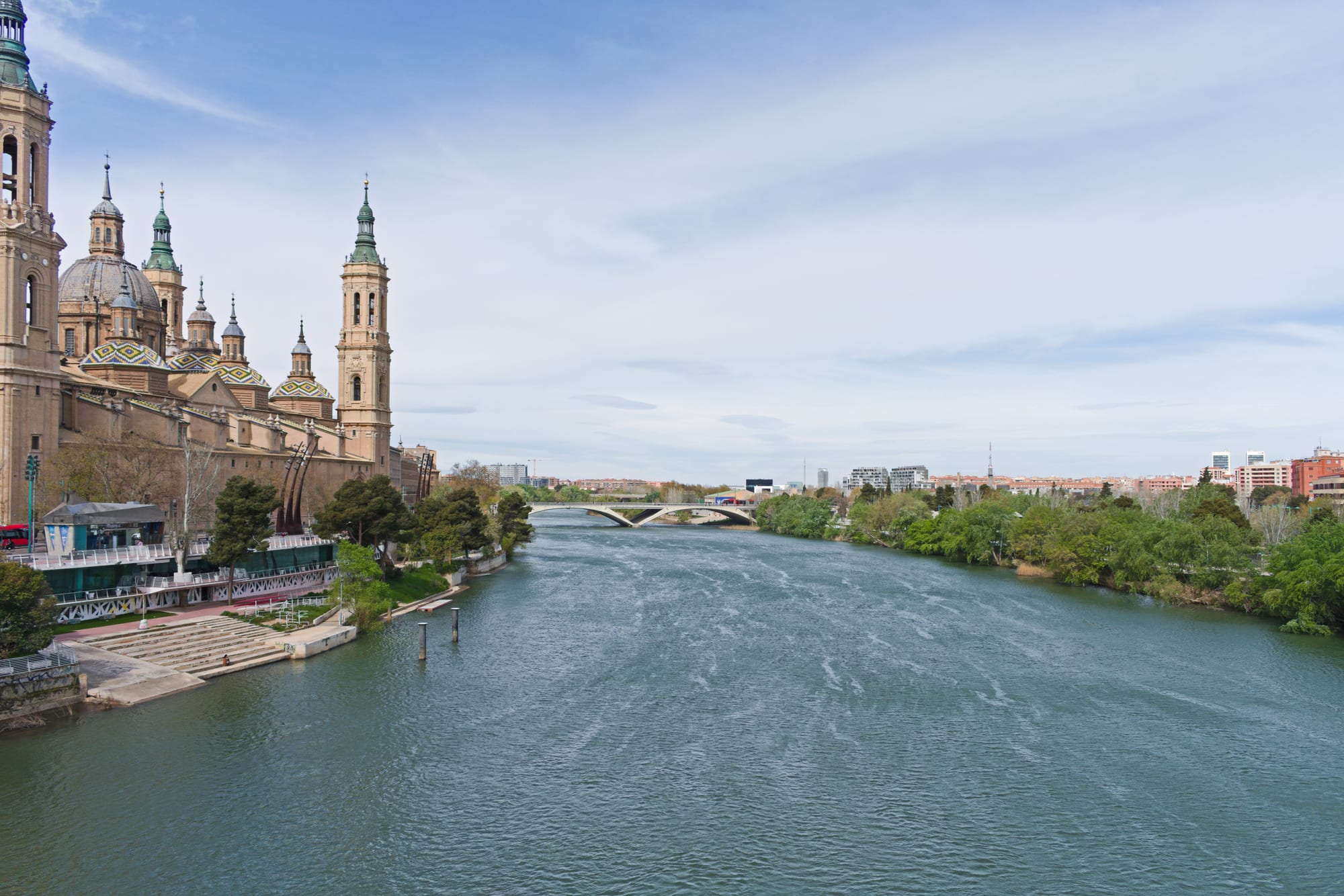
The domes and tall towers of the Basilica of the Pilar beside the wide green Ebro, with a modern bridge and tree-lined bank beyond

Aragon, Spain

Zaragoza

The Basilica of the Pilar on the Ebro, seen upstream from the Puente de Piedra in Zaragoza. (Ymblanter / Wikimedia Commons · CC BY-SA 4.0)

The capital of Aragon and Spain's fourth-largest city, on the Ebro midway between Madrid and Barcelona. Founded by Augustus as Caesaraugusta, it became the seat of a Muslim taifa kingdom and then of the kings of Aragon. The vast Basilica of the Pilar, the Aljafería palace and Mudéjar towers stand in a busy industrial and logistics city that hosted Expo 2008.

Neighbourhoods

  • The old town and the Plaza del Pilar
    • First-time visitors
    • Historic district
    • Close to public transport

    The heart of Roman and medieval Zaragoza on the south bank of the Ebro, around the long Plaza del Pilar with the basilica, La Seo, the town hall, the Lonja and the tourist office. The Roman forum, baths and theatre lie under its streets, and the Puente de Piedra crosses the river here.

    Open in Maps
  • El Tubo
    • Best for food
    • Nightlife

    A tangle of narrow lanes off the Plaza de España, between El Coso and Calle Alfonso I, that forms the city's main and oldest tapas district. Calle Estébanes is the original Tubo.

    Open in Maps
  • The centre and Paseo de la Independencia
    • Shopping
    • Close to public transport

    The 19th- and 20th-century centre running south from the Plaza de España along the Paseo de la Independencia, with department stores, offices and the main shopping streets towards Sagasta. The tram runs through it.

    Open in Maps
  • Universidad and the Parque Grande
    • Parks
    • Quiet and residential
    • Sport

    Residential districts south-west of the centre around the university and the Parque Grande José Antonio Labordeta, the city's big park of 1929.

    Open in Maps
  • The Expo 2008 riverside
    • Modern architecture
    • Walks

    The former Expo site on the Ebro on the western edge of the city, now offices, civic buildings and riverside parks, reached from La Almozara by Zaha Hadid's covered Bridge Pavilion, with a freshwater aquarium among its buildings.

    Open in Maps

Things to do

Famous landmarks

  • Basilica of Our Lady of the Pillarlandmark

    The great Baroque basilica on the Ebro, co-cathedral of the city, built mainly from 1681 to 1872 around the pillar where tradition says the Virgin Mary appeared to Saint James; Goya painted some of its domes.

    Open in Maps
  • La Seolandmark

    The Cathedral of the Saviour, built on the site of the main mosque and mixing styles from the 12th to the 18th centuries, part of a World Heritage Site, with a museum of Flemish tapestries of the 15th to 17th centuries.

    Open in Maps
  • Aljaferíalandmark

    The fortified palace built in the second half of the 11th century for the Banu Hud rulers of the taifa of Zaragoza, the only large surviving example of Islamic architecture from the taifa era, now the seat of the Aragonese parliament.

    Open in Maps
  • Puente de Piedralandmark

    The 15th-century stone bridge over the Ebro, guarded since 1991 by four lions, the symbol of the city.

    Open in Maps
  • Puerta del Carmenlandmark

    A neoclassical gate of 1789, once one of the twelve gates of the city, still marked by the shot of the sieges of 1808–09.

    Open in Maps

Roman and Mudéjar Zaragoza

  • Caesaraugusta Theatre Museummuseum

    The remains of a Roman theatre for 6,000 spectators, built under Tiberius and Claudius, uncovered in 1973 and shown with a museum on the site's later history.

    Open in Maps
  • Caesaraugusta Forum Museummuseum

    The excavated forum of the Roman city beneath the Plaza de la Seo, where a stretch of Roman sewer can be walked; it is part of a route of four Roman museums with the theatre, the baths and the river port.

    Open in Maps
  • Church of Santa María Magdalenalandmark

    A 14th-century Mudéjar church with a square brick tower and a polygonal apse, its interior redone in the Baroque period.

    Open in Maps
  • Church of San Pablolandmark

    A Gothic-Mudéjar church of the late 13th and early 14th centuries with an octagonal tower and a high altar by Damián Forment.

    Open in Maps

Museums and markets

  • Mercado Centralmarket

    A market hall by Félix Navarro, completed in 1903 to replace the open-air market on the old market square, and restored in 2018–2019.

    Open in Maps
  • IAACC Pablo Serranomuseum

    A contemporary art museum named after the sculptor Pablo Serrano.

    Open in Maps
  • Origami museum (EMOZ)museum

    A gallery devoted to the craft of paper folding in the Centro de Historias, run by a long-established local group.

    Open in Maps

Parks and the river

  • Parque Grande José Antonio Labordetapark

    A large park of 1929 with a monumental fountain staircase, renamed in 2008 after the Aragonese singer-songwriter.

    Open in Maps
  • Bridge Pavilionlandmark

    Zaha Hadid's 270-metre covered bridge over the Ebro, built as the main entrance to Expo 2008 and clad in 29,000 grey fibre-concrete triangles.

    Open in Maps
  • River Aquariumattraction

    A large freshwater aquarium on the Expo site, with glass tunnels through a tank planted with underwater trees.

    Open in Maps

Short trips from the city

  • Fuendetodosattraction

    The small village where Francisco de Goya was born in 1746, with a museum of his work.

    Open in Maps
  • Monasterio de Piedrapark

    A Cistercian monastery founded in 1194 by Alfonso II of Aragon beside the Piedra river, set in a park of waterfalls.

    Open in Maps

Seasonal events

  • Holy WeekMarch or April

    Processions with dramatic sculptures, women in black and hundreds of hooded penitents pass through the centre every day; declared of International Tourist Interest in 2014.

  • Fiestas del Pilarthe week around 12 October

    The city's patron fiestas, with the Flower Offering on 12 October, when a huge cloak for the Virgin is covered in flowers, the Fruit Offering the next day, jota dancing, giants and big-heads, concerts and closing fireworks over the Ebro.

Eat and drink

Long-standing places and food districts in Zaragoza. Hours, ratings and directions come from your maps app, always current.

Zaragoza classics

  • Ternasco and Aragonese dishesrestaurant

    Roast young lamb, ternasco, is the signature; menus also offer pollo al chilindrón, bacalao al ajoarriero, migas a la aragonesa and borrajas, borage dressed with olive oil.

    Open in Maps
  • Casa Lacrestaurant

    A restaurant in El Tubo dating from 1825, one of the oldest in Spain.

    Open in Maps
  • Heladería Tortosacafe

    One of the oldest ice-cream shops in the city, opened in 1934 on Calle Don Jaime I, also known for horchata.

    Open in Maps

Food districts and markets

  • El Tuboneighborhood

    The narrow lanes off the Plaza de España, packed with tapas bars and small restaurants, the oldest and best-known place to eat out in the city.

    Open in Maps
  • Mercado Centralmarket

    The restored market hall of 1903, the city's central food market.

    Open in Maps
  • Calle Mayor and Espoz y Minaneighborhood

    Two streets a short walk from the Plaza del Pilar with a wide choice of tapas bars.

    Open in Maps

Experience Zaragoza

History

The Iberian Sedetani had a town here called Salduie before Augustus founded the colony of Caesaraugusta, sometime between 25 and 11 BC, for veterans of the Cantabrian Wars; its name became Saraqusta in Arabic and Zaragoza in Spanish. The Roman city had a forum, baths, a river port and a theatre for 6,000 people. Christian tradition places here the apparition of the Virgin on a pillar to Saint James, and the martyrdom of Saint Engracia and her companions. The Goths took the city in the 5th century with little bloodshed.

Under Muslim rule from the 8th century it was the capital of the Upper March of al-Andalus, and in 1018 it became an independent taifa, ruled from 1039 by the Banu Hud, whose court built the Aljafería. The Almoravids took the city in 1110, and on 18 December 1118 Alfonso I of Aragon captured it and made it his capital. Its large Jewish community, with seven synagogues, left in July 1492 after the expulsion order.

Plague killed about 10,000 people in 1564. The city backed the Habsburg claimant in the War of the Spanish Succession and lost Aragon's own institutions under the Nueva Planta decrees. In 1808–09 it withstood two French sieges and surrendered only after some 50,000 defenders had died. Railways arrived in 1861 and 1863. The military coup of July 1936 succeeded here, and Zaragoza became a key industrial city for the Nationalist side, above all as an ammunition maker. Declared an industrial development pole in 1964, it doubled in population within a short time. A hotel fire in 1979 killed at least 80 people, and a bomb attack on a Civil Guard barracks in 1987 killed eleven, including children. General Motors opened a car plant at Figueruelas in 1982, and in 2008 the city hosted Expo 2008 on water and sustainable development.

Culture & Customs

Devotion to the Virgin of the Pillar shapes the city's identity. Tradition holds that a chapel built on its site by Saint James was the first church ever dedicated to Mary, and pilgrims have prayed before its statue for centuries. The Fiestas del Pilar, centred on 12 October, which is also Spain's national day, are among the most celebrated festivals in Spain: the Flower Offering covers a giant cloak for the Virgin with flowers, the Fruit Offering the next day brings produce from Aragon and other regions of Spain, and the days fill with jota dancing, processions of giants and big-heads, concerts and fireworks over the Ebro. Holy Week, with its hooded processions, has been of International Tourist Interest since 2014.

The Mudéjar churches and towers built by Muslim craftsmen after the Christian conquest, including parts of La Seo, San Pablo and La Magdalena, belong to a UNESCO World Heritage Site, and the Aljafería ranks with the Mosque–Cathedral of Córdoba and the Alhambra among the finest Hispano-Muslim buildings. Goya, born nearby at Fuendetodos, painted domes in the Pilar. Aragonese, long in retreat, has up to 7,000 speakers in the city.

Sport is followed closely. Real Zaragoza, winners of the Cup Winners' Cup in 1995 and six Spanish cups, dropped to the third tier in 2026 while La Romareda is rebuilt as a new stadium; Basket Zaragoza plays in the Liga ACB, the top basketball league.

Daily Life

About 699,000 people lived in the city in 2025, making it the fourth largest in Spain, and around 760,000 in the metropolitan area. It is divided into 15 urban districts and 14 rural neighbourhoods, and in 2017 Romanians were the largest group among foreign residents.

The economy rests on industry and logistics. The car plant at Figueruelas, the household-appliance maker Balay, the train builder CAF and the paper companies SAICA and Torraspapel are major employers. The PLAZA logistics platform and an airport that is one of the Iberian Peninsula's main cargo hubs exploit the city's position at the centre of a rough hexagon formed by Madrid, Barcelona, Valencia, Bilbao, Bordeaux and Toulouse. The city is also home to the army's General Military Academy, an air base and the University of Zaragoza.

Most people live in flats in districts that spread out from the old town in the decades of rapid growth after 1964, including Delicias, Actur and newer areas reached by the tram. Life follows the climate: late evenings on terraces in summer, a near-empty city in August, and coats against the cierzo in winter.

Food

Aragonese cooking is inland and hearty, and roast lamb, ternasco, is its most characteristic dish. Zaragoza's menus also feature pollo al chilindrón, chicken in a sauce of cured ham, tomatoes, onions and paprika; bacalao al ajoarriero, cod with garlic and eggs; huevos al salmorejo; lamb cooked a la pastora, shepherd's style; and migas a la aragonesa, crumbs scrambled with egg and chorizo. Longaniza and chorizo sausages are highly prized, and borrajas, borage, a vegetable eaten almost only in Aragon, is usually dressed simply with olive oil. Peaches in wine, melocotón con vino, are a classic dessert.

Tapas are the city's way of eating out. El Tubo, the knot of narrow lanes off the Plaza de España, is the oldest and best-known tapas district, home to Casa Lac, a restaurant dating from 1825, and the streets around the Plaza del Pilar are full of bars. A tabla is a wooden board of tapas such as cheese and sausage, often with a bottle of wine included. The Mercado Central, a market hall of 1903 restored in 2018–2019, is the central food market.

The sweet tooth is served by frutas de Aragón, candied fruit coated in chocolate; adoquines; guirlache, a nougat; and the plaited trenza de Almudévar. Ice-cream shops along Calle Don Jaime I include one opened in 1934.

Planning tools

Budget

Zaragoza is noticeably cheaper than Madrid or Barcelona, above all for hotels, because it is often overlooked by foreign visitors. The menú del día is widespread, and the Pilar, the riverside and the parks cost nothing. Prices rise during the Fiestas del Pilar in October, and in August many bars and small businesses close.

Daily Budget Midrange
USD 110–230 (mid-range hotel, restaurant dinners, Aljafería and Roman-museum tickets)
Daily Budget Shoestring
USD 50–85 (hostel or pension, tapas and menú del día, buses and the tram)

Buy the joint ticket for the Roman museums, and book well ahead for the week of the Pilar fiestas.

Best Time to Visit

Spring, from April to mid-June, and autumn, in September and October, are the best seasons. Late June and July are hot, but evenings on the terraces are lively; in August the city empties as residents head for the mountains or the coast. October brings the Fiestas del Pilar. Winters are cold and often swept by the cierzo wind.

Suggested Number of Days

Most first visits take about two days, enough for the old town, the museums and an evening or two of tapas. Allow three or four to add trips into the province or towards the Pyrenees. Zaragoza is also an easy stop between Madrid and Barcelona by high-speed train.

First Visit
2 days
With Surroundings
3–4 days

Transportation

City buses run on 31 regular lines, with night buses at weekends, and a single tram line crosses the city from north to south-west through the centre. Cercanías commuter trains serve the suburbs, the Bizi bike-share scheme has stations across the centre, and taxis are plentiful.

A rechargeable transport card, sold at tobacconists, is cheaper than paying the driver and covers both buses and the tram.

Airport & Station Connections

High-speed AVE trains reach Zaragoza from Madrid in about 75 minutes and from Barcelona in about 90, arriving at Delicias station, about 2 km from the centre, which also serves long-distance coaches. Zaragoza Airport, about 16 km west of the city, is a major cargo hub with a limited choice of passenger flights; Madrid and Barcelona airports are within a few hours by train or coach.

Walkability

Good. The old town, El Tubo, the Plaza de España and the riverside are close together and largely flat, and most central sights are within an easy walk. The Aljafería, the Parque Grande and the Expo site are further out but reached by bus or tram. The cierzo can make walks along the river cold even on sunny days.

Safety

Spain is a safe country with low violent crime. The main weather risks are summer heat and the cold, strong cierzo in winter.

Carry warm layers when the cierzo blows, and water on hot summer days. Check current official travel advice before travelling.

Climate

Semi-arid, in a wide basin ringed by mountains that block moist air from the Atlantic and the Mediterranean. Rainfall is low, about 330 mm a year, falling mostly in spring and autumn, and sunny days are many. The cierzo, a cold, dry north-westerly, often blows on clear days, fog can persist in late autumn and early winter, and snowfall is sporadic.

Summer
hot and dry — typically above 30°C in July and August, reaching 40°C on a few days, with evenings of about 18–22°C
Winter
cold, usually between about 0°C and 10°C, with night frosts and the cierzo wind

Local Customs

Zaragoza is a devoutly Marian city — the name Pilar comes from its Virgin — and the October fiestas are its great communal moment, when flowers are laid before her by the thousand. The jota is the folk dance and song of Aragon. Going out for tapas, or sharing a tabla of cheese and sausage with a bottle of wine, is the usual evening out, and siesta habits follow the summer heat.

Tipping is neither mandatory nor considered customary. The Pilar basilica is an active place of worship; dress respectfully and keep quiet during mass.

Common Payment Methods

The currency is the euro. Cards and contactless payment are accepted almost everywhere, including small bars; single bus tickets bought from the driver are cash only, and a little cash is useful for markets.