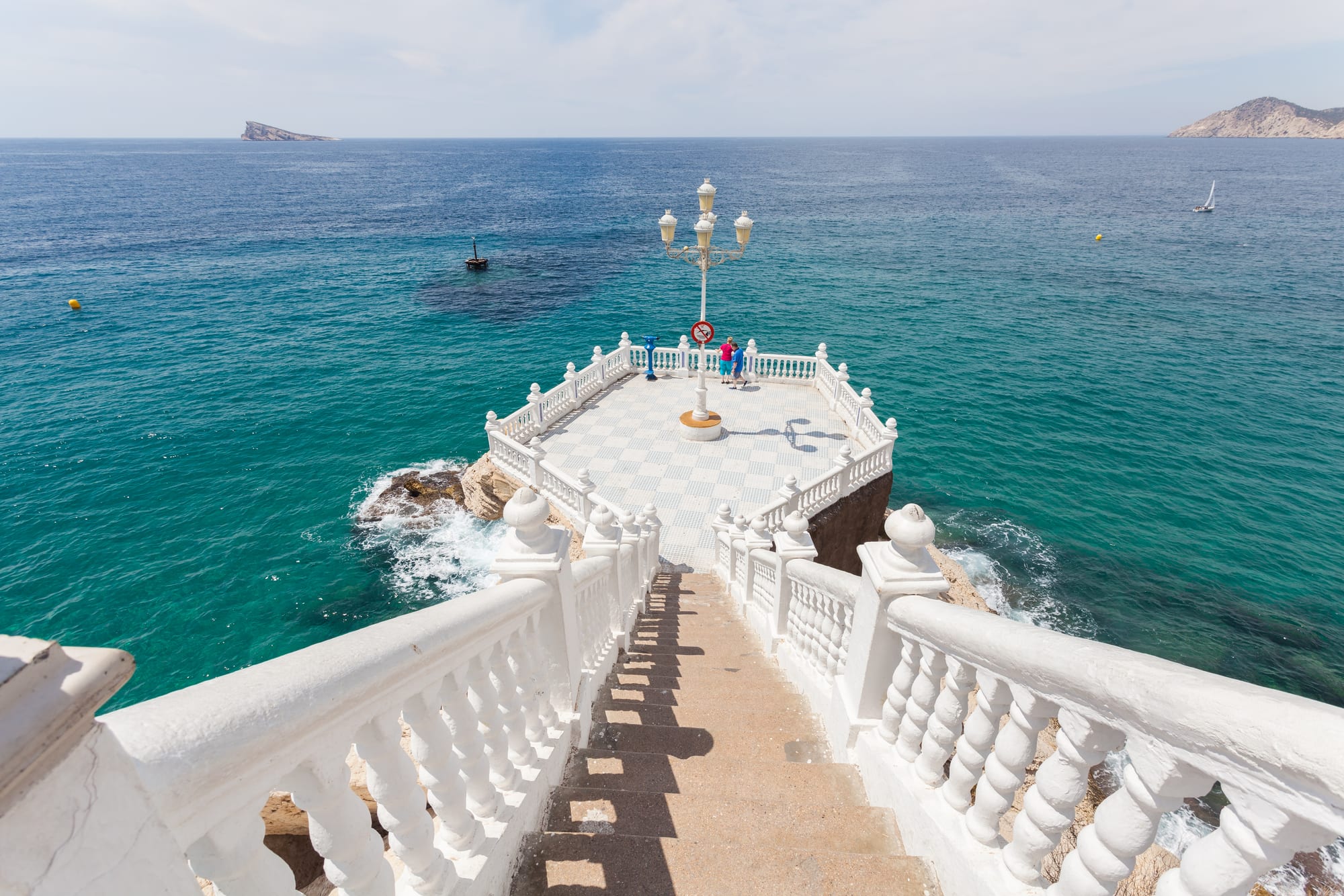
White balustraded steps leading down to a tiled viewing platform over turquoise sea, with a rocky island on the horizon

Valencia & Murcia, Spain

Benidorm

The Balcón del Mediterráneo viewpoint on Benidorm's old-town headland, looking out towards Benidorm Island. (Diego Delso / Wikimedia Commons · CC BY-SA 3.0)

A Costa Blanca resort city in Alicante province, built around two long sandy bays divided by the rocky headland of its small old town. Once a village of tuna fishermen, it was planned for tourism from the 1950s and became a byword for the package holiday — now a dense skyline of towers, theme parks and nightlife, busy all year.

Neighbourhoods

  • Old town (El Castell)
    • First-time visitors
    • Best for food
    • Historic district

    The former fishing village on the rocky promontory between the two bays, with the parish church and the Balcón del Mediterráneo viewpoint at its tip. Its lanes hold the best tapas bars in town, and it suits couples and visitors wanting a less frantic stay.

    Open in Maps
  • Levante
    • Beaches
    • Nightlife
    • Close to public transport

    The eastern bay, fronted by Levante beach and crossed by the Avenida del Mediterráneo. Most of the British-style pubs, cabaret bars and clubs are here, busy late into the night.

    Open in Maps
  • Poniente
    • Beaches
    • Families
    • Quiet and residential

    The western bay, a long beach with a promenade and lines of apartment towers behind it, generally calmer than Levante.

    Open in Maps
  • Rincón de Loix
    • Nightlife
    • Theme parks

    The north-eastern end of Levante beach, below the Serra Gelada, with a dense strip of bars and the Aqualandia and Mundomar parks on the edge of town.

    Open in Maps
  • La Cala
    • Beaches
    • Quiet and residential

    The far western end beyond Poniente beach, a quieter area of apartments by the sea.

    Open in Maps

Things to do

The old town and the coast

  • Balcón del Mediterráneoviewpoint

    The white balustraded viewpoint at the tip of the Canfali headland, where a few remains of the old castle walls survive on the rocks, looking out over both bays and the island.

    Open in Maps
  • Church of San Jaime y Santa Analandmark

    The parish church at the top of the old town, built between 1740 and 1780 after the finding of the image of the Virgen del Sufragio, Benidorm's patron.

    Open in Maps
  • Benidorm Islandattraction

    The uninhabited island a few kilometres offshore that forms the centrepiece of every view of the bay, reached by excursion boats from the port.

    Open in Maps
  • Intempolandmark

    The tallest building in the Valencian Community, near Poniente beach, which took the title from an earlier Benidorm skyscraper.

    Open in Maps

Beaches

  • Levante beachbeach

    The busier of the two main beaches, in front of the city's nightlife district; like the other town beaches it has held the blue flag since 1987.

    Open in Maps
  • Poniente beachbeach

    The western beach, backed by a promenade and apartment towers, quieter than Levante.

    Open in Maps
  • Mal Pas beachbeach

    A small beach tucked between the port and the old-town headland, below the Balcón del Mediterráneo.

    Open in Maps

Theme parks

  • Terra Míticaattraction

    A theme park opened in 2000, inland from the city at the foot of the mountains.

    Open in Maps
  • Aqualandiaattraction

    A water park in Rincón de Loix on the Levante side of town, next to Mundomar.

    Open in Maps
  • Mundomarattraction

    A marine animal park beside Aqualandia, on the outskirts of the Levante side.

    Open in Maps

Short trips from the town

  • Serra Geladatrail

    The natural park on the headland north of Benidorm, with a walk of about 3 km that needs no special fitness.

    Open in Maps
  • Alteaattraction

    A neighbouring town on a hill above the sea, along the coastal railway towards Dénia.

    Open in Maps
  • El Castell de Guadalestattraction

    A small hill village in the mountains behind the coast, with the ruins of a medieval castle above the valley, reached by bus from Benidorm.

    Open in Maps
  • Villajoyosaattraction

    The coastal town to the south-west, on the tram line to Alicante.

    Open in Maps
  • Penyal d'Ifacpark

    The natural park around the Rock of Ifac at Calp, further north along the coast.

    Open in Maps

Seasonal events

  • Fiestas Mayores Patronalesfive days from the second weekend of November

    The town's main festival, in honour of the Virgen del Sufragio and St James, with offerings, masses and processions; it is held in November because that was when the tuna fishermen came home.

  • Low FestivalJuly

    An indie music festival held every summer since 2010.

  • Moors and ChristiansOctober

    Parades re-enacting the medieval battles between Moors and Christians.

  • Hogueras de San JuanJune

    Benidorm's own bonfire festival for Saint John's night, alongside its Fallas in March.

Eat and drink

Long-standing places and food districts in Benidorm. Hours, ratings and directions come from your maps app, always current.

Benidorm classics

  • Old town tapas barsneighborhood

    The old town's lanes, around Calle Santo Domingo and the church, hold the town's best tapas bars, serving Spanish food, jamón and local wines from the nearby Jalón valley.

    Open in Maps
  • Levante café-barsneighborhood

    The Levante side is full of British-style pubs and English café-bars serving home-style food to visitors.

    Open in Maps

Food districts

  • Poniente promenadeneighborhood

    Restaurants along the western promenade face the longer, quieter beach.

    Open in Maps

Experience Benidorm

History

There were settlements around Benidorm as far back as 3000 BC, with Punic and Roman remains, but the place grew only under Arab rule. After the Christian conquest of the region in the 13th century, Admiral Bernat de Sarrià gave it a town charter in 1325 to bring in Christian settlers. For centuries the coast suffered raids by Barbary and Ottoman pirates; in 1448 they carried off most of the inhabitants as slaves, and by 1520 the town was deserted.

Resettled, Benidorm recovered in the 17th century, helped by an irrigation system built in 1666. By the 18th century its fishermen were famous across Spain and beyond for tuna caught by the almadraba, the ancient technique of trapping migrating tuna in a maze of nets, and the town became a base for sea captains and shipbuilding. A spa opened in the 19th century, and in 1925 the port was extended and the first hotels were built.

When the fishing industry declined in the early 1950s, the council turned to tourism. In 1954 the young mayor Pedro Zaragoza Orts created a town plan requiring every building to have an area of open leisure land around it, and he encouraged high-rise building so that more people could see the beaches. Package tourism from northern Europe followed, and the village of about 5,000 people in the late 1950s became the high-rise city of today, nicknamed the "New York of the Mediterranean".

Culture & Customs

Benidorm is often called the birthplace of package tourism, and the image of the resort — the towers, the British bars, the cabaret, the long-stay pensioners of winter — has been satirised in television series in Britain, Spain and Belgium. The town's mayor once protested about a Belgian programme's use of its name. The reality is a resort that receives as many Spanish visitors as foreign ones, and one of the most culturally diverse towns in Europe, with a large immigrant population.

Music has long been part of its story. The Benidorm International Song Festival, held every summer from 1959 to 2000, launched the careers of Julio Iglesias and Raphael, and from 2022 to 2025 Benidorm Fest chose Spain's Eurovision entry here. The Low Festival brings indie bands each July, and every 12 July an Orange parade with marching bands has been held since 2005.

The town's own calendar remains: Fallas in March, bonfires for Saint John in June, Moors and Christians in October, and above all the Fiestas Mayores Patronales in November for the Virgen del Sufragio and St James, held then because that was when the tuna fishermen came home. Sport has a place too — the town hosted the world road cycling championships in 1992 and the start of the Vuelta a España in 2011.

Daily Life

About 77,000 people were registered as living in Benidorm in 2025, the most densely populated municipality of its comarca, and the number in town can reach 400,000 in summer. Almost the whole economy depends on tourism — hotels, apartments, bars, restaurants and the parks — and the old fruit farmers and fishermen have largely gone. Benidorm has worked to present itself as a modern destination; in 2018 it was the first city to be certified under Spain's smart tourism standard.

The town is divided between the old town on its headland, the Levante and Poniente districts behind the two beaches, Rincón de Loix and La Cala. Many residents are foreign-born, and many winter visitors from northern Europe stay for weeks or months. Unlike Barcelona and other Spanish destinations, Benidorm has not seen protests against mass tourism.

Daily rhythms split in two: Spanish families keep late meal times in the old town and on Poniente, while Levante runs on visitor hours, with cabaret from about nine and pubs open until three in the morning.

Food

Benidorm's own tradition is the sea. Its fishermen were known across Spain for tuna caught with the almadraba, a maze of nets set across the path of the fish as they migrate along the coast. Today the best place for local food is the old town, where tapas bars serve Spanish dishes, jamón and wines from the nearby Jalón valley.

The rice dishes of the Alicante coast are found here too. Arròs a banda — "rice on the side" — is rice cooked in fish stock, a dish that began with Alicante's fishermen and is usually served with alioli, and fideuà is a seafood dish of the Valencian coast made like paella but with noodles in place of rice. Turrón, the almond nougat eaten at Christmas, comes from Xixona, inland in the same province.

Away from the old town, Levante caters to its visitors: English café-bars serve home-style food, and pubs, mostly in the British style, stay open until three in the morning.

Planning tools

Budget

Benidorm is one of the cheaper beach resorts in Spain, built for package holidays, with a huge choice of apartments and cheap food and drink. Prices rise in July and August; in winter, when many older visitors from northern Europe stay for weeks, long-stay deals are common. Theme-park tickets are the largest extra.

Daily Budget Midrange
USD 130–230 (mid-range hotel, restaurant dinners, a theme-park day, boat trips or tram excursions)
Daily Budget Shoestring
USD 55–95 (apartment or simple room, set lunches and café-bars, buses and tram)

The beaches, the promenades, the old-town viewpoint and the Serra Gelada walk cost nothing.

Best Time to Visit

Benidorm is open all year. Summer is hot and humid, with the beaches and nightlife at their busiest; spring and autumn are warm and less crowded. Winter is mild and sunny enough to draw many long-stay visitors, and the town's own festival fills the old town in November.

Suggested Number of Days

A short break of three or four days covers the town itself. Most visitors come for a week or more of beach, sun and nightlife, and the coastal railway and buses make longer stays easy to vary with trips along the coast and into the hills.

First Visit
3–4 days
With Surroundings
1–2 weeks

Transportation

The centre, the old town and both beaches are walkable, and local buses run along the bays. The TRAM line runs south to Villajoyosa and Alicante, and trains continue north through Altea and Calp to Dénia; the station is about 2 km west of the centre. Regional buses serve the nearby towns and the hill village of Guadalest.

On the tram towards Alicante, sit on the left-hand side for sea views.

Airport & Station Connections

Most visitors fly into Alicante–Elche Airport and continue by shuttle bus, taxi or hire car up the coast. The tram from Alicante takes a little over an hour, and coastal coaches link Benidorm with Alicante and Valencia.

Walkability

Flat and compact: the promenades run the length of both bays, and the old town sits between them, so most of the resort can be covered on foot. The old-town lanes climb steeply to the church and viewpoint, and the theme parks and the station are best reached by bus or taxi.

Safety

Spain is a safe country with low violent crime. Benidorm's beaches are calm and safe for swimming, but pickpocketing happens on busy beaches and in the late-night bar districts, and summer heat and sun are a real risk on the sand.

Watch bags and phones on the beach and in crowded bars, drink water and use sun protection. Check current official travel advice before travelling.

Climate

A hot semi-arid climate with mild winters and hot, sticky summers, under 300 mm of rain a year, falling mostly in mid to late autumn, and more than 3,000 hours of sunshine. The average annual temperature is about 19°C.

Summer
hot and humid — afternoons typically 28–32°C, with nights of 20–24°C
Winter
mild — afternoons average around 17°C and nights around 8°C

Local Customs

Benidorm receives as many foreign tourists as Spanish ones, chiefly from the United Kingdom, and English is spoken almost everywhere in the tourist areas; Spanish and Valencian are the local languages. The old town keeps a more Spanish rhythm of late lunches and later dinners, while the Levante bars serve food from morning to night. Free cabaret acts begin around 9 pm in many bars.

Cover up away from the beach, especially in the church and during the November processions.

Common Payment Methods

The currency is the euro. Cards and contactless payment are widely accepted, and ATMs are plentiful along the main avenues. A little cash is useful for small bars and beach kiosks.