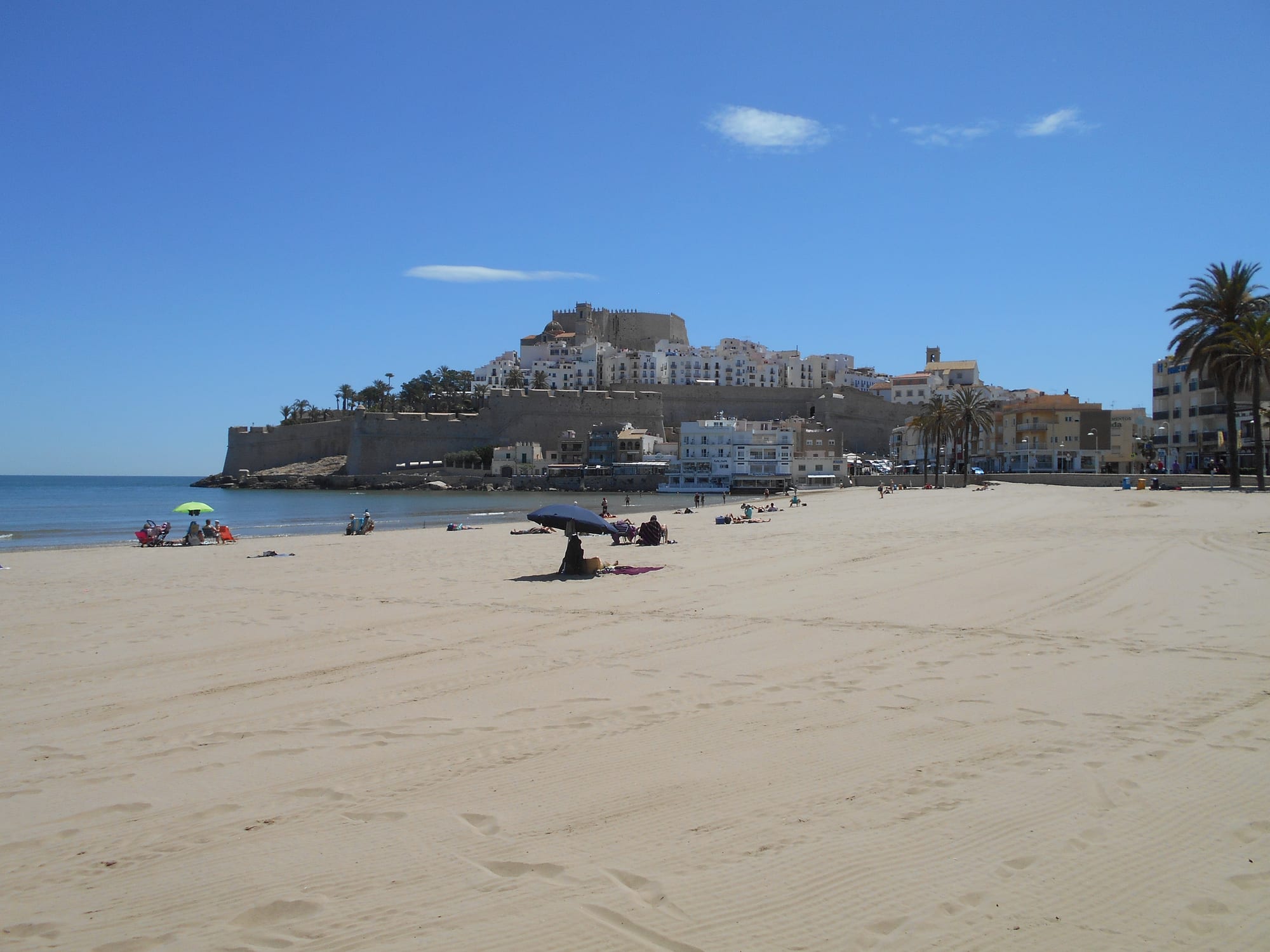
A wide sandy beach leading to a walled rocky headland crowded with white houses and topped by a stone castle

Valencia & Murcia, Spain

Peñíscola

Peñíscola's walled old town and castle seen from the North Beach. (Simon Burchell / Wikimedia Commons · CC BY-SA 4.0)

A walled town on a rocky headland joined to the mainland by a narrow strip of land, on the Costa del Azahar in the north of Castellón province. A Templar castle crowns the rock, home in the early 15th century to the antipope Benedict XIII, Papa Luna. Long beaches on either side have made it a busy summer resort.

Neighbourhoods

  • The old town
    • First-time visitors
    • Historic district

    The casco antiguo on the rock itself, enclosed by 16th-century walls and climbing in steep lanes of whitewashed houses to the castle at the top. It holds the parish church, the sea museum and the gates, and is crowded on summer afternoons and quiet in winter.

    Open in Maps
  • Platja Nord and the seafront
    • Beaches
    • Families

    The long North Beach runs for about five kilometres from the foot of the old town, backed by a promenade and the apartment blocks and hotels of the resort along Avinguda del Papa Luna. This is where most visitors stay in summer.

    Open in Maps
  • Platja Sud and the port
    • Views of the castle
    • Seafood

    On the south side of the headland a smaller beach with a promenade looks straight up at the castle, beside the fishing port completed in 1922. Beyond it the coast rises towards the hills of the Serra d'Irta.

    Open in Maps

Things to do

Famous landmarks

  • Peñíscola Castlelandmark

    The castle of Papa Luna, built by the Knights Templar between 1294 and 1307 on the highest point of the rock, later held by the Order of Montesa and turned into a papal residence and library by Benedict XIII.

    Open in Maps
  • The Renaissance wallslandmark

    The bastions and gates designed by the Italian military architect Giovanni Battista Antonelli for Philip II and built between 1576 and 1578, which still ring the old town.

    Open in Maps
  • Portal de Sant Perelandmark

    The sea gate ordered by Papa Luna in 1414, bearing his coat of arms in stone, through which boats once landed at the foot of the walls.

    Open in Maps
  • Church of Santa Marialandmark

    The parish church beside the town hall, founded in the 13th century on the site of a mosque and renovated in Gothic style in the 15th century, which keeps objects that belonged to Papa Luna and his successor.

    Open in Maps
  • El Bufadorattraction

    A cleft in the rock of the old town through which the sea 'breathes', throwing up spray on stormy days.

    Open in Maps

Museums

  • Museu de la Marmuseum

    A small museum of the sea in the old town, covering fishing and navigation since ancient times, with model ships and aquariums of Mediterranean marine life.

    Open in Maps

Beaches and the coast

  • Platja Nordbeach

    The town's main beach, about five kilometres of sand running north from the old town, lined by a promenade.

    Open in Maps
  • Platja Sudbeach

    The smaller beach south of the headland, with a promenade and a close view of the castle.

    Open in Maps
  • Serra d'Irtapark

    A coastal range of low mountains just south of the town, protected as a natural park and marine reserve, with walking and mountain-biking trails, the Badum watchtower above the cliffs and the hermitage of Sant Antoni.

    Open in Maps

Short trips from the town

  • Benicarlóattraction

    The neighbouring town to the north, with the railway station shared with Peñíscola.

    Open in Maps
  • Vinaròsattraction

    The capital of the Baix Maestrat, a fishing harbour and resort town near the border with Catalonia.

    Open in Maps
  • Morellaattraction

    An ancient walled city on a hilltop inland, the capital of the Els Ports district, known for its bakeries and its sweet flaons.

    Open in Maps

Seasonal events

  • Sant AntoniJanuary

    The feast of Saint Anthony the Abbot, kept on 17 January.

  • International Jazz FestivalJuly

    A summer jazz festival that has brought performers such as Diana Krall, George Benson, Wynton Marsalis and Pat Metheny to the town.

  • Castle Classical Theatre FestivalJuly and August

    Classical theatre performed at the castle through the height of summer.

  • International Festival of Ancient and Baroque MusicAugust

    Concerts of early and baroque music, held since 1996 and opened with a show of fireworks set to music.

  • Festes de la Mare de Déu de l'ErmitanaSeptember

    The patronal festival of the Virgin of the Ermitana, whose main days bring Les Danses, the traditional dances, along with human towers, fireworks and a Moors and Christians parade.

Eat and drink

Long-standing places and food districts in Peñíscola. Hours, ratings and directions come from your maps app, always current.

Peñíscola classics

  • Old town rice and seafood restaurantsneighborhood

    Restaurants in the lanes of the old town and below its walls serving the seafood of the local fishing fleet and the rice dishes of the Valencian coast.

    Open in Maps
  • Seafront restaurants on Avinguda del Papa Lunaneighborhood

    Terraces facing the North Beach along the main seafront avenue, many specialising in paella, arròs a banda and fideuà.

    Open in Maps

Markets

  • Monday street marketmarket

    The weekly mercadillo on Carrer del Mestre Bayarri, selling fresh local produce and other goods.

    Open in Maps

Experience Peñíscola

History

The rocky headland has been settled since the Iberians, and its name descends from the Latin peninsula. Phoenicians, Greeks and Carthaginians all held it in turn — local legend makes it the place where Hamilcar Barca had his son Hannibal swear never to be a friend of Rome — and Arab geographers later described Banáskula as an impregnable castle by the sea, with farms, plentiful water and salt pans. In 1251 James I of Aragon granted the town a charter under the laws of Valencia and handed Muslim property to Christian settlers.

The Knights Templar built the present castle between 1294 and 1307; after the order was suppressed, the Knights of Montesa held it. Its great moment came during the Western Schism. Pedro Martínez de Luna, the Avignon pope Benedict XIII, known as Papa Luna, withdrew here in the 1410s after losing support elsewhere, made the castle a papal palace and library, and stayed until his death in 1423; his successor, Clement VIII, was the second pope of Peñíscola.

Philip II had new walls built between 1576 and 1578 to designs by Giovanni Battista Antonelli. The town gained the title of city in 1707, and in February 1812 Napoleon's general Suchet captured it and expelled its people to the Serra d'Irta. A proper fishing port was finally finished in 1922. After the Civil War, which did great damage here, tourism grew, given a decisive push by two films shot in the town: Berlanga's comedy Calabuch in 1956 and Anthony Mann's El Cid, for which the castle was restored and new walls added.

Culture & Customs

Peñíscola calls itself the City in the Sea, and its identity is bound up with the rock, the castle and the figure of Papa Luna, whose name is attached to the castle, the main seafront avenue and the sea gate he built in 1414. Valencian and Spanish are both in everyday use, and the town's official name is given in both languages.

The film industry has long found its way here. El Cid used the town and castle to stand in for medieval Valencia, and more recently scenes of the series Game of Thrones and of the Spanish series El Ministerio del Tiempo were filmed at the castle and on the Irta coast. Summer brings a busy cultural calendar: a classical theatre festival at the castle in July and August, an international jazz festival in July, and in August a festival of ancient and baroque music, opened with fireworks set to music. At the end of the year a medieval market fills the walled town.

The year's great celebration is the festival of the town's patron, the Virgin of the Ermitana, whose image is kept in a hermitage beside the castle. Its main days in September bring Les Danses, a cycle of music, dances and public rituals, and the last weekend adds parades of Moors and Christians. Local societies keep these traditions going, among them a town band named after the Ermitana and associations for the dances and the Moors and Christians.

Daily Life

The municipality had about 8,800 inhabitants in 2025, but in summer the number of people in town rises to more than 150,000, and the two seasons feel like different places. In July and August the North Beach promenade is busy until late, apartments are full and traffic queues along the seafront; in winter many businesses close and the old town is left largely to its residents.

Tourism is the main source of work, alongside the fishing port, whose completion in 1922 was long demanded by fishermen after many deaths in storms at sea. Most of the town's growth has been along the beaches on either side of the rock rather than within the walls. The neighbouring towns of Benicarló and Vinaròs, a short bus ride away, provide the railway station.

The municipality also includes one of the least developed stretches of the Valencian coast, the Serra d'Irta, protected as a natural park. Balancing growth against it is a standing local debate: the town has acknowledged conflicts between tourism and the environment and has been creating new green spaces for residents and visitors.

Food

Peñíscola's cooking rests on its fishing tradition and the vegetable gardens of the plain behind it. Rice dishes come first, in their seafood forms: paella, the Valencian rice dish named after the wide, shallow pan in which it is cooked over an open fire; arròs a banda, rice cooked in fish stock and usually served with alioli, a dish that began with fishermen who sold their best catch and kept the rest for stock; and fideuà, which is made like a seafood paella but with pasta noodles instead of rice and is seasoned mainly with lemon.

The town's own specialities include all i pebre made with monkfish or with small octopus, known locally as polpet; suquet de peix, the fish stew also called remescló; and paelleta. Shellfish are prominent — mussels, langoustines and snails known as caragol punxent — and the traditional stew of the area is the olleta.

The restaurants of the old town and of the seafront along Avinguda del Papa Luna serve most of these, often on terraces looking at the castle. Inland, the mountain town of Morella is known for its bakeries and its sweet flaons, and the Monday market on Carrer del Mestre Bayarri sells local produce.

Planning tools

Budget

Peñíscola is a resort priced like the rest of the Valencian coast: cheap out of season and much dearer in July and August, when the town's population multiplies many times over and seafront rooms and apartments fill up. Eating rice and seafood at lunchtime rather than dinner keeps costs down.

Daily Budget Midrange
USD 140–240 (mid-range seafront hotel, rice and seafood dinners, castle ticket, occasional car hire)
Daily Budget Shoestring
USD 60–100 (simple guesthouse or campsite, menú del día lunches, local buses)

Book summer stays well ahead; the old town's lanes, the walls and both beaches cost nothing to enjoy.

Best Time to Visit

May, June and September are warm without the August crowds, and early September brings the patronal festival. July and August are the peak of the beach season and of the jazz, theatre and baroque music festivals. Winter is mild and quiet, and many seafront businesses close.

Suggested Number of Days

A day or two is enough for the old town, the castle and the beaches. Three or four days leave room for walking in the hills south of the town and for trips inland and along the coast, and a beach holiday is often longer.

First Visit
1–2 days
With Surroundings
3–4 days

Transportation

The old town and the seafront are best covered on foot. Frequent local buses link Peñíscola with Benicarló and Vinaròs, and in summer town bus routes run along the resort. A car is useful for the Serra d'Irta trail heads and for inland towns such as Morella.

Parking near the old town is scarce in summer; leave the car further along the seafront and walk.

Airport & Station Connections

The nearest railway station is Benicarló-Peñíscola, about seven kilometres north, where long-distance trains between Valencia and Barcelona and regional trains to Castellón and Tarragona stop; taxis and buses continue to the town. Buses also run from Valencia and Castellón. The nearest airport is Castellón's, with Valencia and Reus airports further away.

Walkability

The old town is small but steep, with stepped lanes and cobbles that are slippery when wet and hard going with a pushchair. The flat promenades along both beaches make for easy walking, and the North Beach promenade runs for several kilometres.

Safety

Spain is a safe country with low violent crime. Peñíscola is a quiet family resort, and the main concerns are petty theft on crowded beaches and in the old town's lanes in summer, the strong summer sun, and the heavy autumn storms that can bring sudden flooding to this coast.

Keep bags close in crowded lanes, stay back from the rocks of the headland in rough seas, and heed flood warnings in autumn storms. Check current official travel advice before travelling.

Climate

Mediterranean, warm and temperate, with an average year-round temperature of about 17°C. Summers are hot and dry, winters mild, and most rain falls in autumn.

Summer
hot — August, the warmest month, averages about 25°C
Winter
mild — January, the coolest month, averages about 10°C

Local Customs

Valencian and Spanish are both spoken, and signs often give both forms of the town's name, Peníscola and Peñíscola. Meals follow the Spanish rhythm, with lunch from around 2pm and dinner late; rice dishes such as paella are traditionally eaten at lunchtime.

Dress modestly in the church and hermitages, and expect the festival nights of September to run very late.

Common Payment Methods

The currency is the euro. Cards and contactless payments are accepted almost everywhere, including small bars; a little cash is useful at the Monday market and small kiosks. ATMs are easy to find.