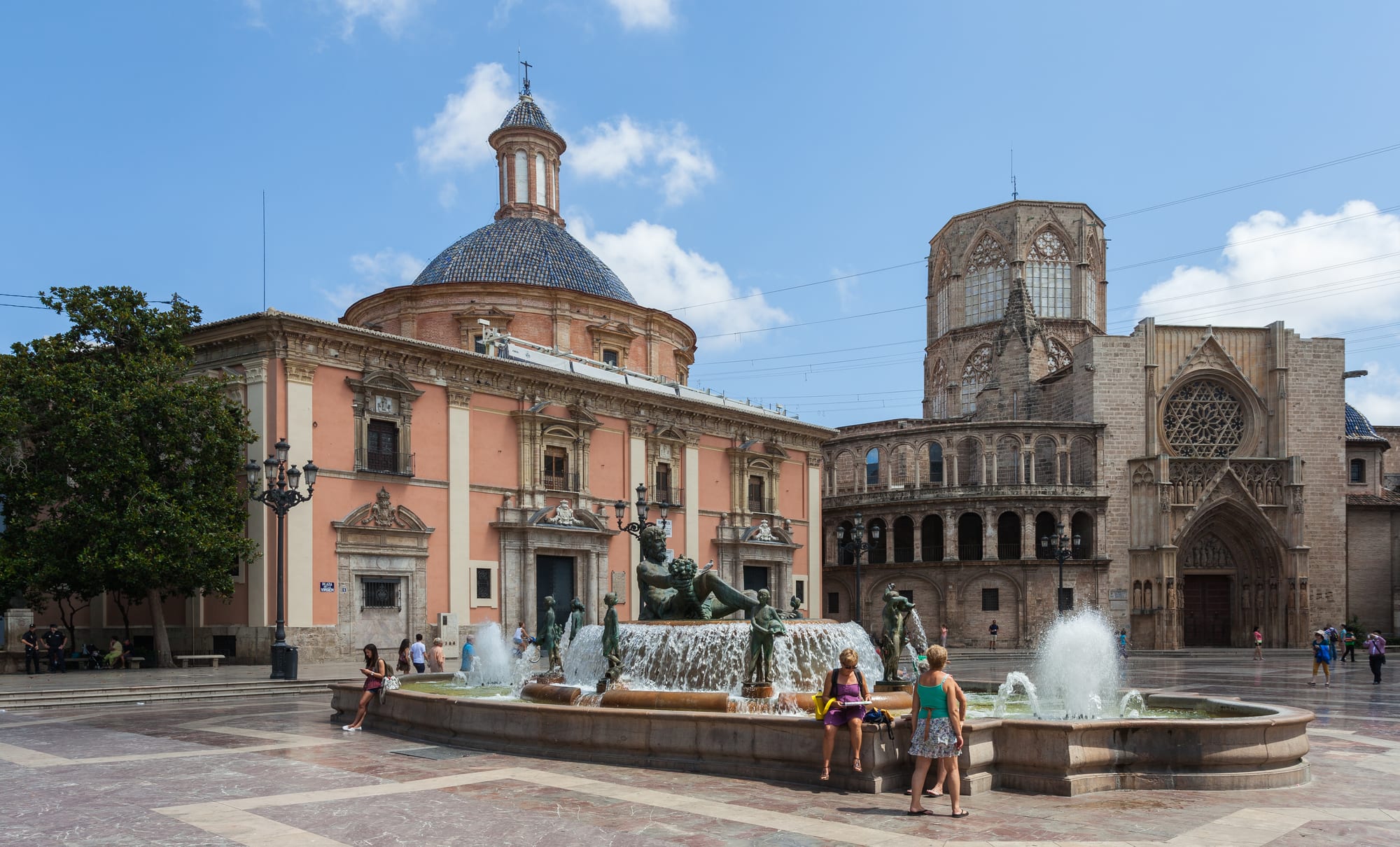
A fountain in a paved square between a pink domed basilica and the Gothic stone front and octagonal tower of Valencia Cathedral

Valencia & Murcia, Spain

Valencia

The Plaza de la Virgen, with the Basilica of Our Lady of the Forsaken and the cathedral, in Valencia's old city. (Diego Delso / Wikimedia Commons · CC BY-SA 3.0)

Spain's third-largest city, on the Turia river and the Mediterranean, capital of the Valencian Community. Founded by Rome in 138 BC and rich on silk and trade in its 15th-century golden age, it is now a port and university city of Gothic monuments, Calatrava's City of Arts and Sciences, a riverbed turned park, city beaches and the Falles.

Neighbourhoods

  • Ciutat Vella (the old city)
    • First-time visitors
    • Historic district
    • Close to public transport

    One of the largest historic centres in Spain, inside the line of the old walls: the cathedral and its squares, the Silk Exchange and the Central Market, the Serranos and Quart gates and a maze of lanes between them. Most of the main sights are within walking distance.

    Open in Maps
  • El Carmen (El Carme)
    • Nightlife
    • Street art
    • Historic district

    The north-western corner of the old city, with winding streets whose buildings go back to Roman and Arab times. It is full of outdoor cafés, small shops and bars, and its walls are covered in street art.

    Open in Maps
  • Ruzafa (Russafa)
    • Best for food
    • Nightlife
    • Local life

    A district just south of the centre that began as a Moorish pleasure garden in the 9th century and grew into a farming village. Today it is a dense grid of cafés, restaurants and galleries around its covered market, and it is one of the city's great Falles districts each March.

    Open in Maps
  • El Cabanyal and Malvarrosa
    • Beaches
    • Local life

    The old fishermen's quarter by the sea, with low, tile-fronted houses, and the city beaches beyond it. A palm-lined promenade of about 4 km runs along the Arenas, Cabanyal and Malvarrosa beaches, lined with restaurants.

    Open in Maps
  • City of Arts and Sciences and Quatre Carreres
    • Architecture
    • Families

    The south-eastern end of the Turia Garden, dominated by Santiago Calatrava's white museum, opera house and cinema complex and the aquarium beside it, with newer residential districts around.

    Open in Maps

Things to do

Famous landmarks

  • Valencia Cathedrallandmark

    Begun in 1262 on the site of the mosque, mainly Valencian Gothic with Romanesque and Baroque parts; its bell tower, El Miguelete, is 63 m high, and it holds a chalice some believe to be the Holy Grail.

    Open in Maps
  • Lonja de la Sedalandmark

    The late Valencian Gothic Silk Exchange of the city's 15th-century golden age, built between 1482 and 1533 and a UNESCO World Heritage Site since 1996.

    Open in Maps
  • Torres de Serranoslandmark

    A medieval gate of the old city wall, built between 1392 and 1398, one of the two surviving gates of the walls that once surrounded Valencia.

    Open in Maps
  • Torres de Quartlandmark

    The 15th-century western gate of the medieval walls, the other surviving gate besides the Serranos towers.

    Open in Maps
  • Water Tribunalattraction

    A court dating from Moorish times that settles disputes over irrigation water, meeting at noon every Thursday outside the cathedral's Apostles' Door.

    Open in Maps

Museums

  • Museu de Belles Arts de Valènciamuseum

    The city's fine arts museum, with paintings mostly from the 14th to the 17th centuries, including works by Velázquez, El Greco and Goya.

    Open in Maps
  • Institut Valencià d'Art Modernmuseum

    IVAM, the modern art museum on the edge of El Carmen, with permanent collections and temporary exhibitions of contemporary art and photography.

    Open in Maps
  • National Museum of Ceramicsmuseum

    Ceramics and decorative arts in the Palace of the Marqués de Dos Aguas, a palace in the old city.

    Open in Maps

The Turia Garden and the City of Arts and Sciences

  • Turia Gardenpark

    The old bed of the Turia, emptied after the flood of 1957 and turned into a long park of paths, playgrounds, sports fields and fountains running through the city under its old bridges.

    Open in Maps
  • City of Arts and Sciencesattraction

    Calatrava and Félix Candela's complex at the end of the Turia Garden: an opera house, a science museum shaped like a whale's skeleton and an IMAX cinema among pools.

    Open in Maps
  • L'Oceanogràficattraction

    Described as the largest aquarium in Europe, with Mediterranean, polar and reef areas, sharks, belugas, penguins and sea lions.

    Open in Maps
  • Bioparc Valenciaattraction

    A zoo at the western end of the Turia Garden.

    Open in Maps

Markets

  • Mercado Centralmarket

    A Valencian Art Nouveau market hall near the Silk Exchange, one of the largest in Europe, packed with fish, meat, fruit and vegetable stalls.

    Open in Maps
  • Mercado de Colónmarket

    The other great Art Nouveau market of the early 20th century, a public market in the city centre.

    Open in Maps

Beaches and sport

  • Malvarrosa and the Passeig Marítimbeach

    Wide sandy city beaches north of the port, backed by a palm-lined promenade and reached by metro and tram.

    Open in Maps
  • Mestalla Stadiumattraction

    The home of Valencia CF, six times Spanish champions, with room for about 49,000 fans.

    Open in Maps

Short trips from the city

  • Albufera de Valènciapark

    A freshwater lagoon about 11 km south of the city, partly within the municipality, ringed by rice paddies and protected as a natural park since 1986.

    Open in Maps
  • El Palmarattraction

    A village within the municipality on the edge of the Albufera, among the lagoon's rice paddies.

    Open in Maps
  • Saguntoattraction

    The town north of Valencia whose siege by Hannibal set off the Second Punic War.

    Open in Maps

Seasonal events

  • Falles15–19 March, with daily mascletàes from 1 March

    Satirical figures are raised in the streets, firecracker displays shake the Plaça de l'Ajuntament every afternoon, and the falles are burned on the night of 19 March, St Joseph's Day — UNESCO intangible heritage since 2016.

  • Semana Santa MarineraHoly Week, March or April

    The Holy Week of the seaside districts, with processions through the old fishermen's quarters, declared a festival of national tourist interest.

  • Valencian Community motorcycle Grand PrixNovember

    Usually the last race of the MotoGP season, at the Circuit Ricardo Tormo in the nearby town of Cheste.

Eat and drink

Long-standing places and food districts in Valencia. Hours, ratings and directions come from your maps app, always current.

Valencia classics

  • Mercado Centralmarket

    The great Art Nouveau market, where Valencians buy rice, fish, vegetables and the beans for paella, with bars among the stalls.

    Open in Maps
  • Horchata at Pataconaneighborhood

    The beach just north of Malvarrosa belongs to Alboraia, a major producer of the tiger nuts used in horchata, and is a good place to drink it with fartons.

    Open in Maps

Food districts and markets

  • Ruzafaneighborhood

    The densest cluster of cafés and restaurants in the city, around the Mercat de Russafa.

    Open in Maps
  • El Carmenneighborhood

    Outdoor cafés and bars along the winding lanes of the old city's north-western quarter.

    Open in Maps
  • Mercado de Colónmarket

    A public market in the city centre and one of the main works of Valencian Art Nouveau.

    Open in Maps
  • Beach restaurants of Malvarrosaneighborhood

    Restaurants along the palm-lined promenade serve rice dishes facing the sea.

    Open in Maps

Experience Valencia

History

Valencia was founded as a Roman colony, Valentia Edetanorum, in 138 BC, on the alluvial plain of the Turia a few kilometres from the sea; its name means "valour", for the veteran soldiers settled there. After the Visigoths, the city surrendered to the Moors around 714. Under Islamic rule new irrigation and crops arrived, and in the 11th century it became the head of an independent taifa. El Cid took it by force in 1094 and held it until his death; on 28 September 1238 it surrendered to James I of Aragon and became the capital of the Kingdom of Valencia.

The 15th century was the Valencian Golden Age. Trade with Italy and the Mediterranean made it the most populous city of the Crown of Aragon, silk-making flourished, and the Serranos and Quart gates, the Miguelete tower and the Silk Exchange were built. Decline followed: Barbary piracy, the shift of trade to the Atlantic, and the expulsion of the Moriscos in 1609. After backing the losing side in the War of the Spanish Succession, the kingdom lost its own laws in 1707, though silk weaving and ceramic tiles revived the 18th-century economy.

The walls came down from 1865, oranges enriched the surrounding farmland, and Art Nouveau markets and the North Station went up in the early 20th century. Valencia was the seat of the Republican government from November 1936 to October 1937 and was bombed hundreds of times. After a flood in October 1957 killed 81 people, the Turia was diverted south of the city and its old bed became a park. Since 1982 the city has been capital of the Valencian Community; the City of Arts and Sciences, the America's Cup races of 2007 and the titles of World Design Capital 2022 and European Green Capital 2024 followed.

Culture & Customs

Valencia's great festival is the Falles. From 1 March firecracker displays called mascletàes shake the city hall square every afternoon, and from 15 to 19 March neighbourhood groups raise huge satirical figures of famous people and topical subjects, competing for prizes. On the night of 19 March, St Joseph's Day, nearly all of them are burned in the cremà. The tradition grew from carpenters burning waste wood on the saint's feast and is now listed by UNESCO as intangible heritage. The seaside districts hold their own Holy Week, the Semana Santa Marinera.

The city is bilingual. Valencian and Spanish are both official, and Valencian — banned in schools under Franco — is now taught to every child, though a 2019 survey found three-quarters of residents use only Spanish in daily life. The question of the language and of the city's name, València, remains political. Older institutions survive: the Water Tribunal has met outside the cathedral since Moorish times, and an international contest for wind bands has been held every year since 1886.

Valencia is known for its ceramics and traditional dress, for Calatrava's architecture, and for football: Valencia CF play at Mestalla, and Levante UD are the city's other club. A lively nightlife keeps bars and beach clubs open well past midnight.

Daily Life

About 824,000 people lived in the city in 2025, making it the third-largest in Spain, and the urban area beyond its limits holds about 1.6 million. The economy is overwhelmingly service-based, with tourism, trade, education and conventions; the port is the biggest on the western Mediterranean coast and handles a fifth of the country's exports, and Ford builds cars at nearby Almussafes. The surrounding huerta, the irrigated market gardens and citrus groves, still reaches the edge of the city.

The city is divided into districts from the old city and the 19th-century Eixample to the seaside Poblats Marítims and a ring of small villages within the municipality, including El Palmar and El Saler by the lagoon. The foreign-born population grew quickly in the 2000s, and in 2022 Valencia was voted the world's top destination for expatriates.

The floods of October 2024, which devastated towns in the Valencia area, left a deep mark on the region; the regional president resigned in November 2025 amid criticism of the response. Daily life follows the Spanish pattern of late lunches and later dinners, with weekends at the beach or in the Turia Garden.

Food

Paella was born in Valencia. Paella valenciana, which Valencians insist is the only true paella, is made with Valencian rice, olive oil, rabbit, chicken or duck, sometimes snails, saffron, tomato, flat green beans and lima beans, cooked in a wide pan. Other rice dishes are as local: arròs a banda, rice cooked in fish stock and usually served with alioli; arròs negre, coloured black with squid ink and made with cuttlefish or squid; and fideuà, a seafood dish like paella but made with noodles instead of rice. Esgarraet, a salad of roasted red pepper torn into strips with salt cod, garlic and olive oil, is a typical tapa.

Valencia is also the home of horchata — orxata de xufa — a cold, sweet drink of soaked and ground tiger nuts, which arrived in Iberia under Muslim rule. It is drunk with fartons, long, spongy, sugar-glazed pastries from the neighbouring town of Alboraia, made for dipping. Bunyols, fritters, are another local sweet. Agua de Valencia, a cocktail of cava, orange juice, vodka and gin, was first mixed in a city bar in 1959.

The Mercado Central is the place to see the raw ingredients, and Ruzafa, El Carmen and the beach promenade are where much of the city eats out.

Planning tools

Budget

Valencia is good value for a large Spanish city and cheaper than Barcelona or Madrid. Rooms are the main cost, and hotel prices rise sharply during the Falles in March. A tourist card covering public transport, including the airport metro, and free or reduced entry to museums is sold at the tourist offices.

Daily Budget Midrange
USD 140–250 (mid-range hotel, paella lunches and restaurant dinners, museum tickets, taxis)
Daily Budget Shoestring
USD 55–100 (hostel bed, set lunches and market food, metro and bike share)

Book well ahead for the Falles; the Turia Garden, the beaches, the markets and the old city's streets cost nothing.

Best Time to Visit

Spring and autumn are the most comfortable. March brings the Falles, the city's great festival, but also crowds and high prices. July and August are hot and busy on the beaches; autumn is the rainiest season, and heavy storms can bring flash floods. Winters are among the mildest in Europe.

Suggested Number of Days

Most first visits take three or four days, as the city has a large historic centre, many museums and its own beaches. Allow five or six days to include the countryside and coast around it, and more during the Falles, when the festival itself takes up much of the time.

First Visit
3–4 days
With Surroundings
5–6 days

Transportation

Metrovalencia runs metro and tram lines linking the centre with the airport, the beaches and the suburbs. Buses cover the rest, and Valenbisi bike share stations are spread across the city; the Turia Garden makes a car-free route right across town. Taxis are plentiful.

Buy a rechargeable multi-trip card at a metro machine.

Airport & Station Connections

Valencia Airport is at Manises, 9 km west of the centre; metro lines 3 and 5 reach the city in about 20 minutes. High-speed trains to Madrid and Alicante use Joaquín Sorolla station, beside the Art Nouveau Estació del Nord, the main terminus. Long-distance buses use the city's bus station, the Estació d'Autobusos.

Walkability

The old city is compact, flat and best seen on foot, and much of it is pedestrianised. The Turia Garden gives a long, shaded walking and cycling route from the old city to the City of Arts and Sciences. The beaches are a few kilometres east, an easy metro, tram or bike ride.

Safety

Spain is a safe country with low violent crime. Pickpockets work the old city, busy beaches and the crowds of the Falles, when fireworks and street bonfires also go off at close range. Autumn storms can bring sudden, deadly flooding, as in October 2024, when floods killed about 240 people in eastern Spain, many of them in the Valencia area; the Turia's diversion channel largely protected the city proper.

Keep a safe distance from bonfires and firecrackers during the Falles, and heed flood warnings in heavy rain. Check current official travel advice before travelling.

Climate

A semi-arid climate bordering on Mediterranean, with an average annual temperature of about 18.6°C and around 2,700 hours of sunshine a year. Winters are very mild and summers hot and dry; most rain falls in autumn, sometimes in violent storms.

Summer
hot and dry — July and August days typically reach 28–32°C, with nights of about 21–24°C
Winter
mild — January days typically reach 15–20°C, with nights of 6–10°C; snow is almost unknown

Local Customs

Valencian and Spanish are both official; most people in the city use Spanish day to day, but street signs are in Valencian, and the city's official name is València. Paella is a lunchtime dish, and many Valencians hold strong opinions about what goes in it. During the Falles, whole neighbourhoods take part through their falla associations, and the streets stay loud day and night.

Dress modestly when visiting the cathedral and churches, and expect noise late into the night during the Falles.

Common Payment Methods

The currency is the euro. Cards and contactless payment are accepted almost everywhere, including on the metro ticket machines, and ATMs are common. A little cash is useful at market stalls and small bars.