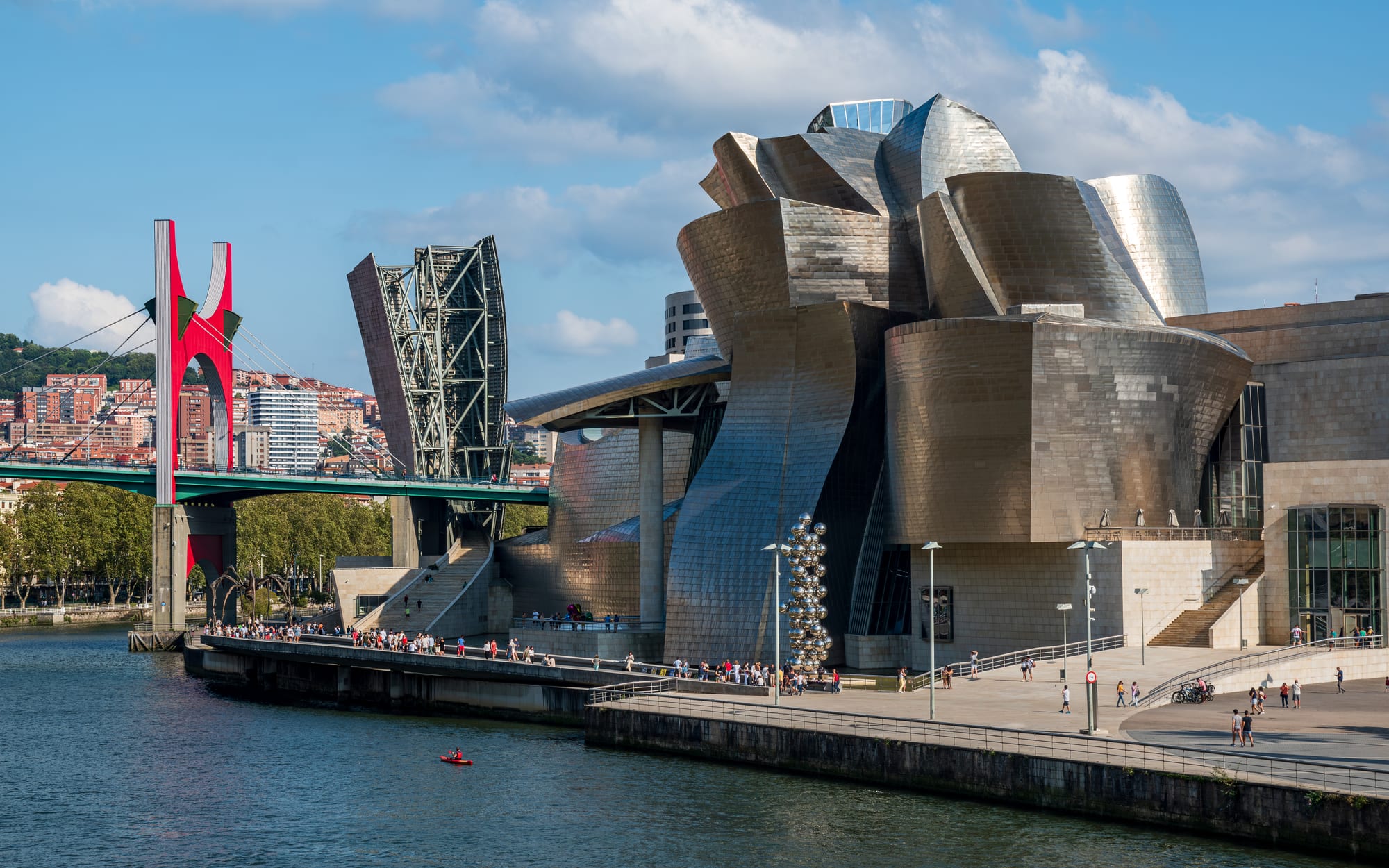
The curving titanium-clad Guggenheim Museum beside the river, with a riverside walkway, a red-arched bridge and hillside flats behind

The Basque Country, Navarre & La Rioja, Spain

Bilbao

The Guggenheim Museum Bilbao on the estuary of the Nervión, with the La Salve bridge and its red arch. (José Ligero Loarte / Wikimedia Commons · CC BY-SA 4.0)

The largest city of the Basque Country, set in a hollow of green hills along the estuary of the Nervión, about 16 kilometres from the Bay of Biscay. A medieval trading port that grew rich on iron, steel, shipbuilding and banking, it fell into industrial crisis in the 1980s and was remade from 1997 around Frank Gehry's Guggenheim Museum, new bridges, a metro and riverside parks.

Neighbourhoods

  • Casco Viejo
    • First-time visitors
    • Historic district
    • Best for food

    The medieval Seven Streets on the right bank of the estuary, with the cathedral, the arcaded Plaza Nueva, the Ribera market and dense rows of pintxo bars, taverns and small shops.

    Open in Maps
  • Abando
    • Shopping
    • Close to public transport
    • Architecture

    The 19th-century Ensanche on the left bank, laid out after Bilbao annexed the town of Abando in 1876. The Gran Vía crosses it past the provincial government palace and the banks, and the main railway stations are here.

    Open in Maps
  • Indautxu
    • Quiet and residential
    • Parks
    • Museums

    A relatively affluent quarter of Abando around the Doña Casilda Iturrizar Park, home to the Fine Arts Museum, private clinics and a large Jesuit school.

    Open in Maps
  • Abandoibarra and the riverside
    • Architecture
    • Museums
    • Riverside walks

    Former docks and shipyards along the left bank, rebuilt since the 1990s with the Guggenheim Museum, the Iberdrola Tower, the Euskalduna conference centre and a long riverside walkway linking the main sights.

    Open in Maps
  • Bilbao La Vieja
    • Nightlife
    • Local life

    The old settlement on the left bank opposite the Casco Viejo, the oldest neighbourhood of the city, older even than the Casco Viejo, now being redeveloped, with new shops and a growing immigrant population.

    Open in Maps
  • Deusto
    • Students
    • Quiet and residential

    A district on the right bank of the estuary below Mount Artxanda, a separate town until 1925, home to the University of Deusto and linked to Abandoibarra by the Deusto bridge.

    Open in Maps

Things to do

Famous landmarks

  • Guggenheim Museum Bilbaomuseum

    Frank Gehry's titanium-clad museum of modern and contemporary art, opened in October 1997 on former docks beside the Nervión, whose success turned the city into a major destination.

    Open in Maps
  • Plaza Nuevalandmark

    An arcaded neoclassical square in the Casco Viejo, completed in 1851, lined with old taverns and bars and home to a Sunday flea market.

    Open in Maps
  • Bilbao Cathedrallandmark

    The Gothic church of Saint James, built in the 14th and 15th centuries and one of the oldest buildings in the city, a stop for pilgrims on the northern Camino de Santiago.

    Open in Maps
  • Teatro Arriagalandmark

    The neo-Baroque opera house on the river, built in 1890 and twice rebuilt after a fire and a flood, named after the Bilbao composer Juan Crisóstomo de Arriaga.

    Open in Maps
  • Basilica of Begoñalandmark

    The basilica in the Begoña district dedicated to Our Lady of Begoña, patron of Biscay.

    Open in Maps
  • Zubizurilandmark

    Santiago Calatrava's curving white footbridge across the estuary, opened in 1997.

    Open in Maps
  • Azkuna Zentroaattraction

    A 1909 wine warehouse redesigned by Philippe Starck as a cultural and leisure centre, with a cinema, library, gym and restaurant inside.

    Open in Maps

Museums

  • Bilbao Fine Arts Museummuseum

    One of the largest Spanish museums outside Madrid, in the Doña Casilda park, with Basque, Spanish and European art from the Middle Ages to the present, including El Greco and Goya.

    Open in Maps
  • Basque Museummuseum

    The museum of Basque archaeology, ethnography and history, opened in 1921 in the Baroque cloister of an old Jesuit college in the Casco Viejo.

    Open in Maps
  • Itsasmuseum Bilbaomuseum

    The maritime museum on the site of the former Euskalduna shipyard, beside the Euskalduna bridge, with the old dry docks and the restored Carola crane outside.

    Open in Maps

Parks and viewpoints

  • Doña Casilda Iturrizar Parkpark

    An English-style park begun in 1907, known locally as the Ducks' Park for its pond, with a fountain ringed by a pergola and century-old trees.

    Open in Maps
  • Artxanda Funicularviewpoint

    A funicular from the centre up Mount Artxanda, where a park and terrace give a panoramic view over the city.

    Open in Maps
  • Etxebarria Parkpark

    A sloping park built in the 1980s on the site of a steel mill, whose chimney was kept, with views over the Casco Viejo; stairs from Plaza Unamuno climb to it from the old town.

    Open in Maps

Markets

  • Mercado de la Riberamarket

    A covered market of 10,000 square metres on the riverbank beside the Casco Viejo, described as the largest covered market in Europe, selling mostly fresh produce.

    Open in Maps

Sport and nights out

  • San Mamés Stadiumattraction

    Athletic Club's stadium of more than 53,000 seats, opened in 2013.

    Open in Maps

Short trips from the city

  • Vizcaya Bridgelandmark

    The world's first transporter bridge, built in 1890–1893 across the mouth of the Nervión between Portugalete and Getxo, a UNESCO World Heritage Site.

    Open in Maps
  • Getxoattraction

    An affluent suburb at the mouth of the estuary, reached by metro, with Las Arenas, the Vizcaya Bridge and beaches.

    Open in Maps
  • Gaztelugatxelandmark

    An islet on the Biscay coast near Bermeo, joined to the mainland by a footbridge and topped by the hermitage of San Juan de Gaztelugatxe.

    Open in Maps
  • Gernikaattraction

    The Biscayan town bombed by German and Italian aircraft on 26 April 1937, the attack that inspired Picasso's painting Guernica.

    Open in Maps

Seasonal events

  • Aste NagusiaAugust, nine days from the first Saturday after 15 August

    The city's Great Week, held since 1978, with concerts, a nightly international fireworks competition and the festive tents of the konpartsak; its symbol is the figure of Marijaia.

  • Bilbao BBK LiveJuly

    A rock and pop festival held every year since 2006 on a purpose-built site on the slopes of Mount Cobetas.

  • Our Lady of Begoña11 October

    The feast of the patron of Biscay, celebrated at the Basilica of Begoña.

Eat and drink

Long-standing places and food districts in Bilbao. Hours, ratings and directions come from your maps app, always current.

Bilbao classics

  • Plaza Nueva barsneighborhood

    The arcades of the square hold some of the oldest and most traditional taverns and restaurants in the city, with pintxos laid out along the counters.

    Open in Maps
  • Casco Viejo pintxo streetsneighborhood

    The Seven Streets have the greatest concentration of bars and restaurants serving Biscayan dishes, pintxos and txakoli, busiest on Friday and Saturday nights.

    Open in Maps

Markets

  • Mercado de la Riberamarket

    The great riverside market, where fish, meat and produce are sold in the mornings.

    Open in Maps
  • Plaza Nueva Sunday marketmarket

    A traditional Sunday market in the square, selling old books, coins, stamps, birds and flowers.

    Open in Maps

Experience Bilbao

History

Bilbao was founded by charter on 15 June 1300 by Diego López V de Haro, Lord of Biscay, on the right bank of the Nervión. A second charter in 1310 forced the trade route from Castile to the sea through the town, and in 1372 it became a free port with privileges in the iron trade. The first three streets, Somera, Artecalle and Tendería, grew into the walled Seven Streets, and the port exported wool and Biscayan iron across Europe. The Consulate of the Sea, created in 1511, made it one of the kingdom's chief ports, and in 1602 it became the capital of Biscay.

In the 19th century Bilbao was a liberal stronghold, besieged by the Carlists in 1835, 1836 and 1874 without falling. Iron mining, steelworks, shipyards and banks — the Bank of Bilbao was founded in 1857 — made it the centre of the second most industrialised region of Spain, and its population rose from 11,000 in 1880 to 80,000 in 1900. The city annexed Abando and built a new grid around the Gran Vía, and Basque nationalism grew up here under Sabino Arana.

In the Civil War the city was bombed and fell to Franco's forces in June 1937. After the war the demand for housing outstripped supply, workers built slums on the hillsides, and ETA was founded in 1959. The industrial crisis of the 1980s and the flood of August 1983 hit hard, but from the 1990s Bilbao rebuilt itself on services: the metro in 1995, the Guggenheim Museum in 1997 and the regeneration of the old docks, recognised with the Lee Kuan Yew World City Prize in 2010.

Culture & Customs

Bilbao's transformation is part of its culture. Since the Guggenheim opened in 1997, the so-called Guggenheim effect has become a byword for regeneration through architecture, and UNESCO named the city a City of Design in 2014. Alongside Gehry's museum stand works by Calatrava, Foster, Starck and Pelli, while the Fine Arts Museum, the Basque Museum and the Arriaga Theatre keep the older city's culture alive.

Basque identity is strong but worn lightly. Spanish is the main language and Basque the second: about 29 per cent of residents consider themselves fluent in Basque, and more than half of Basque speakers are under 30. Athletic Club, founded in the 1890s and one of the most successful clubs in Spanish football, has fielded only players born in or closely linked to the Basque region since 1911, and the new San Mamés stadium, opened in 2013, seats more than 53,000. Basque pelota is played at the Bizkaia Frontoia, and hiking on the surrounding hills, such as Mount Pagasarri, has been a weekend habit since the 1870s.

The year's peak is Aste Nagusia, the Great Week in August, with concerts, a nightly fireworks competition and the festive tents of the konpartsak, under the symbol of Marijaia, a plump figure with raised arms. The txoko, a private gastronomic society where members cook for one another, is a popular institution, and the city has given Spain the musicians of Mocedades and Fito & Fitipaldis.

Daily Life

About 347,000 people lived in Bilbao in 2024, and the metropolitan area along the estuary has about 1.04 million, close to half the population of the Basque Country. The city is divided into eight districts and 34 neighbourhoods, many of them former villages annexed as it grew, from Begoña and Deusto on the right bank to Abando and Basurto on the left. About 16 per cent of residents were born abroad, the largest groups coming from Colombia and Morocco.

The economy has moved from steel and shipbuilding to services, finance, tourism and business events. The banking group BBVA traces its roots to the Bank of Bilbao, the electricity company Iberdrola has its headquarters here, and the port, moved downstream to Santurtzi, is among the five largest in Spain. Tourism grew from about 25,000 visitors in 1995 to more than 932,000 in 2018, most of them Spanish, with the French the largest foreign group.

Daily life centres on the street and the bar. People meet for a drink and a pintxo after work, shop in the Ensanche, take the metro to the beaches of Getxo and Sopelana in summer, and walk in the hills at weekends. Large projects continue to reshape the city: the Zorrozaurre peninsula is being turned into an island of new homes and offices, and a new underground station for high-speed trains is planned to replace Abando and Concordia.

Food

Bilbao's traditional cooking is built on the sea and the estuary, above all salt cod and eels, and it shares the dishes of Biscay. Bacalao al pil pil is salt cod cooked with olive oil, garlic and guindilla peppers until the sauce emulsifies, and bacalao a la vizcaína is salt cod in Biscayan sauce, made mostly from dried choricero peppers. Many restaurants and bars in Biscay are recognised by the main food guides, and the province has several Michelin-starred restaurants.

Like other Basque cities, Bilbao is known for pintxos: small slices of bread topped with an ingredient or mixture of ingredients, eaten in bars from the counter. Other bar snacks include rabas, fried or battered squid rings served with lemon; Spanish omelette of eggs and potatoes; txampis, stuffed mushrooms; triángulos, Bilbao-style sandwiches; and gildas, small skewers. Friday and Saturday nights are the busiest times for a round of pintxos.

The local drink is txakoli, a white wine usually drunk as an aperitif; Bizkaiko Txakolina, the white wine of Biscay, has its own protected designation of origin. Cider, patxaran, a sloe-flavoured liqueur, and Rioja wine are also widely drunk. The Casco Viejo, with Plaza Nueva at its heart, has the greatest concentration of bars and restaurants, and the Ribera market supplies fish, meat and produce every morning except Sunday.

Planning tools

Budget

Hotel rooms in Bilbao fill up for Aste Nagusia, big concerts and Athletic matches. Eating in pintxo bars keeps costs down, and the metro and tram are good value. The Guggenheim and the other museums are the main sightseeing costs.

Daily Budget Midrange
USD 150–300 (mid-range hotel, museum tickets, sit-down meals, day trips by train or bus)
Daily Budget Shoestring
USD 70–110 (hostel or pension, pintxos and a menú del día, metro and tram)

The riverside walk, the Casco Viejo, the parks and the Ribera market cost nothing; book ahead for August and festival weeks.

Best Time to Visit

May to October is the most reliable period, with a drier spell in July. August brings Aste Nagusia, the city's biggest festival, and early autumn is mild. From October to April rain is frequent, November being the wettest month, but the museums, markets and bars make Bilbao a good winter city break.

Suggested Number of Days

Two or three days cover the city itself. Allow four or five to include the coast and towns of Biscay, which are easy to reach by metro, train and bus; a longer stay suits combining Bilbao with San Sebastián or the Rioja wine country.

First Visit
2–3 days
With Surroundings
4–5 days

Transportation

Public transport is excellent and works on one Barik smart card. The metro, opened in 1995 with stations designed by Norman Foster, runs two lines along both banks of the estuary to the coast, and a third line, run by Euskotren, opened in 2017. A tram follows the river past the Guggenheim and San Mamés, Bilbobus covers the city, Bizkaibus the province, and Euskotren runs trains to San Sebastián, Durango and Bermeo.

Buy a Barik card for the metro, tram, buses and local trains; the city is easy without a car.

Airport & Station Connections

Bilbao Airport, the largest in northern Spain, is at Loiu, 9 kilometres north of the city, with flights across Spain and to many European cities; buses and taxis link it with the centre. Bilbao-Abando is the main railway station, with long-distance trains to Madrid and Barcelona, and Brittany Ferries sail from the port at Santurtzi to Portsmouth in England.

Walkability

The centre is very walkable: the Casco Viejo is compact, and the riverside walkway runs about three kilometres along the left bank linking the old town, the Guggenheim and Abandoibarra. Hills surround the city, so climbs to Begoña, Artxanda or the outer districts are steep, though lifts, stairs and the funicular help.

Safety

Spain is a safe country with low violent crime. Bilbao is generally safe for visitors, and violent crime is rare. The estuary can flood after very heavy rain.

Keep bags and phones close in busy pintxo bars and festival crowds. Check current official travel advice before travelling.

Climate

An oceanic climate, with rain in every season and no dry summer, mild temperatures and low sunshine. The rainiest season is October to April. Snow is rare in the city, though it sometimes covers the surrounding hilltops.

Summer
mild to warm; average highs of 25–26°C in the summer months, with occasional much hotter days
Winter
cool and wet; average lows of 6–7°C, with sleet on about ten days a year

Local Customs

Spanish is the main language of the city and Basque the second, and Basque is widely used as the language of teaching in schools. Bilbaínos call their city the botxo, the hole, for the hills around it. Athletic Club, which fields only players born in or closely linked to the Basque region, is a strong part of local identity.

Pintxos are taken from the bar counter with a drink, and Friday and Saturday nights are the busiest for a round of bars; respect the quiet during services in the cathedral and the basilica.

Common Payment Methods

The currency is the euro. Cards and contactless are accepted almost everywhere, including small bars, and cash machines are easy to find; a little cash is useful for markets and pintxo bars.