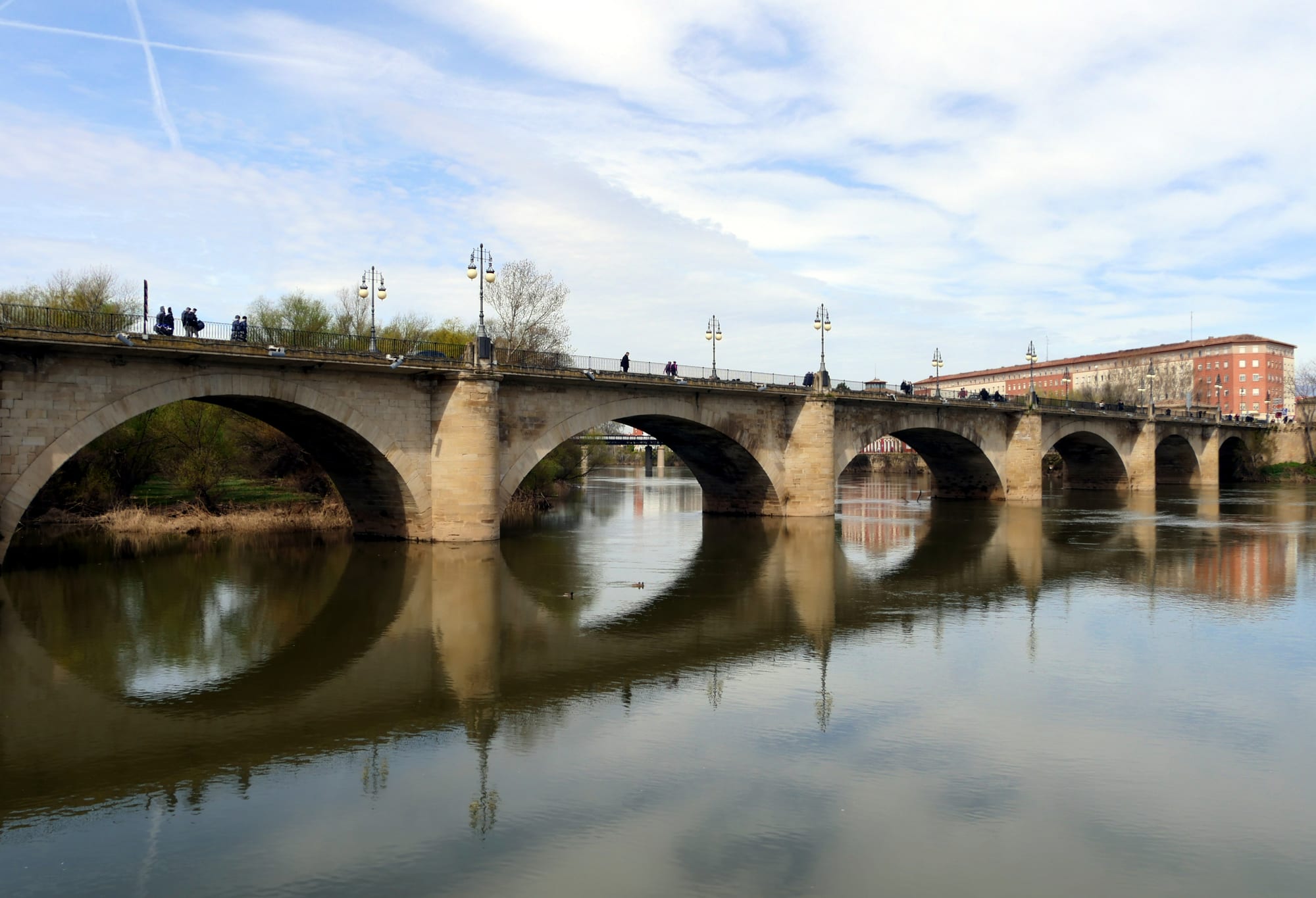
A long stone bridge of wide arches crossing the calm Ebro river, its arches reflected in the water under a pale blue sky

The Basque Country, Navarre & La Rioja, Spain

Logroño

The Puente de Piedra over the Ebro at Logroño, where the Camino de Santiago enters the city. (Jynus / Wikimedia Commons · CC BY-SA 4.0)

The capital of La Rioja, on the south bank of the Ebro where the Camino de Santiago crosses the river — a medieval bridge town given its charter in 1095 and besieged by the French in 1521. Today it is the commercial heart of the Rioja wine country, known for the crowded tapas bars of Calle Laurel and a compact old town of arcaded streets.

Neighbourhoods

  • Casco Antiguo (Old Town)
    • First-time visitors
    • Historic district
    • Best for food

    The old town between the Ebro and the Espolón, home to the co-cathedral, the churches of San Bartolomé and Santiago, the Revellín gate and the Camino's route through the city. Calle Portales, its arcaded main street, is where people stroll and sit out on terraces, and Calle Laurel's tapas bars are a few steps away.

    Open in Maps
  • Centro and the Espolón
    • Shopping
    • Close to public transport

    The commercial and financial centre that grew after the walls came down, around the Paseo del Príncipe de Vergara — the Espolón — with the statue of General Espartero, shops, banks and the city's main squares.

    Open in Maps
  • Calle Mayor and Calle San Juan
    • Nightlife
    • Bars

    Calle Marqués de San Nicolás, known as Calle Mayor, is a restored old-town street near the Plaza del Mercado, where nights out begin, while Calle San Juan, a short walk away, has its own cluster of tapas bars, usually less crowded than Calle Laurel.

    Open in Maps
  • Riverside and the Ebro parks
    • Parks
    • Quiet and residential

    The banks of the Ebro, with the long Parque del Ebro and the newer Parque de la Ribera, crossed by the stone and iron bridges — the green side of the city, used for walking, running and cycling.

    Open in Maps

Things to do

Churches and the old town

  • Co-Cathedral of Santa María de la Redondalandmark

    The co-cathedral on the Plaza del Mercado, named after the round church that once stood here, with two elaborately decorated towers where storks nest.

    Open in Maps
  • Church of San Bartolomélandmark

    The oldest church in Logroño, begun in the 12th century, with a Gothic arched portal whose sculptures tell the life of Saint Bartholomew; it stands on the Way of St James.

    Open in Maps

Sport

  • Estadio Las Gaunasattraction

    The municipal football stadium, opened in 2002, home ground of UD Logroñés and the women's team EDF Logroño.

    Open in Maps

Short trips: wine country and the Camino

  • Navarreteattraction

    A historic town on the French Way between Logroño and Nájera, the only pottery centre still working in La Rioja.

    Open in Maps
  • Laguardiaattraction

    A walled hilltop town in Rioja Alavesa, across the Ebro in the Basque Country, with five old gates and a medieval street plan, living largely from wine.

    Open in Maps
  • San Millán de la Cogollalandmark

    A small village famous for its twin monasteries of Suso and Yuso, declared a World Heritage Site in 1997.

    Open in Maps
  • Haroattraction

    The wine town of Rioja Alta, home of the Viticulture and Enology Station founded in 1892 and a cluster of historic wineries.

    Open in Maps
  • Santo Domingo de la Calzadaattraction

    A Camino town on the Oja named after its founder, who built a bridge and a pilgrims' hostel here; its cathedral always keeps a live cock and hen, in memory of a legendary miracle.

    Open in Maps

Seasonal events

  • San Bernabé11 June

    The city's vow day, remembering its resistance to the siege of 1521; the Fish Brotherhood hands out fried fish, often trout, with bread and wine — said to be all the town had to eat during the siege.

  • San Mateo and the grape harvest festivallate September

    Logroño's main fiesta, coinciding with the harvest, when the first grape must is offered to the Virgin of Valvanera on the Espolón.

Eat and drink

Long-standing places and food districts in Logroño. Hours, ratings and directions come from your maps app, always current.

Tapas streets

  • Calle Laurelneighborhood

    Together with Travesía del Laurel, Calle San Agustín and Calle Albornoz, more than fifty bars serving pinchos — many specialise in a single one, such as mushrooms with garlic butter and a prawn on toasted bread.

    Open in Maps
  • Calle San Juanneighborhood

    About 300 metres away, another thirty bars with their own specialities, usually less crowded than the Laurel.

    Open in Maps

Markets and wine

  • Mercado de San Blasmarket

    The city's covered food market, the Plaza de Abastos, on Calle Sagasta.

    Open in Maps
  • Rioja wine barsneighborhood

    Bars around Calle San Agustín and the Laurel pour Rioja by the glass, from young wines to aged reservas.

    Open in Maps

Experience Logroño

History

The Romans had a river port called Vareia here, founded near an older town of the Berones, but medieval Logroño grew up as a crossing of the Ebro. It was a small village belonging to the monastery of San Millán de la Cogolla until 1095, when Alfonso VI of León granted it a charter, or fuero, to populate this strategic border spot; the charter already mentions the fortified stone bridge over the river, and it became the model for many other charters in the region. The Camino de Santiago brought pilgrims, crafts and trade through the town.

In May and June of 1521 French and Navarrese troops besieged Logroño. The town held out, and the victory is still remembered every 11 June, the feast of San Bernabé; the Revellín gate in the walls was begun the following year. In 1609 and 1610 Logroño was the main seat of the Basque witch trials held by the Spanish Inquisition. Wine was already central to the town's life: in 1635 the mayor banned carts from the streets near the wine cellars in case their vibrations spoiled the wine.

The walls were later removed and the city spread beyond them, though it only passed 30,000 inhabitants in the 1930s. During the Civil War many people were killed in the repression, including workers from the city's tobacco factory, a building that now houses the Parliament of La Rioja. The creation of La Rioja as an autonomous community made Logroño a regional capital, and the city grew into the commercial centre of the wine country.

Culture & Customs

Logroño's culture revolves around wine and the street. The two great fiestas are tied to its history and its vineyards: San Bernabé on 11 June, when the Fish Brotherhood hands out fried fish, bread and wine in memory of the siege of 1521, and San Mateo in late September, at harvest time, when the first grape must is offered to the Virgin of Valvanera on the Espolón.

The Camino de Santiago runs straight through the old town, entering by the stone bridge and continuing past the churches of Santiago and San Bartolomé, and pilgrims with backpacks and scallop shells are part of the everyday scene. The co-cathedral of Santa María de la Redonda dominates the Plaza del Mercado, and the Fountain of the Illustrious Riojans portrays eight famous Riojans in life-size bronze.

Social life is lived outdoors and in bars. Calle Laurel, nicknamed the path of the elephants, and Calle San Juan are where friends meet for pinchos and wine; Calle Portales is the place for a stroll and a terrace; and the Plaza del Mercado is where nights out begin. The city's identity is Riojan rather than Basque or Navarrese, though the Basque wine towns of Rioja Alavesa are just across the river.

Daily Life

About 152,000 people lived in Logroño in 2025, and more than 200,000 in the metropolitan area. It is the shopping and financial capital of La Rioja, and its economy is heavily reliant on wine — the Rioja designation — alongside the manufacture of wood, metal and textile products and the services of a regional capital, including the University of La Rioja.

Most people live in the flats of the districts that spread south of the old town after the walls came down, and the city is easy to cross on foot or by bus. Varea, the village on the site of the Roman port, is part of the municipality.

The rhythm of the day is Spanish and social: the evening brings the paseo along Calle Portales and the Espolón, followed by a round of tapas bars. The river parks are busy with walkers, runners and cyclists, and in autumn the conversation turns to the harvest across the vineyards that surround the city.

Food

Logroño is best known for its tapas streets. Calle Laurel, with Travesía del Laurel, Calle San Agustín and Calle Albornoz, has more than fifty bars, and nearby Calle San Juan another thirty. Many traditional bars serve only one speciality, as a pincho — a single serving — or a media ración, a half portion: one is known for mushrooms with garlic butter and a prawn on toasted bread. All of it is washed down with Rioja by the glass.

The local table is hearty. Patatas a la riojana, Rioja-style potatoes, are stewed with chorizo and peppers in a sauce thickened by their own starch, sometimes with bay leaves, paprika or mushrooms, and go with a glass of red. On San Bernabé the Fish Brotherhood hands out fried fish, often trout, with bread and wine. The Mercado de San Blas on Calle Sagasta is the covered market for local produce.

Wine is the city's pride. Rioja is divided into three zones — Rioja Alta, Rioja Oriental and Rioja Alavesa across the Ebro in the Basque Country — and is graded by ageing. Several wineries can be visited on the edge of the city, and many more in the wine towns of the valley.

Planning tools

Budget

Logroño is good value — cheaper than San Sebastián or Bilbao for beds and meals — and a practical base for the wine country. Tapas and a glass of Rioja make an inexpensive evening; winery visits and a hire car add the most to the bill.

Daily Budget Midrange
USD 140–260 (mid-range hotel, tapas evenings and a restaurant dinner, winery tours, a hire car)
Daily Budget Shoestring
USD 60–95 (hostel, pilgrim hostel or pension, pinchos and a menú del día, city buses)

Stay in Logroño rather than the smaller wine towns for cheaper beds and an easy evening on the tapas streets.

Best Time to Visit

Spring and autumn are the most comfortable seasons. Late September brings the San Mateo fiesta and the grape harvest, the best time for wine country. Summer days can be hot, and winters are cool and grey, with frosts on some nights.

Suggested Number of Days

One or two days are enough for the city and its tapas streets. Allow three or four to visit wineries, the walled wine towns and the monasteries of the Rioja valleys, which need a car or a tour.

First Visit
1–2 days
With Surroundings
3–4 days

Transportation

The city is compact and walkable, and eleven city bus lines cover the rest, with night buses at weekends. Trains run to Zaragoza, Bilbao, Madrid and Barcelona, and long-distance buses link the city with Madrid, Barcelona and the Basque cities. The wineries and wine towns are best reached by car or on an organised tour.

Taxis pick up at ranks or by phone; for winery visits, plan a designated driver or a tour.

Airport & Station Connections

Logroño–Agoncillo Airport, about 14.5 km from the centre near Recajo, has a few domestic flights, including to Madrid, and no public transport; most visitors arrive by train or bus from Madrid, Bilbao, Zaragoza or Pamplona, or walking the Camino de Santiago.

Walkability

Very good. The old town, the Espolón, the tapas streets and the river parks are flat and within a few minutes of each other, and the stone bridge over the Ebro carries the Camino on foot into the city.

Safety

Spain is a safe country with low violent crime. Logroño is a quiet, orderly city; the main things to watch are pickpockets in crowded tapas bars on weekend nights and drink-driving on the roads to the wineries.

Keep phones and wallets secure in packed bars and arrange a sober driver or a tour for winery visits. Check current official travel advice before travelling.

Climate

A transitional climate between the oceanic north and the drier Mediterranean, shaped by the Ebro valley. The average annual temperature is about 14°C, and rainfall is low — around 400 mm a year, spread fairly evenly through the seasons.

Summer
warm to hot; in a particularly hot summer, daytime highs can exceptionally pass 38°C
Winter
cool, with occasional cold spells that can drop below −5°C

Local Customs

Going out for pinchos is the city's social ritual: many bars on Calle Laurel serve one speciality, and people order it with a glass of wine and move on. Calle Portales is the place for the evening stroll, and the Plaza del Mercado for the start of a night out. Pilgrims walking the Camino are a constant presence in the old town.

Dress modestly in churches; in tapas bars, ask for the house speciality and a glass of Rioja rather than a full meal.

Common Payment Methods

The currency is the euro. Cards and contactless are accepted in most bars, shops and restaurants, and ATMs are easy to find; a little cash is handy for small bars and the market.