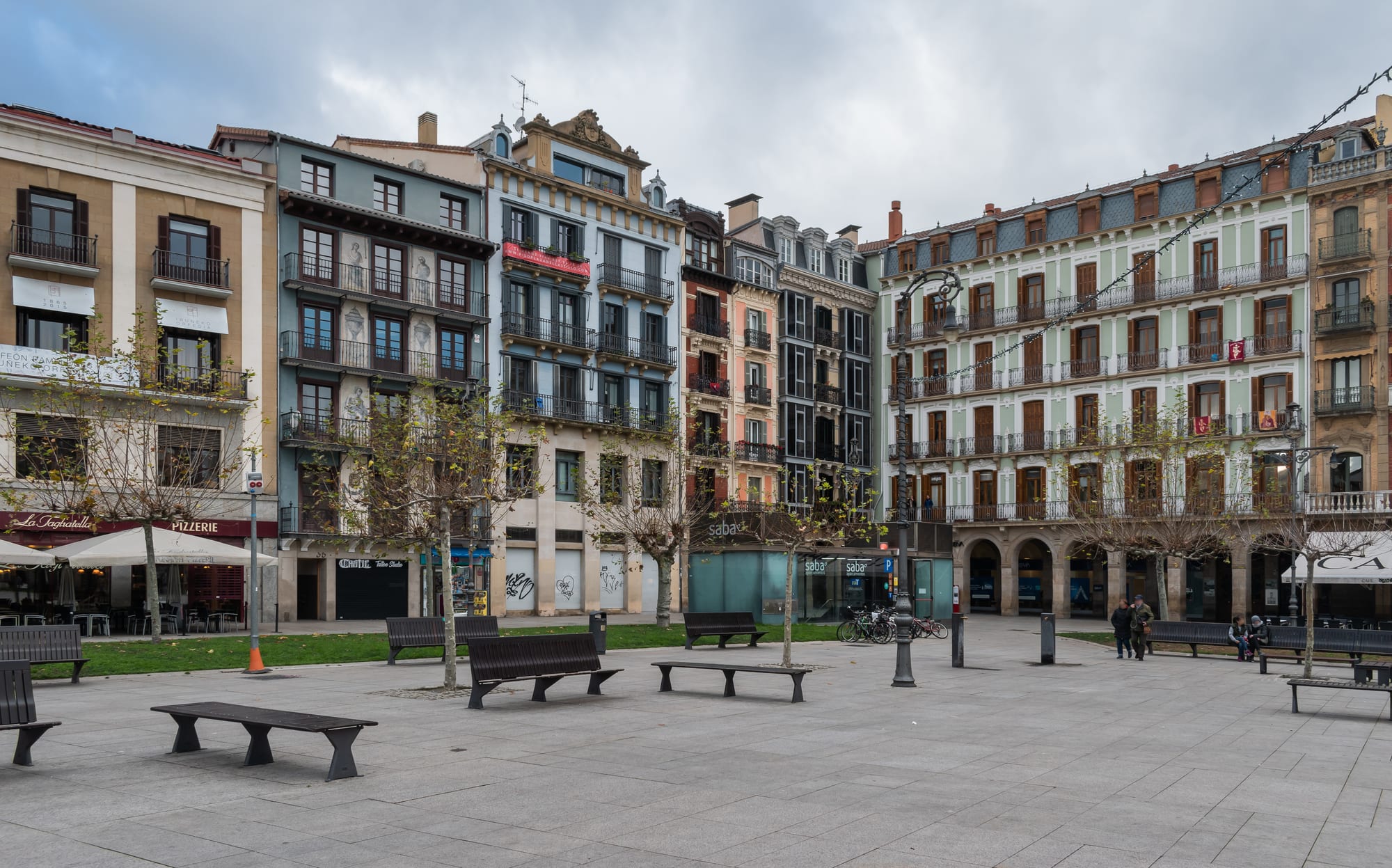
A paved square lined with tall pastel-coloured buildings with balconies and arcades under a cloudy sky, with benches in front

The Basque Country, Navarre & La Rioja, Spain

Pamplona

Buildings with glazed balconies around the Plaza del Castillo, the main square of Pamplona's old town. (Krzysztof Golik / Wikimedia Commons · CC BY-SA 4.0)

The capital of Navarre, on the Arga river in a basin below the western Pyrenees — a Roman foundation that became the seat of a kingdom, a stop on the Way of St James and, for centuries, a walled fortress-city. Today Pamplona-Iruña is a university and car-making city known worldwide for the San Fermín festival and its morning bull runs.

Neighbourhoods

  • Casco Antiguo (Old Town)
    • First-time visitors
    • Historic district
    • Nightlife

    The walled old town of three medieval boroughs — Navarrería, San Cernin and San Nicolás — joined into one city in 1423. The cathedral, the City Hall square, the Plaza del Castillo and the streets of the encierro are all here, along with most of the bars.

    Open in Maps
  • San Nicolás
    • Best for food
    • Bars

    The old borough around the fortified church of San Nicolás, on the southern side of the old town. Calle San Nicolás and the streets around it are lined with pintxo bars, taverns and small restaurants.

    Open in Maps
  • Ensanches
    • Shopping
    • Close to public transport
    • Architecture

    The 'widenings' built outside the old walls: the small First Ensanche and, after the southern walls came down in 1915, the larger grid of the Second Ensanche, with its shops, cafés and offices running towards the citadel park.

    Open in Maps
  • San Juan and Iturrama
    • Quiet and residential
    • Parks

    Districts of flats built in the 1960s and 1970s west and south of the centre, close to the citadel, the University of Navarra campus and Yamaguchi park with its small Japanese garden.

    Open in Maps
  • Rochapea and Txantrea
    • Local life
    • River walks

    Neighbourhoods north of the old town across the Arga, grown after the Civil War and, in Rochapea's case, largely renewed since. The river parks along the Arga are the main draw for visitors.

    Open in Maps

Things to do

Famous landmarks

  • Pamplona Cathedrallandmark

    The Gothic cathedral of Saint Mary, built in the 15th century over earlier churches, with a celebrated cloister behind a Neoclassical façade and the diocesan museum of religious art inside.

    Open in Maps
  • City Hall Squarelandmark

    The square in front of the City Hall, where the chupinazo opens San Fermín on 6 July and the bulls run past each morning of the festival.

    Open in Maps
  • Church of San Nicoláslandmark

    A 12th-century church built also as a fortress during the feuds between the boroughs, with a watchtower, a Gothic interior and a Baroque organ.

    Open in Maps
  • Plaza de Toroslandmark

    The bullring at the end of the encierro route, where the runners and the six bulls arrive each morning during San Fermín.

    Open in Maps

Walls, parks and the citadel

  • Citadel of Pamplonapark

    A pentagonal Renaissance star fort of the 16th and 17th centuries, now a park of lawns, bastions and modern sculptures beside the city centre.

    Open in Maps
  • University of Navarra campuspark

    The large green campus of the university founded in 1952, counted among the city's main parks.

    Open in Maps

Museums

  • Museum of Navarremuseum

    The art museum of Navarre, in a 16th-century former hospital on the Cuesta de Santo Domingo in the old town, with collections running from prehistory to the 20th century.

    Open in Maps

Sport

  • El Sadar Stadiumattraction

    The ground of CA Osasuna, the only Navarrese club to have played in Spain's top division, built in 1967 and holding about 23,500 people.

    Open in Maps

Short trips from the city

  • Puente la Reinaattraction

    A town on the Way of St James between Pamplona and Estella, the first after the French Way and the Aragonese Way meet, named after its medieval bridge.

    Open in Maps
  • Royal Palace of Olitelandmark

    The towered castle-palace of the kings of Navarre from the reign of Charles III the Noble, burned in 1813 and restored over 30 years from 1937.

    Open in Maps
  • Roncesvallesattraction

    A small village at about 900 metres in the Pyrenees, a few kilometres from the French border, on the French Way of the Camino.

    Open in Maps

Seasonal events

  • Festival of San Fermín6–14 July

    The city's great festival, opened at noon on 6 July by the chupinazo rocket from the City Hall balcony and closed at midnight on 14 July with the song Pobre de mí, in honour of Saint Fermin, co-patron of Navarre.

  • The encierro (running of the bulls)7–14 July, every morning

    At 8 am each day of the festival, six bulls run through the old-town streets to the bullring, with runners in front of them — the best-known bull run in the world.

Eat and drink

Long-standing places and food districts in Pamplona. Hours, ratings and directions come from your maps app, always current.

Pamplona classics

  • Old-town pintxo barsneighborhood

    Calle San Nicolás, Calle Estafeta and Calle Jarauta are lined with bars and bodegas; pintxos here are small cooked dishes, paid for rather than given free with a drink, and a round of bars is a social event at any hour.

    Open in Maps
  • Café Iruñacafe

    A café on the Plaza del Castillo, the city's main square, in the heart of the old town.

    Open in Maps

Navarrese produce

  • Chistorra and Navarrese sausagesneighborhood

    Chistorra, a thin fast-cured sausage from Navarre made of minced pork or pork and beef with garlic and paprika, is fried and served on bread in bars across the city.

    Open in Maps

Experience Pamplona

History

People lived in the Pamplona basin from the late Bronze Age, but the city's traditional birth is the winter of 75–74 BC, when the Roman general Pompey camped here during the war against Sertorius and gave the place his name, Pompaelo. The local Vascones called it Iruña, "the city". In the centuries after Rome it passed between self-rule, the Visigoths and the Franks, was held for a time by a Muslim garrison, and in 778 had its walls torn down by Charlemagne on his way back from Zaragoza, shortly before his rearguard was destroyed at Roncevaux. The town became the seat of the kingdom of Pamplona, later Navarre.

From the late 11th century the pilgrim traffic on the Way of St James brought trade and settlers from beyond the Pyrenees. Occitan merchants and craftsmen founded two new boroughs, San Cernin and San Nicolás, beside the old Navarrese core of the Navarrería, and the three fought bitterly: San Nicolás was burned in 1258, and the Navarrería was destroyed and its people massacred in 1276. King Charles III finally united them into one city in 1423.

After Castile conquered Navarre in 1512, Pamplona became a frontier fortress. The pentagonal citadel was built and the walls were rebuilt from the 16th century; building outside them was banned, so the city could only grow denser. In 1915 the army allowed the southern walls to be pulled down, and the Second Ensanche spread south. Immigration from rural Navarre and other parts of Spain in the 1960s and 1970s, drawn by new industry, turned the old fortress town into a modern city.

Culture & Customs

San Fermín defines Pamplona to the outside world. From the chupinazo at noon on 6 July to the singing of Pobre de mí at midnight on 14 July, the city dresses in white and red and celebrates Saint Fermin, co-patron of Navarre, with religious ceremonies, music, dances and fireworks. Each morning from 7 July at 8 am six bulls are run through the old-town streets to the bullring, with runners in front of them. Ernest Hemingway's novel The Sun Also Rises, published in 1926, brought the festival literary renown, and its fame and its many foreign visitors owe much to the book.

The rest of the year belongs to the city. Pamplona-Iruña is bilingual in name, and Basque identity is part of public life, though Spanish is the everyday language of most residents. The University of Navarra, founded in 1952 as a corporate work of Opus Dei, and the Public University of Navarre, founded in 1987, are both based in the city. Football means CA Osasuna, which plays at El Sadar, and cycling has a special place: the five-time Tour de France winner Miguel Indurain was born in an outlying area of Pamplona and still lives in the city.

Social life revolves around the old town's bars and squares, the evening round of drinks and pintxos, and walks in the parks along the walls, the citadel and the Arga.

Daily Life

About 208,000 people lived in Pamplona in 2024, and around 21.6 per cent of them were born abroad. The city grew fastest in the 1960s and 1970s, when people came from the Navarrese countryside and from Castile and León and Andalusia; districts such as San Juan, Iturrama and San Jorge date from that time, and Azpilagaña, Mendebaldea and Mendillorri followed in the 1980s and 1990s.

Car-making is a major industry. The city's car plant, bought by SEAT in 1975 and part of the Volkswagen Group since 1994, built more than eight million Polos between 1984 and 2024 and now makes the T-Cross and Taigo, supported by many supplier firms around the city. Pamplona is also the main commercial and services centre of Navarre, and the University of Navarra and its teaching hospital serve students and patients from across Spain.

Daily rhythms follow the Spanish pattern of late lunches and later dinners. The old town fills in the evenings and at weekends, while most families live in the flats of the Ensanches and the newer districts and use the parks — the citadel, Taconera, Yamaguchi and the river banks — for walks and children's play.

Food

Navarre is famous for its vegetables, and Pamplona's restaurants show them off: asparagus from the Navarrese plots, artichokes, piquillo peppers from the south-west of the region around Lodosa, and the vegetable menestra shared with neighbouring La Rioja and Aragon. Lamb is the classic meat — Navarre's lamb has a protected geographical indication — cooked as cochifrito or in a chilindrón sauce.

From the rivers comes trucha a la navarra, trout stuffed with ham, and from the sea bacalao al ajoarriero, salt cod cooked with garlic. Pork goes into the city's own chorizo de Pamplona and into chistorra, a thin fast-cured sausage with garlic and paprika that is fried and served in bars and at fairs. Roncal, a sheep's cheese from the Pyrenean valley of the same name, and Idiazabal are the cheeses to look for.

The pintxo bars of Calle San Nicolás, Calle Estafeta and Calle Jarauta serve small, often elaborate dishes rather than free snacks with a drink. Meals end with patxaran, a sloe-flavoured liqueur that began as a home-made drink of rural Navarre and became popular well beyond it after it was commercialised in the 1950s.

Planning tools

Budget

Pamplona is good value for most of the year, cheaper than San Sebastián or Bilbao for beds and meals. San Fermín changes everything: rooms cost several times their normal rate and are booked months ahead, and many visitors stay in nearby towns or in San Sebastián instead.

Daily Budget Midrange
USD 150–280 (mid-range hotel, sit-down meals, museum tickets, a hire car for day trips) — far more during San Fermín
Daily Budget Shoestring
USD 65–100 (hostel or pension, pintxos and a menú del día, city buses)

For San Fermín, book a bed months ahead or plan to stay elsewhere; outside July the city is relaxed and affordable.

Best Time to Visit

Late spring and early autumn are mild and pleasant for walking the walls and parks. San Fermín, from 6 to 14 July, is the city's great event — crowded, loud, expensive and unforgettable for those who want it, and best avoided by those who do not. Summers are drier and can be hot; winters are cold, with frosts.

Suggested Number of Days

One or two days cover the compact old town and its walls. Three or four allow trips to the Camino towns, the royal palace country to the south and the Pyrenean valleys. During San Fermín most visitors stay for one or more days of the festival itself.

First Visit
1–2 days
With Surroundings
3–4 days

Transportation

The old town and the centre are walkable, and city buses serve the outer neighbourhoods and the university. Pamplona is on the national rail network towards Madrid and Zaragoza, and buses run to San Sebastián in about an hour. A car is the practical way to reach rural Navarre and the Pyrenees.

During San Fermín, streets in the old town close for the encierro and the processions, so allow extra time for any journey.

Airport & Station Connections

Pamplona Airport lies about 6 km from the city, between Noáin and Esquiroz, with flights mainly to Madrid and Barcelona. The larger airports of Bilbao (156 km) and Biarritz in France (115 km) have more international routes. Trains and long-distance buses link the city with Madrid, Zaragoza and the Basque cities.

Walkability

Excellent in the centre. The old town is compact, with narrow streets closed to most traffic, and the Ensanches, the citadel park and the Taconera gardens are a few minutes away. The walls drop steeply to the Arga, so routes down to the river and the northern neighbourhoods involve slopes and steps.

Safety

Spain is a safe country with low violent crime. Pamplona is calm for most of the year. San Fermín brings the main risks: the bull runs cause injuries every year, the crowds and drinking are intense, and pickpockets work the festival.

Watch the encierro from behind the barriers rather than running, keep valuables close in the San Fermín crowds and never leave belongings unattended. Check current official travel advice before travelling.

Climate

A transitional climate between the rainy Atlantic north and drier inland Spain, with an average annual temperature of about 13°C and around 700 mm of rain a year — less than on the Basque coast, but with colder winter nights and warmer summer days.

Summer
warm and fairly dry, especially from mid-July through August; some days pass 39°C
Winter
cold, with frosts; rare cold spells have brought temperatures down to around −15°C

Local Customs

The city is officially Pamplona-Iruña: Spanish is the main language, and Basque, more widely spoken in the north of Navarre, appears on signs and in the festival's names. Pintxos are paid for, not served free with drinks, and going out for a drink and pintxos is a social event rather than a meal at a fixed hour. During San Fermín people dress in white and red.

Dress modestly in the cathedral and churches; respect the barriers and the stewards' instructions along the encierro route.

Common Payment Methods

The currency is the euro. Cards and contactless are widely accepted in bars, shops and restaurants, and ATMs are easy to find; carry some cash during San Fermín, when bars are packed and queues are long.