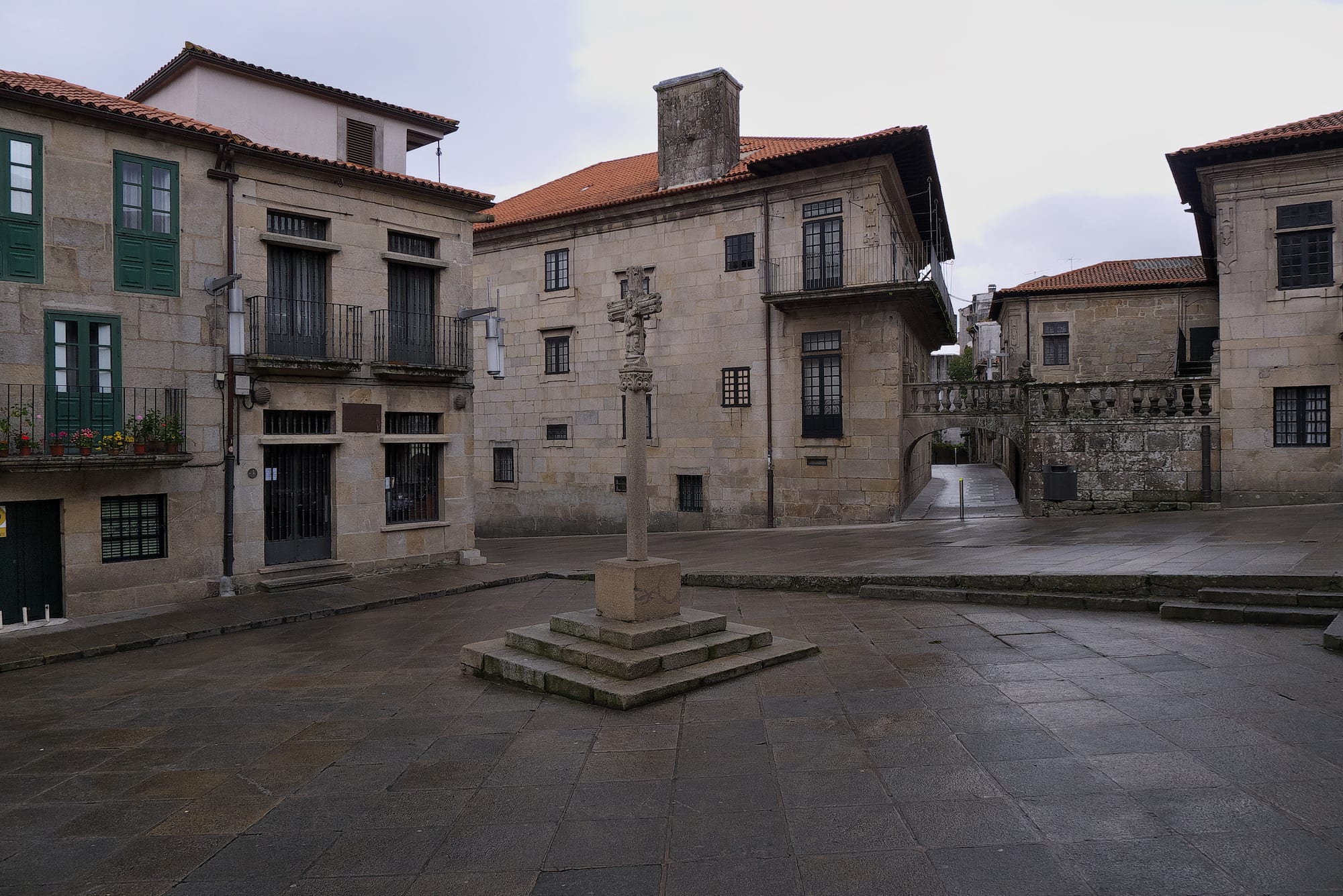
A granite stone cross in the middle of a paved square surrounded by old stone houses with balconies and tiled roofs

Galicia, Spain

Pontevedra

The Praza da Leña, with its stone cross, in the old town of Pontevedra. (José Luis Filpo Cabana / Wikimedia Commons · CC BY 3.0)

A provincial capital at the head of the Ría de Pontevedra, where the Lérez meets the sea in the heart of the Rías Baixas. Galicia's chief port in the 16th century, it declined as the river silted, then revived as an administrative town; since 1999 its granite old quarter of arcaded medieval squares has become one of the most pedestrianised city centres in Spain.

Neighbourhoods

  • Old town
    • Historic district
    • First-time visitors
    • Best for food

    The second-largest historic centre in Galicia after Santiago, almost entirely pedestrian. Small medieval squares named after the trades once carried on in them — firewood, vegetables, the blacksmiths — are linked by granite lanes and lined with arcades, noble houses and tapas bars.

    Open in Maps
  • Peregrina, Praza de España and the Alameda
    • Close to public transport
    • Shopping

    The first expansion of the city outside the walls, also largely pedestrian, where the Pilgrim Virgin church, the town hall and the 19th-century provincial buildings stand around the Alameda park. Shopping streets lead south from here towards the newer districts.

    Open in Maps
  • The Lérez riverbanks
    • Walks
    • Parks
    • Cycling

    Promenades and cycle paths along the river and the ría, crossed by bridges from the medieval Burgo Bridge to modern cable-stayed and arch spans. The Island of Sculptures, the Marismas de Alba park and the Lérez town beach are here.

    Open in Maps
  • O Burgo
    • Quiet and residential
    • The Camino

    The neighbourhood on the north bank across the Burgo Bridge, crossed by the Portuguese Way on its route north, with its own summer feast around 25 July.

    Open in Maps

Things to do

The old town and its squares

  • Church of the Pilgrim Virginlandmark

    The city's symbol, begun in 1778 on a floor plan shaped like a scallop shell, dedicated to the patron of the province and of the Portuguese Way.

    Open in Maps
  • Basilica of Santa María a Maiorlandmark

    A 16th-century Gothic-Renaissance church built by the powerful sailors' guild, with a carved Plateresque façade.

    Open in Maps
  • Convent and church of San Franciscolandmark

    A Gothic Franciscan church overlooking the Praza da Ferrería, holding the tomb of the 13th-century admiral and poet Paio Gómez Chariño.

    Open in Maps
  • Praza da Ferreríalandmark

    The main square of the old town, named after the blacksmiths who worked here in the 15th century, and home to two of the city's oldest cafés.

    Open in Maps
  • Praza da Leñalandmark

    Firewood Square, often called the most typical medieval square in Galicia, with a stone cross at its centre, houses with wooden arcades on two sides and the Baroque houses of the museum on the other.

    Open in Maps
  • Praza da Verduralandmark

    One of the liveliest squares in the old town, whose House of Light recalls that Pontevedra was the first Galician city with electricity and now holds the tourist office.

    Open in Maps
  • Praza de Teucrolandmark

    A square framed by orange trees and noble houses, named after Teucer, the Trojan War hero of the city's foundation legend.

    Open in Maps

Museums

  • Pontevedra Museummuseum

    Founded in 1927 and spread over six buildings, including the ruins of the Gothic church of San Domingos, with painting, sculpture, archaeology and decorative arts.

    Open in Maps
  • Archiepiscopal Towers Interpretation Centremuseum

    An underground museum opened in 2010 in the former moat of the archbishops' fortress-palace, part of the old city walls.

    Open in Maps

Rivers, bridges and parks

  • Burgo Bridgelandmark

    The medieval bridge over the Lérez, built over the Roman bridge that gave the city its name; pilgrims on the Portuguese Way cross it beneath carved scallop shells.

    Open in Maps
  • Island of Sculpturespark

    A river island park displaying twelve granite works by international artists, among them a labyrinth by Robert Morris, linked to both banks by footbridges.

    Open in Maps
  • Marismas de Alba Natural Parkpark

    A large wetland park on the north bank with walkways for walking and cycling, entered beside the Currents Bridge.

    Open in Maps
  • Botanical Garden of Lourizánpark

    An arboretum of more than 850 catalogued species in the 54-hectare grounds of the Pazo de Lourizán, the most important botanical garden in Galicia.

    Open in Maps

Short trips from the city

  • Poioattraction

    The municipality on the north shore of the ría, between the city and Sanxenxo, with the monastery of San Xoán de Poio.

    Open in Maps
  • Sanxenxobeach

    A popular resort about 15 km west of the city, facing the Atlantic between the rías of Pontevedra and Arousa.

    Open in Maps
  • Vigoattraction

    Galicia's largest municipality, a fishing port to the south, with its old quarter, the Casco Vello, and ferries to the Cíes Islands.

    Open in Maps

Seasonal events

  • Carnival and the burial of RavacholFebruary or March

    The carnival ends with the mock funeral of Ravachol, a pharmacist's parrot who died in 1913, when a giant parrot is paraded through the city and burned.

  • Fiestas de la PeregrinaAugust

    The city's main festival in honour of the patron of the province, beginning on the second Saturday of August and opening and closing with fireworks over the ría.

  • Feira Francafirst weekend of September

    A medieval festival recalling the tax-free fair granted to the city in the Middle Ages, with a market, a tournament and about 100,000 people in period costume.

Eat and drink

Long-standing places and food districts in Pontevedra. Hours, ratings and directions come from your maps app, always current.

Food districts and markets

  • Mercado central de Pontevedramarket

    The covered municipal market opened in 1948 on the bank of the Lérez beside the old town, selling fish, shellfish, meat and produce.

    Open in Maps
  • Praza da Verdura and Praza das Cinco Rúasneighborhood

    Two old-town squares filled with Galician taverns and tapas bars, the centre of the evening round.

    Open in Maps
  • Praza da Leñaneighborhood

    The firewood square, where restaurants set tables beside the stone cross.

    Open in Maps

Cafés and bars

  • Cafés of the Praza da Ferreríacafe

    The main square of the old town holds the Carabela, opened in 1946, and the Savoy, an intellectual meeting place since 1936.

    Open in Maps

Experience Pontevedra

History

A local legend credits the founding of Pontevedra to Teucer, a hero of the Trojan War, but historians place the first settlement in the Roman period, around the 1st century BC, beside a bridge over the Lérez that gave the city its name. It grew into a commercial centre in the 12th century and reached its peak in the 15th as a trading and communications hub, when Henry IV granted it a tax-free fair in 1467. In the 16th century it was the largest city and port in Galicia, and its shipwrights built the Santa María, the flagship of Columbus's first voyage, originally named La Gallega.

Silt carried down by the Lérez gradually made the harbour unusable for large ships, and in the 17th and 18th centuries declining trade, dynastic conflicts and epidemics halved the population. In 1809 Spanish forces repelled Marshal Ney's French troops at the battle of Puente Sampayo, within today's municipality. The provincial division of 1833 made Pontevedra a provincial capital, and the town revived as an administrative, cultural and commercial centre, reconnected by the railway. It was here, in 1853, that Xoán Manuel Pintos published A gaita gallega, the first book in modern Galician.

In the early 20th century the city was a heart of Galician politics: Alexandre Bóveda and Castelao founded the Partido Galeguista here in 1931. The Civil War and the dictatorship ended that, with repression and emigration, while the regime favoured Vigo with a free trade zone. Industry arrived only in the 1960s, and some of it, such as the pulp mill on the ría, later raised environmental and health concerns. University teaching came in the 1990s, and in 1999 the pedestrianisation of the old town began the transformation that has made the city an international reference for urban mobility.

Culture & Customs

Pontevedra calls itself the Good City, a name taken from the 14th-century chronicler Jean Froissart. In the early 20th century it was a cradle of Galician intellectual life, recalled by the bronze Tertulia monument in the Praza de San José and by the bronze statue of the writer Ramón del Valle-Inclán in the old town. The Teucer statue on top of a former bank building honours the mythical founder, and the city's best-loved symbol is Ravachol, a pharmacist's parrot who lived in the centre from 1891 to 1913.

The festival calendar is full. Instead of the burial of the sardine held in most Spanish cities, carnival ends with the funeral of Ravachol, a giant parrot dressed to satirise the year's events and then burned. The Mayos, held since 1970, welcome spring in the Praza da Ferrería on 1 May, Holy Week brings processions of several brotherhoods, and the Peregrina festival in August includes bullfights at the only permanent bullring in Galicia. The Feira Franca on the first weekend of September brings some 100,000 people in medieval costume into the old town.

The city is also a stop on the Portuguese Way to Santiago, and pilgrims crossing the Burgo Bridge are part of daily life. Sport is followed keenly: the city has handball clubs including BM Cisne and SD Teucro, Pontevedra CF plays at Pasarón stadium, and the city hosted the 2024 European Cyclo-cross Championships.

Daily Life

About 83,000 people live in the municipality (2025), more than two-thirds of them in the city itself and the rest in fifteen rural parishes; the metropolitan area around the ría has more than 200,000. Pontevedra has grown steadily since 1999, and it has the youngest population in Galicia and north-west Spain.

The city lives mainly from administration and services. The provincial council, the courts, the provincial offices of the central government and a university campus are major employers, and services employ about 65 per cent of workers against 17 per cent in industry. Tourism is rising, with visitors mostly from Spain and Portugal, and the city council is seeking the closure of the pulp mill on the ría.

Everyday life is shaped by the car-free centre. About 65 per cent of trips in the centre are made on foot, the speed limit for vehicles there is 10 km/h, and the city has been described as one of the places in the world where children live best, earning it the name City of Children. Its Metrominuto walking map has been copied by cities across Europe.

Food

Pontevedra eats from the Galician coastal kitchen of the Rías Baixas. Polbo á feira, fair-style octopus, is boiled in a copper cauldron, cut with scissors and dressed with coarse salt, sweet and spicy paprika and olive oil. The Galician empanada is another typical dish, and Padrón peppers, fried in olive oil until they blister and served hot with coarse salt, are an everyday tapa. Shellfish from the ría is the luxury.

The old town is where the city eats out: the Praza da Verdura and the Praza das Cinco Rúas are full of Galician taverns and tapas bars, and restaurants set out tables in the Praza da Leña. The covered central market, opened in 1948 on the bank of the Lérez, supplies the kitchens with fish, shellfish and produce. The cafés of the Praza da Ferrería, such as the Carabela and the Savoy, are among the oldest in the city.

Bread has its own festival: each March the Pamparampán celebrates the Pan de la Villa, an artisan bread made in Pontevedra. Galicia is known for crisp white wines, many of them Albariño, and Outubrofest, the city's own beer festival, has been held since 2008 at the end of October.

Planning tools

Budget

Pontevedra is inexpensive by Spanish standards, with tapas, the menú del día and the house wine cheap and most of the sights free to walk past. Shellfish sold by weight is the main way to spend more. Rooms fill and rise in August during the Peregrina festival and on the Feira Franca weekend.

Daily Budget Midrange
USD 120–220 (mid-range hotel, a seafood dinner, the museum, a hire car or trains along the coast)
Daily Budget Shoestring
USD 50–90 (pilgrim hostel or pension, tapas and menú del día, regional buses and trains)

The Pontevedra Museum and the old town squares are the core of a visit and cost little or nothing; spend on a shellfish dinner instead.

Best Time to Visit

June to September is the driest and sunniest time, with the Peregrina festival in August and the Feira Franca on the first weekend of September. May and June suit pilgrims on the Portuguese Way. Winter is mild but very rainy, though the arcaded squares keep a walk in the old town pleasant.

Suggested Number of Days

The compact old town takes a day or two. Three or four allow time for the beaches and fishing towns around the ría as well. Pilgrims on the Portuguese Way usually stay a single night.

First Visit
1–2 days
With Surroundings
3–4 days

Transportation

Inside the centre almost everything is on foot: the old town and much of the first expansion are closed to through traffic, with a 10 km/h limit for vehicles that do enter. Two urban bus lines and a frequent bus to neighbouring Marín cover the outskirts. Buses and a car are the way to the beaches of the ría.

Use the city's Metrominuto map, which shows walking times between the main points of the city in the style of a metro map.

Airport & Station Connections

Pontevedra has no airport of its own: Vigo–Peinador is about 30 km south, and Santiago de Compostela's airport about 74 km north-east. The railway station on the Atlantic line lies between Santiago, 58 km to the north, and Vigo, 30 km to the south, with high-speed AVE trains on the Atlantic line to A Coruña. Buses link the city with Galician towns, Madrid, Porto and Lisbon.

Walkability

Exceptional. Pedestrianisation began in the old town in 1999 and spread across the centre, and about 65 per cent of trips in the centre are now made on foot. The old town, the Pilgrim Virgin church, the market and the riverbank are minutes apart, and riverside paths continue to the Island of Sculptures and the wetland park.

Safety

Spain is a safe country with low violent crime. Pontevedra won the European Commission's first prize for urban safety in 2020, and the car-free centre is calm by day and night. Ordinary care with bags in crowded bars and during the big festivals is enough.

Watch for cyclists on shared riverside paths and keep belongings close in festival crowds. Check current official travel advice before travelling.

Climate

A humid oceanic climate, unusually mild for a city so far north thanks to the sea and the ría. Rain is heavy at the end of autumn and in winter — 1,700 to 1,900 mm a year on about 134 days — and Atlantic storms bring gales and sudden drops in temperature. Summers are drier, and with about 2,248 hours of sunshine a year Pontevedra is the sunniest city in Galicia.

Summer
mild and fairly dry — July averages about 20.5°C across day and night
Winter
mild and wet — January averages about 9.5°C across day and night, with occasional Atlantic storms

Local Customs

Galician and Spanish are both official; place names and signs use Galician. Meals run late, with lunch after two and dinner after nine, and the evening tapas round moves from square to square. Pilgrims on the Portuguese Way are a familiar sight, and the Pilgrim Virgin church is a working place of worship.

Cover shoulders in churches, keep beachwear for the beach, and give way to pedestrians if cycling in the centre.

Common Payment Methods

Spain uses the euro. Cards and contactless are accepted almost everywhere, including small bars; carry a little cash for markets and small tabernas. Cash machines are easy to find in the centre.