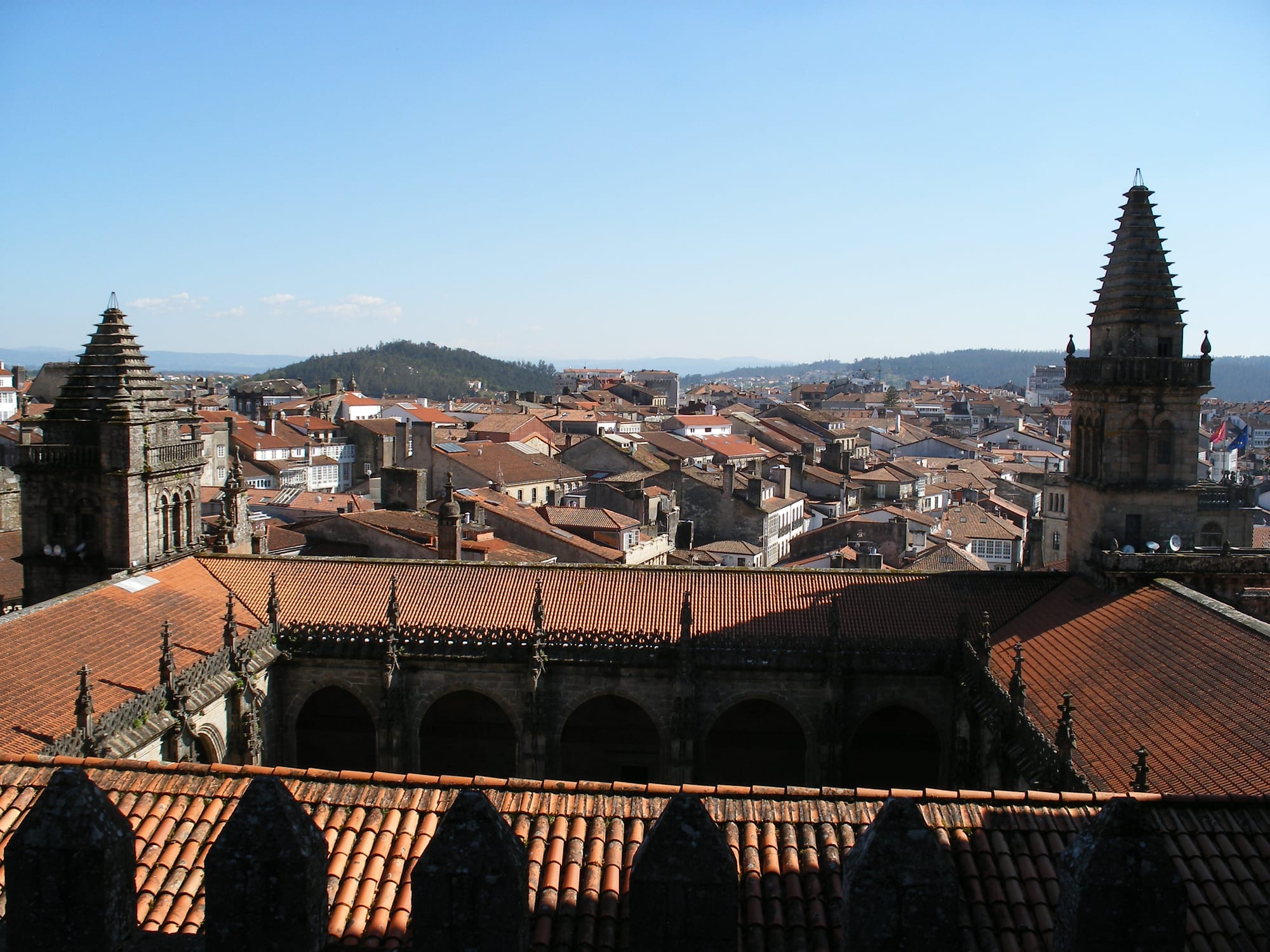
Red-tiled roofs of the old town spreading towards green hills, framed by two carved stone pinnacles and a cloister roof

Galicia, Spain

Santiago de Compostela

The old town of Santiago de Compostela seen from the roofs of the cathedral, above its cloister. (Xosé Antonio / Wikimedia Commons · CC BY-SA 3.0)

The capital of Galicia, a granite city in the green hills of the north-west that grew around the shrine of Saint James and became, with Rome and Jerusalem, one of the great goals of Christian pilgrimage. Its old town, a UNESCO World Heritage Site since 1985, now mixes pilgrims, students of a five-century-old university and the regional government.

Neighbourhoods

  • Zona Vella (Old Town)
    • First-time visitors
    • Historic district
    • Best for food

    The granite old town of paved streets and arcades radiating from the cathedral, with the great squares of Obradoiro and Quintana, monasteries, university buildings and the market. Rúa do Franco and Rúa da Raíña, just south of the cathedral, are its main eating streets.

    Open in Maps
  • Zona Nova (Ensanche)
    • Shopping
    • Local life
    • Nightlife

    The newer town south of the old centre, separated from it by the Alameda park — shops, offices and apartment blocks, with bars where residents and students go out away from the pilgrim crowds.

    Open in Maps
  • Bonaval and San Pedro
    • Arts and culture
    • Parks

    The north-eastern edge of the old town beside the pilgrims' route into the city, around the former convent of San Domingos de Bonaval, its park redesigned with Álvaro Siza, and the contemporary art centre beside it.

    Open in Maps
  • Station area
    • Close to public transport

    The district about a kilometre south of the cathedral around the railway station and the bus station next to it — practical for arrivals and departures rather than for its own sake.

    Open in Maps

Things to do

The cathedral and its squares

  • Cathedral of Santiago de Compostelalandmark

    The reputed burial place of Saint James and the traditional end of the Camino — a Romanesque church begun in 1075 with Gothic and Baroque additions, where the giant Botafumeiro censer is swung through the nave on major religious occasions.

    Open in Maps
  • Praza do Obradoirolandmark

    The great square in front of the cathedral's Baroque west façade, where a plaque at the centre commemorates the pilgrims' way, whose goal lies here, and arriving walkers gather.

    Open in Maps
  • Pazo de Raxoilandmark

    A neoclassical palace completed in 1772 by the French architect Carlos Lemaur on the west side of the Obradoiro, now the city hall and the presidency of the Galician government.

    Open in Maps
  • Monastery of San Martiño Pinariolandmark

    A former Benedictine monastery beside the cathedral, the second largest in Spain after El Escorial, largely rebuilt from the 16th century and now a seminary.

    Open in Maps

Museums and culture

  • Convent of San Domingos de Bonavallandmark

    A former Dominican monastery with work by the Galician Baroque architect Domingo de Andrade, declared a national monument in 1912, beside a park redesigned by Eduardo Chillida and Álvaro Siza.

    Open in Maps
  • Centro Galego de Arte Contemporáneamuseum

    Galicia's centre for contemporary art, presenting exhibitions of current artistic trends next to the Bonaval park.

    Open in Maps
  • City of Culture of Galiciaattraction

    A hilltop complex of cultural buildings designed by a team led by Peter Eisenman, shaped to look like rolling hills, with thousands of custom-shaped windows.

    Open in Maps

Walks and viewpoints

  • Monte do Gozoviewpoint

    The 'Hill of Joy' about 4.5 km from the centre, where pilgrims on the Camino get their first sight of the cathedral's spires.

    Open in Maps

Short trips from the city

  • Padrónattraction

    A town about 18 km from the city, where tradition says the boat carrying the apostle's body arrived at Iria Flavia, and home of the pimientos de Padrón.

    Open in Maps
  • Cape Finisterreviewpoint

    A rock-bound peninsula on the Atlantic coast, believed in Roman times to be an end of the known world, with a lighthouse on Monte Facho.

    Open in Maps

Seasonal events

  • Feast of Saint James25 July

    The city's biggest day, the feast of its patron; in Holy Years, when 25 July falls on a Sunday, pilgrim numbers are at their highest.

Eat and drink

Long-standing places and food districts in Santiago de Compostela. Hours, ratings and directions come from your maps app, always current.

Santiago classics

  • Rúa do Franco and Rúa da Raíñaneighborhood

    The two alleys south of the cathedral that form the city's main eating strip, lined with taverns serving octopus, seafood and tapas; 'Franco' here means French.

    Open in Maps
  • Mercado de Abastosmarket

    The city's main food market, on Rúa das Ameas about 200 metres east of the cathedral.

    Open in Maps

Galician specialities

  • Tarta de Santiagoneighborhood

    The almond cake of the Camino, made from ground almonds, eggs and sugar and dusted with sugar around the silhouette of the Cross of Saint James, sold by bakeries all over the old town.

    Open in Maps
  • Polbo á feiraneighborhood

    Galician fair-style octopus, a traditional dish served across the city's taverns, with seafood the backbone of local menus.

    Open in Maps

Experience Santiago de Compostela

History

The site was a Roman cemetery by the 4th century and was settled by the Suebi in the 5th, but the city itself begins with a discovery. Between 818 and 842, a hermit named Pelagius, guided by strange lights, led Bishop Theodemar of Iria to a tomb that the bishop declared to be that of the apostle James, son of Zebedee. King Alfonso II of Asturias built a church on the spot, a pilgrim settlement grew around it, and by the 10th century it was called Compostela — from a Latin term for a burial ground, although popular tradition prefers Campus Stellae, the "field of the star".

In 997 al-Mansur sacked the town, sparing only the apostle's tomb. Rebuilt after the raid, Compostela began its great cathedral in 1075; under Bishop Diego Gelmírez it became an archbishopric in the 12th century and a magnet for pilgrims from all over Europe, its legends recorded in the 12th-century Codex Calixtinus. The Catholic Monarchs founded a royal pilgrims' hospital on the Obradoiro in 1492, the university followed in the early 16th century, and Baroque façades and monasteries remade the city in granite.

French troops sacked Santiago during the Napoleonic Wars, and the apostle's relics were hidden and lost for nearly a century; in 1884 Pope Leo XIII accepted their authenticity. After Franco's death the city became the capital of Galicia, and in 1985 its old town became a World Heritage Site. A large campaign for the Holy Year of 1993 revived the Camino, and pilgrim numbers have risen ever since. In July 2013 a high-speed train derailed on a bend near the city, killing 79 people.

Culture & Customs

Santiago exists because of pilgrimage, and the Camino still shapes daily life. Walkers with backpacks and scallop shells arrive in the Obradoiro all day, and on major religious occasions the 80-kilogram Botafumeiro censer is swung across the nave by a team of mauve-robed tiraboleiros. The feast of Saint James on 25 July is the biggest day of the year, and Holy Years — when it falls on a Sunday — bring the largest crowds. The cathedral's Obradoiro façade even appears on Spain's 1, 2 and 5 cent coins.

It is also a university town and the seat of Galicia's government, and Galician is widely spoken: in 2008 about 21 per cent of residents always spoke Galician and another 31 per cent mostly did. The Romantic poet Rosalía de Castro is among the city's best-known figures, and by the Alameda park a pair of statues, the Two Marías, recalls two sisters who paraded the streets in colourful clothes in the years after the Civil War.

Students keep the nightlife lively in both the old and new towns. Sport is represented by Obradoiro CAB in basketball and SD Compostela in football, and the city's bars and taverns are where locals and pilgrims meet over a glass of wine and a plate of octopus.

Daily Life

About 101,000 people lived in the municipality in 2025, and the metropolitan area had about 179,000 in 2019. The economy still depends heavily on public administration — the Xunta de Galicia has its headquarters here — together with cultural tourism, higher education and newer industries such as timber processing, vehicles and telecommunications.

The newer town south of the old centre, beyond the Alameda park, is a district of flats, shops and offices, while the old town holds the cathedral, much of the university and the pilgrim trade. Pilgrim numbers have risen year after year since the 1990s, with more than 200,000 completing the route in an ordinary year, and they bring both income and crowding to the old streets.

The rhythm of the day is shaped by the weather: with some of the highest rainfall in Spain, umbrellas and arcades are part of life, and the sunny days of summer fill the squares and terraces. Evenings are spent on the paseo through the Alameda and in the taverns of Rúa do Franco and the new town.

Food

Galicia's seafood dominates the table, and octopus is the city's signature: polbo á feira, fair-style octopus, is a traditional Galician dish, and Santiago's taverns serve it alongside shellfish, fish and tapas. The main eating strip runs along Rúa do Franco and Rúa da Raíña, two alleys south of the cathedral, and the Mercado de Abastos, a short walk east, is the city's main food market.

Pimientos de Padrón, peppers named after the town of Padrón near the city, are a favourite tapa — some are hot and some are not, as a Galician saying warns. Tetilla, a cow's-milk cheese moulded into a peaked cone, is a common part of Galician meals and is often served as a dessert.

The sweet that everyone takes home is the tarta de Santiago, an almond cake from the Middle Ages and the Camino. It is made of ground almonds, eggs and sugar, sometimes on a pastry base, and decorated with powdered sugar around the stencilled outline of the Cross of Saint James. Since 2010 it has had protected status in the European Union: to carry the name it must be made in Galicia and contain at least a third almonds.

Planning tools

Budget

Santiago is generally good value. Pilgrim hostels are very cheap, and octopus, tapas and the house wine cost little, though shellfish sold by weight can push a bill up. Beds fill and rise in price in summer and above all in Holy Years and around 25 July.

Daily Budget Midrange
USD 130–240 (mid-range hotel, a seafood dinner, cathedral visits and museums, a bus or hire car to the coast)
Daily Budget Shoestring
USD 50–90 (pilgrim hostel or pension, menú del día and tapas, city buses)

Book well ahead for July and Holy Years; check the price per kilo before ordering shellfish.

Best Time to Visit

June to September is the driest and warmest time, with the feast of Saint James on 25 July as the high point and the largest crowds. May, June and September are pleasant and less busy. Autumn and spring are mild; winter is wet, quieter and cheaper, with rain on many days.

Suggested Number of Days

Two days are enough for the old town and its museums at a relaxed pace. Allow three to five to add the Atlantic coast and the estuary towns. Pilgrims arriving on foot often stay an extra day to rest.

First Visit
2 days
With Surroundings
3–5 days

Transportation

The old town is pedestrian and best seen on foot. City buses link the centre with the stations and outer districts, and many taxi firms serve the city. High-speed trains reach Madrid in a little over three hours via Ourense, and regional trains run to A Coruña and Vigo; buses cover the rest of Galicia.

From the airport, the city bus stops by the market near the old town before continuing to the stations.

Airport & Station Connections

Santiago–Rosalía de Castro Airport lies in the parish of Lavacolla, 12 km east of the city, with a frequent bus taking about half an hour to the stations. The railway station is about a kilometre south of the cathedral, with the bus station next to it; and thousands arrive each year on foot along the Camino.

Walkability

Excellent in the old town, a compact maze of paved granite streets that is mostly closed to traffic; everything from the cathedral to the market and the Alameda is a few minutes apart. The streets are hilly in places and slippery in the rain, which is frequent.

Safety

Spain is a safe country with low violent crime. Santiago is calm and orderly. The practical hazards are wet, slippery granite paving, crowds in the cathedral and squares on major feast days, and traffic on the final stages of the Camino where it runs along roads.

Carry waterproofs, wear shoes with grip on the granite, and wear reflective gear when walking the Camino along roads. Check current official travel advice before travelling.

Climate

A temperate oceanic climate with mild, wet winters and mild to warm, fairly dry summers. Atlantic winds and the surrounding hills give the city some of Spain's highest rainfall, about 1,800 mm a year; frosts come on only about 13 days a year, and temperatures above 35°C are very exceptional.

Summer
warm and fairly dry — summer temperatures typically reach 25–27°C
Winter
mild and very wet — averages are around 8°C, with frosts on only a few days

Local Customs

Galician and Spanish are both official; Galician takes priority on place-names and signs, and many residents speak it every day. Pilgrims are part of the city's life, and the cathedral is a working church: services take priority over sightseeing. Dinner runs late, as elsewhere in Spain.

Dress modestly and keep quiet in the cathedral during services, and ask before photographing pilgrims at the end of their walk.

Common Payment Methods

The currency is the euro. Cards and contactless are accepted almost everywhere, and ATMs are easy to find in the old and new towns; a little cash is useful at the market and in small taverns.