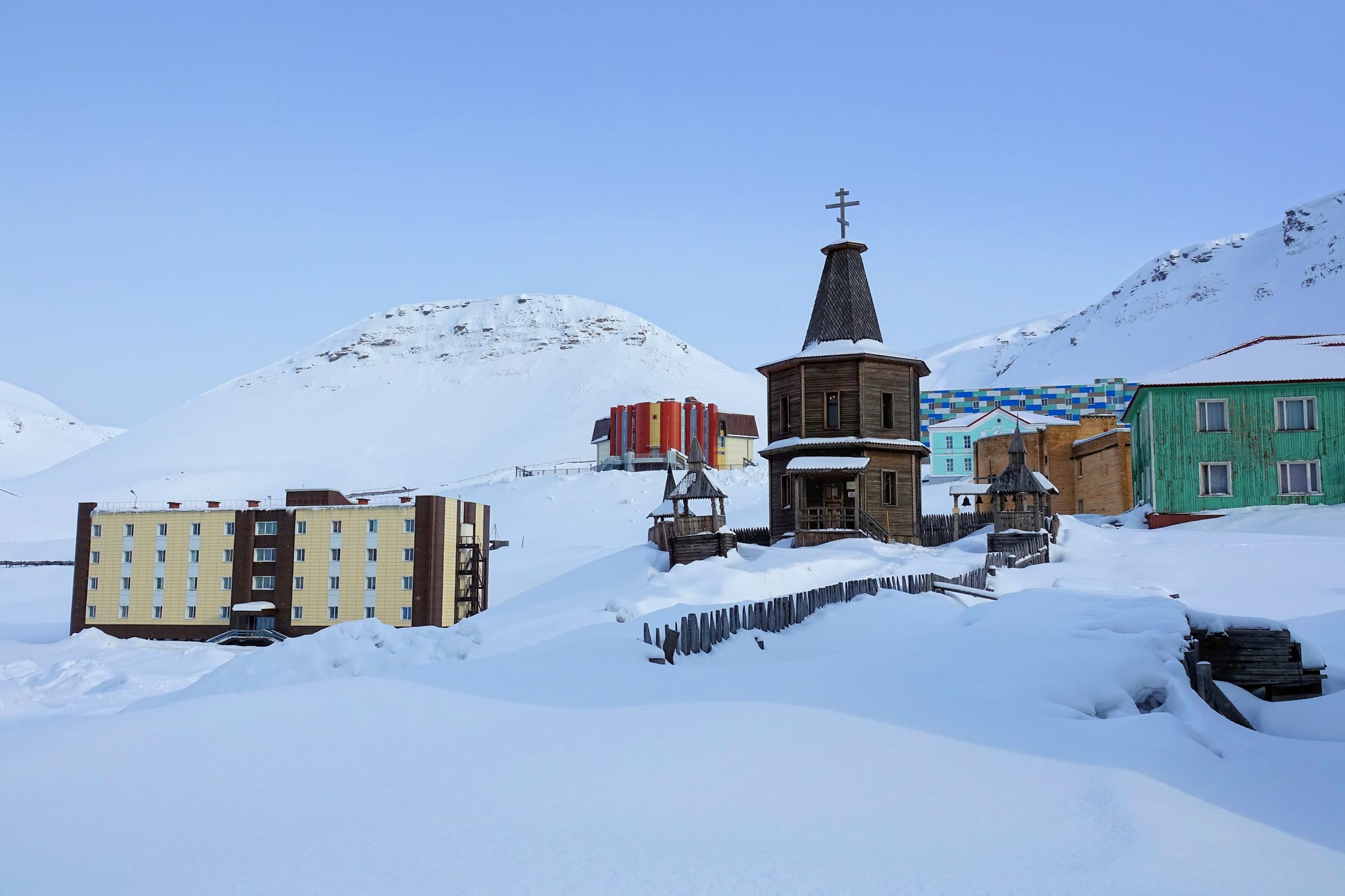
A small wooden Orthodox chapel with a tall roof in deep snow, in front of colourful buildings on a hillside in Barentsburg

Svalbard

Barentsburg

The wooden Orthodox chapel in Barentsburg, with the old and new Russian consulate buildings on the hillside behind. (Bjørn Christian Tørrissen / Wikimedia Commons · CC BY-SA 4.0)

The second-largest settlement in Svalbard, a coal-mining town on the east shore of Grønfjorden run since 1932 by the Russian state company Arktikugol. Founded by a Dutch company and named after Willem Barentsz, it once housed about 1,000 people; today about 300, almost all Russian nationals, live among Soviet-era buildings visited mostly on day trips from Longyearbyen.

Neighbourhoods

  • The harbour
    • Arrival point
    • Waterfront

    The port lies in the middle of the settlement on Grønfjorden, and it is where nearly every visitor steps ashore. Some 220 steps climb from the dock to the town above, with the coal power plant at one end of the shore.

    Open in Maps
  • The main street
    • First-time visitors
    • Soviet-era architecture

    More or less everything stands along one street, ulitsa Ivana Starostina: blocks of flats, the Lenin bust, the chapel, the museums, the sports hall and the brewery. The town is easily covered on foot, and many older buildings stand empty.

    Open in Maps
  • Heerodden
    • Helicopter arrivals
    • Views over Isfjorden

    The cape at the mouth of Grønfjorden about 4 km north of town, site of the heliport and linked to the settlement by road.

    Open in Maps

Things to do

Soviet and Russian landmarks

  • Lenin bustlandmark

    A bust of Lenin on the main street, the second most northerly Lenin monument in the world after the one in Pyramiden, and a popular spot for photographs.

    Open in Maps
  • Star and 'Peace to the World' sloganviewpoint

    A five-pointed star and the Soviet-era slogan Miru Mir on the hillside above town; when the star becomes visible again in late winter, the polar night is over.

    Open in Maps
  • Orthodox chapellandmark

    A small wooden chapel put up in 1996 in memory of the victims of a charter plane that crashed while bringing a new shift of miners to Barentsburg.

    Open in Maps

Museums and the town

  • Pomor Museummuseum

    A museum of Pomor culture, Arctic plants and animals and archaeological finds preserved in the permafrost, with stuffed polar bears and a dinosaur footprint.

    Open in Maps
  • Art Arctic Gallerymuseum

    A gallery whose main exhibition shows whalers' belongings back to the 17th century, with temporary shows of Arctic folk art and paintings of Svalbard.

    Open in Maps
  • Sports hallattraction

    The town's athletic complex, with swimming pools filled with heated seawater, also used for competitions against Longyearbyen.

    Open in Maps
  • Coal mine tourattraction

    Guided visits into Arktikugol's working mine, run in English, Norwegian, French and Russian.

    Open in Maps

Short trips from the town

  • Longyearbyenattraction

    Svalbard's capital across Isfjorden, about 55 km away with no road between them — the base for nearly every visit to Barentsburg.

    Open in Maps

Eat and drink

Long-standing places and food districts in Barentsburg. Hours, ratings and directions come from your maps app, always current.

Barentsburg classics

  • Krasniy Medvedrestaurant

    The 'Red Bear', one of only two breweries in Svalbard, also a restaurant and bar serving its own beer with cod dishes, burgers, meat dishes and soups.

    Open in Maps
  • Shchi in the canteenrestaurant

    Residents eat shchi, the Russian cabbage soup, in the town canteen, a reminder that Barentsburg still runs as a company town.

    Open in Maps

Experience Barentsburg

History

Grønfjorden, named Green Harbour by the English explorer Jonas Poole in 1610, was used by whalers from 1612 until the 1650s. Coal brought the first town. The Dutch Spitsbergen Company, founded in 1920, bought a mine at Green Harbour from its Russian owners, worked it from 1921 to 1926 and named its settlement Barentsburg after the Dutch explorer Willem Barentsz. In 1932 the Dutch sold the mine and the settlement to the Soviet trust Arktikugol, which has run the town ever since. In September 1943 a German fleet bombarded Barentsburg along with Longyearbyen and Grumant.

At its height the settlement had around 1,000 people. On 29 August 1996 a Tupolev charter flight from Moscow, bringing a new shift of miners, crashed into Operafjellet near Longyearbyen on its approach to Svalbard Airport; a wooden chapel in Barentsburg remembers the victims. After the end of the Soviet Union the town declined steadily, and when Pyramiden closed in 1998 Barentsburg was left as the only working Russian settlement.

In October 2006 Norwegian inspectors found a smouldering underground fire, mining stopped, and production resumed only at the end of 2010. Before 2022 many Ukrainians lived and worked here; after Russia's full-scale invasion of Ukraine most non-Russian residents left on their own or were asked to by the local authorities, and Ukrainians were ordered to leave unless they accepted the Russian passports they were offered. Russia announced new investment in Barentsburg and Pyramiden in 2022. In 2023 the Russian consulate general and Arktikugol held a Victory Day parade through the town on 9 May; the Governor of Svalbard was reportedly invited but declined.

Culture & Customs

Barentsburg has been called an open-air museum of the Soviet Union. A bust of Lenin still stands on the main street, and on the hillside above the houses a five-pointed star and the slogan Miru Mir, "Peace to the World", have a practical use: when the star becomes visible again after the polar night, summer is on its way. A few Soviet flags are painted on buildings, and Russian national days are marked with parades.

The town has a small cultural life of its own. The Pomor Museum presents Pomor culture, Arctic wildlife and archaeological finds from the permafrost; the Art Arctic Gallery shows whalers' belongings and folk art; and the sports hall, with its seawater pools, hosts competitions with Longyearbyen. Each summer several dozen scientists from Russia and elsewhere work in the town's research centre, and Barentsburg also has a year-round meteorological observatory and the northernmost cosmic-ray station.

Barentsburg lives under Norwegian sovereignty and Russian management at once. The Svalbard Treaty gives citizens of signatory countries equal rights to exploit natural resources, which is why Arktikugol still mines here; Russia is represented by a consulate, yet the town has a Norwegian postcode and telephone numbers, and a Norwegian mobile operator covers it. Relations with the Norwegian settlements are described as cooler now than they were during the Cold War.

Daily Life

About 300 people lived in Barentsburg in 2025, almost all of them Russian nationals, down from a peak of around 1,000. The main work is coal mining by Arktikugol, with the coal shipped out and usually sold to buyers in northern Europe; some 100,000 tonnes a year are exported. Tourism is being developed but does not yet earn enough to revive the town, and Russia spoke in 2021 of building a plant to process fish for export.

Life is organised around the company. The town depends on mainland Russia for food, and there have been times when too little arrived and aid was sent from Longyearbyen. Residents grow many of their own vegetables in a greenhouse and keep their own livestock barn, and they pay with special plastic cards rather than cash. The settlement has a hospital, a coal power plant, a research park, a hotel, a meeting hall and a school, which in 2014 had three teachers.

Residents live in apartment blocks, while many older buildings stand empty. The working year follows the light: the polar night shuts the sun out for months, and the summer boats bring both supplies and the day visitors who make up most of the town's contact with outsiders.

Food

Barentsburg's food reflects its role as a Russian company town. Residents eat in a shared canteen, where the staple is shchi, the Russian-style cabbage soup; when it is made with sauerkraut instead of fresh cabbage it becomes sour shchi, and versions based on sorrel, spinach or nettle are known as green shchi. Vegetables grown in the town's own greenhouse and produce from its livestock barn supplement what is shipped in from mainland Russia.

For visitors there are only a couple of places to eat and drink. The best known is Krasniy Medved, the "Red Bear", one of only two breweries in Svalbard alongside the one in Longyearbyen. It is a restaurant, bar and party place in one, brewing its own beer and serving cod dishes, burgers, meat dishes and soups. Prices for visitors follow Norwegian levels and are paid in Norwegian kroner. The town's souvenir shop sells matryoshka dolls, Lenin pins and other Soviet-Russian keepsakes, some of them made by local residents.

Planning tools

Budget

Nearly every visit is a guided boat or snowmobile day trip from Longyearbyen, and that excursion is the main cost. The Norwegian krone is used, and prices for tourist activities are set at Norwegian levels.

Daily Budget Midrange
USD 280–560 (hotel, restaurant meals, a full-day guided boat or snowmobile trip to Barentsburg)
Daily Budget Shoestring
USD 110–190 (guesthouse or hostel in Longyearbyen, self-catering, a shared boat day trip)

The trip there and back is the expense; once ashore the town is small, walkable and quickly seen.

Best Time to Visit

Boats sail from about March to November, and in late winter and early spring, when there is enough snow, snowmobile day trips are the more popular way in. In the polar night the town is dark around the clock.

Suggested Number of Days

Most visitors come for the day and spend about two hours ashore, which is enough for the town. An overnight stay suits those who want the quieter evening or a hike to the viewpoints nearby.

First Visit
1 day
With Surroundings
1–2 days

Transportation

There are no roads to Barentsburg, and the town is easily covered on foot. A short road links it with the heliport at Heerodden, but the helicopter serves the mining company and is not available to tourist charters. Activities in town and trips to it are run by the mining company's tourist department.

Expect a stiff climb up the steps from the dock to the town.

Airport & Station Connections

Barentsburg is about 55 km from Longyearbyen, with no road between them. Most visitors arrive on a boat day trip of two to three hours each way, or by snowmobile when the snow allows. No Russian visa or permit is needed to visit. In summer there are occasional boats to Murmansk on the Russian mainland.

Walkability

The whole town lies along one main street above the harbour and is easily seen on foot. Viewpoints two to four hours' walk away can be reached on a tour or independently, but only with firearms precautions.

Safety

Longyearbyen is safe from crime, but the environment is not forgiving. Around Barentsburg the same Arctic rules apply: anyone hiking outside the settlement independently must carry a gun and a signal gun because of the polar-bear risk, as anywhere in Svalbard. Many older buildings in the town stand empty and some are left to decay.

Stay with the tour group or a guide outside the settlement, and keep out of derelict buildings. Check current official travel advice before travelling.

Climate

A tundra climate with short, dry, chilly summers and long, very cold, snowy winters, though milder than many places with a tundra climate. Only four months of the year average above freezing, no month averages more than 10 °C, and snow can fall in any month.

Summer
chilly — only four months average above freezing, and none reaches a monthly average of 10 °C
Winter
long, very cold and snowy — average lows routinely drop below −15 °C

Local Customs

Russian and Ukrainian have been the main languages, and Norwegian is spoken by government officials. Barentsburg is a Russian company town on Norwegian territory: it has a Russian consulate but a Norwegian postcode and telephone numbers, and the post office in town is a branch of Longyearbyen's, with its own postmark.

Russian souvenirs are on sale, made partly by locals; ask before photographing residents.

Common Payment Methods

The Norwegian krone is used in Barentsburg, and tourist prices follow Norwegian levels. Residents themselves pay with special plastic cards, and there are no private businesses in the ordinary sense.