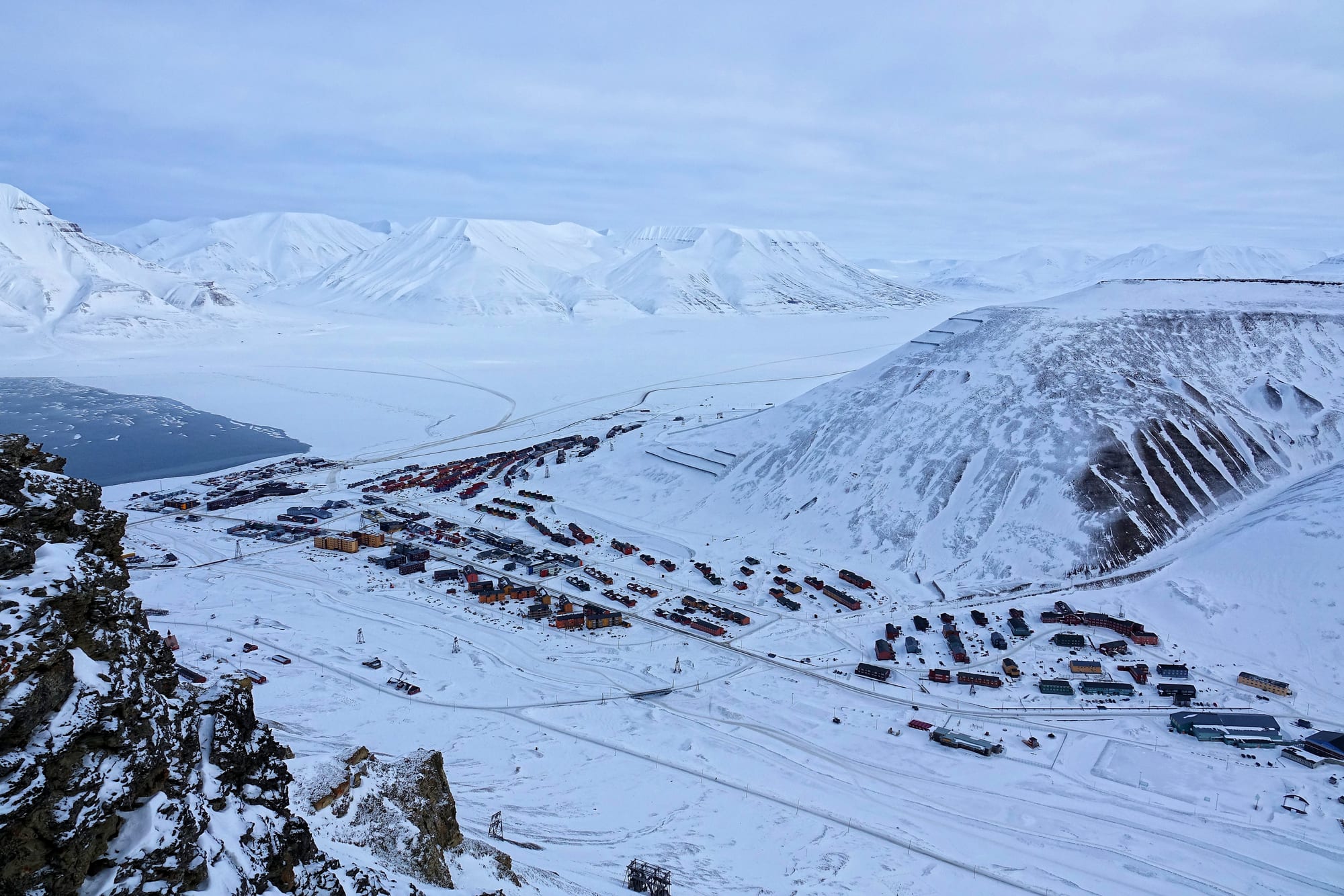
Snow-covered Longyearbyen seen from a rocky slope, rows of coloured houses below a flat-topped mountain and a frozen valley

Svalbard

Longyearbyen

The newer, eastern side of Longyearbyen in winter, with Adventdalen stretching away beyond the town. (Bjørn Christian Tørrissen / Wikimedia Commons · CC BY-SA 4.0)

The capital and largest settlement of Svalbard, strung along the Longyear Valley and the shore of Adventfjorden on Spitsbergen. Founded as an American coal company town in 1906, it was almost destroyed in 1943 and rebuilt around Norwegian mining; since the last Norwegian mine closed in 2025 it lives on tourism, research and its university centre.

Neighbourhoods

  • Town centre
    • First-time visitors
    • Shops and restaurants

    The compact centre on the east side of the river, near the coast, with the main street, the department store, most restaurants and bars, and the university centre and museum building at its upper end. Almost everything a short-stay visitor needs is here.

    Open in Maps
  • Nybyen
    • Quiet and residential
    • Students

    'The New Town', a cluster of former miners' barracks at the top of the valley on the southern edge of town, founded in 1946. It is now used mostly as student housing and holds guesthouses and a gallery, a long walk up from the centre.

    Open in Maps
  • Skjæringa and the harbour
    • Historic district
    • Waterfront

    Across the river on the west side, the port and its industrial buildings line the bay, with the governor's offices on Skjæringa above them.

    Open in Maps
  • Lia, Haugen and Gruvedalen
    • Quiet and residential
    • Local life

    The residential areas on the east side of the valley, with Gruvedalen the largest of them and Haugen home to the school. Reindeer roam freely between the houses.

    Open in Maps

Things to do

Museums and landmarks

  • Svalbard Museummuseum

    The archipelago's history museum, housed in the University Centre building, with a core exhibition, 'Life in Light and Ice', tracing the archipelago's history from the first whalers to mining, research and tourism, alongside exhibits of local plants and animals.

    Open in Maps
  • North Pole Expedition Museummuseum

    A museum of polar aviation and airship expeditions, opened in 2008 and moved in 2012 to a new building closer to the centre.

    Open in Maps
  • Svalbard Churchlandmark

    A red wooden church of 1958 above the town, whose parish covers the whole archipelago, and which sells postcards and books on trust from a bowl.

    Open in Maps
  • Galleri Svalbardmuseum

    An art gallery in Nybyen at the top of the valley.

    Open in Maps

Around the town

  • Svalbard Global Seed Vaultlandmark

    A backup store for the world's crop seeds, cut into the rock near the town and opened in 2008, where the seeds are refrigerated to −18 °C and the surrounding permafrost would help keep them cold if the power failed.

    Open in Maps
  • Platåbergetviewpoint

    The flat-topped mountain of 464 metres west of the town, bordered by the Bjørndalen valley and the Fuglefjella bird cliffs, with the satellite station on its plateau.

    Open in Maps
  • Adventdalenpark

    A 30-kilometre valley that ends at the edge of town, with old mine sites along it and long open views; leaving the settlement on foot means polar-bear precautions.

    Open in Maps

Short trips from the town

  • Barentsburgattraction

    The Russian mining settlement on Grønfjorden, reached by snowmobile in winter or by ship.

    Open in Maps
  • Pyramidenattraction

    The abandoned Soviet mining town on Billefjorden, reached by snowmobile in winter or by ship.

    Open in Maps

Seasonal events

  • PolarjazzFebruary

    The world's northernmost jazz festival, held in the town every year since 1998.

  • Solfestukathe week around 8 March

    The Sun Festival Week, celebrating the first sunlight to reach most of the town after the polar night.

  • Dark Season Blueslate October

    A four-day blues festival in most of the town's venues, with local, Norwegian and international musicians, marking the start of the dark season.

Eat and drink

Long-standing places and food districts in Longyearbyen. Hours, ratings and directions come from your maps app, always current.

Longyearbyen classics

  • Husetrestaurant

    The 1950s miners' community centre — once post office, library, church and school — now a Nordic fine-dining restaurant cooking with local game and foraged ingredients such as seal, whale and ptarmigan.

    Open in Maps
  • Kroarestaurant

    A restaurant and bar popular with locals and visitors, with dishes ranging from ribs to reindeer wraps.

    Open in Maps

Shops and bars

  • Svalbardbutikkenmarket

    The town's department store and its only grocery, selling food, fresh produce, duty-free goods and souvenirs — the self-caterer's essential stop.

    Open in Maps
  • Svalbard Bryggericafe

    The northernmost commercial brewery in the world, brewing since 2015 partly with thawed glacier ice and offering tastings for visitors.

    Open in Maps

Experience Longyearbyen

History

Tourists came before miners: in 1896 a Norwegian steamship company began summer cruises to Hotellneset and put up a prefabricated hotel, which closed after a year. The American industrialist John Munro Longyear visited as a tourist in 1901, met prospectors looking for coal, and in 1906 his Boston-based Arctic Coal Company opened Mine 1a, building docks, housing and an aerial tramway to carry coal 1.2 kilometres down to the shore. Known as Longyear City until 1926, the settlement was sold in 1916 to the Norwegian company Store Norske Spitsbergen Kulkompani, and a coal-dust explosion in Mine 1 later killed 26 men. The first church on Svalbard opened in 1921.

In the Second World War the population was evacuated to Scotland in 1941, and on 8 September 1943 a German fleet led by the battleships Tirpitz and Scharnhorst bombarded the town and almost completely destroyed it. Rebuilding followed: Nybyen's barracks went up in 1946, the community centre Huset in 1951 and a new church in 1958. Mines opened and closed up and down the valleys, the airport arrived in 1975, and snowmobiles soon outnumbered cars.

From the 1990s the town changed character. The University Centre opened in 1993, a satellite station followed in 1999 and the Global Seed Vault in 2008, while mining moved elsewhere and tourism grew. Since 2002 the town has been governed by an elected community council. A large avalanche struck the town in 2015, and on 30 June 2025 Mine 7, the last Norwegian coal mine on Svalbard, closed.

Culture & Customs

Longyearbyen likes to count its "northernmosts": the brewery and the restaurant both claim the title, the church, whose parish takes in the whole archipelago, held it until 2017, and the town has two museums, a cinema, a library and a gallery run with the community council's support. The Arctic Film Festival takes place each year in Kulturhuset, the town's screening venue, and the weekly newspaper Svalbardposten has been published since 1948.

The calendar follows the light. Polarjazz, held since 1998, fills the end of the dark season in February; Solfestuka, the Sun Festival Week around 8 March, celebrates the first sunlight to reach most of the town after the polar night — the first official sunrise comes in mid-February, but the mountains keep the streets in shadow for weeks. In late October Dark Season Blues brings four days of local, Norwegian and international musicians to most of the town's venues just as the sun leaves for the winter.

The rules are unlike the mainland's. Anyone heading outside is recommended to carry a rifle against polar bears, alcohol purchases are rationed, and most live animals may not be imported. Burials have long been avoided, as bodies do not decompose in the frozen ground — the bodies of victims of the 1918 flu were found not to have decomposed and could be preserving microorganisms. Snowmobiles are part of everyday life, and in 2008 more than two-thirds of households owned one.

Daily Life

Between about 2,400 and 2,800 people live in Longyearbyen. It is a young town — roughly half of its people are aged between 20 and 44, there are about 400 children and very few elderly — and a mobile one: in 2009 only about a quarter of residents had lived there since before 2000, and students and staff in tourism, education and government come and go fastest. Many of the Norwegians come from the north of the country, and residents are better educated than the national average.

Coal built the town, but the last Norwegian mine closed in 2025. Work now comes from tourism, research and public services: the University Centre in Svalbard teaches Arctic studies to about 350 students alongside the Norwegian Polar Institute, the Svalbard Satellite Station operates on Platåberget, and the Governor of Svalbard, the hospital and other state offices employ many more. Most tourism is about nature rather than the town itself, and in 2008 the average visitor stayed just over two nights.

Residents live in the houses of Lia, Haugen and Gruvedalen, or in student housing at Nybyen, and shop at Svalbardbutikken, the only grocery store. Local democracy is a live issue: since the 2023 local elections only people who have previously lived on the Norwegian mainland for three years may vote for the community council, a change that took the vote away from many foreign residents.

Food

Longyearbyen's restaurants make the most of what the Arctic provides. Several serve local specialities such as seal and whale, and reindeer appears on menus too, from wraps to fine dining. Huset, the 1950s miners' community centre that over the years served as post office, library, church, school and gymnasium, became a bistro in 2010 and since 2022 has been a Nordic fine-dining restaurant built around local game and foraged ingredients, including seal, whale and ptarmigan. The wider Norwegian kitchen is here as well: high cuisine in Norway leans heavily on game such as reindeer and rock ptarmigan, and whale meat was once a cheap everyday substitute for beef.

Everything else arrives by plane or ship, and Svalbardbutikken, the town's only grocery store, stocks food, fresh produce and duty-free goods for the many visitors who self-cater. Svalbard's tax-free status makes alcohol much cheaper than on the mainland, though purchases are rationed. Svalbard Bryggeri, the northernmost commercial brewery in the world, could only open in 2015 after Norway's parliament changed a law banning commercial alcohol production on the archipelago; part of the water in its beers comes from thawed ice from the Bogerbreen glacier, and its cans are sold across mainland Norway.

Planning tools

Budget

Longyearbyen is expensive: almost everything is shipped or flown in, and the guided trips that are the only safe way out of town are the biggest cost. Self-catering from the town's one grocery store keeps food costs down, and tax-free alcohol is cheaper than on the Norwegian mainland.

Daily Budget Midrange
USD 280–560 (hotel, restaurant meals, a full-day guided snowmobile, boat or glacier trip)
Daily Budget Shoestring
USD 110–190 (guesthouse or hostel bed, self-catering, walks within the town, one short guided trip)

Most of the town — the museums' surroundings, the church and the shop — can be seen on foot; the guided trips are where the money goes, so choose them before arriving.

Best Time to Visit

Late winter and spring bring the returning sun, celebrated in the Sun Festival Week around early March, and the snow cover that makes snowmobile travel possible. Summer brings open water and boat trips. From late October the polar night sets in; the dark months have the town's blues and jazz festivals and a stark atmosphere of their own.

Suggested Number of Days

Two or three days cover the town itself. Most visitors stay longer for guided trips outside the settlement, and the weather can cancel or delay them, so a spare day or two is sensible.

First Visit
2–3 days
With Surroundings
4–6 days

Transportation

There is no public transport apart from the airport shuttle bus, which connects with every flight. Taxis are available, and bikes can be hired in summer. No roads link the settlements of Svalbard: travel beyond the town is by snowmobile in winter and by boat, nearly always with a guide. Snowmobiles outnumber residents.

Drink-driving rules are strict — the blood alcohol limit is 0.02 per cent, and police stop cars and snowmobiles.

Airport & Station Connections

Svalbard Airport lies at Hotellneset, about 5 km north-west of the town, and is the northernmost airport in the world with scheduled public flights. Flights come from mainland Norway, usually through Tromsø or Oslo, where passengers clear passport and customs control on the way back. A shuttle bus meets the flights. Cruise and expedition ships also call at the port.

Walkability

The centre is small and easy on foot, but the town strings out for some distance up the valley, and walking to Nybyen or the airport is tedious in bad weather. Walking beyond the signs marking the settlement limit is not advised without a guide or the right precautions.

Safety

Longyearbyen is safe from crime, but the environment is not forgiving. Polar bears can be met anywhere on the islands at any time of year, and leaving the town centre without a rifle is not recommended; rifles can be rented in town, or a guide hired. The settlement limits are marked with signs bearing a polar bear. Bears are legally protected, and shooting one is investigated thoroughly by the police.

Stay within the signed settlement limits unless with a licensed guide, and treat cold, weather and avalanches as seriously as bears. Check current official travel advice before travelling.

Climate

A polar tundra climate tempered by the North Atlantic Current. The highest temperature ever recorded in the town was 21.7 °C in July 2020 and the lowest −46.3 °C in March 1986, and the climate is warming fast: winters are now more than 7 °C warmer than in the 1970s.

Summer
cool — across Svalbard, daily mean temperatures in summer are about 4–7 °C, with round-the-clock daylight
Winter
cold and dark — across Svalbard, January averages about −13 to −9 °C, and the polar night lasts from late October until the sun returns in February and March

Local Customs

Svalbard has its own rules. Alcohol is tax-free but rationed: a monthly quota applies, and buying it in the shop means showing a plane ticket. Most live mammals and birds may not be brought in. Burials stopped long ago because bodies do not decompose in the permafrost. The community is young, international and transient, with many residents staying only a few years.

Keep a respectful distance from the reindeer that wander through town, and never approach or follow wildlife beyond the settlement.

Common Payment Methods

The currency is the Norwegian krone. Virtually all shops and services take major credit cards, and some businesses no longer accept cash at all. As of 2024 the town had no bank and no cash machines, so cash should not be relied on.