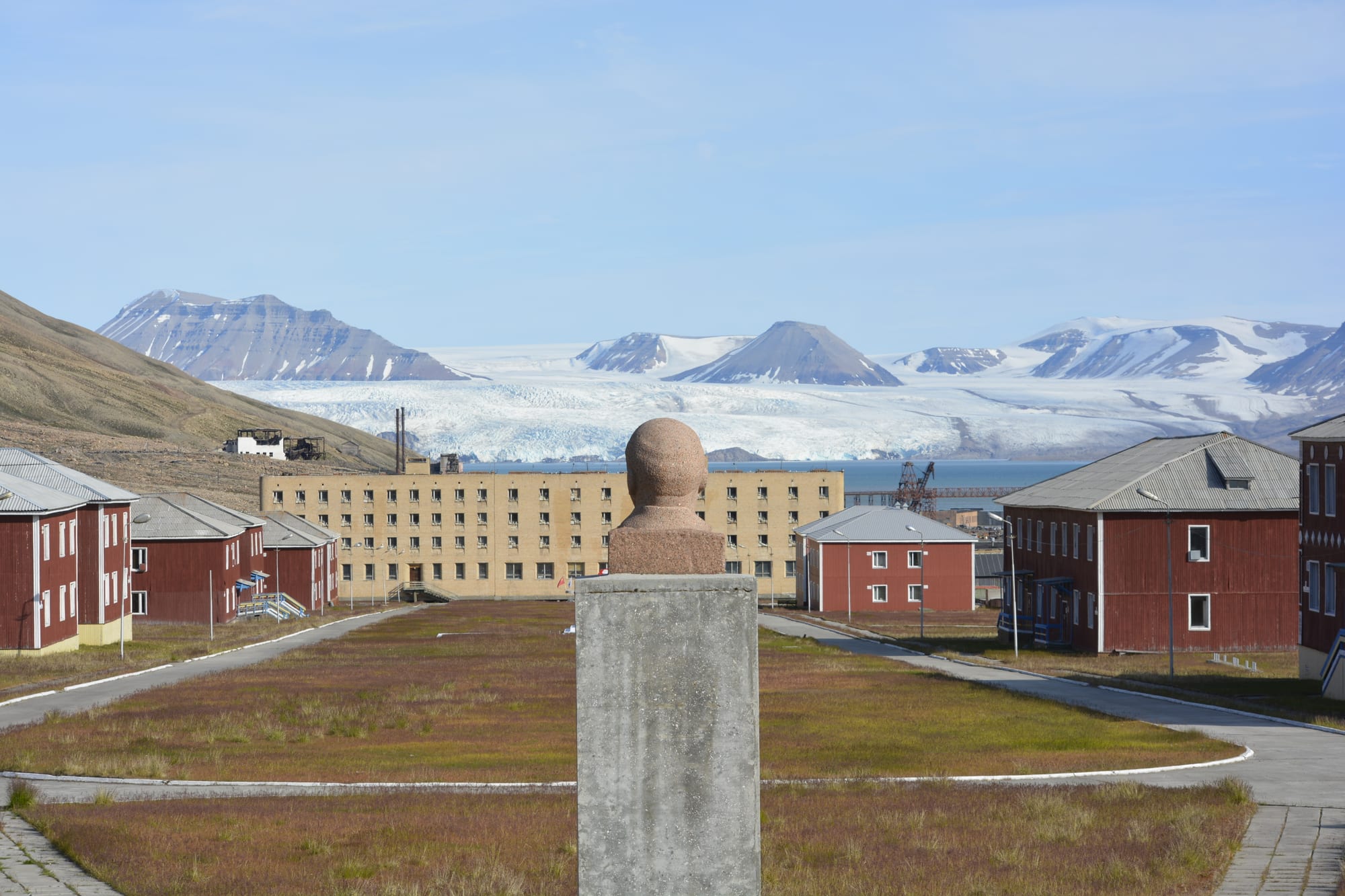
A Lenin bust on a stone plinth facing down Pyramiden's grassy main square to blocks of flats and a wide glacier beyond

Svalbard

Pyramiden

Pyramiden's main street and square, with the Lenin bust in the foreground and Nordenskiöldbreen across the fjord. (Dmitrii Rusanov / Wikimedia Commons · CC BY-SA 4.0)

An abandoned Soviet coal-mining settlement at the head of Billefjorden on Spitsbergen, named after the pyramid-shaped mountain beside it. Founded by Sweden in 1910 and sold to the Soviet Union in 1927, it closed in 1998; its buildings survive largely intact in the cold, and a handful of staff now keep it as a tourist destination.

Neighbourhoods

  • The main square and street
    • First-time visitors
    • Soviet-era architecture

    The heart of the settlement, the main street and square, with the Lenin bust, blocks of flats, the cultural centre and the sports complex. Buildings may only be entered with permission, usually on the guided tour.

    Open in Maps
  • The harbour
    • Arrival point
    • Views of the glacier

    Where the tour boats tie up on Billefjorden below the settlement, facing the ice of Nordenskiöldbreen across the water. In spring ice can stop boats from docking for a time.

    Open in Maps

Things to do

The Soviet settlement

  • Lenin monumentlandmark

    The northernmost monument to Vladimir Lenin in the world, a bust looking down the main square towards the glacier.

    Open in Maps
  • Cultural centrelandmark

    The Soviet-era cultural centre, with a theatre, library and art and music studios; its cinema has been restored to working order, and an archive of more than 1,000 Soviet films is kept on site.

    Open in Maps
  • Swimming pool and sports complexattraction

    The sports complex held what was once the northernmost swimming pool in the world, filled with seawater.

    Open in Maps
  • Pyramiden Museummuseum

    A small museum in the settlement's renovated hotel, which also houses a post office and a souvenir shop.

    Open in Maps

Fjord and glacier

  • Nordenskiöldbreenviewpoint

    A glacier 25 km long and 11 km wide whose front ends in a branch of Billefjorden across from the settlement; boat trips to Pyramiden pass close to its ice wall.

    Open in Maps
  • Billefjordenviewpoint

    The central of the three fjords branching off the inner Isfjorden, about 30 km long, on whose north-western shore the settlement stands.

    Open in Maps

Eat and drink

Long-standing places and food districts in Pyramiden. Hours, ratings and directions come from your maps app, always current.

Eating in Pyramiden

  • The hotel restaurantrestaurant

    The settlement's one restaurant, in one of its only two habitable buildings; visitors are advised to bring their own food and drink as well.

    Open in Maps

Experience Pyramiden

History

Pyramiden takes its name from the pyramid-shaped mountain beside it at the head of Billefjorden. Sweden founded it as a coal-mining settlement in 1910 and sold it to the Soviet Union in 1927. It was run by the state mining trust Arktikugol, which also owns Barentsburg, and in the 1950s about 2,500 people lived here. In Soviet times most of them were Ukrainian, miners from the Donbas and other staff from Volyn. Between 1955 and 1998 as much as nine million tonnes of coal were taken from the mine.

The end came quickly. In 1996 a charter flight for Arktikugol crashed on its approach to Svalbard Airport with the loss of 141 lives. Mining stopped on 31 March 1998, the settlement closed the same year, and the last permanent resident left on 10 October, leaving a ghost town whose interiors stayed much as they had been on the day it emptied. The cold climate has preserved much of what was left behind.

From 2007 Arktikugol began renovating the hotel and upgrading the infrastructure, with a new diesel power station, and in 2013 the hotel reopened for overnight guests. In 2012 Aleksandr Romanovsky became the first person to come back to live in Pyramiden, later joined by others. On 27 August 2019 the settlement held the world's northernmost film festival, marking a century of Soviet cinema, and in 2022 Russia announced new investment to support its presence in Pyramiden and Barentsburg. There are no plans to renovate and reopen the whole settlement.

Culture & Customs

Pyramiden was built as a showcase of Soviet life, and its public buildings show it. The settlement had a cultural centre with a theatre, a library and art and music studios, a sports complex, a primary school and a canteen open 24 hours a day. Residents also had a shooting range, a football pitch and a seawater swimming pool built to international dimensions. The northernmost monument to Lenin and the northernmost swimming pool in the world both stood here.

Today the settlement is a museum of that life rather than a community. The cinema has been restored to working order and films can be shown on request, drawing on an archive of more than 1,000 Soviet films kept in the storerooms. The renovated hotel houses the Pyramiden Museum, a post office and a souvenir shop, and guides lead visitors through many buildings on request. Romanovsky, a musician as well as a guide, has styled himself the "world's most northern head-banger".

Visiting comes with rules. Anyone may go to Pyramiden, but no building may be entered without permission, even if it is open. Break-ins, vandalism and the theft of artefacts have become a serious threat, speeding up the decay of the buildings, and most are now kept locked. Arctic Travel Company Grumant, a division of Arktikugol, maintains the settlement for tourism.

Daily Life

As of 2026, around 20 to 30 people, most of them tourism workers, live in Pyramiden in summer, and in winter that falls to between one and three. Only two buildings are habitable: the hotel with its restaurant, and a dormitory for staff. The rest of the town stands empty, preserved by the cold.

The settlement's year is shaped by the tourist season. In summer the boats arrive from Longyearbyen, and staff meet them at the harbour, guide groups around the square and the cultural centre, and look after the buildings and the power supply. Several operators have run boat trips, and the guided walk ashore has been handled by local staff whichever boat is used. In winter visits are rarer and come by snowmobile, while for part of the spring ice can stop boats from landing at all.

The isolation is real: there is no mobile phone or internet coverage, the nearest settlement, Longyearbyen, is about 50 km away with no road, and polar bears are frequently seen nearby. Pyramiden's few residents keep the infrastructure running and protect the buildings from damage.

Food

In its Soviet years Pyramiden fed its miners from a canteen that stayed open 24 hours a day, part of the full set of public services the settlement was built around. Those days are gone, and today the only place to eat is the restaurant in the renovated hotel, one of the settlement's two habitable buildings. Visitors on day trips are advised to bring their own food and drinks, since supplies on site are limited.

Most of what visitors eat on a trip to Pyramiden is served on the boat or back in Longyearbyen. In 2017 one tour boat served a warm lunch by the glacier — marinated whale meat, baked salmon and pork rib, with locally baked bread — and carried a licensed bar and snacks such as waffles. Back in town, Longyearbyen offers Svalbard's widest choice of restaurants and its only grocery store, where those heading out for the day can stock up beforehand.

Planning tools

Budget

Pyramiden is reached only on a guided boat or snowmobile trip from Longyearbyen, or by helicopter, and that trip is nearly the whole cost of a visit. Prices in Svalbard are high, as almost everything is shipped or flown in.

Daily Budget Midrange
USD 280–560 (hotel, restaurant meals, a full-day guided boat or snowmobile trip to Pyramiden)
Daily Budget Shoestring
USD 110–190 (guesthouse or hostel in Longyearbyen, self-catering, a shared boat day trip)

Ask before booking whether ice is likely to stop the boat from landing, as in spring it sometimes cannot dock.

Best Time to Visit

Summer is the main season, when the boat tours run, more staff live in the settlement and the fjord is open. In winter, when only a few people stay on, visits are by snowmobile. For part of the spring, ice can make it impossible for boats to dock.

Suggested Number of Days

Most visitors come on a long day trip by boat, of which a couple of hours are spent ashore. Staying a night in the settlement adds the quiet of an almost empty town.

First Visit
1 day
With Surroundings
1–2 days

Transportation

There are no roads to Pyramiden. Visitors arrive by boat or snowmobile from Longyearbyen, as part of a tour or independently, and there is also a heliport. Once there, the settlement is small and walked on foot, usually with a local guide.

There is no mobile phone or internet coverage, so plans and pick-ups need to be fixed before setting out.

Airport & Station Connections

Pyramiden is about 50 km north of Longyearbyen across Isfjorden, but the only practical way in is by tour boat in summer or snowmobile in winter. Boat trips commonly pass Nordenskiöldbreen on the way. Pyramiden Heliport, owned by the mining company, has a short gravel runway.

Walkability

The settlement is compact and easily walked, from the harbour up to the main square. Visitors may not enter buildings without permission, even when doors are open, and walking beyond the settlement means polar-bear precautions.

Safety

Longyearbyen is safe from crime, but the environment is not forgiving. Pyramiden is almost uninhabited, polar bears are frequently seen in the area, and anyone not part of a tour group needs a hunting rifle for protection. There is no phone or internet coverage. Breaking into buildings, vandalism and the theft of artefacts are serious threats to the settlement.

Visit with a tour group or a licensed guide, take nothing from the buildings, and enter them only with permission. Check current official travel advice before travelling.

Climate

High Arctic. Across Svalbard, the sheltered inner fjords and valleys have somewhat warmer summers and colder winters than the coast.

Summer
cool — across Svalbard, daily mean temperatures in summer are about 4–7 °C, with the midnight sun
Winter
cold and dark — across Svalbard, January averages about −13 to −9 °C, and the inner fjords are colder than the coast

Local Customs

Pyramiden is kept by the Russian state mining company's tourist division, and its staff guide visitors around. The buildings are a preserved record of Soviet life: nothing should be moved or taken, and buildings are entered only with permission.

Respect the closed buildings; the guided tour is the way to see inside.

Common Payment Methods

The Norwegian krone is the currency throughout Svalbard. Trips to Pyramiden are booked and paid for in Longyearbyen.