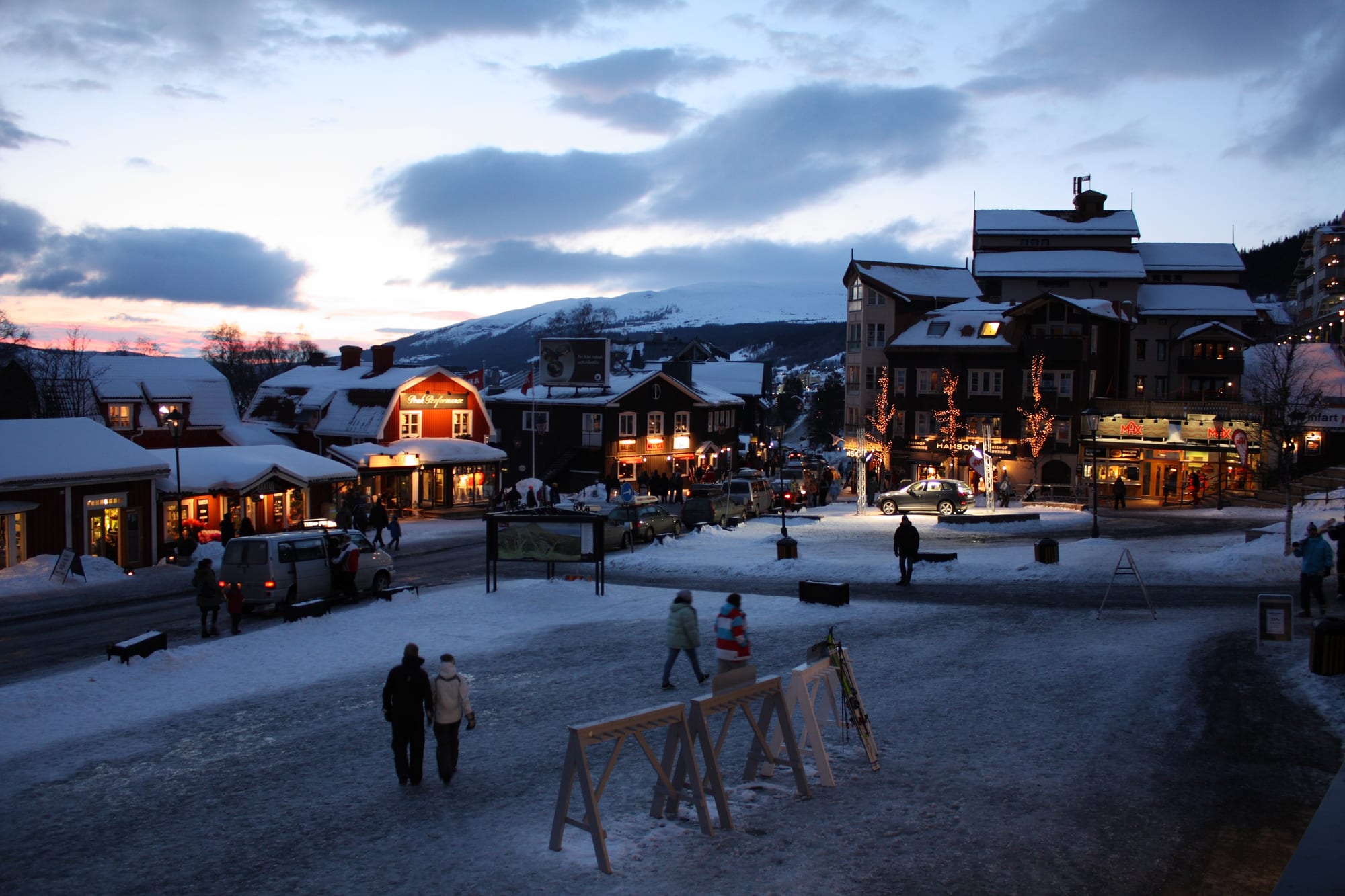
Snowy village square at dusk with lit shops and wooden buildings, people walking, and a white fell behind

Northern Sweden & the High Coast, Sweden

Åre

Åre's village square at sunset in early March. (MattiPaavola / Wikimedia Commons · CC BY-SA 3.0)

A village of about 3,200 people on the shore of Lake Åresjön in western Jämtland, beneath the 1,420-metre fell of Åreskutan. Pilgrims passed through on the way to Trondheim, the railway brought the first tourists in 1882, and Åre is now Sweden's leading ski resort, a three-time host of the Alpine World Championships and a mountain-biking centre in summer.

Neighbourhoods

  • Åre village and the square
    • First-time visitors
    • Nightlife
    • Close to public transport

    The centre between the lake and the slopes, around Åre torg, with the railway station, the lower station of the funicular, most of the shops, restaurants and bars, and the central lifts of the ski area. It is the busiest part of the resort in season.

    Open in Maps
  • Åre Björnen
    • Families
    • Beginners

    A ski area whose first lift was built in 1981, aimed at the youngest skiers and families and linked to central Åre by lifts.

    Open in Maps
  • Duved and Tegefjäll
    • Quieter slopes
    • Families

    Villages along the valley, part of the resort's lift system since 1985. Duved has about 700 permanent residents and slopes for beginners and experts; Tegefjäll beside it suits families with small children, and Duved's slopes have long been seen as more family-friendly than central Åre's.

    Open in Maps

Things to do

The mountain

  • Åre ski areaattraction

    Sweden's largest ski area, founded in 1909, with more than 30 lifts, an 870-metre lift-served vertical drop; it has hosted the Alpine World Championships in 1954, 2007 and 2019.

    Open in Maps
  • Åreskutanviewpoint

    The 1,420-metre fell above the village; the highest lift stops at 1,260 metres, and the summit is reached on foot or by snowmobile.

    Open in Maps
  • Åre Bergbanatransit hub

    A 790-metre funicular opened in 1910, the first fixed link up the fell, climbing from the village square to 556 metres; it has been a listed building since 2008.

    Open in Maps
  • Åre Bike Parktrail

    Sweden's largest mountain-bike resort since the 1990s, with graded downhill trails served by the lifts from spring to autumn; it hosted the 1999 UCI Mountain Bike World Championships.

    Open in Maps

In the village

  • Åre Old Churchlandmark

    A Romanesque stone church of the late 12th century, built when Jämtland belonged to Norway and standing on the Saint Olaf pilgrims' route from the Gulf of Bothnia to Trondheim.

    Open in Maps

Short trips from the village

  • Tännforsenviewpoint

    One of Jämtland's most visited sights and one of its few unharnessed waterfalls, 60 metres wide with a total drop of 37 metres.

    Open in Maps
  • Ristafalletviewpoint

    One of Sweden's largest waterfalls, on the Indalsälven 17 km east of Åre, split in two by a protected wooded island.

    Open in Maps
  • Fröå Mineattraction

    A disused copper mine on the eastern side of Åreskutan, 10 km east of the village, worked in four periods from the 1740s until 1919.

    Open in Maps
  • Storlienattraction

    A small ski and outdoor village two kilometres from the Norwegian border, where the Swedish royal family has a house and most visitors come from Norway.

    Open in Maps

Eat and drink

Long-standing places and food districts in Åre. Hours, ratings and directions come from your maps app, always current.

Åre food and drink

  • Restaurants around Åre torgneighborhood

    Several high-end restaurants have opened close to the slopes, alongside burger bars, pizzerias and casual places in and around the village square.

    Open in Maps
  • Åre Chokladfabrikmarket

    A chocolate maker producing handmade truffles, pralines and toffees since 1991 with local ingredients.

    Open in Maps
  • Åre's breweriesneighborhood

    Two local breweries — Åre Bryggeri, founded in 1990, and Åre Ölfabrik, started in 2014 with the Parkvillan pub — make beer in the village.

    Open in Maps

Experience Åre

History

Åre lies in Åredalen, the valley of the Indalsälven, on the main route across the mountains between the Gulf of Bothnia and Trondheim. Its stone church was built in the late 12th century, when Jämtland belonged to Norway, and for centuries pilgrims passed through the village on the way to the shrine of Saint Olaf in Trondheim. Sami herders settled in the area in the mid-17th century for its good reindeer pasture, and from the 1740s until 1919 copper was mined at Fröå on the eastern side of Åreskutan.

Tourism arrived with the railway. King Oscar II oversaw the building of the Östersund–Trondheim line in 1882, and soon visitors came by train to breathe the mountain air and walk to the top of Åreskutan; they were known as luftgäster, "air guests". A restaurant opened by the station in 1888, a tourist station in 1891 and the first hotels in the 1890s, and the kings of Sweden and Norway holidayed in Åre and Storlien. The funicular up the fell followed in 1910.

The ski area dates from 1909, and Åre grew into the centre of Swedish alpine skiing, hosting the Alpine World Championships in 1954, 2007 and 2019 and more than a hundred World Cup races. Lifts spread to Duved from 1966 and Björnen from 1981, the resort company SkiStar took over the lifts in 2000, and a wave of apartment building changed the village. In the early 2020s Åre was tested by the pandemic and by Storm Hans, whose mudslide flooded the village centre in August 2023.

Culture & Customs

Åre's culture is the culture of the mountain. In winter the village fills with skiers, snowboarders and seasonal workers, and après-ski in the bars around the square is part of the rhythm of the day. Freeskiing has deep roots: the Freeride World Tour winners Henrik Windstedt and Reine Barkered, the latter from Duved, are local names, and the freestyle skiers Jon Olsson and Henrik Harlaut are among the skiers associated with Åre. Åre has been the planned venue for the alpine events in Sweden's eight unsuccessful bids for the Winter Olympics.

Summer has its own crowd. Åre has been Sweden's largest mountain-bike resort since the 1990s, with lift-served downhill trails, the Mayhem festival at the bike park, and the Åre Extreme Challenge each July, a race of paddling, mountain running and mountain biking regarded as an unofficial championship in multisport. Hiking, paragliding, kayaking and Europe's largest zipline park, opened in 2007, fill the long days.

Beneath the resort lies an older Jämtland. The medieval church, the pilgrims' route to Trondheim and the Southern Sami presence in the mountains around the valley — the village's Sami name is Ååre — tie Åre to a history that is older than skiing, and local crafts such as candle-making in Undersåker and glassblowing in Duved draw visitors along the valley.

Daily Life

About 3,200 people lived in Åre in 2018, though far more people stay there in the ski season. It is not the seat of its municipality, which is Järpen. Around a quarter of the local economy depends on tourism — downhill skiing and mountain biking in Åre, Duved and Storlien — and the growth of visitors has brought hotels, apartment blocks, shops and restaurants to what was once a farming village of a few hundred people.

The year has two high seasons. Winter, from December to April, brings skiers and the instructors, lift staff and hospitality workers who serve them, while summer brings cyclists and hikers. The lifts and much of the resort's lodging have been run by SkiStar since 2000, and the E14 and the railway tie the village to Östersund, about 100 km to the east.

Apartment building has come in waves since the late 1980s, when the large 'Mitt i Åre' housing project was planned. The clean-up after the 2023 mudslide, estimated by the municipality at more than 50 million kronor for the stream and its surroundings, was a major local project.

Food

Western Jämtland lies within the old Sami lands, and Sami cooking — based on reindeer, fish and game, with very little seasoning beyond salt — shapes the local table. Reindeer meat is the staple, and the mountain lakes and rivers give whitefish, perch and Arctic char. A modern Sami-influenced dish, suovaskebab, puts slices of smoked reindeer meat, cucumber, salad and garlic dressing into pita bread and turns up at festivals and fairs across northern Scandinavia.

Some of the restaurants near the slopes serve local dishes, while the village also has many casual burger, pizza and à la carte places for hungry skiers. Everyday Swedish husmanskost — meatballs with cream sauce and lingonberry jam, pea soup, herring — and the weekday lunch special are easy to find.

Åre makes its own treats. Åre Chokladfabrik has made handmade truffles, pralines and toffees from regional ingredients since 1991, two breweries make beer in the village, and a small distillery, Buustamons, has worked nearby since 2000. Strong drink is otherwise sold only through the state Systembolaget.

Planning tools

Budget

Åre is at its most expensive in the ski season, when lodging and lift passes cost most. Eating out costs more than the Swedish average. Summer is cheaper, and self-catering apartments and cabins keep costs down.

Daily Budget Midrange
USD 170–330 (hotel or apartment, restaurant dinners, lift pass or bike-park pass; much more in peak ski weeks)
Daily Budget Shoestring
USD 75–120 (hostel or shared cabin, self-catering, ski bus; more with a lift pass)

A separate, cheaper lift pass covers only the Duved and Tegefjäll area, which suits families and those who prefer quieter slopes.

Best Time to Visit

December to April for skiing, with night skiing in the evenings in the busy season; March and April bring longer days. From late spring to mid-autumn the bike park, hiking trails, paragliding and kayaking take over, and the Åre Extreme Challenge multisport race is held each July.

Suggested Number of Days

A ski or bike trip usually runs from a long weekend to a full week. Three or four days gives a good feel for the mountain; five to seven allows time to try the quieter lift areas and the waterfalls and villages further along the valley.

First Visit
3–4 days
With Surroundings
5–7 days

Transportation

In winter an hourly ski bus links the four villages of the resort — Duved, Tegefjäll, Åre village and Björnen — and is free with a ski pass. Lifts connect the ski areas on the mountain. The E14 road and the Mittbanan railway run along the valley through Åre.

Winter tyres are mandatory in winter, and snow and ice cover the roads for much of the season.

Airport & Station Connections

Åre station is in the centre of the village. SJ runs day and night trains from Stockholm, night trains also run from Malmö and Gothenburg in the ski and summer seasons, and Norrtåg regional trains come from Sundsvall and from Storlien, where they connect with trains to Trondheim. Åre Östersund Airport is 94 km east, with daily flights from Stockholm; Trondheim Airport in Norway is about 135 km west. By road Stockholm is about 612 km away.

Walkability

The village centre is small, with the station, the square, the funicular, shops and restaurants close together, though streets climb steeply towards the slopes. Björnen, Duved and Tegefjäll are separate villages reached by ski bus, lift or car. Paths and lanes are often icy in winter.

Safety

Sweden is a very safe country for visitors. In Åre the risks are mountain ones: avalanches off-piste, fast-changing weather and cold above the tree line, collisions and injuries on busy slopes, and winter driving. In August 2023 a storm sent a mudslide down a mountain stream into the village centre, a reminder that heavy rain can bring sudden floods.

Check avalanche forecasts before skiing off-piste, carry warm layers above the tree line and use a helmet on the slopes and bike trails. Check current official travel advice before travelling.

Climate

A subarctic climate at about 400 metres above sea level. Warm Atlantic winds make winters in the western fells comparatively mild, with heavy precipitation, and summers are cool.

Summer
cool — summer temperatures average around 11°C in Jämtland's fell region, and nights around Storlien are very cool, sometimes cold
Winter
cold and snowy — in the fells around Storlien winter temperatures average about -7 to -8°C, mild for the region

Local Customs

Tipping is not customary in Sweden; rounding up the bill is usual for good service, and 5–10 per cent only for exceptional service. Åre has a lively après-ski and bar scene in season. The village also carries a Southern Sami name, Ååre, and Sami herders settled in the area in the 17th century for its reindeer pasture.

Drinks stronger than 3.5 per cent are sold only at the state Systembolaget shops, which do not serve anyone under 20 and ask young-looking customers for identification.

Common Payment Methods

The currency is the Swedish krona (SEK). Sweden is one of the world's most cashless countries: most stores, restaurants and bars accept all major credit cards, contactless phone payments work where the reader shows the icon, and businesses that do not accept cash are common. The Swish app needs a Swedish bank account, and a few small vendors take only Swish or cash, so a small amount from an ATM can be useful.