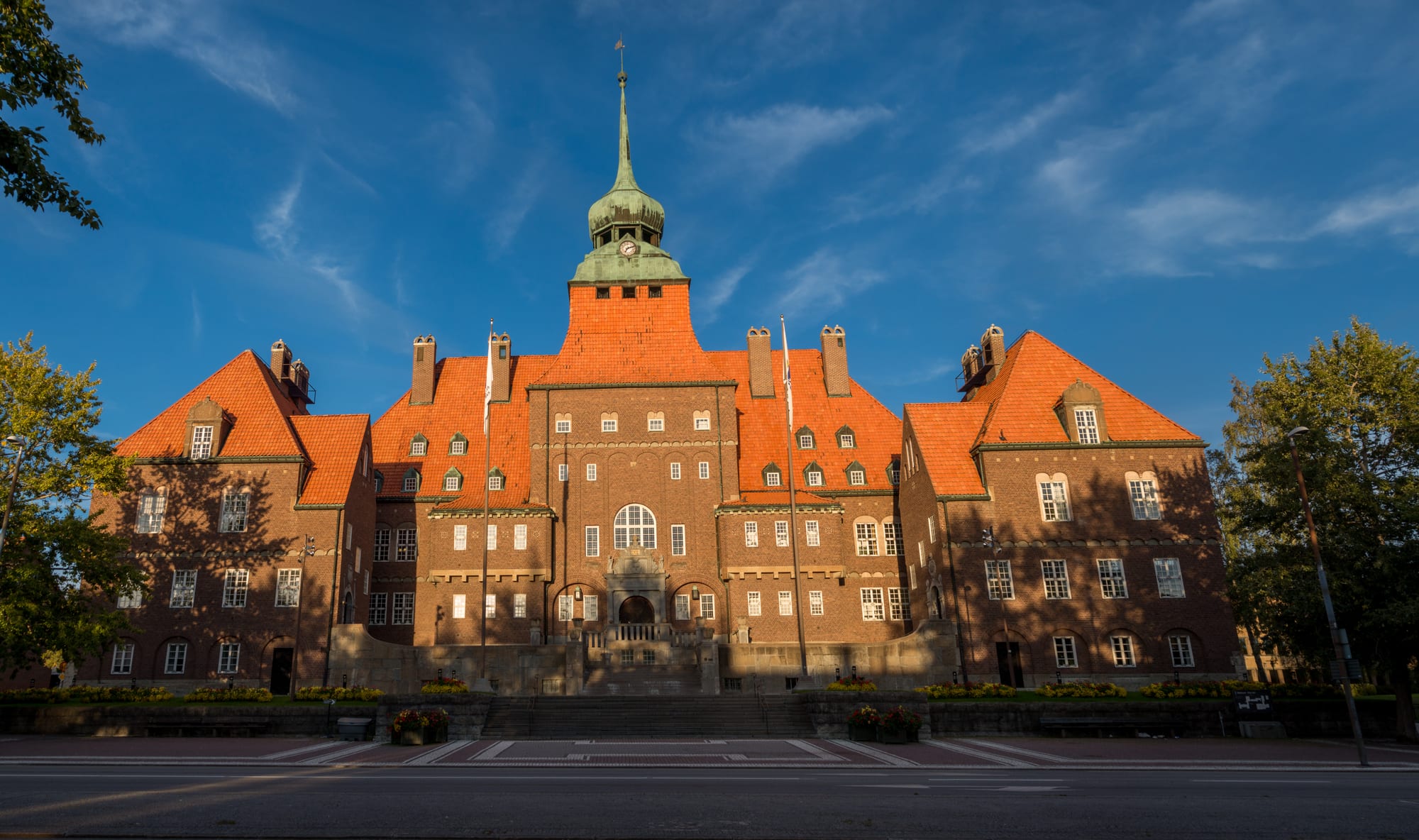
A red-brick city hall with orange tiled roofs and a green onion-domed tower under a blue sky with light clouds

Northern Sweden & the High Coast, Sweden

Östersund

Östersund City Hall, built in 1909–12 in the National Romantic style. (Andreaze / Wikimedia Commons · CC BY-SA 4.0)

Jämtland's only city, on the eastern shore of Lake Storsjön facing the island of Frösön, the old centre of the province. Founded by Gustav III in 1786 and made by the railway a century later, Östersund is a trading, university and winter-sports city, with the Jamtli open-air museum, a famous lake monster and the long-running Storsjöyran festival.

Neighbourhoods

  • Staden — the city centre
    • First-time visitors
    • Shopping
    • Close to public transport

    The grid of streets running down the slope to the lake, with steep cross-alleys framing views west to Frösön and the mountains. Storgatan keeps whole blocks of buildings intact since the 1880s, Prästgatan is the main shopping street, and Stortorget is the market square at the heart of the festivals.

    Open in Maps
  • Frösön
    • Views
    • Quiet and residential
    • History

    The island across the strait, named after the Norse god Freyr and for centuries the centre of Jämtland. Today a large part of the city's population lives on its slopes facing the centre; the runestone, the airport and a lookout tower with a café are here.

    Open in Maps
  • The lakefront and harbour
    • Waterfront
    • Walks
    • Nightlife

    The shore below the centre, with Badhusparken and the harbour. In the week before Storsjöyran bars and restaurants gather by the lake, and in summer old steamships still sail on Storsjön.

    Open in Maps

Things to do

Landmarks and history

  • Östersund City Halllandmark

    The 51-metre National Romantic city hall of 1912, designed by Frans Bertil Wallberg, with an onion-shaped bell tower of Jämtland design and ornament carved in local limestone.

    Open in Maps
  • Frösö Runestonelandmark

    The northernmost raised runestone in Sweden and Jämtland's only runestone, dated to between 1030 and 1050, recording the conversion of Jämtland to Christianity.

    Open in Maps
  • Storgatanneighborhood

    A street whose buildings, in whole blocks intact since the 1880s, are counted among the best-preserved town streetscapes in Sweden.

    Open in Maps
  • Stortorgetlandmark

    One of six 'closed squares' built in Sweden, long the city's market place and the centre of the Storsjöyran festival and the Gregorie market.

    Open in Maps

Museums

  • Jamtlimuseum

    The regional open-air museum of Jämtland and Härjedalen, open to the public since 1930, where actors bring the historical buildings to life in summer and the Viking-age Överhogdal tapestries are on show.

    Open in Maps

The lake and the outdoors

  • Storsjönpark

    Sweden's fifth-largest lake, 74 metres at its deepest, used for swimming, boat trips and fishing in summer and skating and skiing on the ice in winter — and the home of the legendary lake monster, Storsjöodjuret.

    Open in Maps
  • Badhusparkenpark

    A lakeside park on the site of the city's old bath house, one of the large green spaces kept from the first town plan.

    Open in Maps
  • Östersund Ski Stadiumattraction

    The national biathlon stadium, a regular Biathlon World Cup venue whose tracks have opened with stored snow from 1 November every year since 2007.

    Open in Maps

Sport

  • Jämtkraft Arenaattraction

    The football stadium opened in 2007, home of Östersunds FK, who won the Swedish Cup in 2017 and beat Galatasaray on the way to a Europa League campaign.

    Open in Maps

Short trips from the city

  • Åreattraction

    Sweden's leading ski resort, west along the E14 and the railway, with downhill skiing on Åreskutan in winter and mountain biking and hiking in summer.

    Open in Maps

Seasonal events

  • Gregorie marketearly March

    A market on Stortorget tracing its lineage back to the 11th century.

  • Storsjöyranlast weekend of July

    A music festival in the city centre dating from the early 1960s and tied to the tongue-in-cheek Republic of Jamtland, drawing about 55,000 visitors.

  • Jamtli Christmas Marketsecond weekend of Advent

    A well-attended Christmas market in the open-air museum.

  • Biathlon World Cuplate November or early December

    World Cup biathlon races at the ski stadium, held in the city since 1989.

Eat and drink

Long-standing places and food districts in Östersund. Hours, ratings and directions come from your maps app, always current.

Cafés

  • Wedemarks Konditoricafe

    A classic Östersund café and bakery on the main pedestrian street, known locally as 'Wedan'.

    Open in Maps
  • Frösötornetcafe

    A café in a lookout tower on Frösön, with a view across the lake to the city and the mountains.

    Open in Maps

Food streets

  • Restaurants on Prästgatanneighborhood

    The main shopping street holds many of the city's restaurants, from traditional Nordic cooking to Thai food and live-music venues.

    Open in Maps

Experience Östersund

History

The shores of Storsjön have been lived on for thousands of years, but the centre of Jämtland was long the island of Frösön, Freyr's island, where a hill fort was built around 300 AD, a market was held from the 11th century and a runestone recorded the province's conversion to Christianity. Jämtland belonged to Norway for centuries and passed to Sweden only in 1645. The mainland shore opposite was little more than the island's link to the east.

Östersund was founded and chartered by Gustav III on 23 October 1786, the only Swedish town founded in the 18th century. It was meant to give the Crown control over the profitable trade of Jämtland's farmers, but they resisted dealing through middlemen, and for its first fifty years the town grew by an average of only eight people a year. Trade was liberalised and logging grew in the 1850s, but the real change came with the railway in 1879; by 1882 the line ran across the mountains to Trondheim and east to Sundsvall, and Östersund replaced Frösön as the centre of Jämtland. It became a wholesale centre for northern Sweden and a major garrison town, and the Inlandsbanan later crossed it from north to south.

After the Second World War the city grew with new suburbs and industry, and in 1963, as the rest of Jämtland lagged behind, the tongue-in-cheek Republic of Jamtland was proclaimed in protest at government policy, with Östersund as its capital. Frösö köping joined the city in 1970, public-sector jobs expanded, and since 2005 the city has been the largest campus of Mid Sweden University. The garrison closed in the early 21st century.

Culture & Customs

Östersund calls itself the Winter City, and winter sport is central to its identity. It has hosted the Biathlon World Championships in 1970, 2008 and 2019 and World Cup races since 1989, the Nordic Games were held here when Stockholm lacked snow, and the city has bid several times, without success, for the Winter Olympics. The national winter sports research centre works with the university. Östersund's skydiving club, formed in 1958, is the oldest of Sweden's drop zones, and the very first civilian parachute jump was made on the ice of Storsjön in 1956. In football, Östersunds FK rose from the fourth tier to win the Swedish Cup in 2017 and knock Galatasaray out of the Europa League.

Storsjöyran, the city festival, grew out of the Republic of Jamtland joke in the 1960s and now draws around 55,000 people to the centre at the end of July, with bars and restaurants gathering by the lake in the week before. Jamtli keeps the province's past alive with costumed actors in its historical buildings in summer and a Christmas market in Advent.

Local identity is strongly Jamtish. The lake monster Storsjöodjuret, first written about in 1635 and said in one tale to have been bound by a spell carved into the Frösö runestone, is a beloved local legend. Residents are östersundare, though country people call them stassbon, and the city also carries a Southern Sami name, Staare.

Daily Life

In 2020 about 53,000 people lived in the urban area, and the municipality had about 65,000 inhabitants in 2023, making Östersund by far the largest inland city in northern Sweden; a small part of the urban area lies in neighbouring Krokom municipality. It is the county seat and the economic and cultural centre of Jämtland, with the county administration, the regional hospital, government agencies and the Mid Sweden University campus of over 7,000 students.

Daily life follows the slope of the city: people live in the central grid of Staden, in districts such as Odensala, Torvalla, Lugnvik and Körfältet on the mainland, and on the slopes of Frösön, connected by bridges and city buses. The centre's shops and cafés line Prästgatan, and from many streets the lake and the mountains are in view — the so-called windows to the west.

Winter shapes routines, with ice grips, ski tracks and skating on the lake, and summer brings swimming and sunbathing by Storsjön. The closure of the garrison early this century and the long drift of people from the Jämtland countryside to the cities have shaped the city's recent history.

Food

Östersund's best-known contribution to Swedish food is a claim. Gunnar Sjödahl, a confectioner in the city, says he came up with the idea for the smörgåstårta — the sandwich cake, a savoury dish of layered white or light rye bread with creamy fillings and toppings — as an apprentice in Härnösand in 1965, and Smörgåstårta Day falls on 13 November, his birthday. The cake has become popular throughout Sweden, and the city's old cafés, such as Wedemarks on Prästgatan, keep up the tradition of coffee and pastries, or fika.

The lands around Storsjön have been described as the world's northernmost true inland farming district, and the elk, on Jämtland's coat of arms, is part of its heritage. The mountains to the west are Sami country, where traditional cooking is built on reindeer, fish such as whitefish and Arctic char, and game, seasoned with little more than salt.

Everyday eating follows Swedish husmanskost — meatballs with brown cream sauce and lingonberry jam, pea soup, herring and salmon — and the weekday lunch special, dagens rätt. Prästgatan's restaurants range from traditional Nordic cooking to Thai food, and wine and strong beer are sold through the state Systembolaget.

Planning tools

Budget

Östersund is moderately priced by Swedish standards. Free things — the lakeside path, the runestone, the views from Frösön, skating and skiing on the lake — balance the cost of restaurant meals and taxis, which are expensive. The city is busy with visitors during Storsjöyran and the Storsjöcupen youth football tournament.

Daily Budget Midrange
USD 150–280 (central hotel, restaurant dinners, Jamtli and other tickets, a hire car for day trips)
Daily Budget Shoestring
USD 65–100 (hostel bed, bakery and supermarket food, weekday lunch specials, city buses)

Buy long-distance train tickets well ahead — fares bought in the last week can be very high.

Best Time to Visit

Summer for swimming and boat trips on Storsjön, Jamtli's living-history season and the Storsjöyran festival at the end of July. The city sells itself as the Winter City: from late autumn the ski stadium opens, biathlon World Cup races come in late November or early December, and the Gregorie market fills the main square in early March.

Suggested Number of Days

Two days covers the centre, Frösön and the museum. Four or five allow time for the lake, the countryside around it and the mountains to the west; distances are long, so a car or careful use of trains and buses makes a difference.

First Visit
2 days
With Surroundings
4–5 days

Transportation

Stadsbussarna runs nine city bus routes, with tickets sold on board or as pre-paid cards; services thin out after 9 pm and on Sundays. Most of the city has separate cycle paths and bikes can be rented. Taxis are best booked in advance, and bridges link Frösön with the mainland and the islands beyond.

Use registered taxi companies rather than the unlicensed drivers who offer rides outside bars at closing time.

Airport & Station Connections

SJ high-speed and InterCity trains run from Stockholm in about five to six and a half hours, with a nightly sleeper as well; there are overnight trains from Gothenburg and, seasonally, Malmö, and Norrtåg regional trains on the line between Sundsvall and Storlien. The Inland Line, running north–south through Jämtland, also passes through the city. Åre Östersund Airport lies on Frösön, about 11 km from the centre, with buses and taxis into town. Winter snow sometimes disrupts trains.

Walkability

The centre and its surroundings are easy to explore on foot, though the city is built on a slope and the alleys down to the lake are steep. In winter heavy snow makes the streets slippery, and studs or ice grips on boots help. It can be windy by the lake.

Safety

Sweden is a very safe country for visitors. Östersund's risks are small: icy, sloping streets in winter, cold wind off the lake, and unlicensed taxis touting outside bars late at night.

Wear ice grips in winter and keep 112 in mind as the emergency number. Check current official travel advice before travelling.

Climate

A subarctic climate, much milder in winter than most places at this latitude because Atlantic winds reach the city through the mountain passes, but with rather cool summers. Rain and snow are less frequent than the Atlantic influence might suggest, and the city can be sunny in summer; cold north-westerly winds are known locally as nordvästan.

Summer
cool — summer-month temperatures in Jämtland average about 14°C in the east of the province and about 11°C in the fell region
Winter
cold — winter temperatures in Jämtland average from about -7°C in the western fells to about -11°C in the coldest outlying areas

Local Customs

Tipping is not customary in Sweden; rounding up the bill is usual for good service, and 5–10 per cent only for exceptional service. Locals call the city Stan, and rural Jämtlanders call its residents stassbon, 'towners'. Jämtland pride is strong, and the Republic of Jamtland is a long-running joke taken in good humour. The city also has a Southern Sami name, Staare.

Drinks stronger than 3.5 per cent are sold only at the state Systembolaget shops, which do not serve anyone under 20 and ask young-looking customers for identification.

Common Payment Methods

The currency is the Swedish krona (SEK). Sweden is one of the world's most cashless countries: most stores, restaurants and bars accept all major credit cards, contactless phone payments work where the reader shows the icon, and businesses that do not accept cash are common. The Swish app needs a Swedish bank account, and a few small vendors take only Swish or cash, so a small amount from an ATM can be useful.