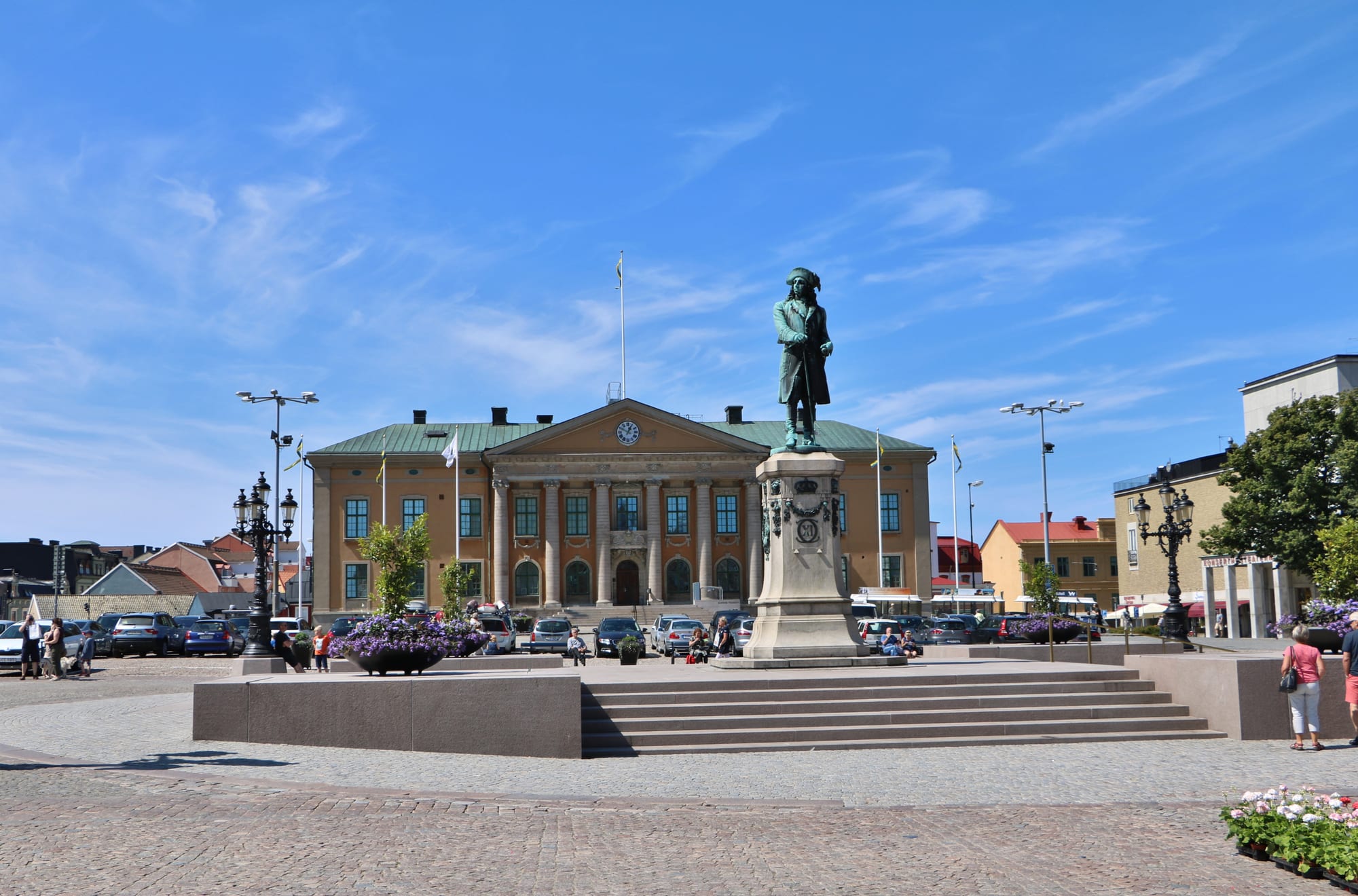
Karlskrona's wide paved main square with a bronze statue of Charles XI on a stone plinth in front of the columned yellow town hall

Skåne & the South, Sweden

Karlskrona

Stortorget in Karlskrona, with the statue of Charles XI and the town hall. (Bernt Fransson,Lindås / Wikimedia Commons · CC BY-SA 4.0)

The capital of Blekinge, spread over some 30 islands in the eastern Blekinge archipelago and founded in 1680 as a new base for the Swedish navy. Its uniform baroque centre on Trossö, the dockyard and the naval port form a UNESCO World Heritage Site, and the town remains home to Sweden's largest naval base alongside a strong information-technology industry.

Neighbourhoods

  • Trossö and Stortorget
    • First-time visitors
    • Historic district
    • Shopping

    The main island and town centre, laid out on a grid with a few diagonal streets and built in a uniform baroque style. The large main square, with two of the town's three World Heritage churches and the town hall, sits on top of a hill, and the pedestrian shopping streets run down from it.

    Open in Maps
  • The naval port
    • Naval history
    • Architecture

    The southern part of Trossö, where the navy's dockyard, its oldest buildings and the red wooden Admiralty Church stand. Much of the area is still a working military base, which makes the town the home of Sweden's largest naval base.

    Open in Maps
  • Western Trossö workers' cottages
    • Quiet and residential
    • Historic homes

    Several streets on the west side of the island, north of the naval yard, lined with the small cottages built for the dockyard's workers.

    Open in Maps
  • Stumholmen
    • Museums
    • Waterfront

    A small island east of Trossö, reached by the Bastionsgatan bridge, once owned by the navy and now home to the Naval Museum, an educational complex and a bathing spot with a diving board.

    Open in Maps
  • Dragsö
    • Beaches
    • Camping

    An island some way out from Trossö with a cluster of red wooden summer houses at Brändaholm, beaches for summer swimming and a large campsite; a bus, a bicycle or a long walk gets there.

    Open in Maps

Things to do

The baroque town

  • Stortorgetlandmark

    The main square, the largest in Sweden, laid out on the baroque pattern of a great-power capital with its churches and town hall at the edges.

    Open in Maps
  • Fredrik Churchlandmark

    The twin-towered baroque church on Stortorget, designed by Nicodemus Tessin the Younger, begun in 1720 and consecrated in 1744; its carillon of 35 bells chimes three times a day.

    Open in Maps
  • Trinity Churchlandmark

    The domed German Church on the main square, inaugurated in 1709 for the town's German-speaking residents and rebuilt in a neoclassical style after the fire of 1790.

    Open in Maps
  • Admiralty Churchlandmark

    Consecrated in 1685 and built entirely of wood, painted Falu red outside and pale blue within; it once seated 4,000, making it Sweden's largest wooden church.

    Open in Maps
  • Rosenbomattraction

    The carved wooden poor box in front of the Admiralty Church, an old man whose hat lifts to take a coin, made famous by Selma Lagerlöf's The Wonderful Adventures of Nils.

    Open in Maps
  • Admiralty clock towerlandmark

    A yellow tower from 1699 in the park south of the main square, built to tell the shipyard workers the time and used as a church tower since 1909.

    Open in Maps

Museums

  • Naval Museummuseum

    Sweden's national naval museum on Stumholmen, founded on a royal model room of 1752, with ship models, figureheads, an underwater tunnel over old wrecks, a submarine hall and four museum ships moored outside.

    Open in Maps
  • Blekinge Museummuseum

    The county museum in the town centre, which also offers traditional Blekinge boats for day hire.

    Open in Maps

Islands and viewpoints

  • Stakholmviewpoint

    A large rock joined to Trossö by a bridge, with views in every direction and a popular place for a picnic at sunset.

    Open in Maps
  • Archipelago boatsattraction

    In summer, boats run between the islands of the archipelago, and cruises of one and a half to three hours leave from the town.

    Open in Maps
  • Aspö and Drottningskärattraction

    An island reached by a free ferry from the harbour in about half an hour, with rugged beaches, a museum of coastal artillery and the 17th-century naval citadel of Drottningskär, part of the World Heritage Site.

    Open in Maps

Short trips from the town

  • Kristianopelattraction

    A small coastal village founded as a town in 1599 by King Christian IV of Denmark, when Blekinge was Danish.

    Open in Maps
  • Ronnebyattraction

    An old spa town with a large park and forest, about half an hour west by train.

    Open in Maps

Seasonal events

  • Lövmarknadenthe day before Midsummer's Eve, June

    The Leaf Fair, the most important day of the year in Karlskrona, a huge market that draws tens of thousands of visitors.

Eat and drink

Long-standing places and food districts in Karlskrona. Hours, ratings and directions come from your maps app, always current.

Food districts

  • The pedestrian streetsneighborhood

    Ronnebygatan and Rådhusgatan, the pedestrian shopping streets, and the square at the top of the hill hold most of the town's restaurants, kebab shops, cafés and pubs.

    Open in Maps

Cafés

  • Kafé Måsencafe

    The Seagull Café, a seasonal eatery in the village of Torhamn, at the south-eastern tip of Sweden, with live music in summer.

    Open in Maps
  • Fika on Trossöcafe

    Cafés around the shopping streets serve fika, the coffee-and-cake break of Swedish afternoons.

    Open in Maps

Experience Karlskrona

History

Under Danish rule, Trossö was farmland and grazing, and the nearest town was Lyckeby on the mainland, which lost its privileges when Christian IV founded Kristianopel in 1599. The Treaty of Roskilde made Blekinge Swedish in 1658, and Sweden, then the dominant power in the Baltic, wanted its fleet out of Stockholm, where it was regularly trapped by winter ice. An ice-free harbour among sheltering islands, facing Denmark and close to Sweden's German and Baltic provinces, was the answer. In 1679 the crown forced the island's owner, the farmer Vittus Andersson, to sell, and the town was founded on 10 August 1680, named Karl's Crown after Charles XI. Ronneby's people were made to move here, and shipwrights came from Ostrobothnia and Stockholm.

Erik Dahlbergh's plan of 1694 shaped the town, and Nicodemus Tessin gave it a uniform baroque style. By 1711 the dockyard was Sweden's largest industrial employer, with 1,100 workers; its oldest dock, the Polhem dock, is cut into the rock. Around the middle of the 18th century Karlskrona had about 10,000 people and was the third largest town in the kingdom, but plague killed about 7,000 in 1701–11, and epidemics struck again in 1741 and 1789. A fire in 1790 burned most of the town, and the plan to make it a new capital was never realised.

The railway arrived in 1874, and an electric tram ran from 1910 to 1949. In October 1981 the Soviet submarine U 137 ran aground in the archipelago nearby, briefly raising tension with the Soviet Union. In 1998 the naval port was declared a UNESCO World Heritage Site.

Culture & Customs

Karlskrona is known as Sweden's only baroque city, and its culture is bound up with the navy. The naval port, the dockyard, the fortifications on the islands and the three churches on Trossö make up the World Heritage Site, and the Naval Museum, the most visited in the town, draws about 250,000 people a year. Its core is the collection of ship models begun in 1752, along with the figureheads carved by Johan Törnström, the navy's royal sculptor in the 1700s.

The town has long been a mix of peoples: a German community had its own church and parish from 1680 until 1846, and a Jewish congregation existed from 1785 to 1994. Rosenbom, the wooden poor box outside the Admiralty Church, has been a local character since the 18th century and entered literature through Selma Lagerlöf's The Wonderful Adventures of Nils. Karlskrona also appears in Patrick O'Brian's The Surgeon's Mate as the base of the British Baltic fleet.

The great day of the year is Lövmarknaden, the Leaf Fair held on the day before Midsummer's Eve, which draws tens of thousands of visitors. In summer the harbour once hosted a festival called The Sail, since replaced by a Skärgårdsfest, an archipelago festival. Local sports clubs include teams in handball, football and ice hockey.

Daily Life

About 37,000 people lived in the town itself in 2021 and around 60,000 in the municipality, which spreads over some 30 islands — Trossö, Saltö, Sturkö, Hästö, Långö and Aspö among them — and the mainland. Most islands are joined by roads, while Aspö depends on its car ferry.

The navy is still central: Karlskrona has Sweden's largest naval base and the headquarters of the Swedish Coast Guard, and work still goes on at the old shipyard. Civilian industry has a strong presence too, especially information technology, and the biggest employers include Telenor Sverige, Ericsson, NKT and Roxtec. The Blekinge Institute of Technology, founded in 1989, has its main campus here, with about 8,000 students and 600 staff.

The town is also a gateway across the Baltic: Stena Line ferries to Gdynia in Poland carry nearly 500,000 people a year. Life follows the seasons of the archipelago: in summer residents head for the islands, beaches and boats, and in winter islands such as Aspö grow quiet, with little open beyond the local shop.

Food

A dish of Blekinge and its neighbouring provinces is the kroppkaka, a boiled potato dumpling usually filled with pork and onion and served with melted butter, lingonberry jam or cream. Each province makes it differently, and Blekinge's version, known as grey kroppkakor, is made almost entirely from raw potato with only a little boiled potato. Fillings of eel and seabirds were once eaten by the poor in Blekinge and on Öland, though pork is by far the most common.

Day-to-day eating centres on the pedestrian streets of Trossö, Ronnebygatan and Rådhusgatan, and the square at the top of the hill, where Swedish restaurants sit beside sushi bars, kebab shops with seating and pubs. Some restaurants serve smörgåsbord-style lunches, and cafés do steady business with fika, the afternoon coffee-and-cake break. In summer, eating moves out to the archipelago, where seasonal cafés such as Kafé Måsen in Torhamn add live music to the menu.

Planning tools

Budget

Karlskrona is cheaper than Malmö or Stockholm, and the town's main sights — the square, the churches, the waterfront and the free Aspö ferry — cost nothing. The Naval Museum, archipelago boat trips and summer accommodation are the main costs.

Daily Budget Midrange
USD 150–260 (hotel on Trossö, restaurant dinners, museum entry, an archipelago cruise)
Daily Budget Shoestring
USD 65–100 (hostel or campsite on Dragsö, self-catering, kebab and lunch deals, local buses and the free ferry)

Bicycles can be hired in town, and riding is a good way to reach the outer islands such as Dragsö.

Best Time to Visit

May to September, when days are often sunny and the archipelago boats run; the town has one of the sunniest climates in Sweden, and the Leaf Fair fills the town the day before Midsummer's Eve. From October to February skies are often grey and overcast, and on islands such as Aspö most things close outside June to August.

Suggested Number of Days

The baroque centre and its museums fit into a day or two. Three or four days leave time for the islands of the archipelago and the coast on either side of the town, which depend on summer boats and ferries.

First Visit
1–2 days
With Surroundings
3–4 days

Transportation

Trossö is compact, and most islands are linked to it by road; the town is not completely flat but has plenty of cycle paths. Blekingetrafiken runs the buses, boats and trains in the county. Aspö is reached by a small road ferry that is free for cars, bicycles and foot passengers, and boats serve the other islands in summer.

Most exhibits at the Naval Museum are in Swedish, so an audio guide is worth picking up.

Airport & Station Connections

Karlskrona Central station is at the northern end of the centre, with direct trains from Copenhagen via Malmö and Kristianstad; from Kalmar, Gothenburg or Stockholm there is a change on the way. Ronneby Airport, about 30 kilometres away, has scheduled flights to Stockholm, and an airport bus runs to the town. Stena Line ferries arrive from Gdynia in Poland at the terminal on the island of Verkö.

Walkability

The centre of Trossö is easy on foot: a grid of streets runs from the station down to the main square, the churches and the waterfront, with Stumholmen and Stakholm a short walk away. Because the streets follow a grid, wind from the sea blows straight into the heart of the town. Dragsö and the outer islands are further and suit a bus or a bicycle.

Safety

Sweden is a very safe country for visitors. Karlskrona is a quiet naval town, and the practical points are the wind off the sea, chilly and damp in winter, and the limited services on the outer islands outside the summer months.

Dress for the wind on the islands, and check boat times before heading into the archipelago outside June to August. Check current official travel advice before travelling.

Climate

One of the driest and sunniest climates in Sweden, as the town lies in the rain shadow of the South Swedish highlands. Spring arrives in March and is often sunny and dry, and autumn stays mild; long-lasting snow cover is uncommon, and snow usually melts within days. Humidity stays high all year because of the sea winds.

Summer
often sunny from May into September, with daytime highs near 20°C and occasional showers once westerly winds pick up around midsummer
Winter
grey and overcast from October to February; December lows stay above 0°C, while January and February are often the coldest months, with plenty of precipitation and damp winds

Local Customs

The navy is part of local identity, and much of the old naval port remains a working base. Lifting Rosenbom's hat and dropping a coin into the old poor box outside the Admiralty Church is a long-standing custom. Wine, spirits and strong beer are sold only in the state Systembolaget shops, one of them in a mall off Rådhusgatan.

The town's churches are working churches; keep quiet during services.

Common Payment Methods

The currency is the Swedish krona. Sweden is one of the world's most cashless countries: card payments are very common, as is the Swish phone app (which needs a Swedish bank account), and businesses that do not take cash at all are common too. Contactless phone payments work wherever the reader shows the contactless icon, and a PIN for the card is needed.