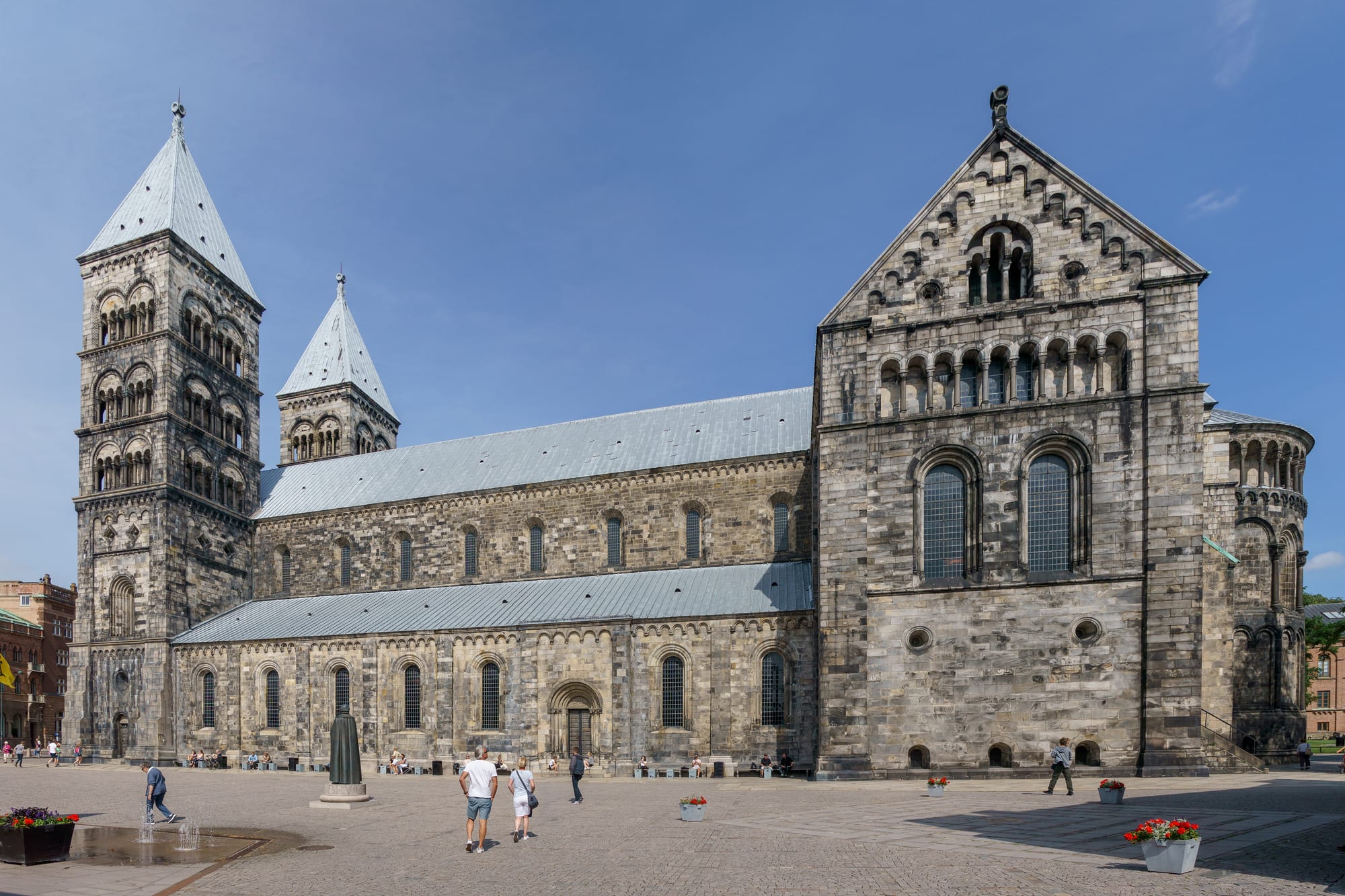
The grey stone Romanesque Lund Cathedral with two west towers and a gabled transept, seen across a sunny paved square

Skåne & the South, Sweden

Lund

Lund Cathedral, the Romanesque church at the centre of the old town. (Colin / Wikimedia Commons · CC BY-SA 4.0)

A university city in western Skåne, a short train ride from Malmö and Copenhagen, founded around 990 when the province was Danish. An archbishopric for all Scandinavia from the early 12th century and a university town since 1666, it keeps a medieval street plan around its Romanesque cathedral, while research and high-tech firms fill its newer northern districts.

Neighbourhoods

  • The old town and Stortorget
    • First-time visitors
    • Historic district
    • Shopping

    The centre keeps much of its medieval street layout, an irregular web of lanes that can be hard to navigate without the cathedral towers as a landmark. The town hall stands on Stortorget, the main square, which hosts concerts and events, and many of the surrounding buildings date from the late 1800s.

    Open in Maps
  • Lundagård and the university quarter
    • Architecture
    • Museums
    • Students

    The park at the heart of the university, between the 1882 main building to the north and the cathedral to the south, with the 16th-century Kungshuset in between. The Historical Museum stands beside it, and the trees hold a large colony of rooks.

    Open in Maps
  • Mårtenstorget and Kulturen
    • Best for food
    • Museums

    The square that was once the cattle market now holds the market hall, with restaurants, food trucks and bars around it and market stalls by day. The open-air museum of Kulturen fills two blocks close by, and the Botanical Garden lies a few blocks to the east.

    Open in Maps
  • The station and Clemenstorget
    • Close to public transport
    • Arriving by train

    The west side of the centre around Lund Central, one of the oldest working stations in Sweden. Tree-covered Clemenstorget beside it has a small market and the tram terminus, and the green square of Bantorget is a step away.

    Open in Maps
  • Norra Fäladen
    • Quiet and residential
    • Students

    A district in the north of the city, built mostly in the 1960s and 1970s, whose eastern part holds the student housing areas of Delphi, Kämnärsrätten and Klosterängen, where a large share of the university's students live.

    Open in Maps
  • The north-east science district
    • Science and technology
    • Close to the tram

    The engineering faculty, the Ideon Science Park, where Bluetooth was created, and the new district of Brunnshög with the MAX IV synchrotron, all strung along the tram line that runs out from the station.

    Open in Maps

Things to do

Famous landmarks

  • Lund Cathedrallandmark

    Built as the archiepiscopal church for all the Nordic countries and largely finished by 1145, it has been called the most powerful representative of Romanesque architecture in the Nordic countries.

    Open in Maps
  • The astronomical clockattraction

    A 15th-century clock inside the cathedral; twice a day figures of the Three Kings parade across its face while a built-in organ plays In dulci jubilo.

    Open in Maps
  • Kungshusetlandmark

    The King's House in Lundagård, built by the Danish king Frederick II between 1578 and 1584 as a residence for the bishop and later the university's first main building.

    Open in Maps
  • Lund University Main Buildinglandmark

    Helgo Zettervall's classical-style university hall, inaugurated by King Oscar II in 1882, with sphinxes on its roof.

    Open in Maps
  • St Peter's Priory Churchlandmark

    The church of one of Denmark's early monastic houses, among the few medieval buildings left in the town.

    Open in Maps

Museums

  • Kulturenmuseum

    Opened on its present site in 1892, the world's second-oldest open-air museum after Skansen, with historic buildings from the Middle Ages to the 1930s set in gardens and cobbled lanes across two blocks.

    Open in Maps
  • Historical Museum at Lund Universitymuseum

    Founded in 1805, it holds the region's prehistoric and medieval collections, including finds from the Iron Age site at Uppåkra, and church art linked to the cathedral.

    Open in Maps
  • Museum of Sketches for Public Artmuseum

    Skissernas museum, founded in 1934, collects the sketches and models behind murals, sculpture and reliefs, showing how public artworks take shape.

    Open in Maps

Parks and green spaces

  • Lundagårdpark

    The tree-shaded park between the cathedral and the university main building, the traditional centre of the university.

    Open in Maps
  • Botanical Gardenpark

    An eight-hectare garden run by the university and open to the public free of charge, with about 7,000 plant species, many of them in greenhouses representing nine climate zones.

    Open in Maps
  • Stadsparkenpark

    The main city park, laid out after the Lund Exhibition of 1907, with gardens, a small lake, sculptures and the old observatory buildings; it is the gathering place for the Walpurgis bonfire on 30 April.

    Open in Maps
  • Sankt Hans backarviewpoint

    A largely artificial hill park in the north of the city, the largest green space in Lund, with views over the town towards the Öresund.

    Open in Maps

Music and nights out

  • Mejerietattraction

    A non-profit cultural venue in an old dairy, open since 1987, with two stages, a cinema and a bar, which has hosted acts from Miles Davis to the Ramones.

    Open in Maps

Short trips from the city

  • Uppåkraattraction

    A village about five kilometres south of Lund on the site of a large Iron Age settlement, excavated since 1996 and thought to be the forerunner of the town.

    Open in Maps
  • Dalby Churchlandmark

    One of the oldest churches in Sweden, commissioned by King Sweyn II of Denmark in the village of Dalby east of Lund.

    Open in Maps
  • Dalby Söderskog National Parkpark

    A tiny national park of broadleaf forest near Dalby, established in 1918.

    Open in Maps
  • Malmöattraction

    Sweden's third-largest city, about 15 kilometres to the south-west, the end of the Öresund Bridge to Denmark.

    Open in Maps

Seasonal events

  • Walpurgis Night30 April

    Students, graduates and alumni celebrate the arrival of spring from early morning to late night, and crowds gather around a large bonfire in Stadsparken.

  • Lund International Architecture Film Festivalautumn

    An annual festival of films about architecture and cities.

Eat and drink

Long-standing places and food districts in Lund. Hours, ratings and directions come from your maps app, always current.

Food districts and markets

  • Lund Market Hallmarket

    The market hall on Mårtenstorget, with food stalls and restaurants under one roof; the square outside fills with food trucks and bars.

    Open in Maps
  • Clemenstorgetmarket

    The tree-covered square by the station, with a small market and flea-market stalls.

    Open in Maps

Cafés and bars

  • Stäketrestaurant

    A restaurant in one of the few buildings in Lund that survive from the Middle Ages.

    Open in Maps
  • Café Arimancafe

    A café where the alternative crowd meets, with board games and soups and sandwiches at lunch.

    Open in Maps
  • Student nation pubsneighborhood

    A large part of the city's student nightlife takes place in the student nations, the university societies named after the regions their members once came from.

    Open in Maps

Experience Lund

History

Lund's origins are older than its streets. Archaeology suggests the town was founded around 990, perhaps by moving the people of Uppåkra, a large settlement about five kilometres to the south that had existed since the first century BC. King Sweyn Forkbeard is credited with the move, to a hill above a ford that was easier to defend. Scania was then part of Denmark, and the church made the town: Lund became a diocese in 1048, and in 1104 the seat of an archbishop whose province covered all of Scandinavia, as far as Greenland. The cathedral was largely finished by 1145, and the cathedral school, founded in 1085, is the oldest school in Scandinavia.

The town's weight shifted with the borders. Malmö, founded as the archbishop's port, overtook it in trade, and a medieval academy was suppressed at the Danish Reformation in 1537. In 1658 the Treaty of Roskilde made Lund Swedish, and in 1666 Sweden founded the university as part of its effort to make the province Swedish. Denmark retook the town in 1676, early in the Scanian War, but in December that year the Battle of Lund, one of the bloodiest in Nordic history, was fought just north of the city and ended in a decisive Swedish victory.

In the 20th century the population more than doubled as the university grew and high-tech companies arrived. Tetra Pak was founded here in 1951, large housing districts such as Norra Fäladen were built in the 1960s and 1970s, and a British aircraft accidentally bombed the town in 1943, injuring several people. The MAX IV synchrotron opened in 2016 and a tram line followed in 2020.

Culture & Customs

Culture in Lund is shaped by the university and its students, more than a quarter of them from abroad. Student life is organised around the nations, societies whose clubs and pubs carry much of the nightlife, and around traditions such as the spex, parodic musical plays that set well-known tunes to new lyrics. Every four years the students stage Lundakarnevalen, a carnival of costumed parades, satire and revues run by thousands of volunteers.

Lund has long been a centre of church and classical music, with an unusually large number of amateur choirs, and since 2006 it has hosted the Lund International Choral Festival. Mejeriet, a former dairy, has been the main stage for rock and pop since 1987. Writers have long gathered here, from Esaias Tegnér to August Strindberg, and the Lund novel, about a young student growing up between Lund and Copenhagen, is a genre of its own. The closing scenes of Ingmar Bergman's Wild Strawberries are set in the town, and in October 2025 Lund was named a UNESCO City of Literature.

Spring is the high point of the student year: on 30 April, Walpurgis Night, students and alumni celebrate from morning to late at night, and crowds gather round a bonfire in the city park. Handball, with the LUGI club, and chess, with Lunds ASK, have strong local traditions.

Daily Life

About 94,000 people lived in the town of Lund in 2023, out of about 130,000 in the municipality, which includes Dalby, Södra Sandby, Veberöd and the surrounding countryside. In 2024 about 23.5 per cent of the municipality's residents were born outside Sweden. Students make up a large part of the population, and their numbers swing sharply at the start of each term, when the shortage of affordable rooms is felt most.

The university, with about 41,000 students, and Skåne University Hospital are major employers. Around them has grown a technology economy: Tetra Pak's headquarters, Axis Communications, the Ideon Science Park, the Medicon Village research park on the old AstraZeneca site, and, in the new north-eastern district of Brunnshög, the MAX IV synchrotron and the European Spallation Source.

The town is built for bicycles. Lund has more than 260 kilometres of cycle paths and about 43 per cent of journeys in the city are made by bike, while car use has not grown for a decade. Direct trains run to Malmö, Copenhagen, Gothenburg and Stockholm, and the station is one of the busiest in Sweden.

Food

Lund eats like the rest of Skåne, one of Sweden's richest farming districts. Spettekaka, a cake central to the province's culinary heritage, is made by rolling a batter of eggs, potato starch flour and sugar slowly onto a turning spit over a fire; the result is dry and crisp, like meringue, is cut with a fine saw rather than a knife, and is often served with dark coffee, vanilla ice cream or port. Skånsk spettkaka has protected status under EU law. Äggakaka, an egg pancake fried in butter and turned once, is always served with fried smoked pork belly and lingonberries; it was once made for farmworkers to eat in the fields. In November, goose is eaten for St Martin's Day, a custom that spread to Sweden from France.

The market hall on Mårtenstorget is the centre of food shopping, with stalls and restaurants inside and food trucks and bars around the square. A university town also eats cheaply: falafel and kebab counters, Persian grills and pizzerias are spread around the centre and the campus, and much of the students' evening life happens in the nations. Röde Orm, a beer brewed in Lund, turns up in the town's pubs.

Planning tools

Budget

Lund is a little cheaper than Stockholm and close in price to Malmö. The main costs are rooms and restaurant dinners; the cathedral, the parks and the Botanical Garden are free, and the compact centre needs no transport.

Daily Budget Midrange
USD 150–280 (central hotel, restaurant dinners, museum tickets, trains to Malmö or Copenhagen)
Daily Budget Shoestring
USD 65–100 (hostel bed, market-hall lunches and falafel, walking and cycling)

Lunch is the cheapest time for a cooked meal, and many sights in the centre — the cathedral, Lundagård, the Botanical Garden — cost nothing to visit.

Best Time to Visit

Late April to September. Walpurgis Night on 30 April opens the spring season with student celebrations, the parks are at their best in May and June, and summer days are long, with up to 17 hours of daylight. Term time brings the student life; midwinter has only around seven hours of daylight but mild temperatures for Sweden.

Suggested Number of Days

The old centre is small and a first visit takes a day or two. Three or four days allow time for the villages and woods around the town and for Malmö, which is close enough by train for an easy visit from Lund.

First Visit
1–2 days
With Surroundings
3–4 days

Transportation

Most of the centre is walked or cycled: Lund has more than 260 kilometres of cycle paths and about 43 per cent of trips in the city are made by bike. Green electric city buses run on seven lines and yellow regional buses serve the surrounding towns. A 5.5-kilometre tram line runs from the station to the hospital, the engineering campus, Ideon, Brunnshög and the research facilities in the north-east.

Buses in Skåne do not take cash: tap a bank card on the reader or buy the ticket in advance.

Airport & Station Connections

Copenhagen Airport is the main gateway, reached by frequent direct trains across the Öresund Bridge in about 35 minutes; Malmö Airport, about 26 kilometres away, is used mainly for domestic flights. Lund Central is one of Sweden's busiest stations, on the main lines to Stockholm and Gothenburg, and trains from Malmö take about 15 minutes.

Walkability

The centre is small enough to see most of it in an afternoon's walk, and the main squares are linked by short streets and passages. The medieval street plan has no river or grid to steer by, so the cathedral towers are the easiest landmark. Cyclists are everywhere, and walkers need to keep out of the cycle lanes.

Safety

Sweden is a very safe country for visitors. Lund's centre is busy with students into the evening, and the practical risks are bicycle theft and the crowded cycle paths.

Lock bicycles securely and stay off cycle lanes when walking. Check current official travel advice before travelling.

Climate

An oceanic climate, mild for its latitude because of the nearby sea, and among the mildest in Sweden. Rain is light to moderate through the year, and snow falls sparingly, mainly from December to March, rarely lying for long.

Summer
warm and pleasant — average highs around 23°C and lows around 14°C, with temperatures often above 25°C
Winter
chilly rather than harsh — temperatures usually between -1 and 3°C, and some winters almost snowless

Local Customs

Student traditions shape the town: the nations run pubs and clubs, amateur choirs are a strong tradition, and the student carnival takes over the town every four years. Wine, spirits and strong beer are sold only in the state Systembolaget shops, one of which is in the market hall. Cycling is the normal way to get about, and pedestrians are expected to keep out of the cycle lanes.

Walpurgis Night on 30 April brings large, cheerful crowds; the cathedral is a working church, so keep quiet during services.

Common Payment Methods

The currency is the Swedish krona. Sweden is one of the world's most cashless countries: card payments are very common, as is the Swish phone app (which needs a Swedish bank account), and businesses that do not take cash at all are common too. Contactless phone payments work wherever the reader shows the contactless icon, and a PIN for the card is needed.