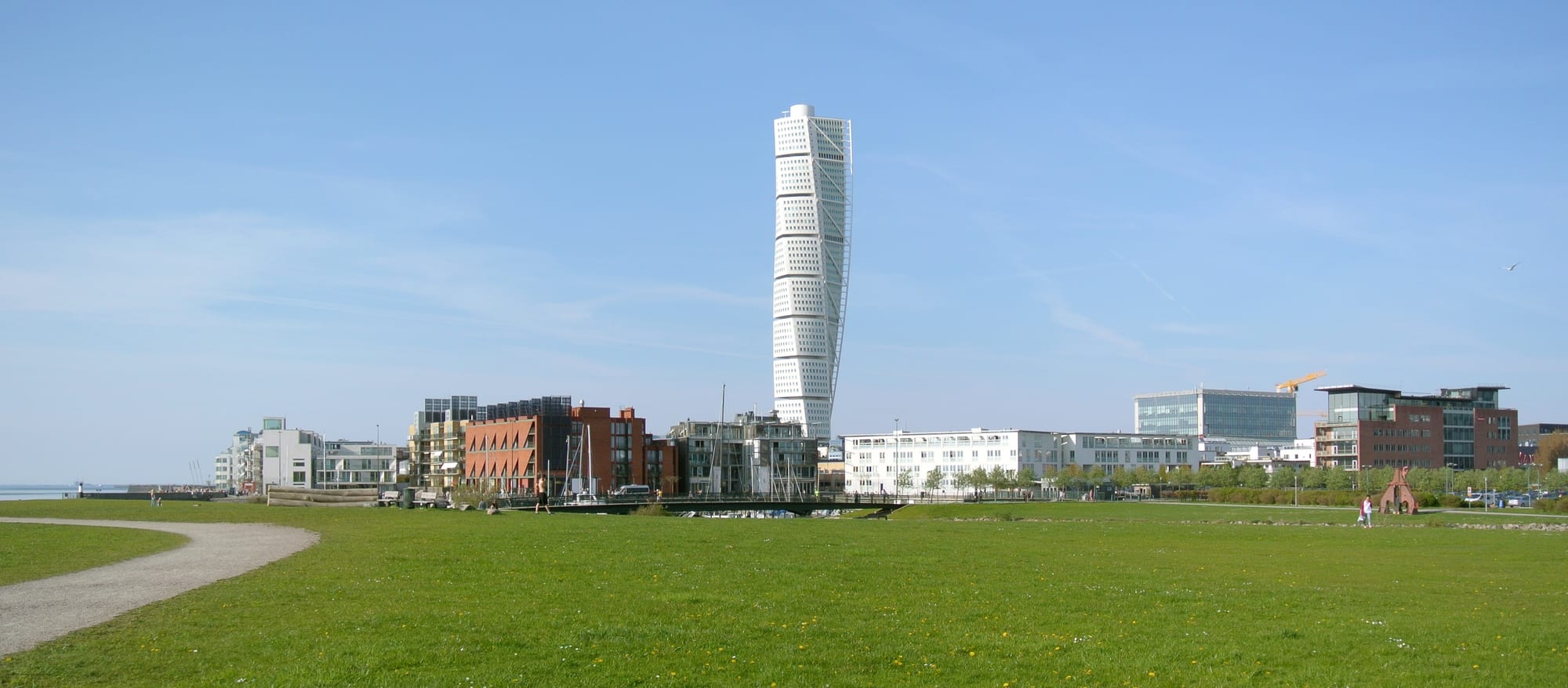
The white twisting Turning Torso tower rising above low modern apartment blocks and a wide green lawn under a blue sky

Skåne & the South, Sweden

Malmö

The Western Harbour and the Turning Torso, seen from Ribersborg beach. (Adbar / Wikimedia Commons · CC BY-SA 4.0)

Sweden's third city, on the Öresund strait facing Copenhagen — a Danish trading and herring town until 1658, then one of Scandinavia's earliest industrial cities, built around the Kockums shipyard. After the yards closed it reinvented itself through a university, the Öresund Bridge and the Western Harbour, and is now a young, diverse and fast-growing city of cyclists.

Neighbourhoods

  • Gamla Staden (Old Town)
    • First-time visitors
    • Historic district
    • Close to public transport

    The historic centre inside the canals, laid out between 1300 and 1600, with three squares — Stortorget, Lilla Torg and Gustav Adolfs torg — linked by a pedestrian shopping street. St Peter's Church, the castle parks and the Central Station are all within a short walk.

    Open in Maps
  • Västra hamnen
    • Modern architecture
    • Waterfront
    • Swimming

    The former industrial Western Harbour, rebuilt from 2001 as a residential district around the Bo01 housing exhibition, with the Turning Torso at its edge. Its long seaside boardwalk is a favourite summer place for bathing and gatherings, especially among students.

    Open in Maps
  • Möllevången
    • Best for food
    • Nightlife
    • Local life

    Möllan, a diverse inner-city neighbourhood with a left-wing reputation, built around Möllevångstorget, home to the city's liveliest market. Cheap restaurants from many cuisines, good-value bars and Folkets Park make it a busy evening district.

    Open in Maps
  • Davidshall
    • Shopping
    • Cafés

    A neighbourhood near Triangeln built around a square of 1920s classicist buildings, with a more upmarket feel than Möllevången and shops along Davidshallsgatan.

    Open in Maps
  • Ribersborg
    • Beaches
    • Quiet and residential

    The seaside district west of the centre, fronted by Ribersborg beach, a long, man-made shallow beach with the historic open-air bathhouse on its pier.

    Open in Maps
  • Limhamn
    • Quiet and residential
    • Waterfront

    The southern district of the city, briefly a town of its own before 1915, with a marina and a quieter, residential seaside character.

    Open in Maps

Things to do

Famous landmarks

  • Malmö Castlelandmark

    Malmöhus, built in 1526–1539 on its islet and the oldest preserved Renaissance castle in the Nordic region, now part of the Malmö Museum.

    Open in Maps
  • St. Peter's Churchlandmark

    The city's oldest building, a 14th-century Brick Gothic church, built as Malmö's main church and probably modelled on St Mary's in Lübeck.

    Open in Maps
  • Stortorgetlandmark

    The main square, laid out from 1538, with the Town Hall, Jørgen Kock's House, the Lion Pharmacy and an equestrian statue of Charles X Gustav.

    Open in Maps
  • Lilla Torglandmark

    The small square in the old town beside Stortorget, ringed by restaurants whose outdoor terraces fill with people in summer.

    Open in Maps
  • Turning Torsolandmark

    Santiago Calatrava's twisting 190-metre residential tower of 2005, the tallest building in the Nordic region until 2022.

    Open in Maps

Museums and culture

  • Malmö Museummuseum

    The city and regional museum, with history, natural history, an aquarium and a science centre at the castle and in the Technology and Maritime Museum, which displays aircraft, boats and a submarine.

    Open in Maps
  • Moderna Museet Malmömuseum

    A branch of Sweden's national museum of modern art, opened in 2009 in a former power station of 1901 with an orange-red perforated-metal annex.

    Open in Maps
  • Malmö Konsthallmuseum

    One of Europe's largest exhibition halls for contemporary art, opened in 1975.

    Open in Maps
  • Malmö Operaattraction

    Sigurd Lewerentz's theatre of 1933–1944, with one of Scandinavia's largest auditoriums at 1,511 seats.

    Open in Maps
  • Malmö Liveattraction

    The concert hall and convention complex opened in 2015, home of the Malmö Symphony Orchestra.

    Open in Maps

Parks and the waterfront

  • Kungsparken and Slottsparkenpark

    Two adjoining parks around the castle and its canal, with the city library in one corner, a large playground and a pond full of ducks, herons and swans.

    Open in Maps
  • Pildammsparkenpark

    A 45-hectare neoclassical park laid out for the Baltic Exhibition of 1914 around two old reservoir ponds.

    Open in Maps
  • Ribersborg open-air bathattraction

    A historic wooden bathhouse of 1898 on a pier off Ribersborg beach, with sea bathing and saunas all year.

    Open in Maps
  • Ribersborg beachbeach

    A man-made shallow beach along the city's shore, sometimes jokingly called Malmö's Copacabana.

    Open in Maps

Markets

  • Möllevångstorgetmarket

    The square at the heart of Möllevången, home to the liveliest market in the city.

    Open in Maps

Short trips from the city

  • Öresund Bridgelandmark

    The road and rail bridge to Denmark, opened on 1 July 2000; the bridge itself is 8 km long, with pylons over 200 metres high, and the whole link with its tunnel is 16 km.

    Open in Maps
  • Lund Cathedrallandmark

    In the university town of Lund, a Romanesque cathedral whose main altar was consecrated in 1145, built as the archiepiscopal seat of all the Nordic countries.

    Open in Maps
  • Copenhagenattraction

    The Danish capital across the strait, about 40 minutes by train from Malmö Central over the bridge.

    Open in Maps

Seasonal events

  • BUFF International Film FestivalMarch

    An international film festival for children and young people, founded in 1984.

  • Malmöfestivalenthird week of August

    A free eight-day festival that fills the city's streets with food from many cuisines and cultural events.

  • Nordisk Panorama Film FestivalSeptember

    A festival of Nordic short and documentary films, held in Malmö every year since 2013.

Eat and drink

Long-standing places and food districts in Malmö. Hours, ratings and directions come from your maps app, always current.

Food districts and markets

  • Möllevångstorgetmarket

    The market square and its surrounding streets, where budget restaurants serve falafel and Indian, Thai, Vietnamese, Middle Eastern and Chinese food.

    Open in Maps
  • Malmö Saluhallmarket

    A lively food hall with several restaurants and food shops.

    Open in Maps
  • Lilla Torgneighborhood

    The old square whose restaurants and outdoor terraces are the centre of the city's summer evenings.

    Open in Maps

Cafés and sweets

  • Konditori Hollandiacafe

    The oldest surviving konditori, or patisserie, in Malmö.

    Open in Maps
  • Davidshall's falafelrestaurant

    A well-known and popular falafel place near Davidshall and Triangeln, one of many in the city.

    Open in Maps

Experience Malmö

History

Malmö is first mentioned as a town in 1275, probably founded shortly before as a fortified quay or ferry berth of the Danish Archbishop of Lund; its old name, Malmhaug, means 'gravel pile' or 'ore hill', and it received town privileges in 1353. In the 15th century it became one of Denmark's largest towns, the most important on the Öresund, with about 5,000 people, a Hanseatic market and a flourishing herring fishery. A citadel was built in 1434 and replaced by today's Malmöhus castle in 1526–1539, and between 1527 and 1529 Malmö became one of the first cities in Scandinavia to convert fully to Lutheranism.

The Treaty of Roskilde made it Swedish in 1658, and in 1677 it held out against a month-long siege by 14,000 Danish troops. War and plague cut the population to 1,800 by 1727, and growth returned only after the modern harbour was built in 1775. Frans Henrik Kockum founded the workshop that became one of the world's largest shipyards in 1840, the Southern Main Line arrived between 1856 and 1864, and textile and engineering works followed. Malmö overtook Norrköping as Sweden's third city in 1870 and reached 200,000 people by 1952.

The recession of the mid-1970s hit hard, Kockums stopped building ships in 1986, and by 1995 the city had lost 27,000 jobs in five years. Under mayor Ilmar Reepalu it turned towards culture and knowledge: Malmö University opened on the old dockside in 1998, the Öresund Bridge to Copenhagen opened in 2000, and the derelict Western Harbour was rebuilt from 2001, with the Turning Torso completed in 2005. The new jobs have largely benefited the middle and upper classes, and the city hosted the Eurovision Song Contest for a third time in 2024.

Culture & Customs

Malmö's culture reflects its double identity as an old Danish-Swedish trading town and a young, international city. Almost half its residents have a foreign background, with people from 187 countries, and the Middle East, the Horn of Africa, the former Yugoslavia and Denmark are the main sources of immigration. Möllevången is the centre of an alternative, left-leaning scene and of the city's most varied food.

The arts have deep roots. Ingmar Bergman directed the city theatre in the 1950s, and actors such as Max von Sydow and Ingrid Thulin became known through his films; Malmö Opera's 1,511 seats make it one of Scandinavia's largest stages; and Skånes Dansteater performs contemporary dance in the harbour. The Cardigans began here, and Bo Widerberg's film Raven's End portrayed the working-class city of the 1930s. The television series The Bridge made Malmö and the Öresund crossing familiar abroad. Malmö has hosted Eurovision three times, in 1992, 2013 and 2024 — the only non-capital city to do so.

Football is the great passion. Malmö FF has won the Allsvenskan more often than any other club and is the only Nordic club to have reached a European Cup final, and FC Rosengård is the most successful club in Swedish women's football. Summer life is spent outdoors at Ribersborg beach, the open-air bath and the Western Harbour boardwalk.

Daily Life

Malmö municipality had about 366,000 people in 2024, and the wider Greater Malmö area, which includes Lund and ten other municipalities, about 780,000. It is young by Swedish standards — almost half its residents are under 35 — and it has grown fast since the 2000s, with new districts planned at Nyhamnen near the Central Station.

The economy has moved from shipyards to services: business services, health and social care and motor-vehicle services are the largest employment sectors, more than 70 firms have moved headquarters or regional offices to the city, including three companies founded by Ingvar Kamprad, and far more people commute into Malmö for work than out of it. Unemployment remains high, at 12.3 per cent in July 2025, and in 2015 and 2017 police placed Rosengård and Södra Sofielund/Seved in their most severe category of high-crime areas, although in 2023 Södra Sofielund/Seved was judged to be improving.

Daily movement is by bicycle for many: about 40 per cent of commuters cycle on 410 km of paths. Malmö University's 24,000 students, the parks and the seafront give the city a relaxed, outdoor feel in summer, when the Western Harbour boardwalk fills with swimmers.

Food

Malmö's food scene is shaped by its mix of residents. Falafel — deep-fried balls of ground chickpeas or fava beans with herbs and spices, served in flatbread — is one of the cheapest and most popular meals, sold from a well-known shop near Davidshall and in the budget restaurants of Möllevångstorget, where Indian, Thai, Vietnamese, Middle Eastern and Chinese kitchens stand side by side. The square also holds the city's liveliest market, and Malmö Saluhall gathers restaurants and food shops under one roof. Malmöfestivalen each August fills the streets with cuisines from around the world.

Older Scanian traditions survive too. Spettekaka, 'spit cake', is a dessert made from a mixture mainly of eggs, potato starch flour and sugar, rolled slowly onto a turning skewer over a fire, and an important part of Skåne's culinary heritage. Äggakaka, a thick oven pancake served with fried slices of pork belly and lingonberries, was once made for farmworkers to carry into the fields.

Coffee and pastry are part of the day: Hollandia is the oldest surviving konditori in the city. At Christmas, pepparkakor — thin spiced biscuits flavoured with ginger, cinnamon and often cloves — are closely tied to Advent and Christmas.

Planning tools

Budget

Hotels are generally expensive in Sweden, and even more so across the bridge in Copenhagen. Rooms are the largest cost, and big events fill them. Eating is where costs can be kept down most easily: the restaurants around Möllevångstorget are among the cheapest in the city, and the beaches, parks and old town cost nothing.

Daily Budget Midrange
USD 150–300 (central hotel, restaurant dinners, museum entry, trains to Lund or Copenhagen)
Daily Budget Shoestring
USD 65–105 (hostel bed, falafel and market-hall meals, bike share or buses)

A day ticket in the Skånetrafiken app can also cover public transport in Copenhagen; check the zones before buying.

Best Time to Visit

Late spring to early autumn, when the beach, the Western Harbour boardwalk and Lilla Torg's terraces are at their best; Malmöfestivalen takes over the streets in the third week of August. Winters are mild for Sweden but grey, windy and dark, while the open-air bath stays open all year for sauna and sea bathing.

Suggested Number of Days

Two or three days suit a first visit to the city itself. Four to six allow for trips further into Skåne or across the strait into Denmark; the frequency of the regional trains is what makes the longer stay easy.

First Visit
2–3 days
With Surroundings
4–6 days

Transportation

Malmö is a cycling city, with 410 km of bike paths, and about 40 per cent of commuting is done by bicycle; a bike-share scheme has stations across the centre. Skånetrafiken runs an extensive bus network, which replaced the trams in 1973, and the City Tunnel links Malmö Central with Triangeln and Hyllie stations. Pågatåg local trains reach Lund, Ystad and Trelleborg.

Bus tickets must be bought in advance, through the Skånetrafiken app, from machines or at customer centres; watch for cyclists, who expect others to give way.

Airport & Station Connections

Copenhagen Airport, Scandinavia's largest hub, is the main gateway: trains from the terminal reach Malmö in about 20 minutes, every 15 minutes during the day. Malmö Airport, about 30 km from the centre by road, serves mainly domestic, charter and low-cost flights, with airport coaches into the centre. SJ, Snälltåget and Vy run trains to Stockholm, Gothenburg and Oslo, and night trains to Hamburg, Berlin and beyond. Identity checks at Hyllie are possible on trains from Denmark.

Walkability

The centre is compact and flat: most sights within the old town are within a few minutes of each other, and the city centre is roughly everything within a 15–20 minute walk of the Central Station. The Western Harbour, Ribersborg beach and Möllevången are an easy walk or a short bike ride further out.

Safety

Sweden is a very safe country for visitors. Despite Malmö's reputation for gang crime, its overall crime rate is moderate by European standards, and the city centre is very safe. The common risks are bicycle theft, pickpocketing and drunken brawls.

Lock bicycles securely, watch belongings in crowds, and take care crossing cycle lanes. Check current official travel advice before travelling.

Climate

An oceanic climate, mild for its latitude thanks to the Gulf Stream, with light to moderate rain spread through the year. Snow falls mainly from December to March but rarely lies for long, and some winters have none. Midsummer brings about 17 and a half hours of daylight, midwinter about seven.

Summer
mild — average highs of 20–23°C and lows of about 11–13°C, with occasional heat waves
Winter
fairly cold and windy, steady between -3 and 4°C and rarely below -10°C

Local Customs

Tipping is not customary in Sweden: a bill may be rounded up for good service, and 5–10 per cent is left only for exceptional service. Malmö is one of Sweden's most diverse cities, with residents from more than 180 countries, and Möllevångstorget is a frequent site of political demonstrations. Cyclists have priority in practice.

The minimum age is 18 in bars and 20 at Systembolaget, the state shop that is the only place to buy strong drink; identification is often asked for.

Common Payment Methods

The currency is the Swedish krona (kr). Sweden is one of the world's most cashless countries: payment by credit and debit card is very common, as is the Swedish payment app Swish, and businesses that do not accept cash at all are common, as are machines that take cards only. Cash machines are widely known as Bankomat.