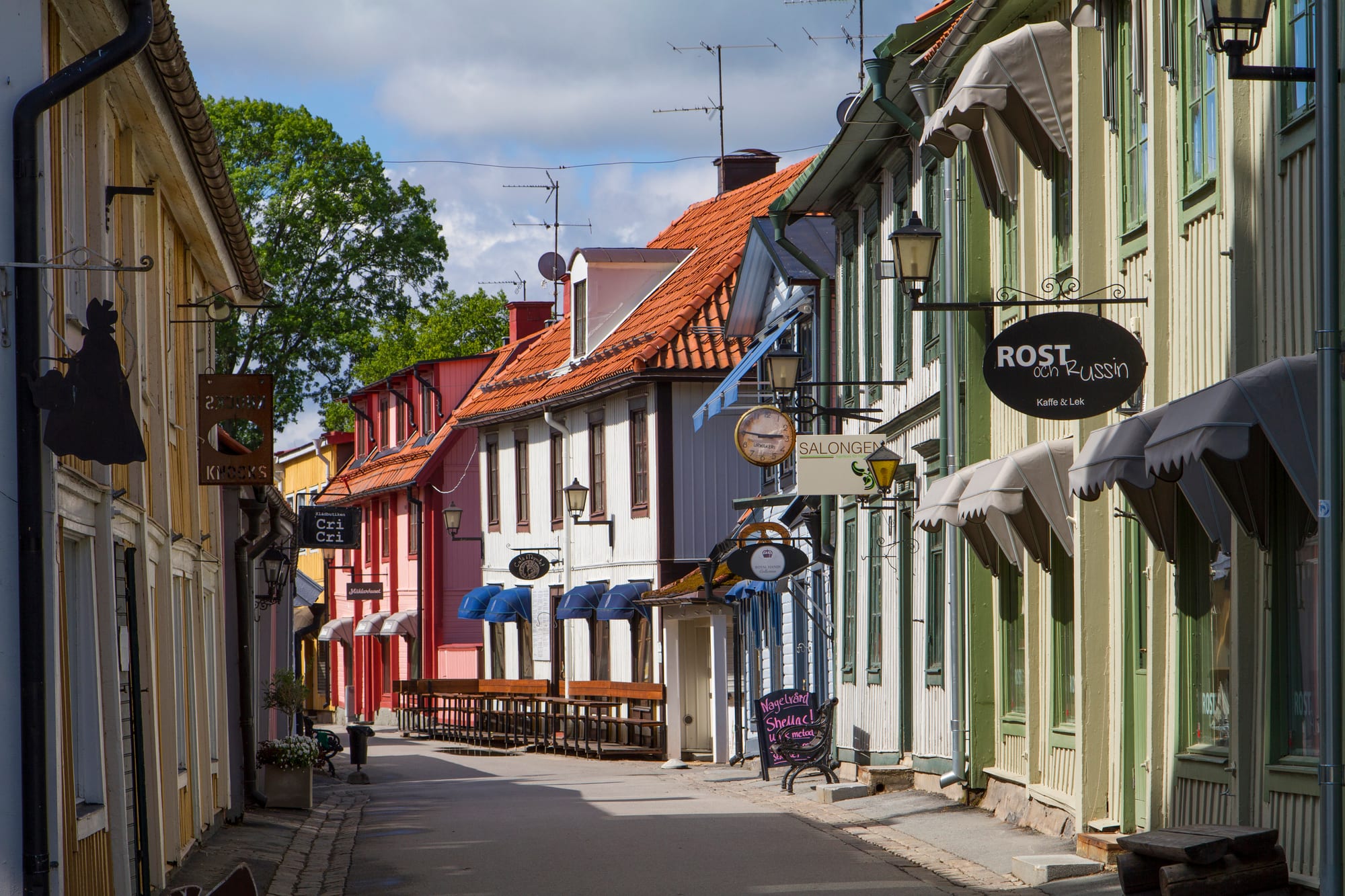
A narrow street of painted wooden houses with hanging shop signs, lanterns and awnings under a summer sky

Stockholm & the Mälaren Valley, Sweden

Sigtuna

Stora gatan, the old main street of Sigtuna. (Brorsson / Wikimedia Commons · CC BY-SA 3.0)

A small lakeside town on a bay of Lake Mälaren between Stockholm and Uppsala, founded around 980 and for some 250 years a royal and commercial centre, where Sweden's first coins were struck. Medieval church ruins, runestones and a low main street of wooden houses survive in a town revived in the 20th century.

Neighbourhoods

  • Stora gatan and the old town
    • First-time visitors
    • Historic district
    • Cafés

    The old main street and the lanes and gardens around it, lined with low wooden houses, small shops, cafés and the tiny 18th-century town hall. Church ruins and runestones stand between the houses, and Stora gatan is the oldest street in Sweden still on its original line.

    Open in Maps
  • The lakeshore
    • Waterside walks
    • Quiet and residential

    The shore of the Skarven bay of Lake Mälaren below the old town, with the boat landing, a waterside path, villas and gardens along Strandvägen.

    Open in Maps
  • The Sigtuna Foundation and the hill
    • Architecture
    • Quiet and residential

    The part of town shaped by the Sigtuna Foundation, founded in 1915, and the boarding schools that followed, which brought new life to a town that had declined for centuries.

    Open in Maps

Things to do

Churches, ruins and runestones

  • St Mary's Churchlandmark

    The 13th-century brick church of the Dominican convent, Sweden's oldest brick church and the only medieval church in the town to survive the Reformation, now the parish church.

    Open in Maps
  • Medieval church ruinslandmark

    The ruins of St Olof's, St Per's and St Lars's churches, dating from the 11th to the 13th centuries, stand in the town from the time when Sigtuna was a bishop's seat.

    Open in Maps
  • Runestonesattraction

    Over 40 runestones have been found in the town, many still standing beside its streets and churchyards, raised in the Viking Age.

    Open in Maps

The old town

  • Stora gatanneighborhood

    The old main street, lined with painted wooden houses, shops and cafés, and a popular summer stroll.

    Open in Maps
  • Sigtuna Town Halllandmark

    A small wooden town hall on the main square, built in 1744 and said to be the smallest in Sweden.

    Open in Maps
  • Sigtuna Museummuseum

    The town museum on Stora gatan, with exhibitions on Sigtuna's earliest history.

    Open in Maps

Short trips from the town

  • Signhildsbergattraction

    Old Sigtuna, a former royal estate a few kilometres west of the present town, linked in Norse tradition with the god Odin.

    Open in Maps
  • Steninge Palacelandmark

    A Baroque palace overlooking Lake Mälaren near Märsta, built in 1694–1698 to designs by Nicodemus Tessin the Younger.

    Open in Maps
  • Rosersberg Palacelandmark

    One of the royal palaces of Sweden, on the shore of Lake Mälaren, built in the 1630s by the Oxenstierna family.

    Open in Maps
  • Skokloster Castlelandmark

    A Baroque castle of 1654–1676 on a peninsula of Lake Mälaren, a stop on the tourist boat between Stockholm and Sigtuna.

    Open in Maps

Seasonal events

  • 1912-themed festivalevery year

    A yearly festival recalling 1912, when the last traditional farmers' council met in Sigtuna and Stockholm held the Olympic Games, with period clothing, craft markets, music, dancing and mock 'Olympic' games.

  • Sigtuna Literature FestivalAugust

    Workshops, seminars and talks on Swedish and international literature.

  • Sigtuna Christmas Marketthe four Sundays before Christmas

    An open-air market with traditional Swedish Christmas food and crafts in the old town.

Eat and drink

Long-standing places and food districts in Sigtuna. Hours, ratings and directions come from your maps app, always current.

Cafés of the old town

  • Tant Bruns kaffestugacafe

    An old-fashioned café in a 17th-century town farm just off the main street.

    Open in Maps
  • Stora gatan's cafésneighborhood

    The main street holds several cafés and small restaurants, with outdoor tables in summer.

    Open in Maps
  • Lakeside cafésneighborhood

    Cafés along the shore road look out over the Skarven bay of Lake Mälaren.

    Open in Maps

Experience Sigtuna

History

Sigtuna was founded around 980, by King Erik the Victorious according to some sources and by Olof Skötkonung according to others, on what was then the shore of Lake Mälaren, about 4 km east of Old Sigtuna, a royal estate linked in Norse belief with the god Odin. The new town is seen as a replacement for Birka as a trading place, and under Olof Skötkonung Sweden's first coins were struck in Sigtuna around the end of the 10th and the beginning of the 11th century.

With a royal mint and, from about 1060, the first bishop's seat in Svealand, Sigtuna was one of the most important towns of Sweden, and stone churches rose between the 11th and 13th centuries: St Olof's, St Per's and St Lars's, now ruins. The bishop's seat moved to Gamla Uppsala in 1130, and in 1187 the town was attacked and burned by raiders from across the Baltic. In 1237 the first Dominican monastery in Sweden was founded here, and its brick church, St Mary's, still stands.

Power and trade moved to Stockholm and Uppsala, and the Reformation, which closed the monastery, sped the decline. Three fires between 1648 and 1666 devastated the town, and by 1700 only 108 people lived there. The tiny town hall was finished in 1744, but Sigtuna remained a sleepy place until the 1910s, when it was revived: the Sigtuna Foundation was founded in 1915 and schools and a folk high school followed.

Culture & Customs

Sigtuna's identity rests on its age. Its claim to be among Sweden's oldest towns, the runestones standing beside its streets and the ruins of its medieval churches draw visitors and shape how the town presents itself. Over 40 runestones have been found in the town and some 170 across the municipality, two of them mentioning Frisian guilds in the town.

The 20th-century revival gave the town a second identity as a place of learning and reflection. The Sigtuna Foundation, founded in 1915, a folk high school and the boarding school Sigtunaskolan Humanistiska Läroverket turned the town's fortunes in the 20th century, and the Sigtuna Literature Festival in August, with its workshops, seminars and talks, carries on that bookish side.

Local events look back to the past: a yearly festival recalls 1912, when the last traditional farmers' council met in the town and the Olympic Games were held in Stockholm, with period dress, crafts, music and dancing. In December, the Sunday Christmas market fills the old town with crafts and Christmas food. Daily life is quiet, and manners are those of a small Swedish town.

Daily Life

The town had about 9,700 inhabitants in 2020. The municipality's seat is Märsta, a larger locality to the east, and much of the area's growth is tied to Stockholm Arlanda Airport, which lies within the municipality about 10 km from Sigtuna. In 1800 the town had only 380 inhabitants, and its growth in the 20th century came with the foundation and the schools, and much of the later growth is tied to the airport.

Commuting by car to the northern parts of Greater Stockholm, to Arlanda and to Uppsala has made Sigtuna an attractive place to live, and local buses timed to meet the commuter trains at Märsta link it with Stockholm. The old centre keeps its small scale: Stora gatan, laid out along the shoreline of the time, still follows its original line.

Life follows the seasons. Summer brings day visitors to the main street and the lakeshore, cafés move outdoors, and boats call from Stockholm; in winter the town is quiet, enlivened by the Christmas market on the Sundays of Advent.

Food

Sigtuna's food is that of the Swedish café and home kitchen. Fika — coffee with a cinnamon bun, kanelbulle, or another pastry — is the main reason many visitors stop on the main street, and the old town's cafés, one of them in a 17th-century town farm, are part of the town's character. Around Lent, bakeries sell semlor, cardamom-spiced buns filled with milk and almond paste and topped with whipped cream.

Lunch follows the Swedish habit of a weekday dagens rätt. Classic dishes include köttbullar, meatballs served with brown cream sauce and lingonberry jam, and fried Baltic herring, stekt strömming. Janssons frestelse, a casserole of potatoes, onions, pickled sprats and cream, is commonly part of the Christmas julbord.

The Christmas market on the Sundays before Christmas sells traditional Swedish Christmas food alongside crafts, and the Midsummer and Christmas tables are set, as across Sweden, with pickled herring, boiled potatoes, sour cream and chives. In summer, cafés along the shore road add outdoor tables with views over the Skarven bay.

Planning tools

Budget

Sigtuna is cheaper than Stockholm and works well as a day trip. Most of its sights — the ruins, the runestones, the church, the street — are free to see, and the town museum and town hall are free or low-cost. Costs rise for a night in the town or a palace nearby.

Daily Budget Midrange
USD 150–280 (a night in the town, restaurant meals, a boat trip or palace visit)
Daily Budget Shoestring
USD 60–100 (a day trip by train and bus, café lunch, free sights)

Ordinary Stockholm transport tickets cover the commuter train to Märsta and the bus on to Sigtuna.

Best Time to Visit

June to August, when the old main street and the ruins are at their most popular and cafés set tables out on the street. Late spring and early autumn are quieter. The Sundays of Advent bring the Christmas market, while the rest of winter is very quiet.

Suggested Number of Days

The town itself is easily seen in a day, which is how most visitors come from Stockholm or Uppsala. Adding the palaces and castles around the lake makes it two.

First Visit
1 day
With Surroundings
2 days

Transportation

Sigtuna is small and walkable, and a car is needed only for the surrounding countryside. Local SL buses link the town with Märsta station, timed to meet the commuter trains, and with Arlanda airport.

Buses do not take cash; buy an SL ticket by app or contactless card before travelling.

Airport & Station Connections

There is no railway station in Sigtuna: the nearest is at Märsta, about 7 km east, on the commuter line from Stockholm, with buses on to the town. Stockholm Arlanda Airport is about 10 km away, with a direct bus. A tourist boat runs between Stockholm and Sigtuna, stopping at Skokloster.

Walkability

Very walkable: the main street, the church, the ruins, the town hall and the lakeshore all lie within a few hundred metres of each other, on gently sloping ground above the water.

Safety

Sweden is a very safe country for visitors. Sigtuna is a quiet small town; the practical risks are icy streets in winter and cold water when swimming or boating on the lake.

Take care on icy cobbles and slopes in winter, and wear a life jacket in small boats. Check current official travel advice before travelling.

Climate

A humid continental climate like that of the rest of the Mälaren valley, with warm, light summers and cold, dark winters.

Summer
mild to warm — in nearby Stockholm daytime highs average 20–25°C, with lows around 13°C
Winter
cold — in nearby Uppsala January has a daily mean of about −2.7°C

Local Customs

Tipping is not customary: a bill may be rounded up for good service, and only truly exceptional service earns 5–10 per cent. Runestones and ruins are protected ancient monuments, and the old town is lived in, so visitors keep to the streets and paths.

Do not climb on runestones or ruins. Be quiet in St Mary's Church, an active parish church, during services.

Common Payment Methods

The currency is the Swedish krona (SEK). Sweden is one of the world's most cashless countries: card payments are very common, as is the Swish phone app (which needs a Swedish bank account), and businesses that do not accept cash at all are common. A small amount of cash from an ATM can still be useful.