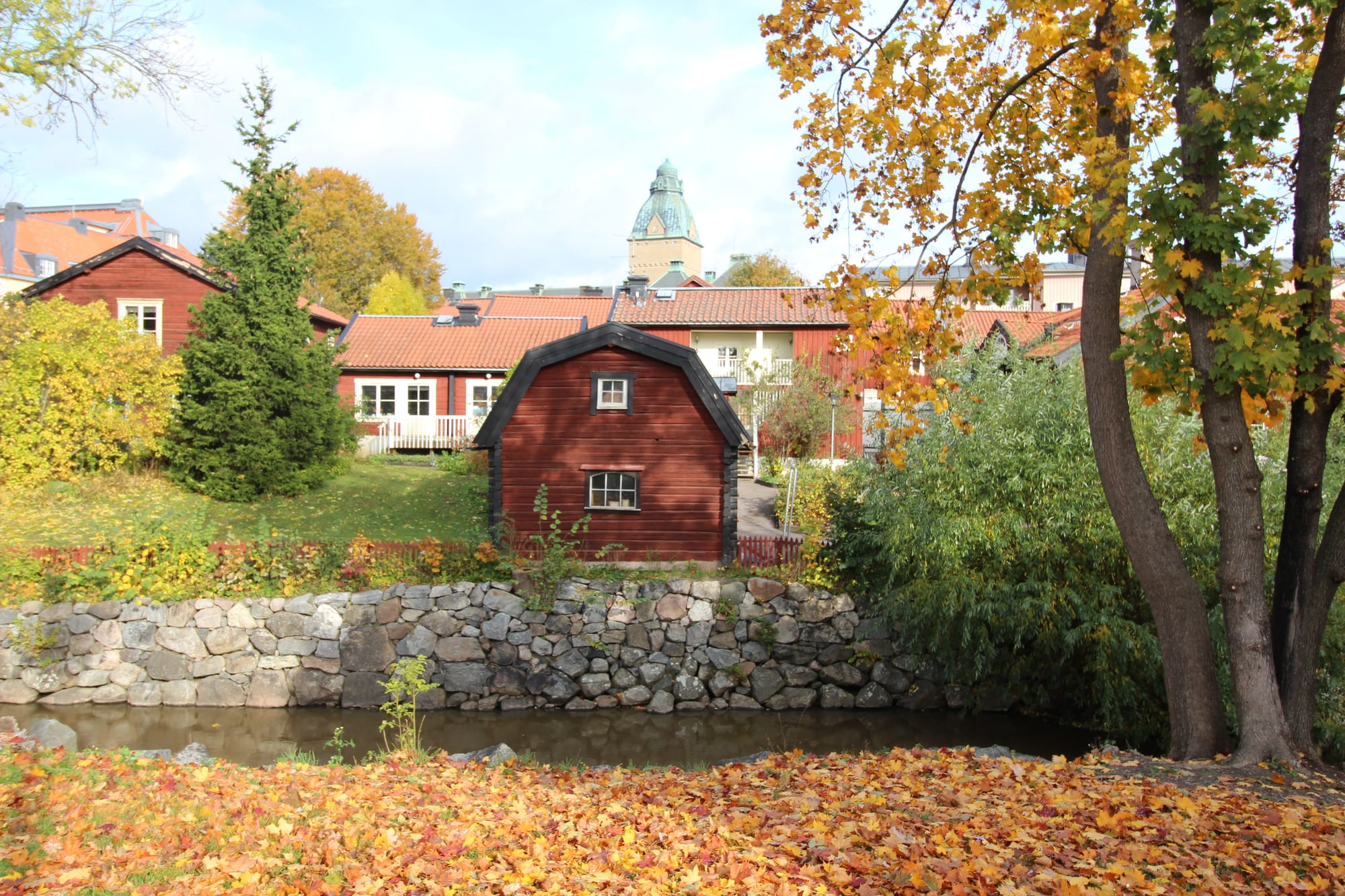
Red wooden houses and a stone embankment beside the Svartån river under autumn trees, with a green copper tower behind

Stockholm & the Mälaren Valley, Sweden

Västerås

Old houses along the Svartån river in central Västerås in autumn. (Sniper Zeta / Wikimedia Commons · CC BY-SA 4.0)

A lakeside city on the north shore of Lake Mälaren, about 110 km west of Stockholm, at the mouth of the Svartån river. A medieval cathedral town known for centuries for its cucumbers, it became the home of the electrical engineering firm ASEA, now ABB, and is today an industrial and university city with a large harbour on the lake.

Neighbourhoods

  • City centre and Stora torget
    • First-time visitors
    • Shopping
    • Close to public transport

    The commercial heart around the main square, Stora torget, with shops, restaurants and pubs, the Svartån river running through it and the Central Station a short walk south.

    Open in Maps
  • Kyrkbacken
    • Historic district
    • Quiet and residential

    The old quarter on the slope north of the cathedral, once the poor part of town, which keeps its old wooden and half-timbered houses and courtyards along narrow lanes.

    Open in Maps
  • The lakeside and the harbour
    • Waterside walks
    • Boating

    The shore of Lake Mälaren south of the centre, with the city's large commercial and leisure port, marinas and boats to the islands in the lake.

    Open in Maps

Things to do

Landmarks of the old city

  • Västerås Cathedrallandmark

    The Gothic brick cathedral, consecrated in 1271 and restored in the 19th century, seat of the Diocese of Västerås.

    Open in Maps
  • Västerås Castlelandmark

    A castle first built in the 12th century, captured and rebuilt by Gustav Vasa in 1540–1544, and repaired and expanded in the 1740s after a fire.

    Open in Maps
  • Kyrkbackenneighborhood

    The old quarter north of the cathedral, with lanes of old timber houses and courtyards that escaped later rebuilding.

    Open in Maps
  • The Turbine Houselandmark

    A small hydroelectric station of 1891 on the Svartån in the city centre, whose early power helped draw the electrical firm ASEA to Västerås.

    Open in Maps
  • Djäknebergetpark

    A hilltop park near the cathedral, founded in the 19th century by Sam Lidman, with hundreds of stones carved with quotations and names.

    Open in Maps

Museums and the lake

  • Vallby Open Air Museummuseum

    An open-air museum about 2 km north of the city centre.

    Open in Maps
  • Lake islandsattraction

    Tourist boats run daily in summer to islands in Lake Mälaren such as Elba and Ridö.

    Open in Maps

Short trips from the city

  • Anundshögattraction

    An ancient site a few kilometres east of the city with Sweden's largest burial mound, stone ships, standing stones and a runestone.

    Open in Maps
  • Ängsö Castlelandmark

    A castle on the island of Ängsö in Lake Mälaren, near Västerås.

    Open in Maps
  • Tidö Castlelandmark

    A castle 17 km south of Västerås.

    Open in Maps
  • Engelsberg Ironworkslandmark

    An ironworks of 1681 in the forests of Fagersta Municipality, preserved as a UNESCO World Heritage Site.

    Open in Maps

Seasonal events

  • Västerås Summer Meetsummer

    A gathering of classic American cars and their owners, held at the site long used by the Power Big Meet, which Västerås hosted until 2017.

Eat and drink

Long-standing places and food districts in Västerås. Hours, ratings and directions come from your maps app, always current.

Västerås classics

  • Stadskällarenrestaurant

    One of the city's oldest and most classic restaurants, on the main square.

    Open in Maps
  • Stora torget's pubs and restaurantsneighborhood

    The main square and the streets around it hold many of the city's pubs, bars and restaurants.

    Open in Maps

Lakeside

  • Björnögårdenneighborhood

    A lakeside recreation area on Björnö, the city's main island, with a beach, walking tracks and kayak and boat hire.

    Open in Maps

Experience Västerås

History

The city's name comes from Västra Aros, "west river mouth", for its place where the Svartån river runs into Lake Mälaren. The land around it was settled long before the town: Anundshög, just outside the city, is Sweden's largest burial mound, set among stone ships and standing stones, and assemblies were recorded there in the Middle Ages. The town grew as a trading place on the river and the lake, and a bishop's see, a cathedral and a monastery followed; the Gothic cathedral, rebuilt by Birger Jarl on an earlier site, was consecrated in 1271.

Västerås Castle, first built in the 12th century, was captured and rebuilt by Gustav Vasa, who also called the riksdag to Västerås. After a great fire in 1741, according to tradition, cucumbers were grown in large quantities on the cleared ground, and through the 18th and 19th centuries cucumber growing gave the city its nickname, Gurkstaden, the Cucumber City.

Modern Västerås was made by electricity. In 1891 a small hydroelectric station, the Turbine House, was built on the Svartån in the centre, and this early power encouraged ASEA, a large maker of electrical equipment, to concentrate its operations here. The company grew into one of Sweden's major industrial firms, merged with Brown, Boveri & Cie in 1988 to form ABB, and made Västerås an engineering city whose population grew through the 20th century.

Culture & Customs

The city markets itself as Mälarstaden, the city by Lake Mälaren, and the lake shapes its leisure: the harbour is the largest lakeside commercial and recreational port in Scandinavia, and in summer boats run to islands such as Elba and Ridö, while Björnögården offers a beach, walking tracks and kayak hire. The cucumber nickname is one the city still keeps.

Sport means bandy above all. Västerås SK, the green and white club founded in 1904, is the most successful bandy team in Sweden, with 22 national championships, and plays in the largest permanent indoor bandy arena in the country; the Bandy World Championship has been played in the city several times. The club's football side reached the top division, Allsvenskan, after winning the second tier, Superettan, in 2023.

For many years the city hosted Power Big Meet, one of the largest gatherings of classic American cars, and the Västerås Summer Meet continues the tradition at the same site. The cathedral, the old quarter of Kyrkbacken and the open-air museum at Vallby keep the city's older history in view, and the student population of Mälardalen University adds a younger side.

Daily Life

The city had about 131,600 inhabitants in 2023, making it Sweden's sixth-largest urban area, and the whole municipality about 161,000 in 2026.

Engineering remains the backbone of the economy. ABB keeps its Swedish headquarters here and makes robots, industrial drives and equipment for high-voltage power transmission; Westinghouse produces nuclear fuel; and railway propulsion systems, power equipment and other manufacturing provide many more jobs. The city-owned Mälarenergi supplies district heating and electricity, and its central location in the Mälaren valley, with railways, waterways and motorways, makes Västerås a major logistics centre, with large distribution warehouses.

Evenings move outdoors in the light months. In summer the lakeshore, the marinas and the islands are where much of the city relaxes; in winter the lake usually freezes from December until the end of March, and it is the season of bandy, the city's leading sport. Mälardalen University brings students into the city centre through the academic year.

Food

Västerås's best-known food is the cucumber. From the 18th century the area grew cucumbers in large quantities, and the Västerås cucumber, first grown here by a German gardener, Bernhard Johan Bohnsack, was sold throughout the country and exported to Europe, giving the city its nickname.

Everyday eating follows Swedish habits: the weekday lunch special, dagens rätt, and classics of husmanskost such as köttbullar, meatballs with brown cream sauce and lingonberry jam, and fried Baltic herring, stekt strömming. Fika, coffee with a cinnamon bun, kanelbulle, or other pastry, punctuates the working day.

The main square, Stora torget, is the centre of eating out, with one of the city's oldest and most classic restaurants, Stadskällaren, and many pubs and bars around it; Piazza di Spagna on Vasagatan is another of the city's oldest restaurants. The skyscraper nicknamed Skrapan, "The Scraper", holds the Sky Bar on its 24th floor, Sweden's highest-elevation cocktail bar. In summer, eating moves out to the lake and its beaches.

Planning tools

Budget

Västerås costs noticeably less than Stockholm for rooms, meals and drinks. Lunch specials (dagens rätt) are the best-value meal, and the cathedral, Kyrkbacken, the parks and the lakeshore cost nothing to enjoy.

Daily Budget Midrange
USD 150–290 (central hotel, restaurant dinners, a boat trip or castle visit)
Daily Budget Shoestring
USD 70–110 (hostel or budget room, lunch specials, local buses, free sights)

A bike or local bus reaches Anundshög and the lakeside; a car helps for the castles further out.

Best Time to Visit

June to August, when the boats run to the lake islands, the beaches and harbour are busy and the long evenings suit the waterfront. May and September are quieter. In winter Lake Mälaren is usually frozen from December until the end of March, and it is the bandy season.

Suggested Number of Days

One or two days covers the cathedral, the old quarter and the lakeshore. Three days allow time for the ancient sites, castles and islands around the city, which depend on boats, buses or a car.

First Visit
1–2 days
With Surroundings
3 days

Transportation

The centre is compact. Local buses serve the suburbs and run to Anundshög, and electric scooters can be hired from several companies by the minute. Boats leave the harbour for islands in the lake in summer.

Check the bus number and summer boat timetables before heading out of the centre.

Airport & Station Connections

Västerås Central Station is in the city centre, next to the bus station, which is served mainly by Swebus Express. Stockholm Arlanda Airport lies about 111 km to the south-east, with direct but infrequent buses; travelling via Stockholm or Uppsala is the alternative. The small Stockholm Västerås Airport is 6 km from the centre, with a town bus timed to Ryanair flights. The E18 motorway links the city with Stockholm.

Walkability

Very walkable: the station, Stora torget, the cathedral, Kyrkbacken and the riverside lie within a short distance of each other, and paths follow the Svartån down to the lake. The harbour and beaches are a longer walk or a short ride from the centre.

Safety

Sweden is a very safe country for visitors. Västerås is a calm city; the practical risks are bicycle theft, icy pavements in winter and cold water or thin ice on the lake.

Never walk on lake ice without local knowledge of its thickness, and wear a life jacket in small boats. Check current official travel advice before travelling.

Climate

A humid continental climate bordering on an oceanic one, with cold winters and warm summers; Lake Mälaren is usually frozen from December until the end of March.

Summer
warm — July days are mostly around 22°C, sometimes above 25°C and occasionally 30°C
Winter
usually cold, with snow cover lasting several months; with air from the Atlantic temperatures over 5°C may be expected, while with air from the Eurasian continent the temperature may not rise above −15°C in the middle of the day

Local Customs

Tipping is not customary: a bill may be rounded up for good service, and only truly exceptional service earns 5–10 per cent. Bandy, played on skates on a large ice surface with sticks and a ball, is the city's leading sport, and the city still keeps its nickname, the Cucumber City.

Stronger alcohol for home is sold only in the state-run Systembolaget shops. Be quiet in the cathedral during services.

Common Payment Methods

The currency is the Swedish krona (SEK). Sweden is one of the world's most cashless countries: card payments are very common, as is the Swish phone app (which needs a Swedish bank account), and businesses that do not accept cash at all are common. A small amount of cash from an ATM can still be useful.