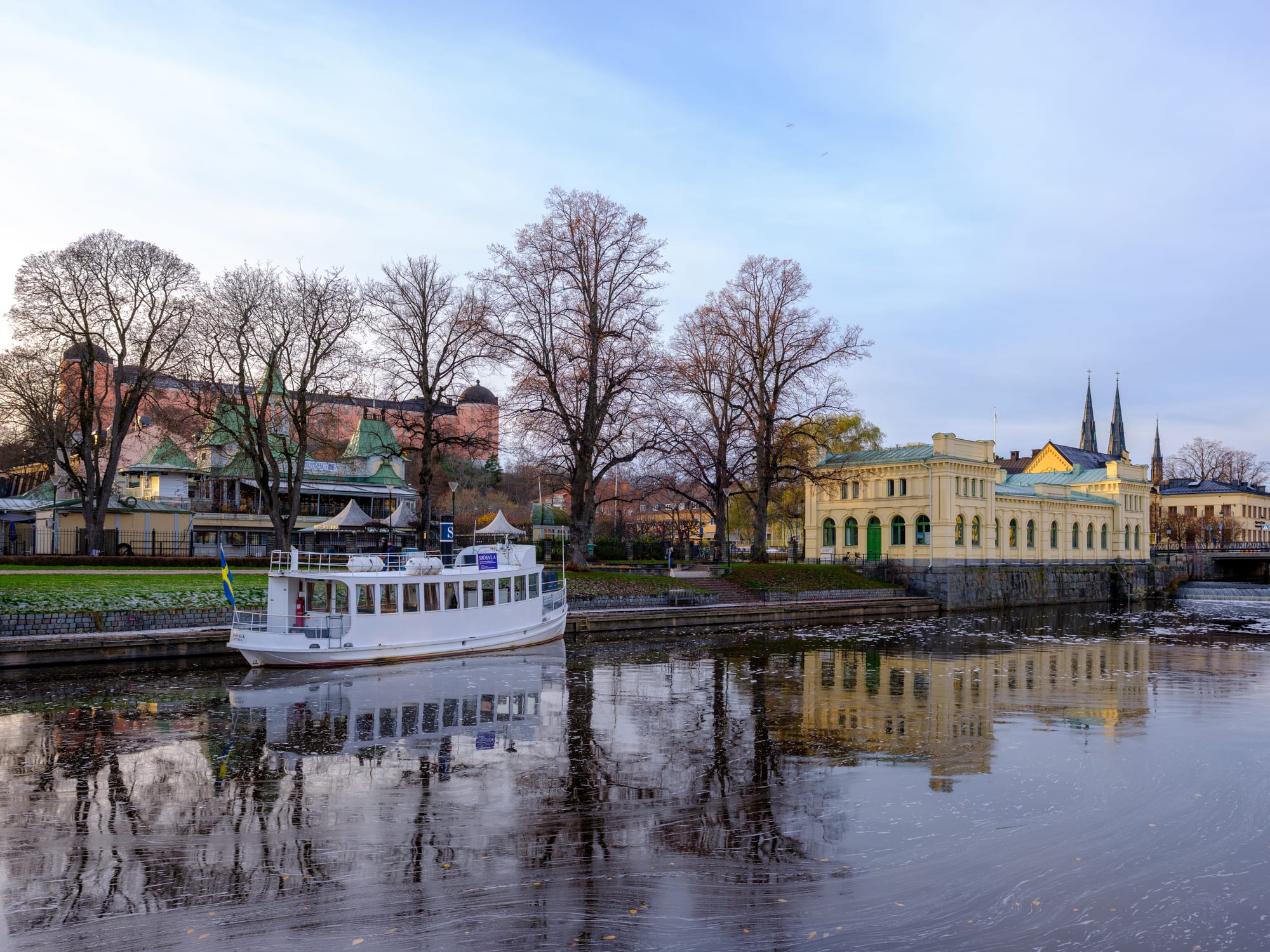
A white boat moored on the still Fyris river beside a pale yellow pumping station, with bare trees and the cathedral spires behind

Stockholm & the Mälaren Valley, Sweden

Uppsala

The Fyris river and the old pumping station, with Uppsala Castle and the cathedral towers behind. (ArildV / Wikimedia Commons · CC BY-SA 4.0)

Sweden's fourth-largest city, on the Fyris river about 70 km north of Stockholm. The seat of the Swedish church since the Middle Ages and of the oldest university in Scandinavia, it grew around a cathedral, a royal castle and the scholars who worked there, Linnaeus and Celsius among them, and is today a student and research city.

Neighbourhoods

  • Fjärdingen and the university quarter
    • First-time visitors
    • Historic district
    • Students and nightlife

    The historic quarter on the west bank of the Fyris, home to the archbishop's residence and the old university district. The cathedral, the Gustavianum, the University Hall, the library and most of the student nations stand within a few streets, with the castle on the ridge above.

    Open in Maps
  • City centre east of the river
    • Shopping
    • Close to public transport

    The modern commercial centre, with the pedestrian shopping street Svartbäcksgatan, the main square, shopping arcades, the market square Vaksala torg and the Central Station a short walk from the river.

    Open in Maps
  • Gamla Uppsala
    • History
    • Quiet and residential

    The village a few kilometres north of the centre, on the site of the older Uppsala, with the great royal burial mounds, a church and a museum, set in open fields.

    Open in Maps

Things to do

Cathedral, castle and university

  • Uppsala Cathedrallandmark

    The largest cathedral in Scandinavia, a Gothic church of brick with towers almost 119 metres high, where Swedish monarchs were often crowned and Gustav Vasa is buried.

    Open in Maps
  • Uppsala Castlelandmark

    The castle begun by Gustav Vasa in 1549 on a ridge above the city, now home to the county governor's residence and the Uppsala Art Museum.

    Open in Maps
  • Gustavianummuseum

    Built in 1622–1625 and the university's main building from 1778 to 1887, now its museum, crowned by the anatomical theatre Olof Rudbeck added in 1662.

    Open in Maps
  • Carolina Redivivalandmark

    The university library's main building, completed in 1841, which holds the Silver Bible, a 6th-century manuscript of the Gothic Bible.

    Open in Maps
  • University Halllandmark

    The university's main building, completed in 1887 in an Italian Renaissance style, in the University Park close to the cathedral.

    Open in Maps

Gardens and museums

  • Linnaean Gardenpark

    The oldest of Uppsala University's botanical gardens, first planted by Olof Rudbeck in 1655 and kept as an 18th-century garden to Carl Linnaeus's specifications, beside the house where he lived.

    Open in Maps
  • Uppsala University Botanical Gardenpark

    The university's principal botanical garden beside the castle, laid out on royal land given by Gustav III.

    Open in Maps
  • Upplandsmuseetmuseum

    The county museum of Uppsala County in the Akademikvarnen, a former university water mill on the Fyris river.

    Open in Maps

Short trips from the city

  • Gamla Uppsalaattraction

    The royal burial mounds, a church and a museum on the site of the pagan cult centre whose temple Adam of Bremen described.

    Open in Maps
  • Linnaeus' Hammarbymuseum

    Carl Linnaeus's former summer home, about 10 km south-east of the city, now a house museum and one of the university's botanical gardens.

    Open in Maps
  • Skokloster Castlelandmark

    A Baroque castle built in 1654–1676 by Carl Gustaf Wrangel on a peninsula of Lake Mälaren between Uppsala and Stockholm.

    Open in Maps

Seasonal events

  • Distingearly February

    An annual market held in Uppsala since prehistoric times, originally alongside the great assembly of the Swedes.

  • Valborg30 April

    The student year's biggest celebration, when students in white caps and crowds of visitors fill the city's parks and riverside; the festivities spill over into the days around it.

  • Uppsala Reggae Festivalsummer

    The largest reggae festival in Scandinavia, first held in 2001.

  • Kulturnattenautumn

    Culture Night, Uppsala's edition of a Swedish tradition and the largest in the country, estimated to draw some 175,000 visitors.

Eat and drink

Long-standing places and food districts in Uppsala. Hours, ratings and directions come from your maps app, always current.

Food halls and food streets

  • Saluhallenmarket

    The market hall on S:t Eriks torg near the cathedral, selling quality ingredients such as seafood and cheese.

    Open in Maps
  • Svartbäcksgatan and Vaksala torgneighborhood

    The pedestrian shopping street and the market square east of the river, with cafés, restaurants and food trucks selling hot dogs and falafel.

    Open in Maps

Student life and Gamla Uppsala

  • Student nation pubsneighborhood

    The thirteen student nations serve simple meals and run pubs and clubs; visitors with a nation guest card can dine at them.

    Open in Maps
  • Odinsborgcafe

    A restaurant and café beside the royal mounds at Gamla Uppsala that brews its own mead.

    Open in Maps

Experience Uppsala

History

The town at first was called Aros, "river mouth", for its place where the Fyris river once met a bay of Lake Mälaren, while the older Uppsala, a few kilometres north, was the royal and pagan cult centre of the Svear, marked by great burial mounds. In 1164 Uppsala became the seat of Sweden's archbishop. When the cathedral at Gamla Uppsala burned, the archbishopric and the relics of Saint Eric moved south to Östra Aros, which took over as the main regional centre in 1274, building the present Gothic cathedral.

The university, founded in 1477, is the oldest in Scandinavia. Gustav Vasa began a castle on the ridge above the town in the 16th century, and coronations were held in the cathedral for many of Sweden's kings and queens until 1719. In 1702 a great fire destroyed much of the town and damaged the university's botanical garden.

The 18th century was the age of Uppsala's scientists: Anders Celsius, whose temperature scale bears his name, and Carl Linnaeus, who taught at the university, revived its garden and built the system for naming plants and animals that biology still uses. In the 19th century a new library, the University Hall and the railway were built, and in the 20th century the city grew with its university and research into Sweden's fourth-largest city.

Culture & Customs

Uppsala's identity is bound up with its university. Students belong to one of thirteen nations, each traditionally representing a region of Sweden, which serve meals and run pubs, clubs and formal dinners, mostly from buildings in the historic quarter west of the river. The student caps, songs and speeches of Valborg on 30 April are the city's great public celebration.

The Church of Sweden's archbishop has his seat in the city, and the cathedral holds the remains of Saint Eric, patron saint of the nation, and the tombs of Gustav Vasa and Linnaeus. The city also takes pride in its deeper past at Gamla Uppsala, where the royal mounds stand among the fields.

Music runs from church and choir concerts to the Uppsala Reggae Festival, the largest in Scandinavia. The Disting market in early February, held since prehistoric times, and Kulturnatten in autumn, the largest culture night in Sweden, bring much of the city out. Manners are those of a quiet, educated university town, with a large international community of researchers and students.

Daily Life

The urban area had about 175,000 inhabitants in 2023, and the whole municipality about 249,000 in 2026. The university draws students and researchers from the rest of Sweden and from abroad.

The university and the University Hospital are central to the city, and companies such as offshoots of the pharmaceutical firm Pharmacia make Uppsala a research city. With trains taking about 40 minutes to the capital, many residents commute to Stockholm, and the train to Arlanda takes 17 minutes.

Bicycles are everywhere, and the term calendar sets the city's rhythm: busy and young from late August to early June, quieter in July. The Fyris river divides the city in two: the modern administrative, residential and commercial centre lies to the east of it, and the historic quarter to the west. The west bank holds the old university quarter and most of the student nations, while the east bank has the shops and the station, with residential districts spreading outward across the fertile Uppsala flatlands.

Food

Uppsala eats much as the rest of central Sweden does: the weekday dagens rätt lunch, köttbullar, meatballs with brown cream sauce and lingonberry jam, and herring dishes at Midsummer and Christmas. The student nations shape eating out, with pubs and cafés that serve simple meals, and formal dinners called gasques, where the student cap and uniform can still be seen. Fried Baltic herring, stekt strömming, is another Swedish classic.

Fika is a habit across the city, and cafés serve kanelbullar, cinnamon buns, and around Lent the semla, a cardamom-spiced bun filled with milk and almond paste and topped with whipped cream. Saluhallen, the market hall near the cathedral, sells seafood, cheese and other quality ingredients, while food trucks on Svartbäcksgatan and the squares sell hot dogs and falafel.

At Gamla Uppsala, beside the royal mounds, a restaurant and café brews its own mead. In the city, the nations' pubs and the cafés around the cathedral and the river are where students and visitors meet.

Planning tools

Budget

Uppsala costs noticeably less than Stockholm, especially for food and drink. The student nations, lunch specials (dagens rätt) and food trucks keep eating out affordable.

Daily Budget Midrange
USD 160–300 (central hotel, restaurant dinners, museum tickets, a trip to Gamla Uppsala)
Daily Budget Shoestring
USD 70–110 (hostel or budget room, lunch specials and food trucks, buses, free sights)

Valborg falls on 30 April, but student celebrations run from 28 April to 1 May, the city's busiest days.

Best Time to Visit

May to September, when the gardens are at their best and the riverside cafés open; summer usually arrives in mid-May and lasts until late September. Late April brings Valborg, the city's busiest and loudest time. The university year makes autumn lively, while winter is dark and quiet.

Suggested Number of Days

The historic centre can be seen in a long day, which is how many visitors come from Stockholm. Two days allow for the gardens and museums at an easy pace, and a third suits trips into the countryside around the city.

First Visit
1–2 days
With Surroundings
2–3 days

Transportation

The centre is small and most sights are within walking distance of each other. Gamla Uppsala and Linnaeus' Hammarby lie outside the centre and need other transport; the nearest bus stop to Hammarby is 2 km from the museum. Cycling is part of daily life for the city's many students.

Local buses do not take cash; buy a ticket by app or card before travelling.

Airport & Station Connections

Uppsala is about 70 km north of Stockholm, roughly 40 minutes by train from Stockholm Central, and many residents commute. Stockholm Arlanda Airport is nearly 40 km to the south-east, 17 minutes by train. Uppsala Central Station also has night trains to northern Sweden and to Narvik in Norway.

Walkability

Very walkable: the cathedral, castle, university buildings, gardens and shopping streets all lie within about a kilometre of the Central Station, divided by the Fyris river, with the castle on a low ridge above the west bank. Gamla Uppsala, about 5 km north, needs other transport.

Safety

Sweden is a very safe country for visitors. Uppsala is a calm university city; the main risks are bicycle theft, crowds and heavy drinking around Valborg, and icy pavements in winter.

Lock bicycles securely, keep an eye on belongings in the Valborg crowds, and use shoe grips on winter ice. Check current official travel advice before travelling.

Climate

A humid continental climate with cold winters and warm summers. Uppsala lies just south of the 60th parallel, so it has over 18 hours of sunshine around the summer solstice and under six around the winter solstice.

Summer
warm, with very long days — since 2002 seven summer months have averaged 20°C or more, and the record high is 37.4°C, set in 1933
Winter
cold — January has a daily mean of about −2.7°C, with under six hours of sunshine around the winter solstice

Local Customs

Tipping is not customary: a bill may be rounded up for good service, and only truly exceptional service earns 5–10 per cent. Student traditions are part of city life — white caps at Valborg and graduation, choirs and the nations' formal dinners — and visitors are welcome at the public celebrations.

Stronger alcohol for home is sold only in the state-run Systembolaget shops. Be quiet in the cathedral, an active church, during services.

Common Payment Methods

The currency is the Swedish krona (SEK). Sweden is one of the world's most cashless countries: card payments are very common, as is the Swish phone app (which needs a Swedish bank account), and businesses that do not accept cash at all are common. A small amount of cash from an ATM can still be useful.