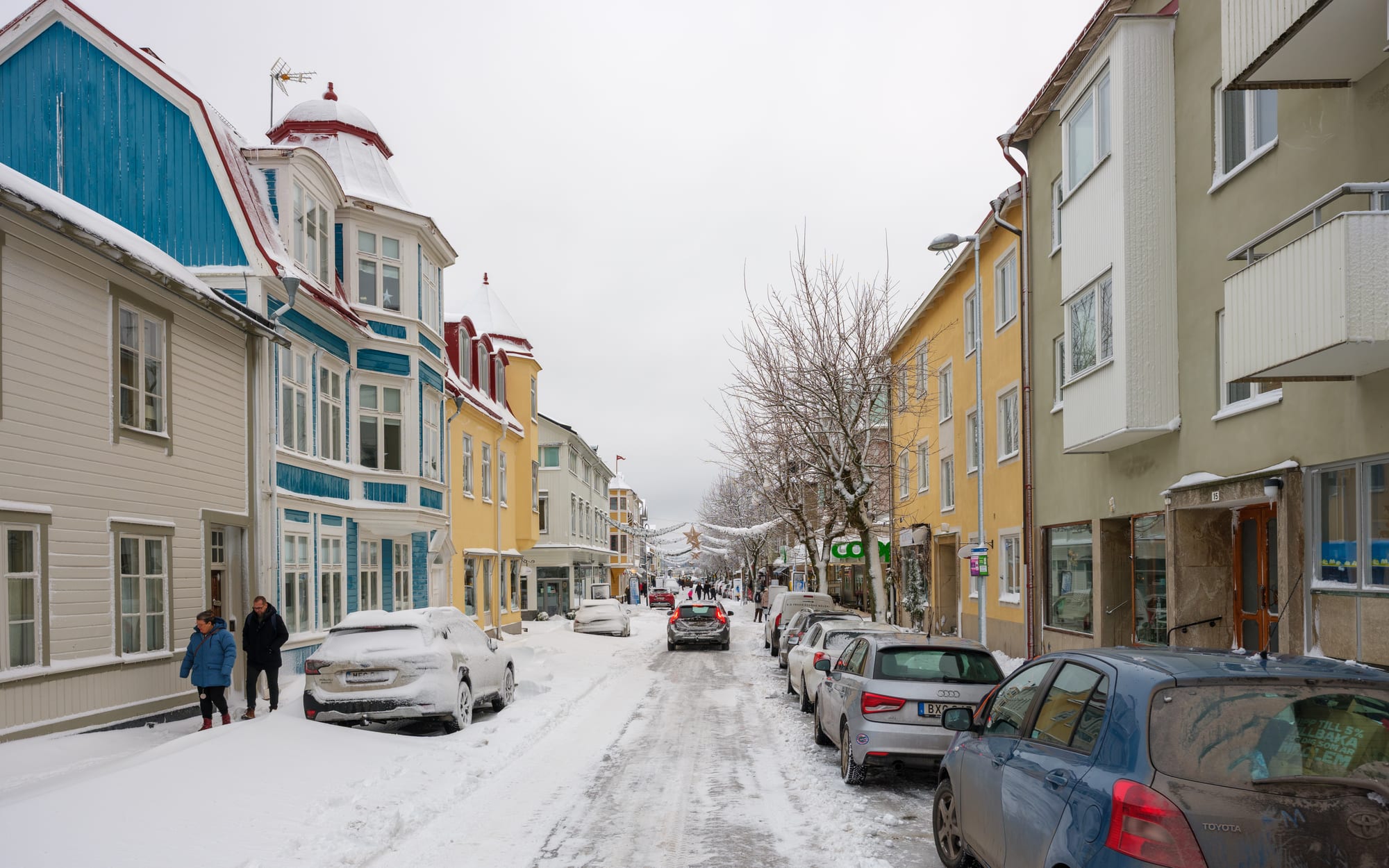
A snowy street lined with painted wooden houses with turrets and balconies, parked cars and bare trees

Stockholm & the Mälaren Valley, Sweden

Vaxholm

Hamngatan, the harbour street of Vaxholm, in winter. (ArildV / Wikimedia Commons · CC BY-SA 4.0)

A small island town in the Stockholm archipelago, built beside a 16th-century fortress that guarded the sea route to the capital. Steamboats made it a summer resort in the 19th century, leaving streets of painted wooden villas, and today it is the seat of its municipality and a major ferry terminal for the northern archipelago.

Neighbourhoods

  • The town centre and harbour
    • First-time visitors
    • Historic district
    • Close to the ferries

    The old core of the town on the island of Vaxön, where Hamngatan leads to the harbour facing the fortress. Wooden villas and town houses, shops, cafés, the church and the boat landings are all within a few minutes' walk.

    Open in Maps
  • Norrhamnen and the north shore
    • Quiet and residential
    • Waterside walks

    The northern side of the island, with the small-boat harbours of Norrhamnen and Norrbergshamnen, the local heritage museum on the Blombergska point and quieter residential streets of houses and gardens.

    Open in Maps
  • Rindö
    • Nature
    • Military history

    The island across the Kodjupet strait, reached by a short car ferry, long an important defensive site between the two main shipping routes into Stockholm.

    Open in Maps

Things to do

The fortress and the town

  • Vaxholm Fortressmuseum

    The stone fortress on its islet in the Kodjupet strait, first built under Gustav Vasa to defend Stockholm from the sea and now home to a fortress museum.

    Open in Maps
  • Kastellet cable ferrytransit hub

    An electrically powered cable ferry that crosses the channel from the town to the fortress islet.

    Open in Maps
  • Vaxholm Churchlandmark

    A Neoclassical church completed in 1803 to drawings by Carl Fredrik Adelcrantz and Olof Tempelman, in the centre of the town.

    Open in Maps
  • Vaxholm heritage museummuseum

    A local museum by Norrhamnen showing how a fishing family lived in the later 19th century, when about 50 families lived mainly from herring fishing, with a fisherman's cottage and a longboat.

    Open in Maps

Islands and short trips

  • Rindöattraction

    The neighbouring island, between the two main shipping channels into Stockholm, where the Vaxholm Coastal Artillery Regiment was based for most of the 20th century.

    Open in Maps
  • Grindaattraction

    A small rural island east of Vaxholm, largely owned by the Archipelago Foundation and popular in summer with campers and day-trippers.

    Open in Maps
  • Bogesund Castlelandmark

    A former manor built in the 1640s on the initiative of Per Brahe the Younger and rebuilt several times since, on the Bogesundslandet peninsula in a nature reserve near the town.

    Open in Maps

Eat and drink

Long-standing places and food districts in Vaxholm. Hours, ratings and directions come from your maps app, always current.

Harbour and town

  • Harbour cafés and restaurantsneighborhood

    Cafés and restaurants line the quay and the streets behind it, looking across to the fortress and the passing boats.

    Open in Maps
  • Hamngatanneighborhood

    The harbour street of the old town, lined with wooden houses, with cafés and small shops.

    Open in Maps

Experience Vaxholm

History

The town takes its name from Vaxholm Fortress, which Gustav Vasa built in 1548 on a small islet in the Kodjupet strait, one of the two main routes into Stockholm from the open sea. In 1558 the king bought farms on the island of Vaxön beside it, and a small trading settlement was founded whose main tasks were keeping watch against attack from the sea and providing pilots for shipping. It became a merchant town and in 1652 received its royal charter.

For centuries Vaxholm was a military place first. The fortress was rebuilt several times, and together with defences on Rindö and at the Oxdjupet strait it guarded the sea approach to the capital. In the later 19th century about fifty families lived mainly from herring fishing, and the population grew slowly, from around 600 in 1762 to about 1,700 by 1900.

In 1849 a steamboat service began from Stockholm, and from the 1860s Vaxholm became a popular resort, especially for bathers, and many wooden summer houses were built by people from Stockholm; until 1912 houses could be built only of wood, which gives the town its distinctive appearance. A coastal artillery regiment based on Rindö operated from 1902 to 2000, and most defence facilities in the archipelago closed in the early 2000s. The fortress now houses a museum, and Vaxholm is a gateway to the archipelago.

Culture & Customs

Vaxholm's identity is tied to the water. Boats are everyday transport, and the arrivals and departures of the white archipelago ferries set the rhythm of the harbour, especially in summer, when the town fills with day visitors from Stockholm and sailors passing through. The town has a strong sense of its history as a fortress and fishing town, kept alive at the fortress museum and in the heritage museum by the northern harbour, with its fisherman's cottage and longboat.

The fortress has had a second life on screen: in 1970 it was the pirate stronghold in the film Pippi in the South Seas. The wooden houses of the resort era, built at a time when other materials were not allowed, give the town its distinctive appearance and are part of what draws visitors.

Summer is the high point of the year, as across the archipelago, with Midsummer celebrated around maypoles, swimming from the rocks and long light evenings on the water. In winter the town is quiet, and life turns inward to the community of permanent residents.

Daily Life

About 6,200 people lived in the town in 2020; for historical reasons it has always been called a city despite its size. The wider municipality, which uses the name City of Vaxholm for all its territory, includes 64 islets in the archipelago. Around 1950 the town had about 3,700 inhabitants, so it has grown considerably since.

A bus service connects the town with Stockholm, and boats link it with the city centre and many islands of the archipelago. In summer the café at the heritage museum is a popular outing for residents as well as visitors.

Daily life follows the seasons. In summer the harbour is crowded with day trippers, yachts and ferries, and the cafés and restaurants on the quay are full; in winter many businesses shorten their hours, boat services thin out and the town settles into the routine of a small commuter community, linked to the mainland by bridges and to Rindö by the car ferry.

Food

The archipelago's food tradition is built on fish, above all Baltic herring, strömming, which the families of 19th-century Vaxholm caught for a living. Fried strömming, and pickled herring with boiled potatoes, sour cream and chives, are classics of the Swedish table, the pickled kind central at Midsummer.

Visitors eat mostly in the cafés and restaurants on the harbour and along Hamngatan, many of them busiest in summer and some with views across to the fortress. Fika — coffee with a cinnamon bun, kanelbulle, or other pastries — is a fixture of a day out in the archipelago.

Beyond the town, the inner islands are a place for picnics and simple summer meals, and Swedish holidays bring their traditional foods: herring and new potatoes at Midsummer, crayfish in August and a Christmas table of herring, ham and meatballs. A visit is best timed for the summer season, when the full range of harbour cafés and restaurants is open.

Planning tools

Budget

Vaxholm is mainly a day trip from Stockholm, and costs are close to the capital's. The bus is the cheapest way out; the archipelago boats cost more but are part of the experience. A night on the island or in the fortress raises the bill.

Daily Budget Midrange
USD 170–320 (a night in the town, restaurant meals, boat trips to nearby islands)
Daily Budget Shoestring
USD 70–110 (a day trip by bus or boat, picnic or café lunch, the fortress museum)

A multi-day archipelago boat card covers repeated trips on the public boats; ordinary Stockholm transport passes cover the buses.

Best Time to Visit

June to August, when the archipelago boats run most often, the harbour is busy and the islands are at their best. May and September are quieter and often bright. In winter the town is calm and the fortress and islands are reached on fewer services.

Suggested Number of Days

Most visitors come for a day from Stockholm. Staying two or three days allows time for the islands nearby, which depend on boat timetables that thin out outside summer.

First Visit
1 day
With Surroundings
2–3 days

Transportation

The town is easy to cover on foot. The cable ferry crosses to the fortress, the Vaxholmsleden car ferry links the town with Rindö, and the public Waxholmsbolaget boats and private lines connect Vaxholm with central Stockholm and many islands of the archipelago.

Check boat timetables before setting out in spring, autumn and winter, when services to the outer islands are much reduced.

Airport & Station Connections

Vaxholm lies on islands linked to the mainland by road bridges. Buses run from Tekniska högskolan metro station in Östermalm, Stockholm, and from spring to autumn Waxholmsbolaget's boats leave from Strömkajen in the city centre, with private boats from Nybrokajen. The nearest major airport is Stockholm Arlanda.

Walkability

Very walkable: the harbour, the main street, the church and the boat landings lie within a few hundred metres, and the north shore is a short stroll away. Some streets are steep and pavements can be icy in winter.

Safety

Sweden is a very safe country for visitors. Vaxholm is a quiet town; the practical risks are cold water and sudden wind when boating or swimming in the archipelago, and icy streets and quays in winter.

Wear a life jacket in small boats and kayaks, and check the weather before paddling or sailing. Check current official travel advice before travelling.

Climate

The archipelago shares the climate of nearby Stockholm, humid continental bordering on oceanic, with long light summers and cold, dark winters.

Summer
mild to warm — in nearby Stockholm daytime highs average 20–25°C, with lows around 13°C
Winter
cold — in nearby Stockholm average winter temperatures run from about −3 to −1°C

Local Customs

Tipping is not customary: a bill may be rounded up for good service, and only truly exceptional service earns 5–10 per cent. Many houses on the island are private homes and summer houses, and gardens and jetties are not public.

Stronger alcohol for home is sold only in the state-run Systembolaget shops. Keep noise down near homes and on quays late in the evening.

Common Payment Methods

The currency is the Swedish krona (SEK). Sweden is one of the world's most cashless countries: card payments are very common, as is the Swish phone app (which needs a Swedish bank account), and businesses that do not accept cash at all are common. A small amount of cash from an ATM can still be useful.