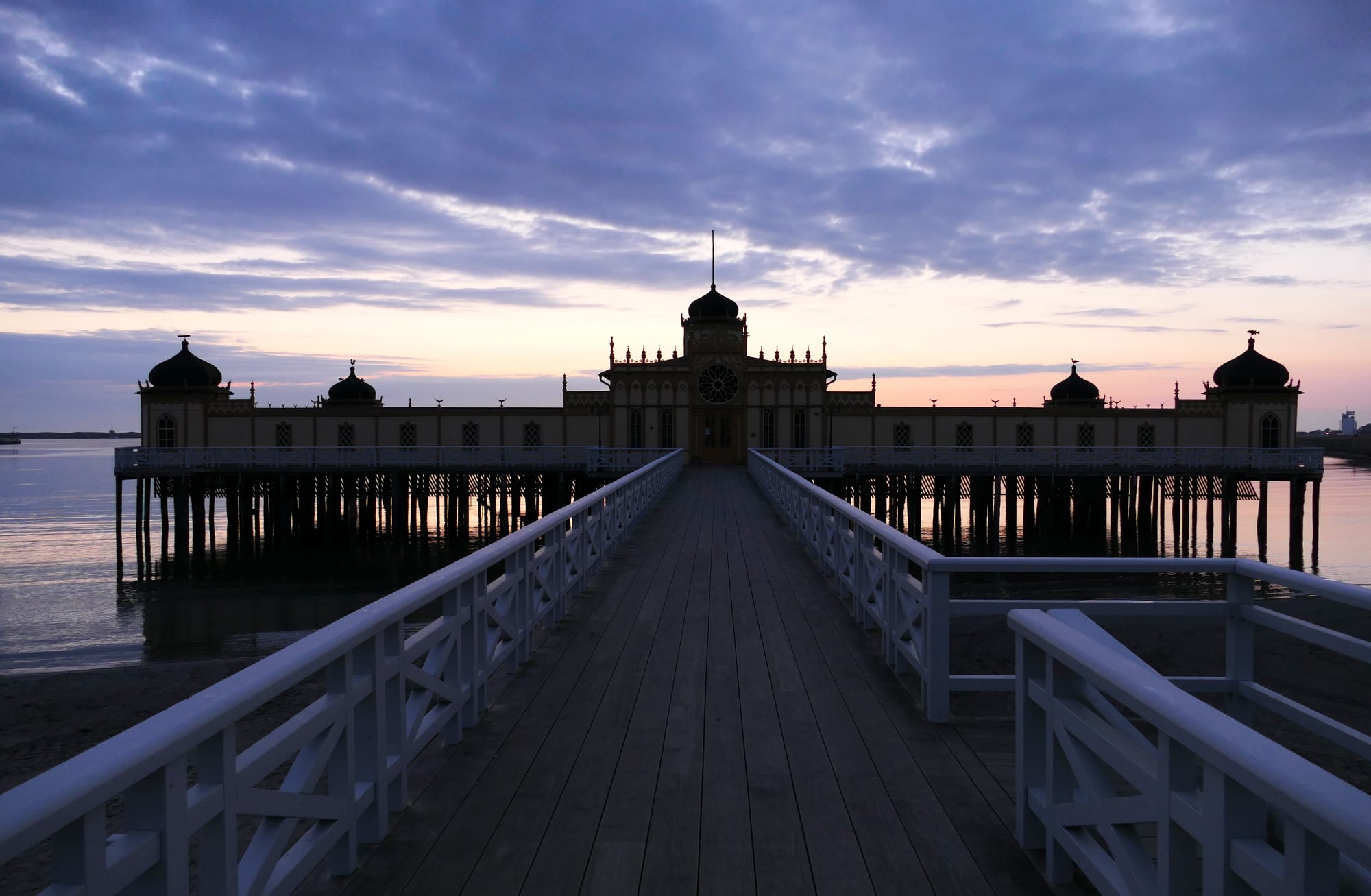
A white-railed wooden walkway leading to an ornate domed bathhouse standing on piles in calm sea at dusk

Gothenburg & West Sweden, Sweden

Varberg

Varberg's cold bathhouse of 1903, built on piles out in the sea north of the fortress. (Per A.J. Andersson / Wikimedia Commons · CC BY-SA 4.0)

A Halland seaside town about 70 km south of Gothenburg, where the coast's long sandy beaches give way to rock. A medieval Danish fortress, now a museum holding the Bocksten Man, stands over the harbour; a Moorish-style cold bathhouse on piles recalls its long spa history, and Apelviken's beach draws windsurfers and summer crowds.

Neighbourhoods

  • Town centre
    • First-time visitors
    • Shopping
    • Historic district

    The compact centre, rebuilt in stone and brick after the great fire of 1863 and still largely intact, with streets running down to the sea and the harbour. The fortress, the cold bathhouse and the Society Park are all within a few minutes' walk.

    Open in Maps
  • Norra Förstaden
    • Architecture
    • Culture

    The district north of the old core, added in the late 19th century as the town grew after the railways arrived. Its straight, tree-lined streets hold the red-brick town hall of 1894 and the Komedianten cultural centre.

    Open in Maps
  • Apelviken and the south coast
    • Beaches
    • Watersports
    • Summer stays

    The beach and leisure area a few kilometres south of the centre, with a surf centre, rental spots for windsurfing, kitesurfing and paddleboarding, and restaurants along the sand. Since 2015 the town has grown together with Södra Näs and Träslövsläge further south.

    Open in Maps
  • Getterön
    • Nature
    • Birdwatching
    • Beaches

    A former island immediately north-west of the town, joined to the mainland in 1936, with a bird station, a nature reserve and several beaches.

    Open in Maps

Things to do

Landmarks

  • Varberg Fortressmuseum

    Begun as a castle around 1280 and extended over the centuries, a military post until 1830 and a prison until 1931; it now houses the county museum.

    Open in Maps
  • Bocksten Manmuseum

    One of Europe's best-preserved medieval bog bodies, a man killed in the 14th century and found in 1936, displayed in the fortress museum with his complete clothing.

    Open in Maps
  • Cold bathhouselandmark

    Varberg's Moorish-style wooden kallbadhus of 1903, standing on piles in the sea north of the fortress by a shallow sandy beach, the third on the site and open all year.

    Open in Maps
  • Komediantenattraction

    A cultural centre with the municipality's main library, an art gallery and an 1895 theatre, converted and expanded in 2010–2012.

    Open in Maps
  • Konsthallen Hamnmagasinetmuseum

    An art gallery in a yellow-brick harbour warehouse of 1874.

    Open in Maps

Parks, beaches and the coast

  • Societetsparkenpark

    The Society Park near the harbour, with the wooden Societetshuset of 1886 built, like the bathhouse, in a Moorish style.

    Open in Maps
  • Apelvikenbeach

    The beach south of the town, known for some of the best windsurfing in Sweden, with a surf centre and board rentals.

    Open in Maps
  • Getterön Nature Reservepark

    Wetlands, beaches and a bird station on the former island just north-west of the town.

    Open in Maps

Short trips from the town

  • Grimeton Radio Stationlandmark

    A longwave transatlantic telegraphy station of 1922–1924 with the world's only surviving working Alexanderson alternator, a UNESCO World Heritage Site since 2004, open to visitors in summer.

    Open in Maps

Eat and drink

Long-standing places and food districts in Varberg. Hours, ratings and directions come from your maps app, always current.

Varberg food

  • Apelviken beach restaurantsneighborhood

    A handful of restaurants spread along the sand south of the town, busiest in summer, some with concerts.

    Open in Maps
  • Varberg harbourneighborhood

    The harbour has a fish shop for those cooking their own meal.

    Open in Maps
  • Town-centre caféscafe

    Cafés in the centre serve kanelbullar and coffee, some with afternoon cake buffets, and the town has one of Sweden's largest ice-cream parlours.

    Open in Maps

Experience Varberg

History

A fortress called Wardbergh, 'watch hill', was built in the 1280s as one of a chain of strongholds along what was then the Danish coast, and in the middle of the 14th century the old settlement of Getakärr, a kilometre to the north, took its name; a letter of 1343 is the oldest record of the town. It was moved about 5 km north around 1400, destroyed in the Kalmar War of 1611–1612 and rebuilt beside the fortress. Centuries of war between Denmark and Sweden were fought along this coast before Halland passed to Sweden by the Treaty of Brömsebro in 1645 — Varberg then had about 600 inhabitants — and permanently by the Treaty of Roskilde in 1658. After a fire in 1666 the town moved once more, to the site of today's centre.

The fortress remained a military post until 1830 and was used as a prison from the late 17th century until 1931. Varberg's career as a resort began in 1811, when a mineral spring at Apelviken was launched as a spa; from the 1850s steamers along the coast between Gothenburg and Copenhagen brought bathers, and in 1866 the first cold and warm bathhouses were built. A great fire in 1863 devastated the town, which was rebuilt in stone and brick. The railways arrived in 1880 and 1888, the population passed 4,000 by 1890 and reached 8,500 in 1930 with industrialisation, and the present cold bathhouse went up in 1903 after its predecessor was wrecked by the great Christmas storm of 1902.

In 1971 Varberg became the seat of a much larger municipality. Some houses were demolished in the 1970s, but most of the centre survives, and in 2025 the railway was moved into a tunnel beneath it.

Culture & Customs

Bathing and the sea are at the heart of local identity. Varberg has been a spa town for two centuries and is still one of Sweden's main spa and health resort towns. The cold bathhouse, in wood and in a Moorish style like the 1886 society house, is the town's best-loved building, and Apelviken is a centre for windsurfing, kitesurfing and paddleboarding, with some of the best windsurfing in Sweden.

The town enjoys its reversals of fortune. In 1826 the poet and bishop Esaias Tegnér called it the least appealing place in Sweden — a town of bare rock and sand without trees — and the line has since been used in Varberg's own marketing, now that parks such as Societetsparken and the English Park have softened the centre. It is often ranked among Sweden's most beautiful towns.

Cultural life centres on Komedianten, opened in 2012 as an arts centre around the main library and an 1895 theatre, and on the art gallery in an old harbour warehouse. In summer, restaurants on the beach at Apelviken stage concerts with well-known Swedish artists. Varbergs BoIS and Varbergs GIF are the town's long-standing sports clubs, and the dance band Face-84 and the singer Sara Löfgren both come from here.

Daily Life

Varberg had about 38,600 inhabitants in 2023, making it Sweden's 36th-largest urban area, and is the seat of a municipality of close to 56,000. Since 2015 it has grown together with Södra Näs and Träslövsläge to the south. Residential districts such as Breared and Träslöv, with its villa areas from the 1970s to the 1990s, spread east and south of the centre, and a new district, Västerport, is planned for the harbour area.

Tourism is the largest part of the economy: Varberg is one of Sweden's most visited summer towns and a leading spa town. The harbour, with more than a kilometre of quays, handles ships up to 230 metres long, and Campus Varberg, opened in the harbour area in 2003, brings higher education to the town.

The year turns on the summer, when visitors from across Sweden crowd the beaches and the town's nightlife is at its busiest. Out of season the town is a quiet market and commuter centre, with frequent trains to Gothenburg about 40 minutes away.

Food

Varberg's food is shaped by the sea and by its seaside season. The harbour has a fish shop, and on the beach at Apelviken a small row of restaurants serves summer visitors on the sand. Swedish coastal cooking draws on fish and seafood: pickled, sweetened herring, inlagd sill, is a traditional starter, salmon is cured as gravlax, poached or fried, and in August crayfish boiled in salted water with dill are eaten at the kräftskiva, the crayfish party.

Coffee culture runs through the town. Cafés serve kanelbullar, cinnamon buns, with coffee, and some lay on afternoon cake buffets, and the town has one of Sweden's largest ice-cream parlours, with up to 60 flavours.

At midsummer, new potatoes are served with pickled herring, chives and sour cream, and the strawberries of the season follow as dessert. Inland, in the farm country of the municipality, Nordic cooking is also served at a countryside farm restaurant.

Planning tools

Budget

Varberg is one of Sweden's most visited summer towns, and in July rooms near the sea are scarce and prices high. Outside summer it is a quiet, moderately priced market town. The beaches, the parks and much of the fortress grounds cost nothing, and frequent trains make a day trip from Gothenburg easy.

Daily Budget Midrange
USD 160–320 (hotel room, restaurant dinners, fortress museum and bathhouse entry, train fares)
Daily Budget Shoestring
USD 70–110 (hostel bed or campsite, self-catering, a café lunch, local buses)

Book summer stays early; cycle paths make a bicycle a practical way to reach the beaches south of the town.

Best Time to Visit

June to August for the beaches, swimming and the busiest town life; July is the peak, when Apelviken's restaurants put on concerts. Spring and autumn are quieter and suit walks along the coast and on Getterön. The cold bathhouse is open all year.

Suggested Number of Days

One or two days cover the town, the fortress and the shore. Three or four allow time at the beaches and in the countryside inland, or a slower pace along the Halland coast. Grimeton's summer-only opening and beach weather both affect how long is worth staying.

First Visit
1–2 days
With Surroundings
3–4 days

Transportation

The centre is easy on foot, and bicycles are popular, with several cycle paths through the town. Hallandstrafiken runs a small bus network, with at least half-hourly departures from morning to early evening. Apelviken is a short taxi ride south, and the E6/E20 motorway passes just outside the town.

Öresundståg train tickets must be bought before boarding, from machines at the station or online.

Airport & Station Connections

Varberg is on the West Coast Line between Gothenburg and Copenhagen via Malmö, with trains every hour during the day and more often at peak times: about 40 minutes from Gothenburg and three hours from Copenhagen. A new station opened in 2025, when the railway was moved into a tunnel under the town centre. The nearest international airport is Gothenburg Landvetter; Copenhagen Airport is about two and a half hours away by train.

Walkability

Very good in the centre: the station, shopping streets, harbour, fortress, Society Park and cold bathhouse are all close together. The beaches at Apelviken and the Getterön reserve are a bike ride or short drive away, and the seafront walk is open and windy.

Safety

Sweden is a very safe country for visitors. Varberg is a small, calm town; the practical risks are on the water — wind and waves at the surf beaches and cold sea outside high summer.

Swim at supervised beaches in summer and check wind conditions before surfing or kiting. Check current official travel advice before travelling.

Climate

An oceanic climate, moderate by Swedish standards but with marked seasons. Summers are generally a little cooler than in Halmstad or Gothenburg, as sea air holds down the highs, though some summer days are very warm and some winter nights bring hard frost.

Summer
generally cooler than in Gothenburg; the highest temperature recorded since 1901 is 33.6°C, on 31 July 2018
Winter
some nights bring severe frost; the lowest recorded since 1901 is -25.5°C, in January 1942

Local Customs

Tipping is not customary in Sweden: a bill may be rounded up for good service, and 5–10 per cent is left only for exceptional service. Coffee and a kanelbulle, the cinnamon bun, are part of daily life. The right of public access, allemansrätten, lets everyone walk and swim along most of the shore, but not through private gardens.

The minimum age is 18 in bars and 20 at Systembolaget, the state shop that is the only place to buy strong drink; identification is often asked for.

Common Payment Methods

The currency is the Swedish krona (kr). Sweden is one of the world's most cashless countries: payment by credit and debit card is very common, as is the Swedish payment app Swish, and businesses that do not accept cash at all are common. Cash machines are widely known as Bankomat.