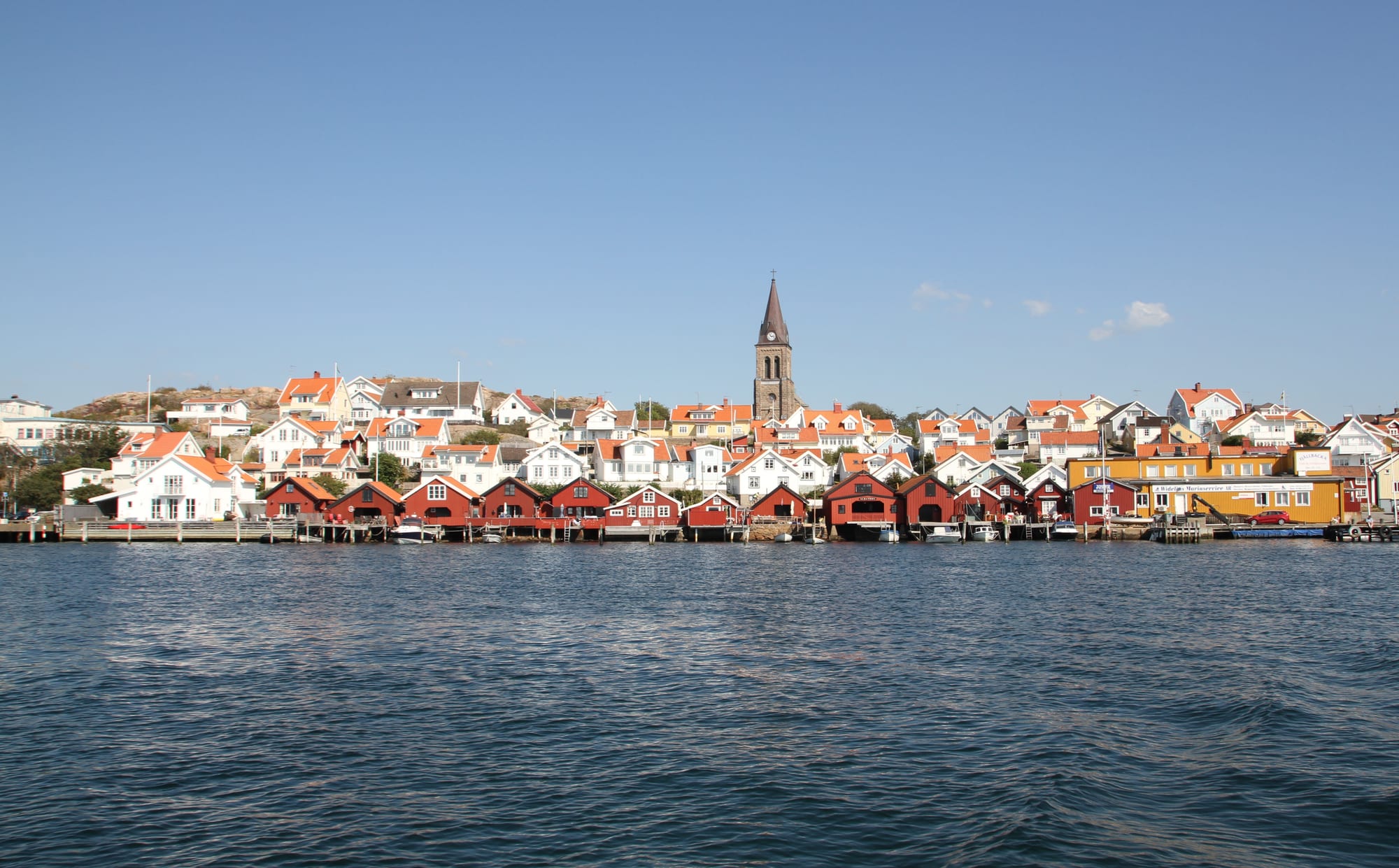
Row of red wooden boathouses along the water in front of white houses and a church spire under a clear blue sky

Sweden

Gothenburg & West Sweden

The waterfront of Fjällbacka, a fishing village on the Bohuslän coast. (Bjoertvedt / Wikimedia Commons · CC BY-SA 4.0)

Sweden's west-facing side on the Kattegat and Skagerrak, from the bare granite islands of Bohuslän down the sandy Halland coast, and inland to Lake Vänern — a region built around Gothenburg, the country's great port and industrial city, and famous across Sweden for its seafood.

Explore Gothenburg & West Sweden

History

The western coast was a frontier for most of its history. Bohuslän belonged to Norway and Halland to Denmark, leaving Sweden only a narrow outlet to the sea at the mouth of the Göta river, guarded by Älvsborg fortress. Long before, Bronze Age farmers carved ships, weapons and figures into the granite around Tanum, and Iron Age and Viking chieftains held the fertile plains of Västergötland, which has a strong claim as one of the cradles of the Swedish kingdom, with the early bishopric at Skara.

Gothenburg was founded in 1621 by Gustavus Adolphus to give Sweden a North Sea port free of Danish tolls. Dutch engineers laid out its canals and grid, and Dutch, German and Scottish merchants settled there. In 1658 the Treaty of Roskilde brought Bohuslän and Halland permanently under Swedish rule, and the fortress of Carlsten was built at Marstrand to hold Bohuslän. Magnus Gabriel De la Gardie rebuilt Läckö Castle on Lake Vänern in the same era.

The Swedish East India Company, founded in 1731, made Gothenburg rich on tea and porcelain from China. The 19th century brought textile mills around Borås, the Trollhätte canal linking Vänern to the sea, and herring booms on the Bohuslän coast. In the 20th century Gothenburg became Sweden's industrial capital, with the SKF ball-bearing works and Volvo, which built its first car there in 1927, and huge shipyards that closed in the crises of the 1970s and 1980s.

Culture & Customs

West Swedes see themselves as more relaxed, friendlier and funnier than Stockholmers, and the rivalry between the two cities is a staple of national humour. The Gothenburg dialect, göteborgska, has its own vocabulary and is associated with the göteborgsvits, the groan-worthy pun that locals are supposed to deliver effortlessly. Football runs deep: IFK Göteborg won two UEFA Cups in the 1980s, and each July the Gothia Cup brings youth teams from dozens of countries to the city.

The city's working-class, harbour past shows in a strong labour tradition and in the student, music and club scene that produced a string of indie and metal bands. The Gothenburg Film Festival in winter and the Way Out West festival in August are among Sweden's biggest cultural events.

On the coast, life follows the sea and the summer. The fishing villages of Bohuslän were built by fishermen and are now largely summer homes, and the region's sailors gather at Marstrand for regattas. Halland's towns — Halmstad, Falkenberg, Varberg — are beach resorts in July, and Halmstad gave its name to the Halmstad Group, painters who brought surrealism to Sweden in the 1930s. Inland, Västergötland's plains and the Vänern shore are quieter farming country, with free-church traditions strong in parts of the region.

Daily Life

Västra Götaland has more than 1.6 million people and Halland about 340,000. Gothenburg municipality has around 600,000 residents and the wider metropolitan area around 1 million. Borås, once the textile town and now known for mail-order retail and a university, has about 75,000 in its main town; Halmstad about 70,000; and Trollhättan, Uddevalla, Skövde, Varberg and Kungsbacka are the other sizeable centres.

The economy is still industrial at heart. Volvo Cars, now Chinese-owned, and the separate Volvo Group trucks company are the largest employers, with SKF and a cluster of suppliers and engineering firms. Gothenburg's port is the largest in the Nordic countries, and life sciences, the Chalmers technical university and the University of Gothenburg anchor the knowledge economy. Along the coast, fishing has shrunk and tourism, second homes and aquaculture have grown.

Days follow the national pattern of early starts, lunch around noon and fika breaks, with a July holiday when Gothenburgers pack the archipelago and the Halland beaches. Issues include housing costs in Gothenburg, segregation between its centre and outer suburbs, and the future of car manufacturing as it shifts to electric vehicles.

Food

The west coast is Sweden's seafood larder. Bohuslän's cold, clean waters give oysters, mussels and langoustines, and the lobster season, opening in late September, is an event in the coastal villages. Shrimp (räkor) are eaten peeled on bread in a räksmörgås or by the bagful on the quay, and mackerel, herring and cod are smoked and pickled along the coast. In Gothenburg the fish market was long housed in the Feskekôrka, the "fish church", a 19th-century hall built to look like a Gothic chapel, and the city's restaurants have made west coast seafood the core of their menus.

Local specialities include hönökaka, a soft flatbread from the island of Hönö in the Gothenburg archipelago, and the biscuits of Göteborgs Kex, long baked at Kungälv. Halland is known for its fertile farmland, and Falkenberg, on the river Ätran, has a salmon smokery.

Lake Vänern contributes whitefish, perch and pike-perch, and the Västergötland plains grow grain and dairy. Gothenburg's cafés are known for oversized cinnamon buns, and the city's breweries are among the leaders of Sweden's craft-beer revival.

Attractions & Natural Wonders

Gothenburg's centre runs along its canals from the harbour to Kungsportsavenyn, the main boulevard, rising to Götaplatsen and the art museum. The Haga district has wooden houses and cafés, the Liseberg amusement park is among Scandinavia's most visited, and the Universeum science centre, the botanical garden and the Nya Älvsborg fortress at the harbour mouth round out a stay. Trams and ferries reach the southern archipelago islands of Styrsö, Vrångö and Brännö.

North of the city, Marstrand's Carlsten Fortress and wooden villas stand on an island off Koön, and the Bohuslän coast continues past Käringön, Smögen with its boardwalk and harbour, Fjällbacka, and the Tanum rock carvings to Strömstad and the marine national park of Kosterhavet. Inland, the falls and locks at Trollhättan, and the elk-hunting table mountains of Halleberg and Hunneberg, lie on the way to Lake Vänern, the largest lake in Sweden. On its southern and eastern shores, Läckö Castle sits on the island of Kållandsö, the terraced hill of Kinnekulle rises above the water, and the Göta Canal leaves the lake at Sjötorp.

South along the Halland coast, Varberg has its fortress, the Bocksten Man and a striking wooden bathhouse built out over the sea, Falkenberg has its beaches, and Halmstad has the long sands of Tylösand, its castle and the Halmstad Group's museum at Mjellby.

Cities in Gothenburg & West Sweden

Planning basics

Budget

Gothenburg is somewhat cheaper than Stockholm, and the smaller towns and inland Västergötland cheaper again. The Bohuslän coast is the exception: in July, rooms in villages such as Smögen, Fjällbacka and Marstrand are scarce and expensive, and a seafood dinner is a real outlay. Camping, hostels and self-catering cabins keep costs down.

Daily Budget Midrange
USD 160–330 (hotel or guesthouse, seafood dinners, museum entry, a hire car or ferry trips)
Daily Budget Shoestring
USD 70–110 (hostel or campsite, self-catering, lunch deals, Västtrafik travel card)

Book summer accommodation on the Bohuslän coast months ahead, and buy shrimp or fish at the harbour to eat outdoors rather than at restaurants.

Safety

The region is safe for visitors. Gothenburg has had gang-related violence in some outer districts, which rarely touches the city centre. The practical risks are pickpockets in crowded places, slippery rocks and strong wind on the coast, cold sea water outside high summer, and heavy summer traffic on narrow coastal roads.

Take care on wet granite and when swimming off rocks, and wear a life jacket in small boats. Check current official travel advice before travelling.

Climate

The mildest and wettest part of Sweden outside the far south. Westerly winds off the North Sea bring rain in every season, frequent wind on the coast and winters that are often grey rather than snowy. Inland around Lake Vänern, winters are colder and snow more common.

Summer
mild, typically 17–23°C, breezy on the coast, with warm sea water by late July
Winter
cool, damp and windy, around -2 to 4°C in Gothenburg; colder with more snow inland

Transportation

Gothenburg's Landvetter airport and Central Station connect the region; trains reach Stockholm in about three hours and Oslo and Copenhagen in roughly four. The Halland coast is on the fast line south to Malmö, and the Bohuslän railway runs north to Strömstad. Gothenburg has an extensive tram network, and free or cheap public ferries serve the southern archipelago. A car is the simplest way to explore Bohuslän's villages and the Vänern shore.

Use the Västtrafik app for trams, buses and archipelago ferries; the passenger ferry to Marstrand is a short crossing from Koön.

Best Time to Visit

June to August for the coast, island-hopping and swimming, with July the busiest month. Late August and September are quieter and warm enough for the islands, and the shellfish season opens in autumn, with lobster from late September. Gothenburg's festivals — the Gothia Cup youth football tournament in July and the Way Out West music festival in August — fill its hotels. Winter suits a city break for museums and Christmas markets.