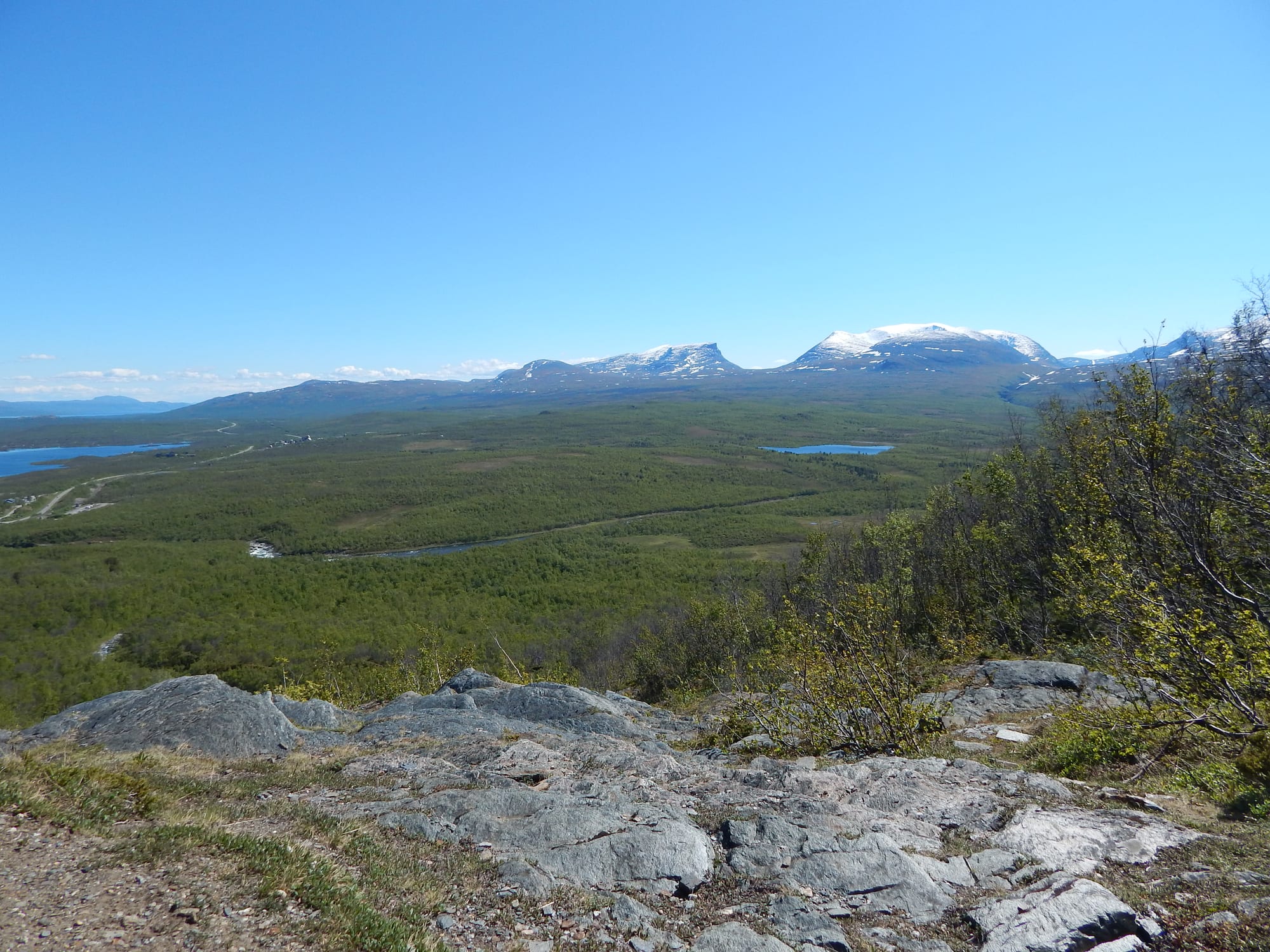
Grey rock in the foreground above a wide green valley of birch forest and small lakes, snow-capped mountains beyond

Sweden

Swedish Lapland

The Abisko valley in early summer, with the U-shaped notch of Lapporten on the horizon. (Monteuxs / Wikimedia Commons · CC BY-SA 4.0)

Sweden's vast, thinly peopled north, stretching from the Bothnian coast and the cities of Umeå and Luleå inland across forest and bog to the mountains of the Norwegian border — the homeland of the Sami, the iron-ore town of Kiruna, the wilderness of Sarek, and the land of the midnight sun and the northern lights.

Explore Swedish Lapland

History

People have lived in the north since the ice retreated, and the Sami, who may have been here for thousands of years, developed a culture of hunting, fishing and later large-scale reindeer herding across the interior. From the Middle Ages Swedish settlers moved up the river valleys from the coast, and the Crown pushed north to tax the Sami and trade furs, building churches and holding markets such as Jokkmokk's, established in 1605.

Church towns grew up so that farmers from scattered settlements could stay overnight when attending services; Gammelstad, near Luleå, is the largest to survive. The Lutheran church campaigned against Sami religion, and in the 17th century the silver mine at Nasafjäll relied on Sami conscripted to haul ore. In the 19th century the Laestadian revival movement, founded by the priest Lars Levi Laestadius, spread through Sami and Tornedalen communities and remains influential.

Industry arrived with the railway. The Iron Ore Line from Luleå to Kiruna and Narvik, completed in 1903, opened the Kiirunavaara deposit, and Kiruna grew as a company town of the state mining firm LKAB. Hydroelectric dams on the Lule and Ume rivers followed, flooding Sami grazing lands. In the 20th century Swedish policy pressured the Sami to assimilate, and today the Sami Parliament, set up in 1993, and the state's truth commission reflect a continuing reckoning. Since the 2000s, mine subsidence has forced Kiruna to move its centre several kilometres to the east.

Culture & Customs

Swedish Lapland is home to much of Sweden's Sami population. Sami culture shows in duodji, the craft of bone, antler, wood and leather, in the chanted song called joik, and in the colourful gákti dress worn at festivals and on national day, 6 February. Reindeer herding, still reserved for Sami, organises the year around calving, marking and autumn round-ups, and the Jokkmokk winter market combines trade and Sami culture.

The Torne valley on the Finnish border has its own language, Meänkieli, related to Finnish and recognised as a minority language, and many families there speak Finnish too. Laestadian congregations, with their strict customs, are still active in parts of the region.

The coastal cities are more like the rest of Sweden: Umeå is a young, university-led city with a strong music and arts scene, while Luleå and Skellefteå are industrial and hockey-mad. Across the north, winter means ice-fishing, cross-country skiing and snowmobiles, and summer means hiking, fishing, and picking cloudberries on the bogs. Northerners are famously laconic, and value self-reliance in a land of long distances.

Daily Life

The two counties have about 525,000 people across more than a third of Sweden's area. Umeå has about 130,000 in its municipality, Luleå about 80,000, Skellefteå about 75,000 and Piteå about 40,000; Kiruna has around 22,000 and most inland municipalities only a few thousand.

Mining and metals are the base of the economy: LKAB's iron-ore mines at Kiruna and Malmberget, and steel at Luleå, where new projects aim to make steel with hydrogen instead of coal. Hydroelectricity, forestry, data centres, the Esrange space centre near Kiruna, universities in Umeå and Luleå, and car testing on frozen lakes around Arjeplog add to it. Skellefteå's large battery factory drew thousands of workers before its owner, Northvolt, collapsed in 2025.

Life is shaped by light and cold. People make the most of the midnight sun in summer and adapt to weeks of darkness in winter. Key issues are the relocation of Kiruna, conflicts between mining, wind power and reindeer herding, and whether the green-industry boom will last.

Food

Northern food is built on reindeer, fish, berries and bread. Suovas, Sami salted and smoked reindeer meat, and renskav, thin shavings of reindeer fried with onion and served with mashed potato and lingonberries, are the classic dishes. Palt are dense dumplings: pitepalt from Piteå are filled with salt pork, and blodpalt are made with reindeer or pig's blood.

From the rivers and lakes come Arctic char, grayling and whitefish, and the Bothnian coast around Kalix produces Kalix löjrom, the orange roe of the vendace, which holds EU protected status. Västerbotten gives its name to Västerbottensost, a hard, strong, aged cow's-milk cheese made at Burträsk, served at crayfish parties and baked into savoury pies.

Tunnbröd, a thin flatbread, is baked across the north, and cloudberries (hjortron), gathered on the bogs in late summer, are served warm with ice-cream or waffles. Coffee is drunk in quantity, sometimes in the Sami and Tornedalen style with pieces of dried cheese dropped into the cup.

Attractions & Natural Wonders

In the far north, Kiruna has the LKAB visitor mine, its new town centre and the Kiruna Church, which has been moved to the new town. Jukkasjärvi, a short drive east, has the Icehotel and its year-round ice building. Abisko, beside Torneträsk, is the classic base for the northern lights, with the Aurora Sky Station on Mount Nuolja, the Abisko canyon and the view of Lapporten. It is also the northern start of the Kungsleden trail, and Kebnekaise, Sweden's highest mountain, rises to the south.

The Laponian Area covers the national parks of Sarek, Padjelanta, Stora Sjöfallet and Muddus. Sarek, with its glaciers, the Rapadalen delta and peaks of around 2,000 metres, is a trek for experienced hikers, usually from Kvikkjokk or Saltoluokta. Jokkmokk has the Ájtte Swedish mountain and Sami museum and the Arctic Circle nearby.

On the coast, Luleå has Gammelstad Church Town and an archipelago of more than a thousand islands, reachable by boat in summer and over the ice in winter. Umeå has the Bildmuseet art museum, the Västerbotten Museum and the Ume river, while Hemavan and Tärnaby in southern Lapland offer skiing and the southern end of the Kungsleden.

Cities in Swedish Lapland

Planning basics

Budget

Lapland is expensive for activities rather than for daily living. Hotels in Umeå and Luleå are fairly priced, and mountain huts and hostels are cheap, but winter tours — dog-sledding, snowmobiling, northern-lights trips — and a night at the Icehotel cost a great deal. Distances are long, so transport adds up.

Daily Budget Midrange
USD 180–410 (hotel or lodge, restaurant dinners, a guided winter excursion)
Daily Budget Shoestring
USD 70–110 (hostel or mountain hut, self-catering, trains and buses)

Book winter activities and the Icehotel well ahead for December to March; hikers can save by using the Swedish Tourist Association's mountain huts.

Safety

Crime is low; nature is the danger. Extreme cold, whiteouts, polar-night darkness and icy roads are serious winter hazards, and weather in the mountains can change within hours in any season. Sarek has no marked trails and few bridges, so river crossings and navigation require real experience. Mobile coverage is patchy away from towns.

Carry proper cold-weather clothing, a map and emergency supplies, leave a route plan with someone, and hire a guide for Sarek or winter trips if inexperienced. Check current official travel advice before travelling.

Climate

Subarctic, with long, cold winters and short, light summers. Inland, temperatures can fall below -30°C in midwinter, while the coast around Umeå and Luleå is milder but still snowy. North of the Arctic Circle the sun does not set for weeks around Midsummer and barely rises in December. Abisko lies in a rain shadow and is unusually dry.

Summer
cool to mild, typically 12–20°C, with midnight sun north of the Arctic Circle and many mosquitoes in July
Winter
very cold and snowy, often -10 to -25°C inland and colder in spells; polar night in the far north

Transportation

Airports at Umeå, Luleå, Skellefteå and Kiruna connect to Stockholm. Trains from Stockholm run to Luleå and to Kiruna, Abisko and on to Narvik in Norway, a long but scenic journey. The coast is linked by trains and buses, but inland distances are very long and public transport thin; a car, or organised transfers in winter, is often necessary. Sarek has no roads, and is reached on foot from trailheads such as Kvikkjokk.

Drive only with winter experience between November and April, and watch constantly for reindeer on the roads.

Best Time to Visit

Late February to March combines deep snow, longer days and good odds of the northern lights, which are visible roughly from September to March on clear, dark nights. The Jokkmokk winter market is held in early February. Late June to August is for hiking the Kungsleden and the national parks under the midnight sun, and September brings autumn colour and fewer insects.