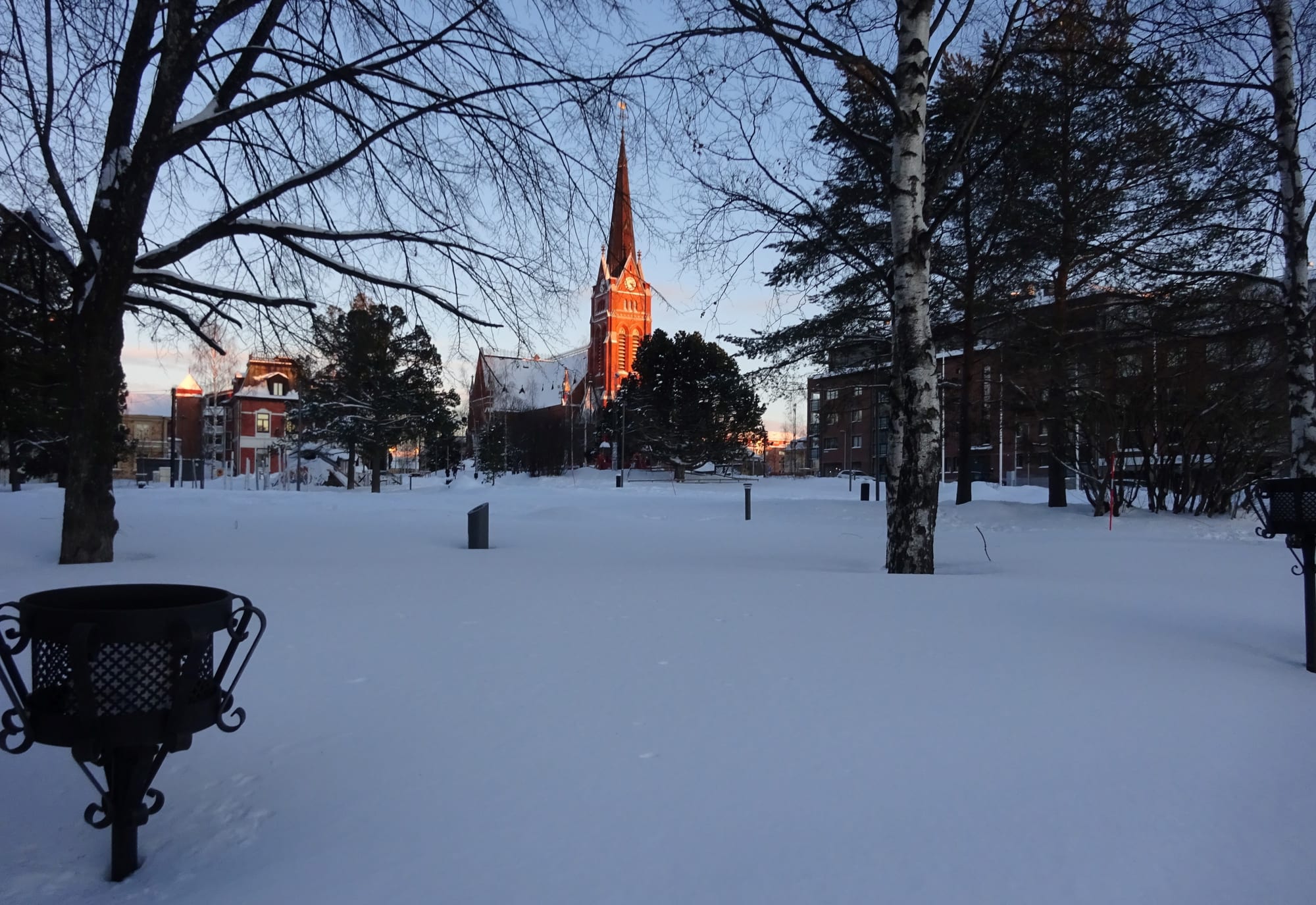
The red-brick tower of Luleå Cathedral glowing at dusk beyond a snow-covered park with birch trees

Swedish Lapland, Sweden

Luleå

Luleå Cathedral seen across a snowy park in the city centre in winter. (MikaPr65 / Wikimedia Commons · CC BY-SA 4.0)

The capital of Norrbotten County, at the mouth of the Lule River on the Bay of Bothnia, chartered in 1621 and moved to its present site in 1649 when the rising land left its first harbour too shallow. A steel, port and university city, it looks out on an archipelago of more than 1,300 islands, with the medieval church town of Gammelstad upstream.

Neighbourhoods

  • City centre
    • First-time visitors
    • Shopping
    • Close to public transport

    The centre on its peninsula, rebuilt after the fire of 1887 destroyed most of the town. Storgatan, with the Shopping mall, is a main shopping street, the cathedral, the county museum and Kulturens hus are here, and the north harbour is the stage for the summer festival.

    Open in Maps
  • Gammelstad
    • Historic district
    • Quiet and residential

    The site of the original town, about 10 kilometres upstream, now a district of Luleå around the UNESCO-listed church town. Its wooden cottages, built for churchgoers from the countryside, cluster around the medieval stone church.

    Open in Maps
  • Porsön
    • Students
    • Families

    The suburb where Luleå University of Technology opened its first campus in 1971, with the science centre Teknikens Hus beside it.

    Open in Maps
  • Bergnäset
    • Quiet and residential

    A suburb across the Lule River, reached by the Bergnäs bridge opened in 1954, which grew up as Luleå expanded in the 20th century and is now counted as part of the city.

    Open in Maps

Things to do

Famous landmarks

  • Gammelstad Church Townlandmark

    The best-preserved church town in northern Scandinavia, a UNESCO World Heritage Site since 1996, where more than 400 wooden houses were used only on Sundays and church festivals by worshippers who lived too far away to return home the same day.

    Open in Maps
  • Nederluleå Churchlandmark

    The 15th-century stone church at the centre of the church town, the largest medieval church in Norrland.

    Open in Maps
  • Luleå Cathedrallandmark

    A Neo-Gothic red-brick church consecrated in 1893 as the Oscar Fredrik church, on the highest point of the city-centre peninsula; it became a cathedral in 1904.

    Open in Maps

Museums and culture

  • Norrbottens Museummuseum

    The county museum, founded in 1886, covering the archaeology, ethnology, art and history of a county that takes up a quarter of Sweden.

    Open in Maps
  • Teknikens Husmuseum

    Sweden's northernmost science centre, supported by Luleå University of Technology, which also holds the Sedna model of the Sweden Solar System.

    Open in Maps
  • Norrbottens järnvägsmuseummuseum

    A railway museum in Luleå, the city at the southern end of the Iron Ore Line from Narvik.

    Open in Maps
  • Kulturens husattraction

    The House of Culture in the city centre, opened in January 2007, with a library, concert halls and art exhibitions.

    Open in Maps

The archipelago

  • Luleå archipelagoattraction

    More than 1,300 islands and islets offshore, a few with small permanent populations and most used only for summer recreation; tour boats run out in summer, and the islands are icebound in winter.

    Open in Maps
  • Klubbviken on Sandönbeach

    A bay with a beach on the island of Sandön, a pleasant stop on summer boat trips into the archipelago.

    Open in Maps

Shopping, sport and nights out

  • Shoppingattraction

    The indoor mall designed by Ralph Erskine and opened in October 1955, the first purpose-built indoor shopping centre in the world.

    Open in Maps
  • Coop Norrbotten Arenaattraction

    The 6,150-seat home of Luleå HF, the ice hockey team that won the Swedish championship in 1996 and again in 2025.

    Open in Maps

Seasonal events

  • Minus 30-festivalenA Saturday in mid-March

    One of the city's largest winter festivals, held indoors at Kulturens hus.

  • Luleå HamnfestivalSummer

    A harbour festival centred on the north harbour, held each summer since 2013 as the successor of earlier summer festivals going back to 1988.

  • Musikens maktAugust

    A smaller free music festival held at Gültzauudden in the third week of August since 2010.

Eat and drink

Long-standing places and food districts in Luleå. Hours, ratings and directions come from your maps app, always current.

Norrbotten classics

  • Paltrestaurant

    Meat-filled potato dumplings made from raw potato, a northern Swedish tradition served with butter, lingonberry preserve and cold milk; pitepalt is the speciality of nearby Piteå.

    Open in Maps
  • Kalix löjromrestaurant

    The roe of the vendace from the coast at Kalix, north-east of Luleå, given its distinctive taste by fresh water from the great rivers and protected as a geographical speciality by the EU.

    Open in Maps

Food districts

  • Storgatanneighborhood

    A main street of the centre, with the Shopping mall and bars and restaurants along it.

    Open in Maps
  • Gammelstadneighborhood

    Places to eat near the church town for visitors spending a day among the cottages.

    Open in Maps

Experience Luleå

History

Luleå first appears in documents in 1327, on the site of today's Gammelstad, where a trading settlement grew up around the parish church. King Gustavus Adolphus granted the town its royal charter in 1621, but the land was still rising after the last Ice Age, and the bay became too shallow for ships. In 1649 the town was moved to its present site on the coast, and the old settlement became Gammelstad, the "old town", whose church town of wooden cottages survives as a UNESCO World Heritage Site.

The new town grew slowly and burned often, in 1653, 1657 and, most devastatingly, in 1887, when a fire destroyed most of Luleå and spared only a few buildings. In 1805 it had only 947 inhabitants. It became the county town of Norrbotten in place of Piteå, industry began to take root from the 1860s, and the Iron Ore Line made Luleå a hub for ore, steel and freight moving between road, rail and ship. The Neo-Gothic Oscar Fredrik church, now the cathedral, was dedicated in 1893.

The 20th century brought the steelworks, now run by SSAB, the Norrbotten air force wing at the airport and, in 1955, an indoor mall designed by Ralph Erskine that is described as the first in the world. Luleå University College opened in 1971 and became Luleå University of Technology in 1997. In 2011 Facebook chose the city for its first data centre outside the United States, completed by 2016, and the region began to market itself as the Node Pole.

Culture & Customs

Luleå has a range of cultural institutions: the regional theatre Norrbottensteatern, the county museum, and the Norrbotten Big Band. Kulturens hus, opened in 2007, brings a library, concerts and exhibitions under one roof. The city has a heavy music scene, home to the hardcore band Raised Fist and the metal bands The Duskfall and Machinae Supremacy, and it has also hosted ice music, concerts played on instruments carved from ice inside a large igloo.

Sport has a large place in city life. Luleå HF won the Swedish ice hockey championship in 1996 and again in 2025, and also won the European Trophy in 2012 and the Champions Hockey League in 2015; the women's team Luleå HF/MSSK plays in the top league. In basketball, BC Luleå has won eight Swedish championships and the women of Luleå Basket two. The Swedish championship in yukigassen, a team snowball-fighting sport, is held in the city every year.

The festival calendar follows the light: the indoor Minus 30 festival in mid-March, the harbour festival in summer, and the Musikens makt music festival in August. Luleå has names in several of the north's languages, Luleju in Lule Sami and Luulaja in Finnish and Meänkieli, and the archipelago, frozen in winter and full of boats in summer, is central to how people spend their free time.

Daily Life

About 50,000 people live in the urban area of Luleå, and about 80,000 in the municipality as a whole, which makes it the largest city in Norrbotten County. It is the county capital, with the administration and the shops that serve a huge and thinly populated hinterland.

The economy mixes heavy industry, research and services. The SSAB steelworks and Luleå University of Technology, with more than 19,000 students across its campuses in Luleå, Kiruna, Skellefteå and Piteå, are major employers, alongside the Norrbotten air force wing, a Scania subsidiary and a port that is one of the country's biggest for bulk shipments. Facebook's data centre, announced in 2011 and completed by 2016, drew attention to the region's cheap renewable electricity and cold climate, and an information-technology sector has grown around the university.

The year swings between extremes. In summer the nights barely darken and people head for boats and summer houses in the archipelago; in winter the sea freezes, the islands are icebound, and life moves indoors to the arena, the cultural centre and the malls. Suburbs such as Bergnäset across the river and Gammelstad upstream have been counted as part of Luleå since the municipal merger of 1969.

Food

Luleå eats the food of the Norrbotten coast and the forests behind it. Palt, the meat-filled potato dumplings of northern Sweden, are made from raw potato and traditionally served with butter and lingonberry preserve and a glass of cold milk. One variant, pitepalt, is the speciality of Piteå, down the coast, and is made with a mix of wheat and barley flour; in the far north there is also blodpalt, made with blood, from reindeer in the very north, mixed with flour, boiled and served with fried pork.

From the coast to the north-east comes Kalix löjrom, the roe of the vendace. The fresh water pouring in from the great rivers around Kalix gives it a distinctive flavour, and the EU has granted it protected geographical status. Reindeer is the meat of the inland, most famously as sautéed reindeer, renskav, thinly sliced, fried in fat with salt and black pepper and served with mashed potatoes and lingonberries.

Cloudberries, hjortron, are served in Sweden as a topping for ice cream, pancakes and waffles. In the city itself most restaurants, cafés and bars are found in the centre, around Storgatan, while visitors to Gammelstad can eat near the church town, and the university has a student bar run by and for its students.

Planning tools

Budget

Luleå is a working city, and everyday costs are those of urban Sweden: restaurant meals and alcohol are the expensive part, supermarkets and lunch deals the cheap one. Boat trips into the archipelago in summer and winter excursions on the ice add to the bill, and hotel prices can rise when big events fill the city.

Daily Budget Midrange
USD 170–350 (city hotel, restaurant dinners, an archipelago boat trip or a guided winter excursion)
Daily Budget Shoestring
USD 70–110 (hostel or budget room, supermarket food, local buses)

Gammelstad Church Town can be reached by local bus and walked freely, and the city's ice and shoreline cost nothing to enjoy.

Best Time to Visit

June to August for the archipelago, boat trips, the harbour festival and very light nights. Winter brings snow, ice on the bay and the chance of the northern lights, which can be seen on clear nights from September to March; mid-March, with longer days and deep snow, is the time of the Minus 30 festival.

Suggested Number of Days

One or two days are enough for the city itself. Time on the water in summer, or on the ice in winter, adds a day or two, and winter plans depend on the weather.

First Visit
1–2 days
With Surroundings
3–4 days

Transportation

Luleå Lokaltrafik runs the city buses, with five main lines, several more, and night buses at weekends; regional buses from the bus station serve the rest of Norrbotten County. Tour boats reach the archipelago in summer. Most of the centre is close enough to cover on foot.

A visitors' pass for the local buses is sold at the tourist office and is useful for several trips a day.

Airport & Station Connections

Luleå Airport, near Kallax about 7 kilometres south of the centre, is the largest airport in Norrland, with frequent flights to Stockholm Arlanda; city buses link it with the centre. A night train runs south to Stockholm, a journey of about 14 hours, and trains on the Iron Ore Line run north via Boden, Gällivare and Kiruna to Narvik, about seven and a half hours away.

Walkability

The centre is compact and flat, with the cathedral, museum, shopping streets and harbours within a short walk of each other. Gammelstad, Porsön and the airport are a bus ride away. Pavements are snowy and icy through the long winter.

Safety

Sweden is a very safe country for visitors. In Luleå the main hazards are winter ones: cold, ice on pavements and roads, and the risks of walking or driving on sea ice that has not been declared safe.

Keep to marked and maintained routes on the frozen sea, dress for real cold, and carry the emergency number 112. Check current official travel advice before travelling.

Climate

A subarctic climate with short, mild to warm summers and long, cold, snowy winters, softened by the Gulf of Bothnia and the North Atlantic so that Luleå is milder than most places at the same latitude. Summers are very bright around the solstice, and the northern lights can appear on clear nights from September to March.

Summer
short and mild to warm, with some days in June and July reaching around 30°C
Winter
long, cold and snowy, with the sea around the city frozen; in Piteå, down the coast, lows from December to February are typically −22 to −10°C

Local Customs

Tipping is not customary in Sweden; some people round up the bill for good service. Alcohol stronger than 3.5 per cent is sold only in the state Systembolaget shops. Ice hockey and basketball have large followings, with teams in the top Swedish leagues.

The right of public access applies on the archipelago islands, but not to private houses and the land close to them.

Common Payment Methods

The currency is the Swedish krona. Sweden is one of the world's most cashless countries: most stores, restaurants and bars accept all major credit cards, PIN pads are used instead of signatures, and businesses that do not accept cash at all are common. Some small vendors take only Swish or cash, so a small amount from an ATM can be useful.