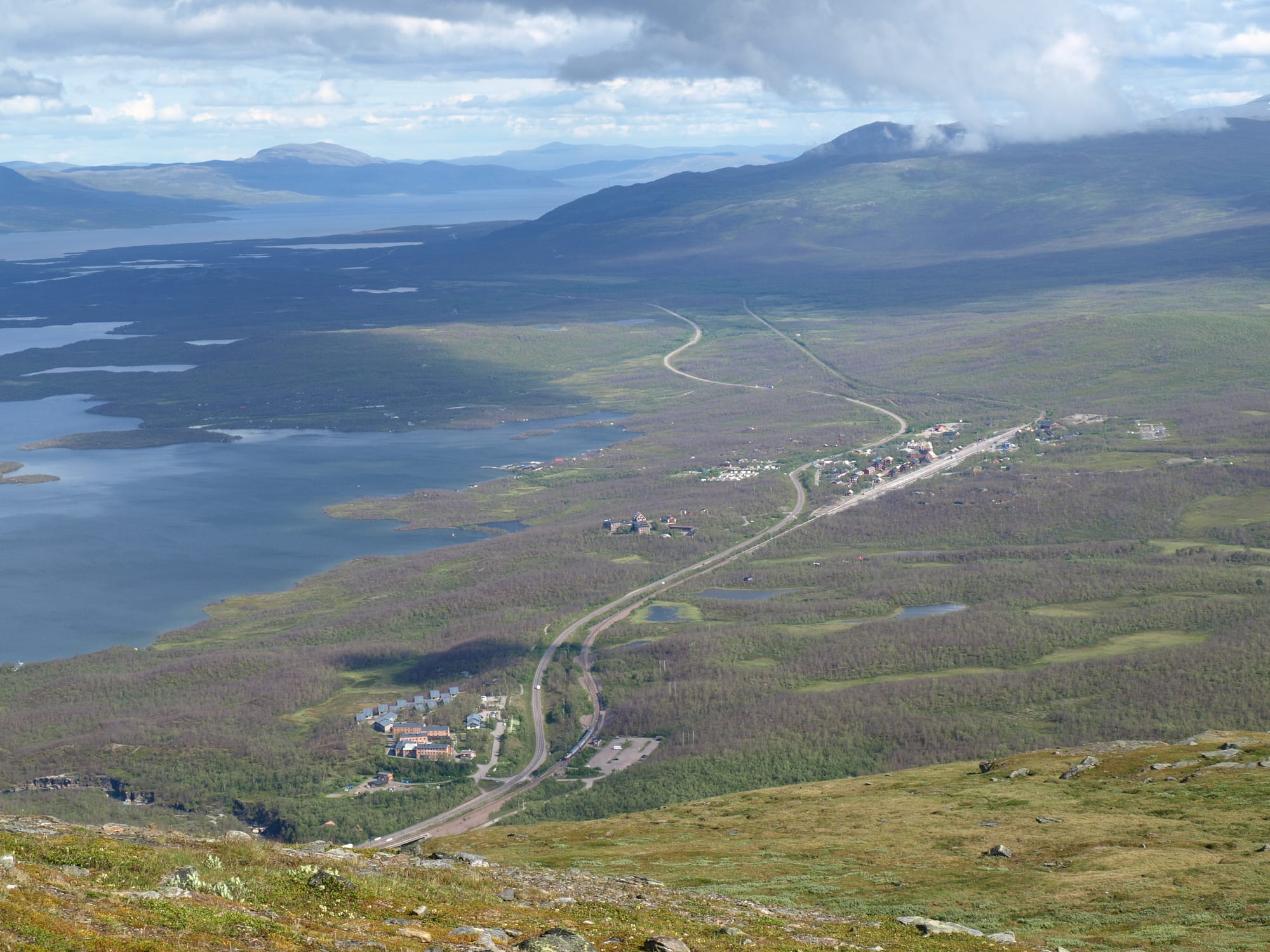
A green valley seen from a mountainside, with the lake Torneträsk on the left and a road and railway leading to a small village

Swedish Lapland, Sweden

Abisko

Abisko from the slopes of Nuolja, with Torneträsk on the left and the village of Abisko Östra in the distance. (Ojan / Wikimedia Commons · CC0)

A small village on the southern shore of the lake Torneträsk, about 200 kilometres north of the Arctic Circle, that grew up while the iron-ore railway to Narvik was built around 1900. Beside a national park established in 1909 and the northern end of the Kungsleden trail, it lies in a rain shadow that makes it one of the driest places in the country.

Neighbourhoods

  • Abisko Östra
    • Local life
    • Close to public transport

    The village itself, gathered around its railway station on the line between Kiruna and Narvik and along the E10. It is a handful of streets of houses and holiday cottages, with a shop and petrol station, a bed and breakfast, and the Abisko Scientific Research Station on the lakeshore nearby.

    Open in Maps
  • The western end, by the national park
    • Hiking
    • Northern lights

    About two kilometres west, where the Abiskojåkka river runs through its canyon into Torneträsk. The Abisko Turiststation railway halt, the start of the Kungsleden, the chairlift up Nuolja and the national park's trailheads are all here.

    Open in Maps

Things to do

The national park and the lake

  • Abisko National Parkpark

    Established in 1909, the same year as Sweden's first nature conservation laws, by a group of scientists including the geologist Fredrik Svenonius; it runs from the shore of Torneträsk some 15 kilometres to the south-west.

    Open in Maps
  • Lapportenviewpoint

    The Lapponian Gate, or Tjuonavagge in Northern Sami, a U-shaped valley between two mountains of more than 1,500 metres, one of the most familiar sights of the Swedish mountains and visible from Abisko.

    Open in Maps
  • Abisko Canyonattraction

    The gorge cut by the Abiskojåkka river just before it reaches Torneträsk, one of the main sights close to the village.

    Open in Maps
  • Torneträskattraction

    Sweden's sixth-largest lake and its second deepest, at 168 metres, left by a glacier and usually frozen from December to June.

    Open in Maps

Northern lights and viewpoints

  • Aurora Sky Stationviewpoint

    A station on Mount Nuolja, opened in 2007 and best reached by chairlift, with a café and a lookout made above all for watching the northern lights.

    Open in Maps
  • Nuoljatrail

    The mountain above the village, crossed by a 12-kilometre hiking trail through mountain birch forest, with a chairlift that runs in summer and in the aurora season.

    Open in Maps

Trails and history

  • Kungsledentrail

    Probably Sweden's best-known hiking trail, which starts at Abisko and runs south through the mountains to Hemavan, with cabins and huts along the way.

    Open in Maps
  • Abisko Scientific Research Stationattraction

    A field station on the shore of Torneträsk for research into subarctic ecology, geology and climate, visited by about 500 scientists from around the world each year.

    Open in Maps
  • Tornehamn cemeterylandmark

    The Rallarkyrkogården, a cemetery and monument for the workers who died building the railway line.

    Open in Maps
  • Sámi camp displayattraction

    Near the tourist station, a sameviste: a group of the storage buildings and dwellings once used by the Sámi of the area.

    Open in Maps

Eat and drink

Long-standing places and food districts in Abisko. Hours, ratings and directions come from your maps app, always current.

Abisko classics

  • Aurora Sky Station cafécafe

    The café at the top of the chairlift on Nuolja, at the station built above all for watching the northern lights.

    Open in Maps
  • Reindeer and cloudberriesrestaurant

    Local menus draw on the surrounding nature, with dishes such as reindeer meat served with cloudberry jam.

    Open in Maps

Experience Abisko

History

Abisko's story begins with the building of the Malmbanan, the iron-ore railway between Kiruna and Narvik, between 1899 and 1902. The tunnel through the mountain Nuolja was one of the largest tasks of the project, and many tunnel workers lived here for years, with a temporary hydroelectric plant on the Abiskojåkka river supplying power for the work. Those who died building the line are remembered at the Tornehamn cemetery. When the railway was finished, the Swedish Tourist Association bought one of the houses by the river and began to take in visitors, and tourism has shaped the village ever since.

In 1909, the year Sweden passed its first nature conservation laws, a group of scientists including the geologist Fredrik Svenonius secured the creation of Abisko National Park. Research became the village's second pillar: the Abisko Scientific Research Station, now run by the Swedish Polar Research Secretariat, studies the ecology, geology and climate of the subarctic. During the Second World War, in 1944, British bombers on their way to attack the German battleship Tirpitz used Torneträsk as a rendezvous point, in violation of Swedish neutrality.

The E10 road between Kiruna and Narvik reached the area in the early 1980s, making Abisko accessible by car as well as by train. Today it is a village of fewer than a hundred people that receives far more visitors, drawn by the northern lights in winter and the trails in summer.

Culture & Customs

The village's Northern Sami name, Ábeskovvu, means roughly "the forest by the big water", and the big water is the river Abiskojåkka rather than the lake. The landscape's other names are Sami too: Lapporten is Čuonjávággi, the Goose Valley, and Torneträsk is Duortnosjávri. Near the tourist station a sameviste shows the storage buildings and dwellings once used by the Sámi of the area.

Life in Abisko revolves around the outdoors. The Kungsleden, probably Sweden's best-known hiking trail, begins here, and the Nordkalottleden and the European long-distance path E1 pass through, so in summer the village fills with walkers setting off or finishing. In winter people come to cross-country ski, snowshoe and watch for the aurora; Abisko lies within the auroral belt, and its dry climate and low cloud give good chances of a clear sky.

Science gives the village an international feel. About 500 researchers from around the world come to the research station each year, and Umeå University's Climate Impacts Research Centre works there on the effects of a warming climate. One of those effects is visible on the ground: the low-altitude permafrost around the village is disappearing because of global warming and increased snowfall. In the evening, the pub at the tourist station and a restaurant and bar by Abisko Östra are the places to go for a drink.

Daily Life

About 85 people lived in Abisko in 2005. The village is part of Kiruna Municipality, and Kiruna, about 100 kilometres away by road, is the nearest town for most services.

Work depends on tourism, the research station, the railway and the road. The tourist station, which provides lodging, food and other services for hikers and is one of a chain of similar facilities along the Kungsleden, is at the centre of the visitor trade, and the chairlift up Nuolja runs both in summer and late into the night in the aurora season. Trains between Kiruna and Narvik stop at both of the village's stations, and the ore trains of the Malmbanan run past.

The year is set by light and snow. The midnight sun lights summer hikes, while winter brings weeks of short days, lake ice that often lasts from December into June, and visitors staying up for the northern lights. Shopping is limited to a small shop at the tourist station that stocks hikers' daily needs and outdoor equipment, and a village shop with a petrol station.

Food

Abisko is too small to have a food culture of its own, and it eats the way the mountains of the north eat: reindeer, berries, and whatever hikers carry. The restaurant at the tourist station serves food inspired by the surrounding nature, with dishes such as reindeer meat with cloudberry jam. Cloudberries, hjortron in Swedish and snattren in parts of northern Sweden, are gathered on the bogs; in Sweden the berries and their jam are used as a topping for ice cream, pancakes and waffles.

The best-known traditional reindeer dish of Sápmi is sautéed reindeer, renskav in Swedish: thin slices of reindeer, usually cut while still frozen, fried in fat and seasoned with salt and black pepper, then served with mashed potatoes and lingonberries, traditionally raw lingonberries mashed with sugar.

Up on Nuolja, the Aurora Sky Station has its own café beside its lookout for the northern lights. On the trails, cooking is a matter of self-catering: hikers stock up at the shop before setting off, and some of the mountain cabins along the Kungsleden, such as Abiskojaure, have small shops of their own. In the evenings, the pub at the tourist station and the restaurant and bar by the petrol station near Abisko Östra serve drinks and food.

Planning tools

Budget

Abisko has very few places to eat or stay, so most costs are fixed: a room or a hostel bed, meals at the few restaurants, and the chairlift or a northern-lights visit. Self-catering and the right to roam, with camping outside the national park, keep costs down for hikers. Getting there by night train or by flight to Kiruna adds to the bill.

Daily Budget Midrange
USD 180–380 (private room or cabin, restaurant meals, the chairlift and an evening at the Aurora Sky Station)
Daily Budget Shoestring
USD 70–110 (hostel bed or camping, self-catering from the village shop, walking)

Joining the Swedish Tourist Association, STF, before booking lowers the price of its mountain accommodation and cabins along the trails.

Best Time to Visit

Winter, from about December to March, is the northern-lights season, and Abisko's dry climate and low cloud make it a good place to see them. Midsummer brings the midnight sun and the hiking season on the Kungsleden and the park's trails. Torneträsk is usually frozen from December to June.

Suggested Number of Days

Two or three nights give several chances of clear skies for the northern lights and time for day walks. Hikers stay longer, and a walk along the trails south can take a week or more; bad weather can add a day or two to any plan.

First Visit
2–3 days
With Surroundings
4–7 days

Transportation

Roads are limited to the strip along the E10, and outside the village the ways to get around are on foot, on skis in season, and on the chairlift up Nuolja. The two railway stops, Abisko Östra in the village and Abisko Turiststation to the west, are about two kilometres apart. A marked snowmobile route runs towards Abiskojaure in winter.

The Abiskojåkka delta is closed in summer to protect nesting birds.

Airport & Station Connections

Night trains from Stockholm to Narvik stop at both Abisko stations, one direct and one with a change at Boden, and daily trains run from Luleå and Narvik. The nearest airports are Kiruna, about 100 kilometres to the south-east, and Narvik/Harstad in Norway, about 120 kilometres to the west. By road Abisko is on the E10, about 80 kilometres from Narvik and 100 from Kiruna.

Walkability

The village is small and easy to walk, and the canyon, lakeshore and trailheads are within reach on foot. The walk between the two railway stops is about two kilometres. Snow and ice cover the paths for much of the year.

Safety

Sweden is a very safe country for visitors. Around Abisko the risks are natural: cold, darkness in midwinter, ice and fast-changing mountain weather, and long distances between help on the trails.

Carry proper clothing, a map and supplies on the trails, leave a route plan with someone, and keep the emergency number 112 to hand. Check current official travel advice before travelling.

Climate

A subarctic climate in a rain shadow of the Scandinavian Mountains, which makes Abisko one of the driest places in Sweden, with less than half the precipitation of nearby Riksgränsen, though it is often cloudy. Winters are long and cold, softened by mild air from the west, and Abisko's yearly average is milder than Kiruna's despite cool summers.

Summer
cool and fairly rainy, with chilly nights and the midnight sun; in Kiruna, about 100 kilometres away by road, July averages about 12°C
Winter
long and cold, with often modest snow cover; in Kiruna, about 100 kilometres away by road, January averages about −14.5°C

Local Customs

Tipping is not customary in Sweden; some people round up the bill for good service. Alcohol stronger than 3.5 per cent is sold only in the state Systembolaget shops, so drinks come mainly from the few bars and restaurants. The right to roam lets visitors camp almost anywhere except inside the national park and close to private houses.

Inside the national park, camping is allowed only at the designated sites.

Common Payment Methods

The currency is the Swedish krona. Sweden is one of the world's most cashless countries: most stores, restaurants and bars accept all major credit cards, PIN pads are used instead of signatures, and businesses that do not accept cash at all are common. Some small vendors take only Swish or cash, so a small amount from an ATM can be useful.