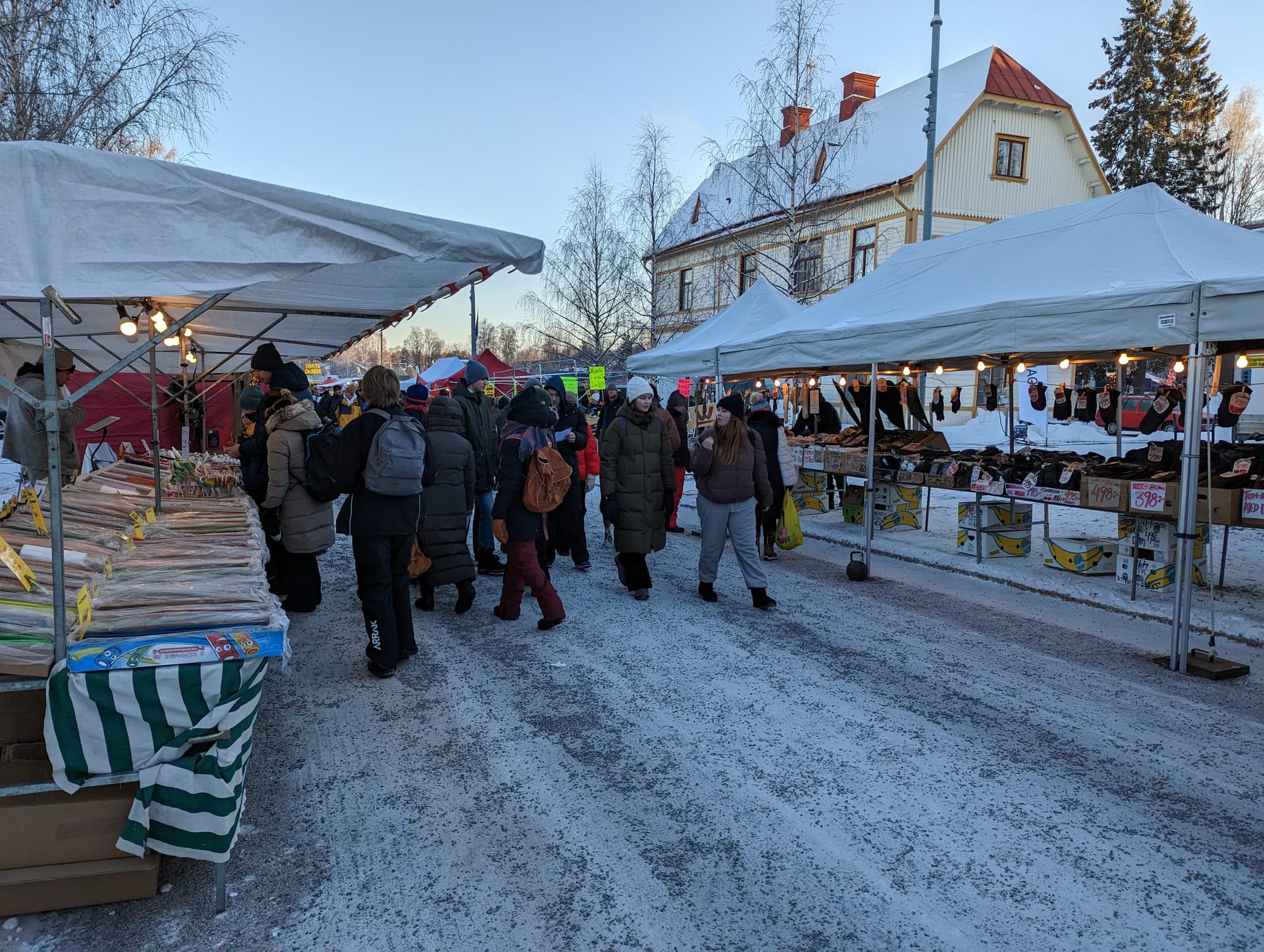
Visitors in winter coats walking between white market stalls on a snowy street, with a yellow wooden house behind

Swedish Lapland, Sweden

Jokkmokk

Stalls and visitors at the Jokkmokk winter market in early February. (AleWi / Wikimedia Commons · CC BY-SA 4.0)

A small town on the Lilla Luleälven just north of the Arctic Circle, chosen by the Swedish Crown in 1602 as a market place in Lule Lappmark. Its winter market has been held every February since 1605, and the town is a centre of Sámi life, home to the Ájtte museum, a Sámi education centre and an office of the Sámi Parliament.

Neighbourhoods

  • The town centre
    • First-time visitors
    • Sámi culture
    • Markets

    A grid of straight streets laid out in the late 19th century around the church, with the square where the February market fills the streets, the Ájtte museum, the Sámi Duodji handicraft foundation and several art and craft shops.

    Open in Maps
  • Around the old church and Talvatissjön
    • Quiet and residential
    • Walks

    The quieter edges of the town, with the rebuilt old church, the lake Talvatissjön at the southern end of Jokkmokk and the Storknabben lookout a couple of kilometres to the south-east. The E45 and the Inland Line railway divide the town in two.

    Open in Maps

Things to do

Sámi culture and history

  • Ájtte, Swedish Mountain and Sami Museummuseum

    The main museum and archive of Sami culture in Sweden, opened in June 1989, which also covers the nature of the northern mountains; its name is the Lule Sami word for a storage hut.

    Open in Maps
  • Sámi Duodjiattraction

    The Sámi handicraft foundation, Sameslöjdstiftelsen, based in Jokkmokk.

    Open in Maps
  • Jokkmokk Old Churchlandmark

    The church first consecrated in 1753, which stood until it burned down completely in 1972 and was then rebuilt.

    Open in Maps
  • Jokkmokk winter marketmarket

    Held every February since 1605: thousands of people gather for concerts, exhibitions and trade in Sami handicraft and produce, one of the most important social events of the year in Sápmi.

    Open in Maps

Viewpoints

  • Storknabbenviewpoint

    A hill about two kilometres south-east of the town with a lookout point.

    Open in Maps

Short trips from the town

  • Porjus Hydroelectric Power Stationmuseum

    One of the oldest and largest power plants in Sweden, built in 1910–15, which also supplied power for the trains of the Iron Ore Line; the old brick building is kept as a heritage site, with tours in summer.

    Open in Maps
  • Laponiapark

    A UNESCO World Heritage Site since 1996, covering about 9,400 square kilometres of mountains, rivers and lakes, parts of it still used as pasture by reindeer-herding Sami, including the national parks of Muddus, Sarek, Padjelanta and Stora Sjöfallet.

    Open in Maps
  • Sarek National Parkpark

    Established in 1909, with six of Sweden's thirteen peaks over 2,000 metres; it has no marked trails and only two bridges in its interior, so beginners are advised to go with a guide.

    Open in Maps

Eat and drink

Long-standing places and food districts in Jokkmokk. Hours, ratings and directions come from your maps app, always current.

Jokkmokk classics

  • Suovaskebabrestaurant

    Sliced suovasbierggo with cucumber, salad and garlic dressing in pita bread, a dish of modern Sámi cooking found at festivals and fairs in northern Scandinavia.

    Open in Maps
  • Sautéed reindeer (renskav)restaurant

    Thinly sliced reindeer fried in fat with salt and black pepper and served with mashed potatoes and lingonberries, perhaps the best-known traditional meal of Sápmi.

    Open in Maps

Experience Jokkmokk

History

The place was a winter gathering point long before it was a town. The Sámi name Dálvvadis means winter settlement, and Jokkmokk appears in 16th-century tax rolls as Jochmochs by, a fiscal unit of Lule Lappmark where traders from the coast came to deal with the Sámi. In 1602 Duke Karl, later King Charles IX, decided that fixed market places should be established in the Lapland territories, and Jokkmokk was chosen for Lule Lappmark. A simple vicarage, a customs house and market booths were built, and in 1605 the first market was held. Its purpose was to strengthen the state's hold on the north: to collect taxes, spread the Christian faith and hold courts, with the Sámi also required to attend church during the market days.

For a long time there was hardly any permanent population outside market time. A state school for Sámi children was founded in 1732, the year Carl Linnaeus passed through on his Lapland journey and was unimpressed by both chaplain and schoolmaster. A new church was consecrated in 1753, and it stood until it burned down in 1972 and was rebuilt; it is now known as the old church. Settlement and forestry grew through the 19th century, a second church was consecrated in 1889, and the village was laid out with straight streets and blocks.

In the early 20th century the population reached about 1,000. The power station at nearby Porjus was built in 1910–15, the railway station opened in 1927, and the Inland Line was completed in 1937. During the Second World War, Jokkmokk was a transit centre for Sámi refugees from Norway.

Culture & Customs

Jokkmokk is one of the main centres of Sámi life in Sweden. Ájtte, the Swedish Mountain and Sami Museum, opened in 1989 as the main museum and archive of Sámi culture in the country and was set up by a foundation that includes the two national Sámi organisations. The town also has the Sámi education centre, the Sámi Duodji handicraft foundation, a Sámi school for younger children and an office of the Sámi Parliament. Its Lule Sámi name, Jåhkåmåhkke, is usually explained as "river's curve", though the scholar Olavi Korhonen has suggested it may instead refer to an overland passage between two waterways.

The winter market, held every February since 1605 and celebrating its 400th anniversary in 2005, remains the high point of the year. Over the first Thursday to Saturday of the month thousands of people come for concerts, exhibitions and trade, and it is one of the most important social events for the Sámi across Sápmi, as well as a market for handicraft, Sámi produce and ordinary market goods.

Skiing has deep roots: the local ski club was founded in 1893, and since 2016 it has organised the Nordenskiöldsloppet, a 220-kilometre classic-style race described as the longest ski race in the world. Swedish is the dominant language in official life, as elsewhere in Lapland, while Lule and Northern Sámi names remain part of everyday geography.

Daily Life

About 2,800 people lived in the town in 2010. It is the seat of Jokkmokk Municipality, the second largest in Sweden by area at about 19,500 square kilometres, much of it mountain and national park.

The town is a service centre for this huge, thinly populated area: it has an upper secondary school, Lapplands Gymnasium, and three compulsory schools, including the Sámi school for pupils up to year six, alongside the Sámi institutions that give Jokkmokk a role far beyond its size. Hydropower is important in the wider municipality: the Porjus power station also supplied power for the trains of the Iron Ore Line, six of Sweden's ten largest hydroelectric plants lie in the municipality, the Laponia area holds three major hydropower stations, and Laponia's national parks draw hikers.

Life is shaped by the climate. Jokkmokk has the coldest winters of any municipal seat in Sweden, made colder by its inland position and by temperature inversions at night, and the sun barely clears the horizon at midwinter. Summer brings the midnight sun and a short season of trains on the Inland Line. The town lies on the Lilla Luleälven and is divided in two by the E45 and the railway.

Food

The food of Jokkmokk is the food of Sápmi, built above all on reindeer. The best-known traditional dish is sautéed reindeer, renskav in Swedish and báistebiđus in Northern Sami: steak or the back of the reindeer, sliced thinly while still frozen so that it cuts easily, fried in fat — traditionally reindeer fat, more often butter or oil today — and seasoned with salt and black pepper. It comes with mashed potatoes and lingonberry preserve, or more traditionally with raw lingonberries mashed with sugar.

Sámi cooking has also produced new dishes from older ones. The best known is the suovaskebab: sliced suovasbierggo served in pita bread with cucumber, salad and garlic dressing, found at festivals and fairs across northern Scandinavia.

Palt, the meat-filled potato dumplings of northern Sweden, belong to the wider cooking of the north; in the very north a version called blodpalt is made with reindeer blood mixed with flour, boiled and served with fried pork. Cloudberries, which grow on bogs and tundra, are eaten in Sweden as a topping for ice cream, pancakes and waffles. The market is also where much Sámi produce changes hands each year, alongside handicraft and ordinary market fare.

Planning tools

Budget

Jokkmokk is a small town with few places to stay and eat, so costs depend mostly on the season. The February market draws thousands of visitors and is the busiest time of year; in summer, hikers heading for Laponia and Sarek spend more on transport and guides than in the town itself.

Daily Budget Midrange
USD 160–350 (hotel or cabin, restaurant meals, museum entry and a guided excursion)
Daily Budget Shoestring
USD 70–110 (hostel or camping, supermarket food, buses)

Ájtte also serves as an information centre for tourism in Lapland, a useful first stop before heading into the mountains.

Best Time to Visit

Early February for the winter market, held over the first Thursday to Saturday of the month, when the town is at its liveliest and the cold can be extreme. Summer brings the midnight sun, the Inland Line's seasonal trains and the hiking season in the national parks to the north-west.

Suggested Number of Days

One or two days are enough for the town itself, and a little more at market time. Trips into the mountains and national parks to the north-west add several days, and trekking takes a week or more.

First Visit
1–2 days
With Surroundings
3–7 days

Transportation

The town is small and walkable. Buses link Jokkmokk with Luleå and with Murjek, the nearest stop for night trains. A car makes it much easier to reach the mountains, but distances are long and winter driving demands experience.

Watch constantly for reindeer and moose on the roads, especially in the dark winter months.

Airport & Station Connections

The nearest airports are at Luleå and Gällivare. Night trains from Stockholm stop at Murjek, about 60 kilometres away, with a bus on to Jokkmokk, and buses also run from Luleå. The Inland Line's trains serve Jokkmokk in a limited season. By road the town is on the E45, and road 97 runs to Boden and Luleå.

Walkability

The centre is compact and easy to walk, with the museum, shops and market streets close together. In winter the cold can be severe, so even short walks need proper clothing.

Safety

Sweden is a very safe country for visitors. Jokkmokk's dangers are natural: it has the coldest winters of any municipal seat in Sweden, and temperatures during the February market can fall to −40°C. The national parks to the west are remote, and Sarek has no marked trails.

Dress for extreme cold, cover exposed skin, carry the emergency number 112, and hire a guide for Sarek or any winter trip into the mountains without experience. Check current official travel advice before travelling.

Climate

A subarctic climate that is very cold by Swedish standards: the town stands at about 250 metres at the foot of the mountains and gets strong temperature inversions at night. Summers have the midnight sun, and in midwinter the sun barely clears the horizon. Temperatures have risen by about 1.9°C since the late 19th century, one of the largest increases in Sweden.

Summer
normally mild, sometimes warm, with temperatures of 25–30°C on some days and the midnight sun
Winter
long, dark and cold, sometimes extremely so — temperatures during the February market can drop as low as −40°C

Local Customs

Tipping is not customary in Sweden; some people round up the bill for good service. Alcohol stronger than 3.5 per cent is sold only in the state Systembolaget shops. Jokkmokk is an important place for the Sámi people, and the market is one of the most important social events for the Sámi in Sápmi.

Take all rubbish back from the forests and fells.

Common Payment Methods

The currency is the Swedish krona. Sweden is one of the world's most cashless countries: most stores, restaurants and bars accept all major credit cards, PIN pads are used instead of signatures, and businesses that do not accept cash at all are common. Some small vendors take only Swish or cash, so a small amount from an ATM can be useful.