A white curved cultural centre beside a riverside promenade lined with young birch trees under a blue sky

Swedish Lapland, Sweden

Umeå

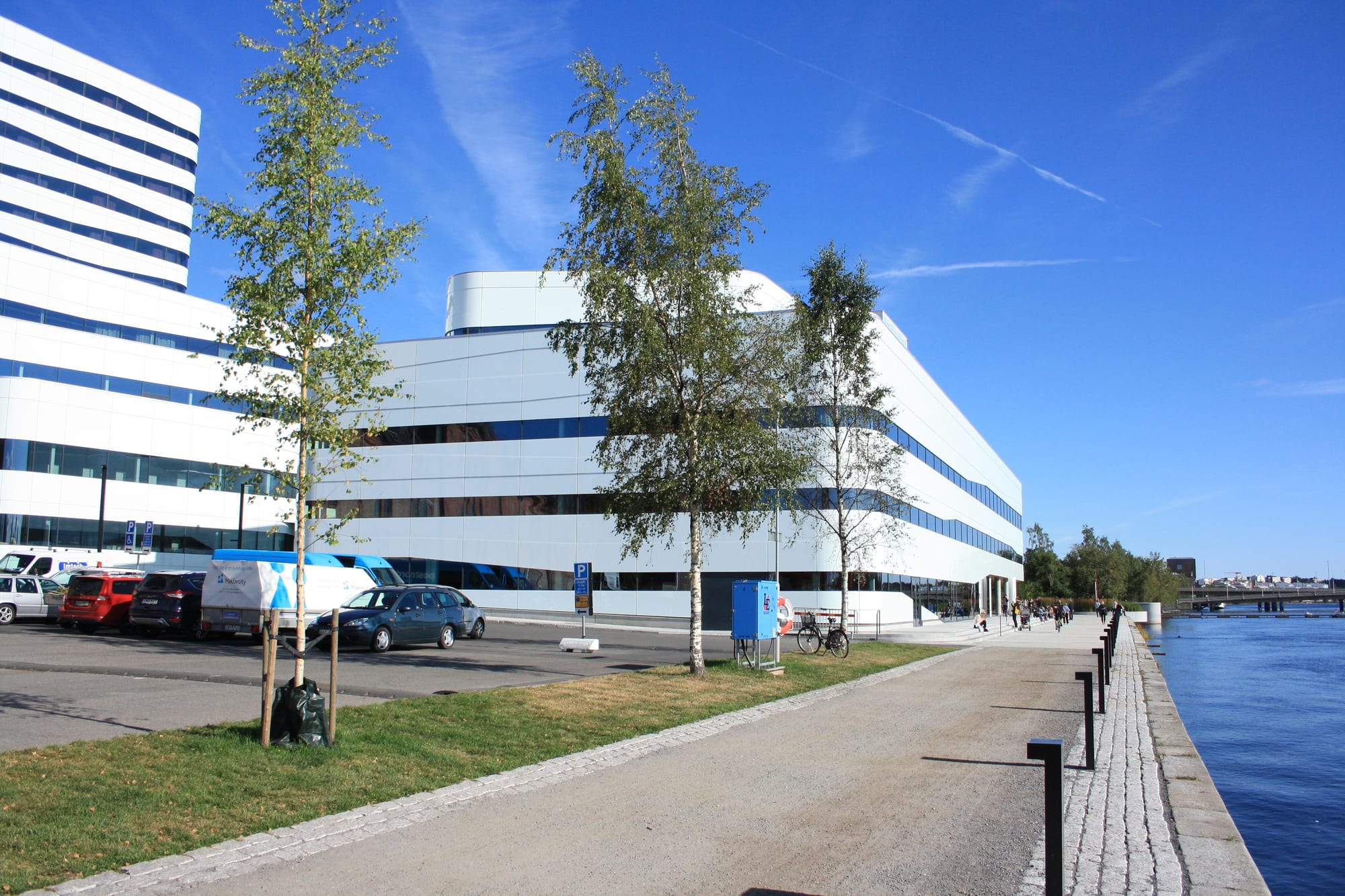
The cultural centre Väven on the quay of the Ume River in central Umeå. (MikaelLindmark / Wikimedia Commons · CC BY-SA 3.0)

The capital of Västerbotten County and the largest city in Norrland, on the Ume River near the Gulf of Bothnia. Re-founded in 1622 and rebuilt after a great fire in 1888 with avenues of birch trees, it grew fast after its university opened in 1965 and is now a young city of students, research, music and the arts.

Neighbourhoods

  • City centre
    • First-time visitors
    • Shopping
    • Close to public transport

    The grid of birch-lined avenues on the north bank of the Ume River, rebuilt after the 1888 fire. Rådhustorget by the town hall is the heart of the shopping district along Kungsgatan and Storgatan, Vasaplan is the hub of the local buses, and Väven and the riverside parks face the water.

    Open in Maps
  • Teg
    • Quiet and residential
    • River views

    The residential district on the south bank of the river, joined to the centre by two bridges, Tegsbron and Kyrkbron.

    Open in Maps
  • Ålidhem and the university
    • Students
    • Nightlife

    About three kilometres from the centre, Ålidhem was built in 1966–73 as part of the Million Programme and is home to about 9,000 people, many of them in student housing for the neighbouring Umeå University campus.

    Open in Maps
  • Umedalen
    • Art
    • Quiet and residential

    A residential area about five kilometres west of the centre, known for the sculpture park laid out in its grounds.

    Open in Maps
  • Backen
    • Historic district

    Upriver from the centre, the place where Umeå began as a parish with a wooden church and a trading post, still marked by Backen Church.

    Open in Maps

Things to do

Museums and culture

  • Västerbottens Museummuseum

    The county museum in the Gammlia area, with an open-air museum of old buildings, a ski exhibition, and fishing and maritime displays.

    Open in Maps
  • Bildmuseetmuseum

    Umeå University's museum of contemporary art and visual culture, part of the arts campus by the river, in a seven-storey building with a larch facing.

    Open in Maps
  • Guitars – the Museummuseum

    A collection of some 500 guitars in a 1904 brick former school downtown, opened in 2014 and sharing the building with a rock club, a restaurant and music shops.

    Open in Maps
  • Vävenattraction

    The riverside cultural centre opened in late 2014, the year Umeå was a European Capital of Culture, bringing together cultural institutions moved from other parts of town.

    Open in Maps
  • NorrlandsOperanattraction

    The opera company of northern Sweden, founded in 1974, now with its own symphony orchestra and stages for opera, dance, music and art.

    Open in Maps

Landmarks

  • Umeå City Churchlandmark

    The church between Vänortsparken and the north bank of the river, inaugurated on the first Sunday of Advent in 1894, after the fire.

    Open in Maps
  • Umeå Arts Campuslandmark

    A former industrial area by the river, rebuilt in 2009–12 for the university's schools of fine arts, design and architecture.

    Open in Maps
  • Backen Churchlandmark

    The church at Backen, where Umeå's first parish church and trading post stood.

    Open in Maps
  • Umeå Town Halllandmark

    The town hall at the centre of the city, with Rådhustorget behind it, Rådhusparken in front and the small flower park Trädgård i Norr down by the waterfront.

    Open in Maps

Parks and the river

  • Umedalen skulpturparkpark

    An open-air sculpture park in Umedalen, open around the clock, with permanent works and changing exhibitions.

    Open in Maps
  • Nydalasjönpark

    A lake on the edge of the city, with a campsite and a pool open in summer at its northern end.

    Open in Maps
  • Vänortsparkenpark

    A small park beside the City Church with artworks linked to each of Umeå's twin towns and sister cities.

    Open in Maps
  • Arboretum Norrpark

    An arboretum at Baggböle, about 10 kilometres up the Ume River, planted with trees from around the world that grow at the same latitude; the riverside bike path leads there.

    Open in Maps

Sport

  • Gammliavallenattraction

    The 10,000-capacity stadium shared by the women's football club Umeå IK and Umeå FC.

    Open in Maps

Short trips from the city

  • Norrforsen rock carvingsattraction

    Rapids on the Ume River 15 kilometres west of the city, where an island holds petroglyphs of moose, boats and a human figure carved between about 3000 and 2000 BCE and discovered in 1984.

    Open in Maps
  • Holmsundattraction

    Umeå's port, 18 kilometres south of the city, from which ferries cross the Gulf of Bothnia to Vaasa in Finland in about four and a half hours.

    Open in Maps

Seasonal events

  • Rally SwedenFebruary

    The World Rally Championship's round on snow, based in Umeå since 2022 after more than 70 years in Värmland, moved here because the region is more reliably snowy.

  • Umeå Jazz FestivalOctober or early November

    First held in 1968 and one of the larger Scandinavian festivals for modern jazz, with some 30 concerts of modern jazz and improvised music, mainly at the Folkets hus and NorrlandsOperan.

Eat and drink

Long-standing places and food districts in Umeå. Hours, ratings and directions come from your maps app, always current.

Umeå classics

  • Västerbotten cheese pierestaurant

    Västerbottensostpaj, a pie of the county's aged hard cheese with cream, eggs and black pepper, eaten across Sweden at Christmas, Easter, Midsummer and the August crayfish season.

    Open in Maps
  • Rullkebab on Rådhustorgetrestaurant

    Rolled kebab and rolled pizza, a local speciality sold from the grill on the town hall square.

    Open in Maps

Food districts

  • Kungsgatan and Storgatanneighborhood

    The central shopping streets around Rådhustorget, with restaurants of many kinds among the shops, from lunch places serving husmanskost to Indian, Chinese and Japanese kitchens.

    Open in Maps

Experience Umeå

History

People have lived in the Ume River valley for thousands of years; the rock carvings at Norrforsen, 15 kilometres west of the city, date from around 3000 BCE. The name is thought to come from the Old Norse Úma, "roaring", making Umeå "the roaring river". The first written mention dates from the 14th century, when the coast was being settled by people who came north by boat along the Bothnian Bay. Umeå began as a parish, with a wooden church and a trading post at Backen, and for centuries remained a scattering of farms where goods from the Sámi were traded, the last inhabited area before the northern wilderness.

An early attempt to found a town failed, and Umeå lost its town privileges in the 1590s. Gustavus Adolphus re-established it in 1622, and by 1638 it had about 40 houses; in 1647 it became the seat of Västerbotten county. It was attacked by Russian forces in 1714 and burned to the ground in 1720, and at the end of the Finnish War in 1809 a Russian army occupied it from June to August. On 25 June 1888 a fire devastated the eastern part of the town and left at least 2,300 of its 3,000 inhabitants homeless. In the rebuilding almost 3,000 silver birches were planted along wide avenues to stop fires from spreading, which gave Umeå its nickname, the City of Birches. The river kept silting up, and since the 1920s the port has been at Holmsund near its mouth.

Umeå University, founded in 1965, transformed the city: the population grew rapidly and housing doubled between 1980 and 2010. In 2014 Umeå was a European Capital of Culture together with Riga, and in 2020 the Nobel Prize in Chemistry went to Emmanuelle Charpentier for the CRISPR gene-editing research she had led at the university.

Culture & Customs

Music has a large place in Umeå. In the 1990s its hardcore punk scene, with bands such as Refused and labels such as Desperate Fight Records, made the city the European centre of straight edge culture, with shows every week for years; Västerbottens Museum told the story in a 2013 exhibition, "Umeå — the European Capital of Hardcore 1989–2000". Metal bands such as Meshuggah and Cult of Luna also come from the city. The Umeå Jazz Festival, first held in 1968, is one of the larger Scandinavian festivals for modern jazz.

The city has the opera company of northern Sweden, NorrlandsOperan, an English-language theatre company, the Bildmuseet art museum and the arts campus on the river, and its year as European Capital of Culture in 2014 left behind the Väven cultural centre. SVT and TV4 run their northern Swedish operations from Umeå, and the landscapes around the city inspired the video game Unravel. Umeå is a member of the International Cities of Refuge Network, sheltering persecuted writers and artists.

Sport is popular: Umeå IK plays women's football at Gammliavallen, the ice-hockey team IF Björklöven, whose name means "the birch leaves", was very successful in the 1980s, and Rally Sweden has been based here since 2022. The city's Ume Sámi name is Ubmeje and its Finnish name Uumaja, and Finland is the most common country of origin among residents born abroad.

Daily Life

About 92,000 people lived in the urban area in 2020, and about 132,000 in the municipality at the beginning of 2023, making Umeå the largest place in Norrland. Its two universities, Umeå University and a branch of the Swedish University of Agricultural Sciences, have around 40,000 enrolled students, about 30 per cent of the population. In 2015 about one in ten residents of the municipality was born abroad, most often in Finland, Iraq, Iran or Somalia.

The economy rests on education, research and health care — the university hospital serves the whole of northern Sweden — alongside industry, including Komatsu Forest's European headquarters and Volvo Trucks. Research includes plant science at the Umeå Plant Science Centre, and the city has been certified as a sustainable destination. The municipality plans for 200,000 inhabitants by 2050, a projection that an independent study has questioned.

Life is lived by bike and bus between the centre and districts such as Ålidhem, Teg and Haga, each with its own small shopping centre and supermarkets; locals live "on" their district rather than in it. Summer evenings are spent by the river and at Nydalasjön, winter means snow and short days, and the academic year sets the rhythm of the city's bars and clubs.

Food

Umeå's best-known food comes from the county it governs. Västerbotten cheese is a hard cow's-milk cheese with tiny holes and a firm, granular texture; as with Cheddar, the curd is heated, cut and stirred before the cheese is moulded and aged, for at least 12 months and more often 14. The village of Burträsk claims it was invented there in the 1870s by a dairy maid, Ulrika Eleonora Lindström, and it is still made only at the dairy in Burträsk. Its most common use is västerbottensostpaj, a pie filled with the cheese, cream, eggs and black pepper, eaten across Sweden at Christmas, Easter, Midsummer and during the crayfish season in August.

Everyday eating reflects a young, student-heavy city. Kebab and pizza places are everywhere, and the rullkebab — rolled kebab and rolled pizza — sold at the grill on Rådhustorget is counted a local speciality. At lunchtime some restaurants serve husmanskost, traditional Swedish home cooking. Indian, Chinese and Japanese restaurants and pizzerias are among the places to eat in the centre, where most shops line Kungsgatan and Storgatan.

Further north, the best-known traditional dish of Sápmi is sautéed reindeer, served with mashed potatoes and lingonberries, and across Sweden cloudberries are served as a topping for ice cream, pancakes and waffles.

Planning tools

Budget

Umeå costs about what other Swedish cities do. Restaurant dinners and alcohol are the expensive part; the many kebab and pizza places, lunch menus and supermarkets are the cheap one.

Daily Budget Midrange
USD 160–330 (city hotel, restaurant dinners, museum tickets, a concert or a game)
Daily Budget Shoestring
USD 65–100 (hostel or budget room, lunch menus and kebabs, buses or a bike)

The sculpture park is open around the clock, and the riverside paths and lakes cost nothing to enjoy.

Best Time to Visit

June to August, when the nights are short and light, people head for Nydalasjön and the riverside fills up; autumn brings colour along the river and the jazz festival. Winter is long and freezing but milder than inland, with snow, skiing and Rally Sweden in February.

Suggested Number of Days

Two or three days give time for the main museums, the river and the city's music and food. Allow a day or two more for the countryside upriver, the coast or a ferry crossing to Finland.

First Visit
2–3 days
With Surroundings
3–5 days

Transportation

Local buses run from the hub at Vasaplan in the centre across the city. Umeå is a cycling city, with many bike-friendly roads and bike-only bridges, and the riverside paths are the pleasant way to get about. The E4 and E12 European highways pass the city.

In Umeå people live 'på' a district rather than 'i' it — 'på Ålidhem', 'på Haga' — a useful detail when asking directions.

Airport & Station Connections

Umeå Airport is on the edge of the city, about 4 kilometres from the centre, with a shuttle bus to Vasaplan. The Bothnia Line, opened in 2010, gives fast trains to Stockholm in just over six hours, stopping at the main station and at Umeå East by the university and hospital. Ferries from Holmsund cross to Vaasa in Finland in about four and a half hours.

Walkability

The centre is compact and flat, with the town hall, shops, Väven, the City Church and the river within a few minutes of each other. The university, Gammlia and the lakes are a longer walk or a short bus or bike ride. Pavements are icy in winter.

Safety

Sweden is a very safe country for visitors. Umeå is a calm university city; the main hazards are winter ones — ice, cold and short, dark days.

Use proper winter footwear on icy pavements and carry the emergency number 112. Check current official travel advice before travelling.

Climate

A subarctic climate bordering on humid continental, with short and fairly warm summers and long, freezing winters that are usually milder than in more continental places at the same latitude. The record high is 32.2°C, set in July 2014, and the record low −38.2°C, in February 1978.

Summer
short and fairly warm, with a daily mean above 10°C in only three months of the year
Winter
long and freezing, with a record low of −38.2°C, though the nearby sea makes winters somewhat milder

Local Customs

Tipping is not customary in Sweden; some people round up the bill for good service. Alcohol stronger than 3.5 per cent is sold only in the state Systembolaget shops. Umeå has a large student population, and the city is often called Björkarnas stad, the City of Birches.

Identification may be asked for when paying by credit card in shops, though not in supermarkets, where the PIN code is used.

Common Payment Methods

The currency is the Swedish krona. Sweden is one of the world's most cashless countries: most stores, restaurants and bars accept all major credit cards, PIN pads are used instead of signatures, and businesses that do not accept cash at all are common. Some small vendors take only Swish or cash, so a small amount from an ATM can be useful.