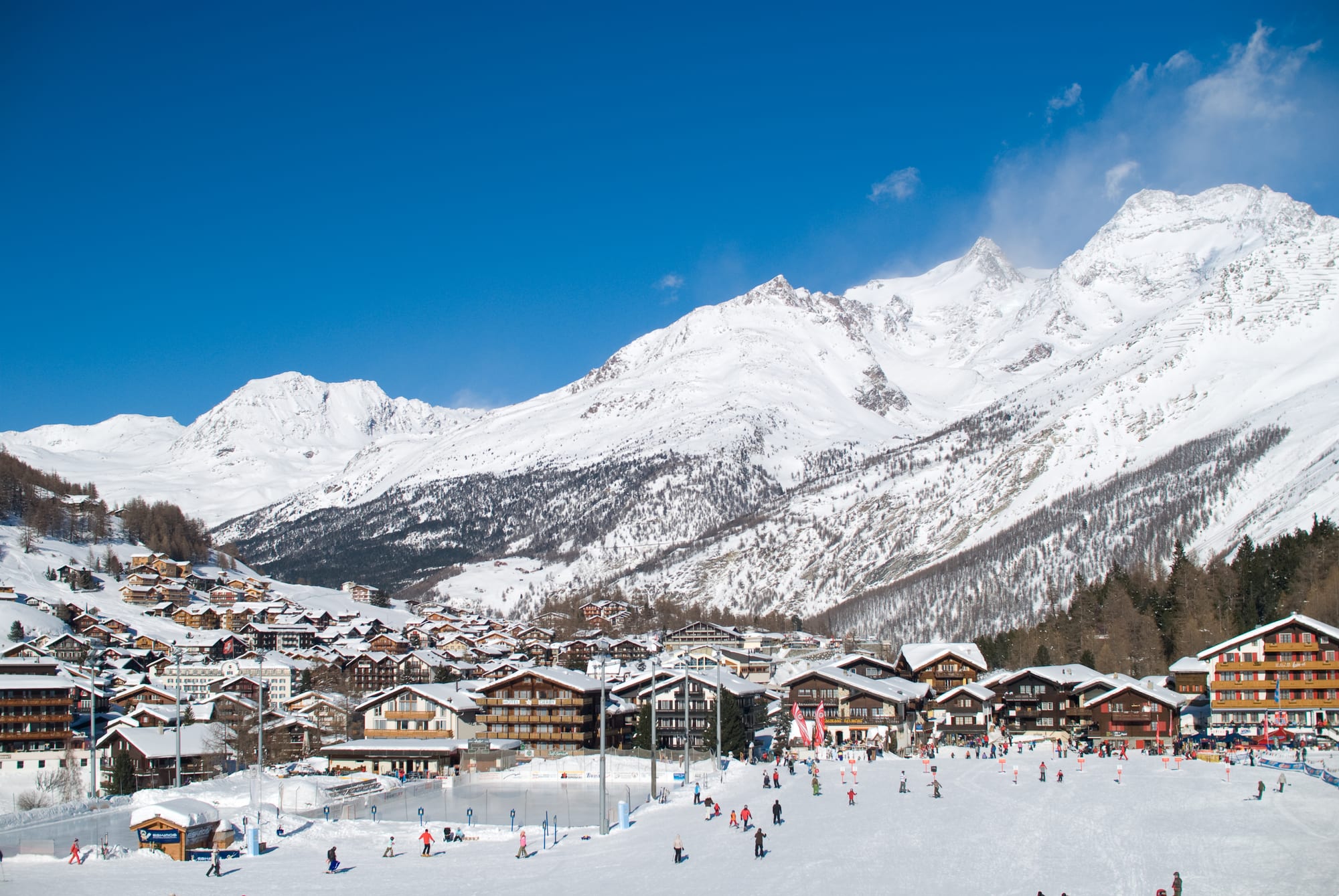
Wooden chalets of Saas-Fee beside a snowy practice slope, below a ridge of high white peaks under a deep blue sky

Valais, Switzerland

Saas-Fee

Saas-Fee village and the peaks of the Mischabel range in winter. (Aleman89 / Wikimedia Commons · CC BY-SA 3.0)

The main village of the Saas Valley in the German-speaking Upper Valais, on a plateau at about 1,800 metres ringed by thirteen peaks over 4,000 metres. A mountain farming village that opened to climbers in the 19th century and to skiers after its road arrived in 1951, it is car-free, with glacier skiing reached by an underground funicular.

Neighbourhoods

  • Village centre
    • First-time visitors
    • Car-free streets
    • Shopping

    The car-free core around Obere Dorfstrasse, a short walk from the bus terminal and the car park at the entrance to the village. Wooden houses, shops, three supermarkets, restaurants and après-ski bars line narrow lanes where small electric vehicles carry luggage and goods.

    Open in Maps
  • The lift stations
    • Close to the lifts
    • Skiing

    The edge of the village under the Fee Glacier, where the Alpin Express, Spielboden and Plattjen lifts leave for the ski area and the Hannig lift rises on the opposite slope. In the main season small free shuttle buses link the lifts with the rest of the village.

    Open in Maps
  • Saas-Grund
    • Cheaper base
    • Valley life

    The village on the valley floor below Saas-Fee, where the first inn in the valley opened in 1833. It has its own ski area at Hohsaas, cars on its roads, and a bus every half-hour up to Saas-Fee.

    Open in Maps
  • Saas-Almagell
    • Quiet and residential
    • Hiking

    A valley-floor village, quieter than Saas-Fee, on the way to the Mattmark reservoir at the head of the valley, reached by changing buses at Saas-Grund.

    Open in Maps

Things to do

Glaciers and high mountains

  • Metro Alpin and the Mittelallalinattraction

    The highest funicular in the world, opened in 1984 and running entirely underground from the Felskinn cable-car station to the Mittelallalin at 3,456 metres, where the world's highest revolving restaurant opened in 1985.

    Open in Maps
  • Fee Glacierviewpoint

    The glacier that fills the head of the valley between the Dom and the Allalinhorn, used as a ski area and shrinking from 5.0 km long in 1973 to 4.7 km in 2005.

    Open in Maps
  • Allalinhorntrail

    A 4,027-metre peak whose standard route, starting from the Mittelallalin, has made it one of the easiest and most popular 4,000-metre peaks in the Alps.

    Open in Maps
  • Hannigviewpoint

    The slope opposite the village, reached by its own lift and used for sledging in winter.

    Open in Maps

Village and valley

  • Saaser Museummuseum

    A museum in the old clergy house of 1732, with exhibits on the traditions of the Saas Valley and the history of tourism there.

    Open in Maps
  • Chapel Trailtrail

    A footpath from Saas-Grund up to Saas-Fee past 15 chapels and shrines, each showing a different biblical scene.

    Open in Maps
  • Hohsaasviewpoint

    A cable-car station and ski area at 3,101 metres above Saas-Grund, with views of the Dom and 18 peaks over 4,000 metres, including the Weissmies.

    Open in Maps

Short trips from the village

  • Mattmarkseeviewpoint

    A reservoir at the head of the valley, dammed in 1960–65, with a circular walk; in 1965 a collapse of the Allalin Glacier buried 88 workers building the dam.

    Open in Maps

Eat and drink

Long-standing places and food districts in Saas-Fee. Hours, ratings and directions come from your maps app, always current.

Saas-Fee classics

  • Racletterestaurant

    The Valais dish of a heated cheese round scraped onto plates, served with potatoes, cornichons and pickled onions, often with Fendant wine.

    Open in Maps
  • Revolving restaurant on the Mittelallalinrestaurant

    The world's highest revolving restaurant, at the top of the Metro Alpin, turning slowly to show the peaks around the Fee Glacier.

    Open in Maps

Food districts and bars

  • Obere Dorfstrasseneighborhood

    The main village street, with restaurants, shops and the pubs and après-ski bars that make up most of the valley's nightlife.

    Open in Maps
  • Saas-Grundneighborhood

    The valley village below, with its own restaurants and inns serving the quieter end of the valley.

    Open in Maps

Experience Saas-Fee

History

Saas-Fee is first mentioned in 1304. Its people were German-speaking Walsers, and in the same era many of them left the valley in the Walser migrations for lack of a living. Saas-Fee had its first chapel in 1535 and a new parish church in 1893; for centuries it was a mountain farming village on the plateau above the Saas Valley, reached by a mule track from Saas-Grund.

Tourism began with the first inn in the valley, at Saas-Grund, in 1833. The parish priest Johann Josef Imseng encouraged villagers to welcome visitors, and in 1849 he is said to have tried skiing on home-made boards, perhaps the first person in Switzerland to do so. Climbers came for the Allalinhorn, first climbed in 1856, and the surrounding peaks, local guides such as Alexander Burgener made their names, and hotels were built from the 1880s. In the 1920s André Gide set part of his novel The Counterfeiters in the village.

The road from Saas-Grund arrived only in 1951, and the village chose at once to keep cars out. The same year a ski school opened, and lifts followed: to Spielboden in 1954, Plattjen in 1962, Felskinn and Hannig in 1969, and in 1984 the underground Metro Alpin to the Mittelallalin. In 1965 a collapse of the Allalin Glacier killed 88 workers building the Mattmark dam at the head of the valley, most of them Italians.

Culture & Customs

Saas-Fee calls itself the Pearl of the Alps, after the thirteen peaks above 4,000 metres that surround it, the highest concentration in the Alps. It is a German-speaking Catholic community whose dialect, Walser German, is partly unintelligible even to speakers of Standard German. Many old customs have survived tourism: villagers still make their own traditional costumes, and costume and music societies perform at festivals and processions.

Writers have long come here. Carl Zuckmayer lived in Saas-Fee from 1957 until his death in 1977 and is buried there, and Gide used the village as a retreat from society in fiction. The ski chase in the 1969 James Bond film On Her Majesty's Secret Service was filmed on the slopes above the village, and Wham! shot the video for Last Christmas here in 1984; surviving cast and crew returned in 2024 to unveil a pillar marking the song's 40th anniversary.

The decision to ban cars, taken in 1951 to keep the air clean, shapes the character of the village, whose lanes of dark wooden houses are shared by walkers, skiers and small electric vehicles. A campus of the European Graduate School adds an unusual academic thread to resort life.

Daily Life

Saas-Fee had about 1,600 residents in 2020, more than a quarter of them foreign nationals in 2008, but around 6,600 beds for rent to visitors. Most people speak German as their first language. The village primary school had eight classes and 137 pupils in the 2010–2011 school year.

Tourism is almost the whole economy: in 2008 more than half of all service jobs were in hotels and restaurants, and agriculture had all but disappeared. In 2000 the village drew in more workers than it sent out.

Life follows the two seasons, winter and summer, with quiet spells in between. Without private cars, the bus to Visp is the lifeline to the Rhône valley, and in peak season the narrow lanes can become crowded when electric vehicles meet the stream of skiers coming off the slopes. A railway to the village was planned in the 20th century but never built, because villagers refused to sell the land.

Food

Raclette is the dish of the Valais and of Saas-Fee's restaurants: a round of cheese is heated, in front of a fire or under a special machine, and the melted surface is scraped onto plates with boiled potatoes, cornichons and pickled onions. In the canton it is drunk with black tea or Fendant, the local white wine.

Cholera, from the Valais, is a covered pie traditionally filled with apples, pears, potatoes, onions, leeks, bacon and raclette cheese, usually from the Goms. Pain de seigle valaisan, the dense Valais rye bread, has a protected designation; its history goes back to the Middle Ages, when communal village ovens were fired only two or three times a year, and the bread is still served with raclette cheese and cured meats.

In the village itself, most eating happens around Obere Dorfstrasse and at mountain restaurants on the slopes. The most unusual is the revolving restaurant on the Mittelallalin, opened in 1985 at the top of the Metro Alpin and the highest of its kind in the world. Evenings are mostly spent in pubs and après-ski bars.

Planning tools

Budget

Prices in Saas-Fee are high, though generally below those of better-known resorts such as Zermatt or Crans-Montana. Christmas, February and high summer are the dearest times. Saas-Grund and Saas-Almagell are quieter, and holiday apartments there are often cheaper.

Daily Budget Midrange
USD 340–650 (village hotel, restaurant dinners with raclette and wine, lift pass)
Daily Budget Shoestring
USD 140–220 (valley guesthouse or apartment, supermarket food, postbuses and walking)

Staying in the lower valley villages saves on rooms; the shuttle buses within Saas-Fee are free in the main season.

Best Time to Visit

December to April for skiing, with mostly north-facing slopes at high altitude, and a glacier area that stays open for skiing in summer. Summer is the season for hiking and climbing the 4,000-metre peaks. Many places close between seasons in spring and November.

Suggested Number of Days

A short stay covers the village and a ride to the glacier in good weather; skiers and walkers usually stay a week, which also allows for the other villages of the valley. Cloud on the peaks is the main reason to allow a spare day.

First Visit
2–3 days
With Surroundings
4–6 days

Transportation

The village is car-free and small enough to walk around; small electric vehicles serve hotels and shops, and in the main season free shuttle buses run on five lines to the lifts. Taxis exist but are expensive for the short distances. Postbuses link Saas-Fee with Saas-Grund, Saas-Balen and Saas-Almagell.

The electric vehicles are very quiet, so watch for them in the lanes; drivers must leave their cars in the large car park at the entrance to the village.

Airport & Station Connections

There is no railway. Trains up the Rhône valley stop at Visp and Brig, and postbuses run from both about every half-hour, taking around 50 minutes from Visp. Drivers can reach the car parks at the village entrance; the valley road can be snow-covered in winter but is usually cleared quickly. Buses can be crowded on Friday evenings.

Walkability

Excellent. The car-free centre, the bus terminal and the lift stations are all within walking distance, and the lanes are shared only with electric vehicles and pedestrians, which can crowd them when the pistes close in the afternoon. Paths are steep and can be icy in winter.

Safety

Switzerland is very safe, with low crime. The dangers are those of the high Alps: the glaciers above the village hide crevasses, even the easier 4,000-metre peaks need roped glacier travel, and in 1965 a collapse of the Allalin Glacier above the Mattmark dam site killed 88 workers.

Climb the high peaks and cross glaciers only with a guide or proper experience, respect closed paths and avalanche warnings, and take out insurance that covers helicopter rescue. Check current official travel advice before travelling.

Climate

High mountains around the valley block much of the weather, so the climate is drier than its altitude suggests. Summers are short and fresh; winters are long and snowy, with skiing at high altitude on the glacier.

Summer
fresh — average summer temperatures in Saas-Fee are around 14°C
Winter
cold and snowy at the village; even on the valley floor at nearby Sion, far lower down, January averages about 0.5°C

Local Customs

Saas-Fee is German-speaking and Catholic, and locals speak Walser German, a dialect that speakers of Standard German find partly hard to follow. Traditional costumes, music societies and processions are still part of village life. By law a service charge is included in Swiss restaurant bills, so tipping is a personal choice.

Keep to the lanes' edges for the electric vehicles, and dress respectfully in the chapels along the valley paths.

Common Payment Methods

The currency is the Swiss franc. Card payments are common and all ATMs accept foreign cards, although Switzerland is more cash-oriented than many European countries. Some places accept euro notes, but not coins, and give change in francs.