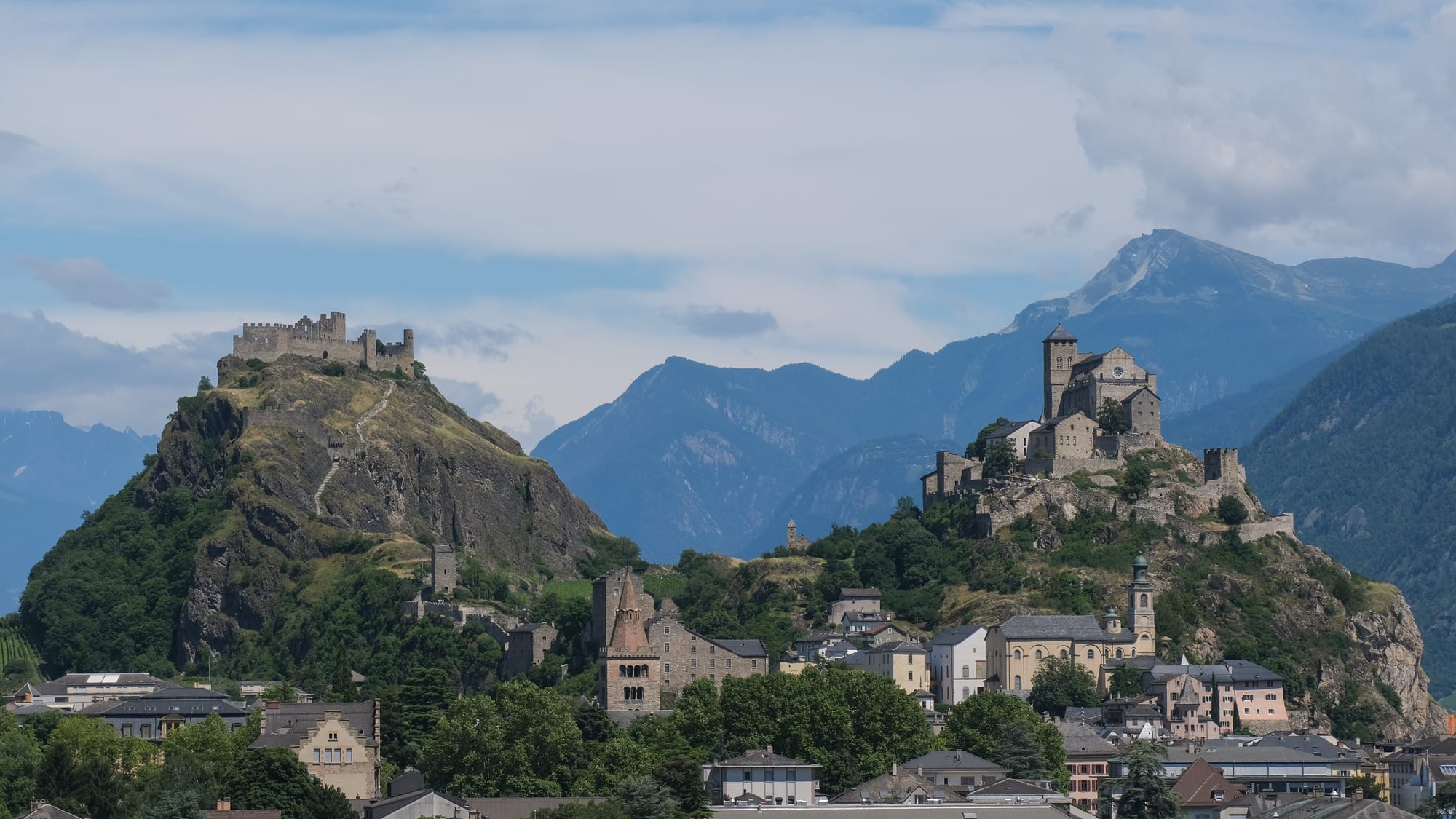
Two rocky hills above the rooftops of Sion, one topped by castle ruins and the other by a fortified stone church, with mountains behind

Valais, Switzerland

Sion

The ruins of Tourbillon (left) and the Valère basilica (right) above Sion, seen from the west. (Christian David / Wikimedia Commons · CC BY-SA 4.0)

The capital of the Valais, a French-speaking town of about 35,000 on the floor of the Rhône valley, settled since the Neolithic and seat of the oldest diocese in Switzerland. Two rocky hills crowned by the Valère basilica and the ruined Tourbillon castle rise above an old town of bishops' houses, surrounded by vineyards in one of the sunniest corners of the country.

Neighbourhoods

  • Old town
    • First-time visitors
    • Historic district
    • Best for food

    The medieval town at the foot of the two hills, listed as a whole in the Inventory of Swiss Heritage Sites. The cathedral, the town hall with its astronomical clock, the Witches' Tower and most of the traditional restaurants lie within its pedestrian streets, which hold a market every Friday morning.

    Open in Maps
  • Valère and Tourbillon
    • Viewpoints
    • Historic sites

    The two steep hills at the east end of the old town, Valère at 610 metres and Tourbillon at 658. Footpaths climb from the old town to the fortified basilica on one and the castle ruins on the other, with views up and down the Rhône valley.

    Open in Maps
  • La Planta and the station quarter
    • Close to public transport
    • Shopping

    The newer town between the old centre and the railway, around the Place de la Planta, where Savoyard troops were driven back from the gates in 1475. Department stores, supermarkets, schools and cantonal offices give it the feel of a regional capital.

    Open in Maps
  • Bramois
    • Quiet and residential
    • Village atmosphere

    A former village east of the centre, merged into Sion in 1968 and itself listed in the Inventory of Swiss Heritage Sites, where late Neolithic remains have been found.

    Open in Maps

Things to do

Famous landmarks

  • Valère Basilicalandmark

    A fortified 12th–13th-century church on its own hill, made a minor basilica in 1987, with a pipe organ believed to date from 1435 that is among the oldest playable organs in the world.

    Open in Maps
  • Tourbillon Castlelandmark

    The bishops' castle built at the end of the 13th century on the higher hill, burnt in 1417 and left in ruins after the city fire of 1788, with its keep, chapel and walls still standing.

    Open in Maps
  • Sion Cathedrallandmark

    The Cathedral of Our Lady, seat of the diocese, built in the late 15th and early 16th centuries on the foundations of the Romanesque church, whose 12th-century bell tower survives.

    Open in Maps
  • Tour des Sorcierslandmark

    A 14th-century guard tower of the town walls, later a prison where people accused of witchcraft were questioned under torture, which gave it its name.

    Open in Maps
  • Town hall and astronomical clocklandmark

    The town hall in the old town, a heritage site of national significance with an astronomical clock and Roman inscriptions inside.

    Open in Maps
  • Church of St-Théodulelandmark

    A church in the old town listed, like the cathedral and the Valère basilica, as a heritage site of national significance.

    Open in Maps

Museums

  • Cantonal museumsmuseum

    The Valais's cantonal museums of history, nature and art are all in Sion.

    Open in Maps
  • Maison de la nature de Montorgemuseum

    A nature centre at Montorge, one of the town's exhibition spaces alongside the cantonal museums.

    Open in Maps

Sport and the outdoors

  • Stade Tourbillonattraction

    Home ground of FC Sion, about a kilometre west of the centre, with room for some 14,300 spectators; it hosted matches of the Women's Euro in 2025.

    Open in Maps
  • Alaia Bayattraction

    A surfing wave pool that opened in Sion in 2021.

    Open in Maps

Short trips from the town

  • Saint-Léonard underground lakeattraction

    An underground lake in a cave at Saint-Léonard, a short way up the Rhône valley.

    Open in Maps
  • Grande Dixence Damlandmark

    At the head of the Val d'Hérémence, the tallest gravity dam in the world at 285 metres, holding back the Lac des Dix, the largest lake above 2,000 metres in the Alps.

    Open in Maps
  • Crans-Montanaattraction

    The large resort on a sunny plateau above Sierre, for skiing in winter and walking in summer.

    Open in Maps
  • Fondation Pierre Gianaddamuseum

    In Martigny, a foundation opened in 1978 with a car museum, a Gallo-Roman museum, a sculpture park and touring art exhibitions.

    Open in Maps

Eat and drink

Long-standing places and food districts in Sion. Hours, ratings and directions come from your maps app, always current.

Sion classics

  • Racletterestaurant

    The Valais dish of a heated cheese round scraped onto plates, served with potatoes, cornichons and pickled onions; it was promoted as the canton's national dish at the 1909 cantonal exhibition in Sion.

    Open in Maps
  • Valais winerestaurant

    Sion is among the largest wine-making areas in Switzerland, and its vineyards produce Fendant, the Valais name for the dry white Chasselas.

    Open in Maps

Food districts and markets

  • Old town pedestrian streetsneighborhood

    Where most of the town's traditional restaurants are, serving local dishes and fondue, many with tables out in the pedestrian zone.

    Open in Maps
  • Friday marketmarket

    A traditional market held in the old town every Friday morning since 2003.

    Open in Maps

Experience Sion

History

Sion's site, the alluvial fan of the Sionne and the rocky hills of Valère and Tourbillon, has been lived on almost continuously since early Neolithic farmers from the Mediterranean arrived around 5800 BC; at Le Petit Chasseur archaeologists have found dolmens and carved standing stones from about 2500 BC. Its Celtic inhabitants were conquered by the Romans in the 10s BC, and the town became Sedunum.

The diocese of Sion is the oldest in Switzerland. Its first historical bishop, Theodore, attended a council in 381, and the town's fortunes grew when the bishops settled here. In 999 King Rudolph III of Burgundy gave the bishop the whole County of Valais, and Sion became its capital. The prince-bishops built the castle of Tourbillon at the end of the 13th century, while the citizens won a measure of self-government, with walls, written freedoms and market rights. The town was sacked several times before 1475, when Savoyard troops were defeated at its gates in the battle of La Planta.

The present cathedral was built in the late 15th and early 16th centuries, and the Counter-Reformation kept Sion Catholic. In 1788 a fire destroyed 115 of the town's 284 inhabited houses and left Tourbillon in ruins. The Rhône was straightened twice, in 1863–94 and 1930–60, and a third project to widen it began after floods in the 2000s. Sion bid four times for the Winter Olympics and withdrew its bid for 2026 in June 2018, after it was rejected in a referendum.

Culture & Customs

Sion is the political, religious and cultural centre of the French-speaking Valais. The cathedral chapter and the bishop still sit here, and the town's skyline of fortified church and ruined castle is its best-known sight. Its medieval townscape is protected as a whole, and the Valère basilica keeps a pipe organ from about 1435, one of the oldest still played anywhere.

Music has a strong place. The Haute École de Musique, also known as the Tibor Varga academy, trains musicians, and the town hosts the Sion Festival with the Tibor Varga international violin competition, an early-organ festival, open-air concerts and the PALP festival. The cantonal museums of history, nature and art are all here.

Football is a passion: FC Sion, back in the Super League since its promotion in 2024, fills the Stade Tourbillon, and the town also has an ice hockey club. Since 2021 Alaia Bay, a surfing wave pool, has added an unexpected sport to a valley far from the sea.

Daily Life

About 35,000 people lived in Sion in 2020, after the mergers of Bramois in 1968, Salins in 2013 and Les Agettes in 2017. Most residents speak French, and at the 2000 census about 78 per cent were Roman Catholic.

As the cantonal capital, Sion lives from administration, schools and colleges, and medicine: the regional hospital, the central institute of the Valais hospitals and a rehabilitation clinic are all here. Far more workers commute into the town each day than leave it. Wine is still important — Sion is one of the biggest wine-growing areas in Switzerland — but vineyards and orchards are steadily giving way to building.

Life is lived outdoors for much of the year in one of the sunniest climates in the country. The Friday market brings the old town to life, and the ski resorts and walking paths of the mountains are within easy reach of the valley.

Food

Raclette belongs to Sion as much as anywhere: melting cheese by the fire is recorded in the Valais from 1574, and the dish was promoted as the national dish of the canton at the 1909 cantonal exhibition held here. The cheese is heated and the melted surface scraped onto plates of boiled potatoes, with cornichons and pickled onions, black tea or Fendant.

Fendant is the Valais name for Chasselas, a grape usually made into a full, dry, fruity white wine, and the vineyards on the slopes around Sion are among the most extensive in Switzerland. Pain de seigle valaisan, the Valais rye bread, has a protected designation and is served with raclette cheese and cured meats, and cholera, a covered pie of potatoes, apples, pears, leeks, onions, bacon and raclette cheese, is a Valais speciality.

Most of the traditional restaurants are in the old town's pedestrian streets, serving local dishes and fondue at outdoor tables in summer. The Friday market sells regional produce, and the department stores near the centre stock local and regional specialities.

Planning tools

Budget

Sion is cheaper than the mountain resorts of the Valais, and its hotels and restaurants serve a working regional capital rather than a ski crowd. Many visitors use it as a lower-cost base for day trips into the resorts by train or bus. Prices are still Swiss.

Daily Budget Midrange
USD 280–520 (town hotel, restaurant dinners with raclette and wine, museum tickets, day trips)
Daily Budget Shoestring
USD 130–200 (hostel or budget hotel, supermarket food and market lunches, regional trains)

Sion has some of the Valais's few department stores and well-stocked supermarkets, useful for stocking up before a self-catering stay in the mountains.

Best Time to Visit

Late spring to autumn. Summers are hot and dry, with more days of 30°C or more than anywhere else in Switzerland; autumn brings the grape harvest to the vineyards. Winter in the valley is cold but often sunny, and the ski resorts are close.

Suggested Number of Days

The old town and its two hills can be seen in a short stay. With the Rhône valley's other towns, the side valleys and the resorts above, a longer stay makes Sion a useful base; the season and the weather on the mountains change the number most.

First Visit
1–2 days
With Surroundings
4–5 days

Transportation

The historic core is compact and mostly closed to buses, so walking is the usual way to get around. City buses cover the outskirts, though not very often, and bikes can be borrowed for a few hours near the Place de la Planta and at the station in Châteauneuf-Conthey in the warmer months. Trains and postbuses run up the valley and into the side valleys.

Drivers leave the A9 motorway at Sion-Est or Sion-Ouest for the centre.

Airport & Station Connections

Trains arrive every half-hour from Geneva and from Brig, calling at the main Valais towns, and EuroCity trains on the Geneva–Milan line stop here. Geneva Airport, the nearest large international airport, is about 160 km to the west; Sion's own airfield has few routes and serves as an air-rescue base. Martigny is about 20 minutes away by train.

Walkability

Good. The station, the Place de la Planta and the old town are close together, and the old town's lanes are pedestrian. The climbs to Valère and Tourbillon are short but steep, on stepped paths with little shade in summer.

Safety

Switzerland is very safe, with low crime. In Sion the hazards are natural rather than criminal: summer heat in the valley, steep paths on the castle hills, and a Rhône that has flooded severely in the past and is being widened to manage the risk.

Carry water on hot days, wear proper shoes on the castle paths, and take local warnings seriously when heading into the mountains. Check current official travel advice before travelling.

Climate

One of the driest and sunniest places in Switzerland, sheltered by mountains on both sides of the valley, with about 600 mm of rain or snow a year. Summers are hot, winters cold but dry, and the most precipitation falls in December.

Summer
warm to hot — July averages about 20.6°C, and Sion has about 21 days a year of 30°C or more, the most of any place in Switzerland
Winter
cool to cold — January averages about 0.5°C, with about six days a year staying below freezing

Local Customs

Sion is French-speaking and has had a Catholic cathedral since probably the 6th century, with churches, chapels and religious processions still part of its life. By law a service charge is included in Swiss restaurant bills, so tipping is a personal choice. The town is proud of its wine, its football club and its role as cantonal capital.

Greet shopkeepers with a 'bonjour' and dress respectfully in the cathedral and the Valère basilica.

Common Payment Methods

The currency is the Swiss franc. Card payments are common and all ATMs accept foreign cards, although Switzerland is more cash-oriented than many European countries. Some places accept euro notes, but not coins, and give change in francs.