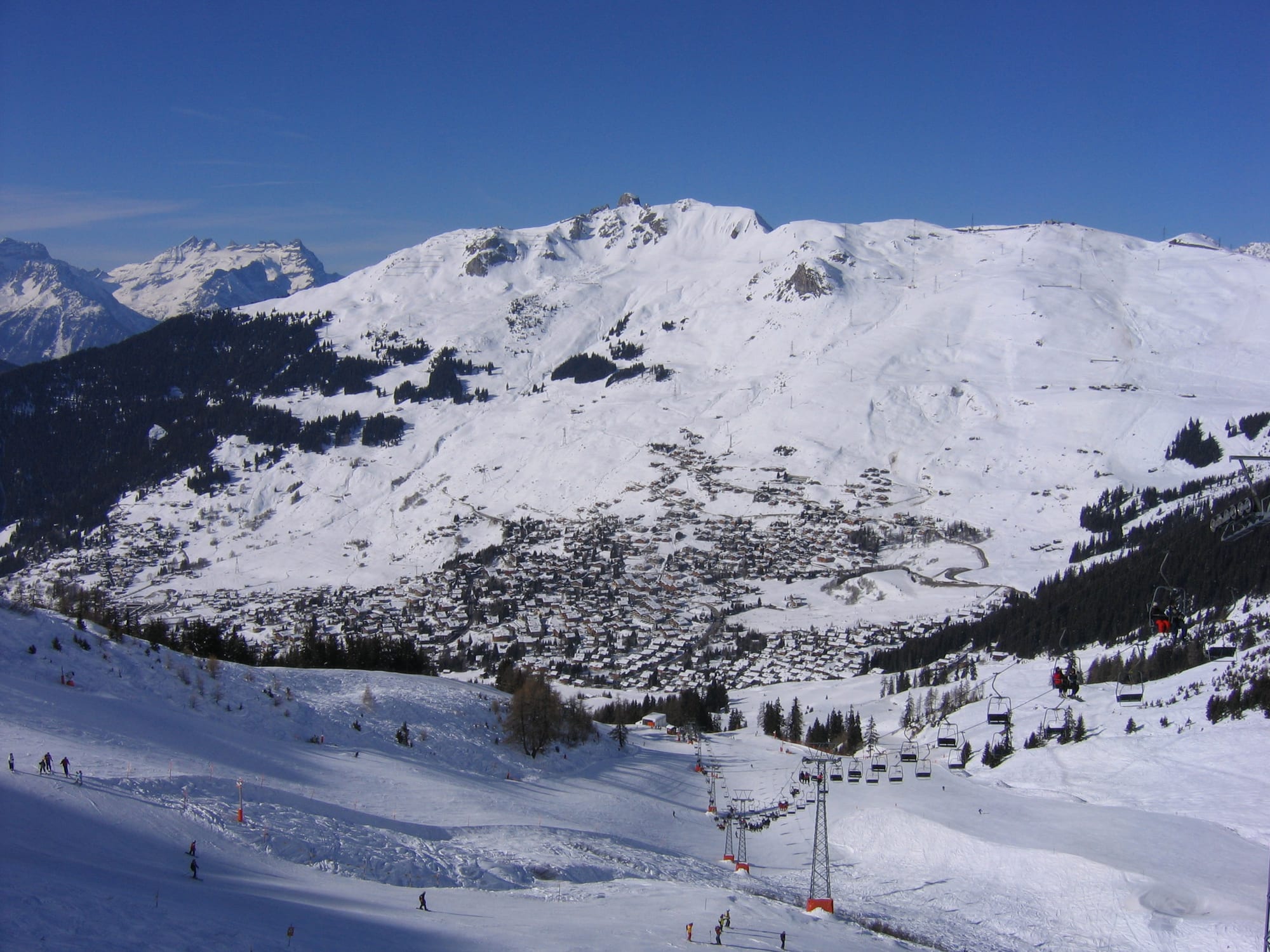
Verbier's spread of chalets on a snowy mountain terrace below white slopes, with a chairlift and skiers in the foreground

Valais, Switzerland

Verbier

Verbier seen from the ski slopes above the resort in February. (Norbert Aepli, Switzerland (User:Noebu) / Wikimedia Commons · CC BY 2.5)

A ski resort on a south-facing terrace at about 1,500 metres above the Val de Bagnes in the French-speaking Valais, looking across to the Grand Combin. A farming terrace that grew into a major resort after its first chairlift of 1950, it is now the western hub of the Four Valleys ski area, a byword for off-piste skiing and home each summer to a classical music festival.

Neighbourhoods

  • Verbier Station
    • First-time visitors
    • Nightlife
    • Close to the lifts

    The resort proper, on the sunny terrace facing the Grand Combin massif. Shops, restaurants, bars and nightclubs fill the streets around the Place Centrale and Rue de Médran, the main Médran gondola climbs from its edge, and free buses loop the village.

    Open in Maps
  • Verbier Village
    • Quiet and residential
    • Local life

    The older settlement just below the station, passed on the road up from the valley. It joins the resort without a break, has its own parish church of 1973, and some bus lines loop through it in winter and summer.

    Open in Maps
  • Savoleyres side
    • Beginners
    • Families

    The northern part of the resort around the Savoleyres gondola, which serves the sector most suited to beginners and links over the ridge to La Tzoumaz. It is quieter than the centre while staying within reach of the lifts.

    Open in Maps
  • Le Châble
    • Valley base
    • Close to public transport
    • Historic village

    The valley village below the resort, administrative centre of the Val de Bagnes since the 12th century and end of the railway from Martigny. A gondola rises from beside its railway station to Verbier, and its late Gothic parish church and 16th-century ossuary are among the valley's listed monuments.

    Open in Maps

Things to do

Mountains and skiing

  • Mont Fortviewpoint

    The 3,328-metre summit at the top of the Four Valleys, reached by cable car via the Col des Gentianes.

    Open in Maps
  • Médran and Les Ruinettesattraction

    The main lift station in the resort, where Verbier's first chairlift was built in 1950 and today's gondola climbs to Les Ruinettes and the pistes linking into the Four Valleys.

    Open in Maps
  • Off-piste and freeride terrainattraction

    Verbier is known worldwide for off-piste and itinerary runs, from the mogul fields of Tortin and Gentianes to more advanced itineraries and couloirs; mountain guides offer their services in the resort.

    Open in Maps
  • Bec des Rossesviewpoint

    The less accessible peak whose slopes host the Xtreme de Verbier freeride competition, the final of the Freeride World Tour.

    Open in Maps

Summer in the mountains

  • Hiking trailstrail

    Some 400 km of marked walking trails cross the slopes above the resort, where chamois and ibex can be seen and some paths cross ground under snow all year.

    Open in Maps
  • Mountain-bike trailstrail

    About 200 km of mountain-bike routes; Verbier is also the start of the Grand Raid race to Grimentz.

    Open in Maps
  • Église de Verbier-Stationlandmark

    A modern church built in 1959–61 to a design by Jean Ellenberger, its shape recalling a chalice, which hosts many Verbier Festival concerts.

    Open in Maps

Short trips from the town

  • Lac de Mauvoisinviewpoint

    A reservoir in the upper Val de Bagnes behind the 250-metre Mauvoisin Dam, built in 1951–57, between the Grand Combin massif and La Ruinette.

    Open in Maps
  • Fondation Pierre Gianaddamuseum

    In Martigny at the foot of the valley, a foundation opened in 1978 with a car museum, a Gallo-Roman museum, a sculpture park and touring art exhibitions.

    Open in Maps
  • Great St Bernard Passviewpoint

    The ancient crossing to Italy at the head of the neighbouring valley, with the Great St Bernard Hospice, founded in 1049, at its highest point.

    Open in Maps

Seasonal events

  • Xtreme de Verbierspring

    The professional freeride contest on the slopes of the Bec des Rosses, first held as a snowboard event in 1996 and now the final of the Freeride World Tour.

  • Patrouille des Glaciersend of April, every two years

    A ski-mountaineering race organised by the Swiss Armed Forces for military and civilian teams, from Zermatt or Arolla over the high Alps to the finish in Verbier.

  • Verbier Festivallate July to early August

    A classical music festival founded by Martin Engström in 1994, with international soloists, an academy and youth orchestras, and free fringe events across the resort.

Eat and drink

Long-standing places and food districts in Verbier. Hours, ratings and directions come from your maps app, always current.

Verbier classics

  • Racletterestaurant

    The Valais dish of a heated cheese round scraped onto plates, served with potatoes, cornichons and pickled onions, often with Fendant wine.

    Open in Maps
  • Pub Mont Fortrestaurant

    A bar on Chemin de la Tinte serving simple, inexpensive food such as burgers.

    Open in Maps

Food districts and bars

  • Place Centrale and Rue de Médranneighborhood

    The resort's centre, lined with restaurants, pizzerias and bars; the pubs fill with skiers in the early evening and the nightclubs stay busy late in peak season.

    Open in Maps
  • Le Châbleneighborhood

    The valley village at the foot of the gondola, with places to eat that serve the year-round population rather than the ski season alone.

    Open in Maps

Experience Verbier

History

For most of its history Verbier was a cluster of farms and summer pastures on a terrace high above the Val de Bagnes, part of a parish first mentioned in 1178 and governed from Le Châble in the valley below, where a castle called the abbaye was recorded in 1287. The valley lived from alpine farming and was repeatedly struck by floods of the Dranse, most destructively in 1818, and in the 19th century its villages were divided by violent feuds between radicals and conservatives.

Verbier has received guests from other European countries since the early 20th century. During the First World War the local economy suffered from the loss of tourists, and from 1916 to 1918 Verbier, like other Alpine villages, housed interned German, French and British soldiers in need of medical care. A road from the valley reached Verbier Village in 1936, a local tourism society was founded in 1937 to guide development, and the road was extended to the terrace in 1949.

The decisive change came in 1950, when the first chairlift was built up to Les Ruinettes. The railway reached Le Châble in 1953, the Mauvoisin dam was built in the upper valley in the 1950s, and a cable car from Le Châble opened in 1975. Verbier became one of the best-known ski resorts in the Alps, popular with British and Scandinavian visitors and second-home owners. In 2015 an investigation of building permits found about fifty breaches of local and cantonal building law, and in 2021 Bagnes merged with Vollèges to form the municipality of Val de Bagnes.

Culture & Customs

Two things give Verbier its reputation. One is freeriding: the resort is regarded as one of the world's great off-piste destinations, and the Xtreme de Verbier, first held on the Bec des Rosses in 1996, grew into the Freeride World Tour, whose final is still held here. A community of photographers and artists has grown out of winter-sports action photography, and the resort also lies on the Haute Route ski tour from Chamonix to Zermatt and at the finish of the army's Patrouille des Glaciers race.

The other is music. The Verbier Festival, founded by the Swedish expatriate Martin Engström in 1994, brings leading soloists to the resort for about two and a half weeks each summer, with concerts in the chalice-shaped church and the Salle des Combins, an academy for young musicians and free fringe events. The resort has also hosted stages of the Tour de France and the Tour de Suisse.

Beneath the international surface the valley remains French-speaking and largely Catholic, with old chapels scattered through its hamlets. Since the late 1960s Verbier has attracted celebrities and royal families, many with chalets of their own, and English is spoken widely alongside French.

Daily Life

Verbier had about 2,800 permanent residents in 2006, but the number of people in the resort can rise to around 35,000 in the winter season. The wider former municipality of Bagnes had about 8,100 residents in 2019, a large share of them foreign nationals, among them noticeable British and Scandinavian communities.

The economy is tourism: ski lifts, ski schools and mountain guides, restaurants, shops, building and the care of chalets that stand empty for much of the year. Children attend local state schools up to secondary level, then travel down to the valley, and there are private international schools in the resort.

Life swings between seasons. Winter fills the streets, lifts and après-ski bars, summer brings walkers, mountain bikers and festival audiences, and spring and November are quiet. The resort is reached by a single road or the gondola from Le Châble, and the growth of tourist building and its oversight by the authorities have long been debated locally.

Food

Raclette is the dish of the Valais and of Verbier: a round of cheese is heated, in front of a fire or under a special machine, and the melted surface is scraped onto plates. It is served with boiled potatoes, cornichons, pickled onions and black tea or Fendant, the local white wine. Melting cheese this way in front of a fire is recorded in the Valais as early as 1574, and the dish was promoted as the national dish of the canton at the 1909 exhibition in Sion.

Cheese remains part of the local farming economy: the herdsmen of Verbier and Médières share a cattle-breeding cooperative and have run a central dairy since 1960. The assiette valaisanne, a platter of cured meats, cheese and rye bread, is another Valais speciality.

In the resort itself, food follows the visitors. Pizzerias, mountain restaurants on the slopes and bars serving burgers stand around the Place Centrale and along Rue de Médran, and in peak season the pubs are packed in the early evening before dinner and nightclubs that stay open into the small hours. Prices are high.

Planning tools

Budget

Verbier is one of the expensive resorts of the Valais, above all at Christmas, in February and during the summer festival, and the Four Valleys pass is needed for the Mont Fort lifts. Staying in Le Châble or further down the valley, and riding the gondola up, is cheaper, and many places are half-closed but much cheaper between the seasons.

Daily Budget Midrange
USD 360–700 (resort hotel or chalet room, restaurant dinners with raclette and wine, lift pass)
Daily Budget Shoestring
USD 140–220 (valley-town room, supermarket food, trains, postbuses and walking)

The village is walkable and its buses are free; check whether a Verbier-only pass covers the skiing wanted before paying for the Four Valleys.

Best Time to Visit

The ski season usually runs from late November to late April, one of the longest in Switzerland, with the Xtreme freeride contest at its end. Summer brings hiking, mountain biking and the Verbier Festival in late July and early August. Spring and November are quiet, with many businesses closed.

Suggested Number of Days

A short visit gives a taste of the resort and its views; most skiers come for a week, which also allows time for the rest of the Val de Bagnes, Martigny and the pass roads to Italy. Weather can close the high lifts, so a spare day helps.

First Visit
2–3 days
With Surroundings
5–7 days

Transportation

The resort is small enough to cover on foot, even in ski boots, and free buses run around it during the day. A single road climbs from Le Châble, where the cable car from the valley, opened in 1975, and a postbus link the railway with the resort. Lifts link Verbier with the rest of the Four Valleys.

Anyone staying in the valley should check the times of the last gondola and postbus from the resort.

Airport & Station Connections

The nearest international airport is Geneva, about two hours away by road; minibus transfers run from the airport in the ski season. By rail, Martigny is about 1 hour 45 minutes from Geneva, and the regional Saint-Bernard Express runs from there to Le Châble, where the cable car or a postbus climbs to Verbier.

Walkability

Easy within the resort: the centre, the Médran lift station and most shops are a short walk apart, and free buses cover the outer chalets. Streets are steep and can be icy in winter. Walking down to the valley is a hike, not a stroll.

Safety

Switzerland is very safe, with low crime. Verbier's real dangers are on the mountain: much of its fame rests on off-piste terrain, where avalanches, hidden obstacles, crevasses and very steep ground can be lethal, and skiers have been killed on well-known routes above the resort.

Ski off-piste only with a guide and full avalanche equipment, check the avalanche bulletin, and take out insurance that covers helicopter rescue. Check current official travel advice before travelling.

Climate

The resort lies on a sunny, south-facing terrace above the central Rhône valley, one of the driest and sunniest parts of Switzerland. Winters bring heavy snow, and the high altitude of the ski area keeps the snow cover reliable; summers are mild at the resort and cold on the glaciers.

Summer
mild at the resort; down in the Rhône valley at nearby Sion, July averages about 20.6°C, and the terrace and the glaciers above are cooler
Winter
cold and snowy at the resort; in nearby Sion, on the valley floor, January averages about 0.5°C, and the terrace above is colder, with heavy snow

Local Customs

The Val de Bagnes is French-speaking and largely Catholic, and greetings in French are appreciated, though English is widely heard in a resort with many British and Scandinavian residents. By law a service charge is included in Swiss restaurant bills, so tipping is a personal choice.

Keep to the marked pistes and respect closed routes; outside the ski season, dress and behave quietly in the valley's churches and chapels.

Common Payment Methods

The currency is the Swiss franc. Card payments are common and all ATMs accept foreign cards, although Switzerland is more cash-oriented than many European countries. Some places accept euro notes, but not coins, and give change in francs.