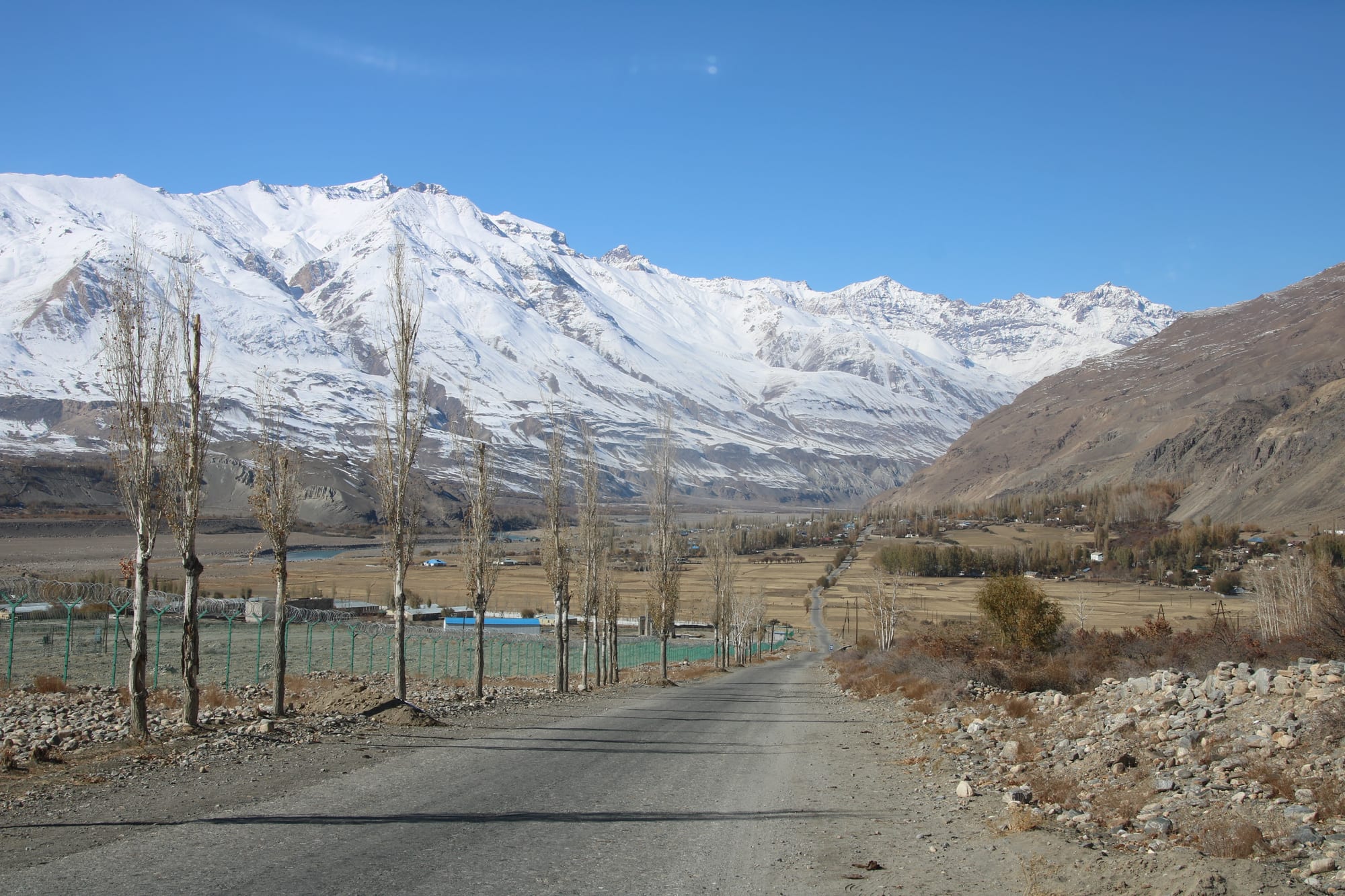
A straight road lined with bare poplars leading into a village of low houses on a dry plain, with a long snow-covered mountain wall behind

The Pamirs, Tajikistan

Ishkashim

The road into Ishkashim, with the snow-covered ranges of the upper Panj valley behind. (Jboenisch / Wikimedia Commons · CC BY-SA 4.0)

A village in the south-western Pamirs where the Panj river swings east and the road turns off the Pamir Highway into the Wakhan corridor. It is the centre of Ishkoshim district, a place of irrigated fields, poplars and flat-roofed Pamiri houses facing Afghanistan across the river, with the snow peaks of the Hindu Kush filling the southern horizon.

Neighbourhoods

  • The village centre
    • First-time visitors
    • Local life
    • Close to transport

    A short main street with the district administration, a school, a few shops, a bank and the bazaar. Shared cars for Khorugh and for the Wakhan villages wait near by, and most guesthouses are within a few minutes' walk.

    Open in Maps
  • The fields and the riverside
    • Quiet and residential
    • Walking
    • Views

    The irrigated terraces of wheat, potatoes and fodder that spread between the village and the Panj, divided by channels and lines of poplars. Tracks run out through the fields towards the river, with Afghan villages visible on the far bank.

    Open in Maps
  • The Wakhan road
    • Views
    • Close to transport

    The eastern edge of the village, where the road leaves for the Wakhan corridor between the Panj and the mountains. Houses thin out quickly, and the valley opens towards the peaks that mark the Afghan and Pakistani ranges beyond.

    Open in Maps

Things to do

In and around the village

  • Ishkashim bazaarmarket

    The village market, a small grid of stalls and containers selling flour, tea, tools and clothing, busiest when trucks arrive from Khorugh.

    Open in Maps
  • The Panj riversideviewpoint

    Tracks and field paths that reach the river below the village, where the Panj marks the border and the Afghan bank lies a short distance away.

    Open in Maps
  • Pamiri houses of the districtattraction

    The traditional chid, a single room with five carved wooden pillars and a stepped skylight, still the centre of family life in many local homes.

    Open in Maps

Short trips into the Wakhan

  • Wakhan Corridorattraction

    The long valley running east between the Panj and the mountains, with Pamiri and Wakhi villages, ruined forts, hot springs and views to the Hindu Kush.

    Open in Maps
  • Yamchun Fortresslandmark

    A large ruined hill fort above the Wakhan valley, with round towers and long walls on a spur between two gorges.

    Open in Maps
  • Bibi Fatima hot springsattraction

    Mineral hot springs in a cave-like bathhouse on the slope above Yamchun, long visited by local families as well as travellers.

    Open in Maps
  • Vrang stupalandmark

    A stepped structure on a terrace above the village of Vrang, of uncertain origin and usually described as a Buddhist stupa.

    Open in Maps
  • Garm Chashmaattraction

    Hot springs in a side valley off the road north to Khorugh, about 40 kilometres from Khorugh, where mineral water emerges at up to 75°C over white terraces into bathing houses.

    Open in Maps

Seasonal events

  • NowruzMarch

    The Persian new year, marked in the Pamiri villages with house cleaning, special dishes, music and visiting as the valley begins to thaw.

  • Imamat DayFebruary

    The anniversary of the Ismaili Imam's succession, kept by Ismaili communities; Aga Khan V became Imam on 4 February 2025, and the day is marked in the village and the Wakhan settlements with gatherings and celebration.

  • Independence DaySeptember

    Tajikistan's national day on 9 September, marked with sport, music and official events at the district centre.

Eat and drink

Long-standing places and food districts in Ishkashim. Hours, ratings and directions come from your maps app, always current.

Pamiri classics

  • Qurutobrestaurant

    Torn flatbread soaked in a sauce made from dried yoghurt balls, topped with onion, herbs and sometimes meat, and eaten by hand from a shared dish.

    Open in Maps
  • Shirchoycafe

    Milk tea, salted and often buttered, with bread broken into the bowl — the standard breakfast in guesthouses and village homes.

    Open in Maps

The market and the table

  • Ishkashim bazaarmarket

    Bread, dried mulberries and apricots, walnuts, tea and whatever fresh produce has come up the valley that week.

    Open in Maps
  • Guesthouse mealsrestaurant

    Almost all meals here are eaten in family guesthouses, where dinner and breakfast come with the room — soup, bread, dairy, potatoes and tea.

    Open in Maps

Experience Ishkashim

History

The Panj valley here has been settled for a very long time, watered by channels led off side streams onto terraces above the river. The area belonged to Wakhan, one of the small Pamir principalities ruled by local mirs, and the forts and watchtowers strung along the valley to the east — among them Yamchun, high above the river — show how routes through these mountains were controlled. Branches of the Silk Road used the valley between the Tarim basin and the lands of the Oxus, and Buddhism left traces here, including the stepped structure at Vrang usually described as a stupa.

Ismaili Islam reached the Pamirs by the 11th century, and tradition credits its spread to the poet and missionary Nasir Khusraw. The decisive change came in the late 19th century, when Russia and Britain fixed their frontier in the Pamirs. The boundary agreement of 1895 made the Panj the border with Afghanistan and created the Wakhan corridor as a buffer between the empires, dividing the Wakhi- and Ishkashimi-speaking communities and leaving a village of the same name on each bank.

Under Soviet rule the settlement became the centre of Ishkoshim district, with a school, clinic, administration and collective farms, supplied along the road from Khorugh. Independence and the civil war of the 1990s brought hardship and isolation, eased by relief and later development work organised through the Aga Khan network. In the 2000s a bridge across the Panj and a cross-border market brought contact with the Afghan side for a time. Since then the border has tightened again, and the village lives on farming, government jobs and the summer traffic of travellers heading into the Wakhan.

Culture & Customs

Ishkashim is a Pamiri village, and the distinctions that set the western Pamirs apart from the rest of Tajikistan are all present here. People are Ismaili Shia Muslims who follow the Aga Khan; religious life takes place in the jamoatkhona, the prayer house, and the calendar and ceremonies differ from those of the Sunni lowlands. The Aga Khan's institutions have shaped schooling, health care and energy supply for a generation, and education is valued highly for a place of this size.

Language marks the valley too. Ishkashimi, a small Eastern Iranian language, is spoken in a handful of villages near by, Wakhi is the language of the settlements up the corridor, and Tajik and Russian serve for school, office and trade. Most of these tongues belong to a different branch of Iranian from Tajik itself, and few of them are written in daily use.

The Pamiri house, the chid, is the centre of social life: a single room with five wooden pillars and a stepped skylight, each element carrying religious meaning, where meals, celebrations and funerals all take place. Music is part of gatherings, from devotional maddoh singing to dance tunes at weddings. Hospitality is an obligation rather than a courtesy — a traveller will be fed and given the best seat — and families across the river in Afghan Ishkashim are in many cases relatives, a fact that colours how the border is felt here.

Daily Life

The village is small, home to a few thousand people, and serves a district of roughly thirty thousand spread along the Panj and its side valleys. Life runs on irrigated agriculture: wheat, barley, potatoes, fodder and vegetables on the terraces, apricot and apple trees, and cattle, sheep and goats taken to higher pastures in summer. Households store fuel, dried fruit and flour for a winter that closes the valley in on itself.

Paid work is scarce. The district administration, the school, the clinic and development organisations provide most salaries, alongside driving, small shops and, in summer, guesthouses and guiding for travellers on the Wakhan route. As across Tajikistan, many working-age men spend part of the year in Russia, and the money they send home is a mainstay of village budgets. Electricity comes from small hydroelectric schemes and is limited in winter.

The day begins early with animals and irrigation, slows in the heat of the afternoon and ends with families indoors. Children walk to school, tea is drunk constantly, and news travels between houses faster than by telephone. The border is a constant presence: guard posts, permits and checks are routine, and contact across the river has become far more limited than in the years after the bridge opened. Young people leave for Khorugh, Dushanbe or abroad, returning in the summer months.

Food

Food here is Pamiri mountain food, built on bread, dairy and what the terraces produce. Qurutob, considered a national dish, is made by soaking dried yoghurt balls, qurut, into a sauce that is poured over torn flatbread and topped with fried onion, herbs and sometimes meat, then eaten by hand from a shared platter. Shirchoy — tea boiled with milk and salt, often with butter and with bread broken into it — is the usual breakfast and a defence against cold mornings.

Bread is baked at home in flat rounds and treated with respect. Dairy runs through the diet: sour milk, fresh cheese, kaymak, a thick clotted cream, and qurut eaten hard and salty as a snack. Soups of barley, potato and mutton are everyday meals, noodles and dumplings appear regularly, and plov is cooked for guests and celebrations, with rice carried up from the lowlands and treated as a small luxury. Meat is mostly mutton and goat, eaten sparingly.

The orchards of the valley give apricots, apples, walnuts and mulberries. Mulberries are eaten fresh in summer, dried by the sack for winter and sometimes ground into a sweet flour; dried apricots and walnuts accompany tea at any hour. Fresh vegetables are strongly seasonal, and what the bazaar holds depends on when a truck last came up from Khorugh, so meals are repetitive by late winter and generous in the months after the harvest.

Planning tools

Budget

The village itself is cheap: homestays and guesthouses charge a simple nightly rate including dinner and breakfast, and there is little else to spend money on. Transport is the real cost, since seeing the Wakhan means a hired car and driver or patience with infrequent shared vehicles. Fuel and imported food cost more than in the lowlands.

Daily Budget Midrange
USD 95–190 (a share of a hired 4x4 and driver, guesthouses, a guide)
Daily Budget Shoestring
USD 25–50 (homestay with meals, bazaar food, shared cars and hitched rides)

Bring all the cash needed in somoni; there is no dependable cash machine here and cards are not accepted, so draw money in Khorugh or Dushanbe.

Best Time to Visit

July to September is the main season, when the Wakhan road is clear, fields are green and guesthouses are open. June and early October are colder but possible. Winter is long, with snow, short days in a deep valley and very few visitors, and side roads can be blocked for days.

Suggested Number of Days

The village itself takes only a few hours, and most travellers use it as a stop before or after the valley road east. Three or four days allow the wider valley at a reasonable pace, and more if walking between villages or waiting on transport.

First Visit
1 day
With Surroundings
3–4 days

Transportation

Shared cars and 4x4s leave from the village centre for Khorugh and, less frequently, for villages up the Wakhan, generally in the morning and only when full. There is no bus service. Within the village everything is walkable, and a hired vehicle with a driver is the usual way to travel the valley road.

Ask at a guesthouse the evening before about departures, and allow spare days for landslides, river crossings and vehicles that do not fill.

Airport & Station Connections

The village sits on the Panj about 100 kilometres — a long half-day's drive — south of Khorugh, the regional capital and the nearest place with an airport, banks and hospitals. Most travellers arrive by shared car or hired 4x4 from Khorugh, or come the other way along the Wakhan valley from the eastern plateau. A GBAO permit is required for the region and passports are checked at posts along the road.

Walkability

Everything in the village is within a few minutes on foot, and the field tracks towards the river make easy walks with the mountains in view. Roads are gravel, there are no pavements, and the altitude makes climbing slower than expected. Walking on to neighbouring villages is straightforward, though distances along the valley are long.

Safety

The village is quiet and crime against travellers is very rare, and hospitality is the norm. The Panj here forms the Afghan border, which is closely guarded, and the riverbank, the crossing point and any military post should be treated with care. The wider region has seen tension between Pamiri communities and the central government in recent years. Altitude, cold, rough roads and the distance to medical care are the everyday risks.

Check the current situation in GBAO before setting out, carry the GBAO permit and copies, keep away from the riverbank near the border, checkpoints and soldiers, and carry insurance with evacuation cover. Check current official travel advice before travelling.

Climate

A dry mountain climate high in the Panj valley, with strong sun, very little rain and a wide gap between day and night temperatures. Snowmelt from the surrounding ranges feeds the irrigation channels through the growing season.

Summer
warm and dry by day, often 25–30°C, with cool nights around 10°C
Winter
cold — January days are commonly around -2 to 2°C with nights near -12°C, and snow lies in the valley

Local Customs

Most people here are Ismaili Shia Muslims who follow the Aga Khan, and religious life centres on the jamoatkhona, the prayer house, which is not a visitor attraction. Dress is modest, shoes come off at the door, guests are given the best place in the room, and refusing tea or food takes some care. Wakhi is spoken up the valley alongside Tajik and Russian.

Ask before photographing people or houses, never photograph the border, soldiers or checkpoints, and pay a guesthouse family promptly or leave a small gift rather than tipping.

Common Payment Methods

The currency is the Tajikistani somoni and the village runs on cash. Small notes are needed for the bazaar, guesthouses and shared cars. Cards are not accepted, cash machines are unreliable at best, and clean US dollar notes can sometimes be exchanged, so most travellers arrive with enough money for the whole valley.