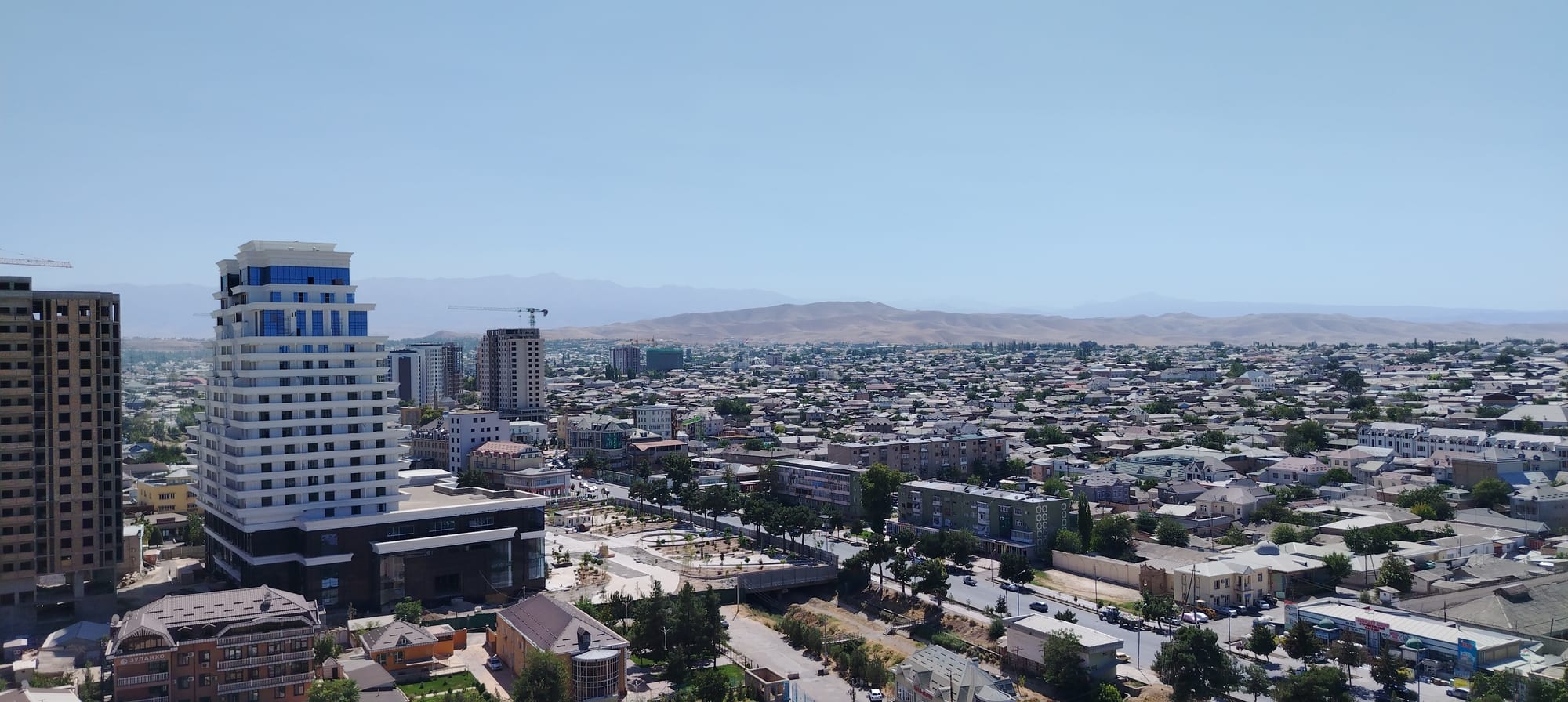
A wide view over Istaravshan's low houses and trees, with a white tower block and cranes on the left and dry brown hills on the horizon

Khujand & the North, Tajikistan

Istaravshan

Istaravshan spread across its plain below the hills of the Turkestan range. (VASHGIRD / Wikimedia Commons · CC BY 4.0)

One of the oldest towns in Central Asia, in the northern foothills of the Turkestan range where the road from Khujand climbs towards the Shahriston pass. Known for centuries as Ura-Tyube and renamed Istaravshan in 2000, it is a town of craft workshops, knife makers and old mud-brick quarters gathered below the citadel hill of Mug Teppa.

Neighbourhoods

  • The old quarters
    • Historic district
    • Crafts
    • Walking

    The lanes of mud-brick and plastered houses north and west of the centre, where blank walls face the street and courtyards hide behind heavy wooden doors. Old mosques, mausoleums and small workshops stand among them, and the quarters, or mahallas, still organise much of local life.

    Open in Maps
  • The bazaar and the centre
    • First-time visitors
    • Best for food
    • Local life

    The commercial heart, where the covered and open market rows sell fruit, spices, bread and hardware, and the knife stalls are a speciality of the town. Soviet-era administrative buildings, a park and the main road through to Khujand are all beside it.

    Open in Maps
  • Below Mug Teppa
    • Views
    • Historic district
    • Quiet and residential

    The residential streets on the northern side of the town, under the flat-topped citadel mound that carries the rebuilt gateway. Orchards and vine-shaded yards run up towards the hill, and the ground rises to give views back over the roofs to the plain.

    Open in Maps

Things to do

Mosques, madrasas and the citadel

  • Kok Gumbazlandmark

    The town's best-known monument, the mosque and madrasa of Abdulatif Sultan, whose blue-tiled dome gives it the name Kok Gumbaz, 'blue dome', set in a walled garden.

    Open in Maps
  • Mug Teppalandmark

    The flat citadel mound above the town, layered with the remains of successive fortifications and crowned by a rebuilt gateway.

    Open in Maps
  • The old quartersneighborhood

    Lanes of mud-brick courtyard houses, small mosques and mausoleums west and north of the centre, still the setting of daily neighbourhood life.

    Open in Maps

Markets and crafts

  • Istaravshan bazaarmarket

    The town market, where the knife-makers' stalls sit alongside rows of fruit, dried apricots, bread and household goods.

    Open in Maps

Short trips from the town

  • Bunjikatattraction

    The excavated capital of the principality of Ustrushana from the 6th to the 9th century, near Shahriston on the road south, whose wall paintings are among the most important works of Sogdian art.

    Open in Maps
  • Khujandattraction

    Tajikistan's second city on the Syr Darya about 78 kilometres to the north-east, with a reconstructed fortress and museum, the vast covered Panjshanbe bazaar and a long riverside.

    Open in Maps

Seasonal events

  • NowruzMarch

    The Persian new year, the biggest celebration of the year, marked with public gatherings, music, sumalak cooked overnight in great pans, and family visits.

  • Independence DaySeptember

    Tajikistan's national day on 9 September, marked with concerts, parades and decorations in the town centre.

  • Fruit harvestlate summer and autumn

    The season when apricots, grapes, melons and pomegranates fill the bazaar and families spread fruit on rooftops to dry for winter.

Eat and drink

Long-standing places and food districts in Istaravshan. Hours, ratings and directions come from your maps app, always current.

Istaravshan classics

  • Oshi palovrestaurant

    The rice, carrot, mutton and onion dish cooked in a kazan that marks every celebration, and the standard hot meal in the town's chaikhonas.

    Open in Maps
  • Tandoor bread and sambusarestaurant

    Round non baked on the wall of a clay tandoor, and sambusa, triangular pastries of minced meat, onion and fat, baked in the same ovens.

    Open in Maps

Markets and tea houses

  • Istaravshan bazaar food rowsmarket

    Stalls of dried apricots, raisins, almonds, spices and fresh fruit, with shashlik grills and bread sellers among them.

    Open in Maps
  • Chaikhonas on the main roadcafe

    Tea houses with raised platforms and cushions where green tea comes in bowls with bread, nuts and sweets, and where most meals in town are eaten.

    Open in Maps

Experience Istaravshan

History

Istaravshan claims a very long history. Local tradition and Tajik scholarship identify it with Cyropolis, the town said to have been founded by Cyrus the Great of Persia in the 6th century BC and stormed by Alexander the Great in 329 BC during his campaign on the Syr Darya, and the town celebrated its 2,500th anniversary in 2002 on that basis. The identification is debated, but excavation on the Mug Teppa mound has shown occupation reaching back into antiquity.

In the early medieval centuries this was part of Ustrushana, a principality between Sogdiana and the Fergana Valley whose capital, Bunjikat, lay near present-day Shahriston. The region was absorbed into the Muslim world in the 8th and 9th centuries, and the town grew as a market and craft centre on the roads linking Samarkand, Khujand and the Fergana towns. Its finest surviving monuments, among them the blue-domed mosque and madrasa known as Kok Gumbaz, belong to the later Islamic centuries.

Under the name Ura-Tyube the town was fought over by the khanates of Bukhara and Kokand before Russian forces took it in 1866. It became a district centre of Soviet Tajikistan, gaining light industry, schools and blocks of flats while keeping its old quarters and its craft trades largely intact. In 2000 the government restored a historical form of its name, and it has been Istaravshan since. Today it is one of the larger towns of Sughd province and one of the most visited for its architecture.

Culture & Customs

Istaravshan is known across Tajikistan as a town of craftsmen. Its knives, made with forged blades and decorated handles, are the best-known product and are sold from dedicated rows in the bazaar; woodcarvers, embroiderers, skullcap makers, potters and metalworkers also keep workshops here, often as family trades passed down through generations. The reputation is old enough that Istaravshan knives are given as gifts far beyond the town.

Life is organised around the mahalla, the neighbourhood, whose households gather for weddings, funerals and religious holidays and share the costs and work of them. Weddings are large and public, with music, drums and the shashmaqom and folk repertoire of the region, and a bride's dowry traditionally includes embroidered suzani hangings. Nowruz in March is the great festival of the year, with sumalak, a sweet wheat-germ paste, cooked overnight in enormous pans while women sing beside them.

Religion here is Sunni Islam, practised within the framework the state sets, and the town's old mosques and mausoleums remain places of prayer and visiting rather than museums. Both Tajik and Uzbek are widely spoken, reflecting the mixed population of the Fergana fringe, and Russian is still understood by older people. Manners are formal and unhurried: greetings with a hand on the heart, tea before business, and a reluctance to let a guest leave hungry.

Daily Life

About 65,000 people live in the town itself, with many more in the surrounding district of irrigated villages. The economy rests on farming, trade and small manufacturing: orchards and vineyards on the plain, market gardening, food processing, textiles and the craft workshops. As in the rest of Tajikistan, a large share of working-age men spend part of the year working abroad, mostly in Russia, and the money they send home pays for houses, weddings and schooling.

The day begins early. The bazaar is busiest in the first hours after dawn, when produce arrives from the villages, and quietens through the hot afternoon before a second round of activity in the evening. Lunch is the main meal, tea is drunk all day, and summer evenings bring families out to the parks and into shaded courtyards. Children walk to neighbourhood schools, and most households keep a vegetable plot, a vine and a few fruit trees.

Housing is a mix of single-storey courtyard houses in the old quarters and Soviet-era blocks near the centre, with new brick houses spreading onto the edges of town. Everyday concerns are familiar across the country: work and the cost of living, electricity supply in winter, irrigation water in summer, and the condition of the roads. The town's craft economy has been helped by domestic tourism, and Tajik visitors come from Khujand and Dushanbe for the knives and the monuments.

Food

Istaravshan eats the food of the Fergana Valley, shared with neighbouring Uzbekistan. Oshi palov — rice cooked with mutton, yellow carrot, onion and cumin in a cast-iron kazan — is the dish of weddings and guests, and every family has an opinion on how it should be made. Non, the round flatbread stamped in the centre and baked against the wall of a clay tandoor, appears at every meal and is never placed face down.

The tandoor also turns out sambusa, triangular pastries of minced mutton, onion and fat, and the grills of the bazaar produce shashlik, skewers of mutton and tail fat cooked over charcoal. Manti, large steamed dumplings, and lagman, hand-pulled noodles in a broth of meat and vegetables, are the other everyday dishes, alongside shorbo, a plain mutton and vegetable soup. Qurutob, the national dish of layered flatbread, yoghurt and vegetables, is eaten here as elsewhere in Tajikistan.

Fruit is the pride of the area. Apricots, grapes, melons, peaches, pomegranates and cherries ripen through the summer, and much of the crop is dried on rooftops for the winter. The bazaar's dried-fruit and nut rows sell apricots, raisins, walnuts and almonds by the sack. Green tea is drunk constantly, served in bowls with bread, sweets and dried fruit, and chalop, chilled yoghurt with dill and chopped vegetables, cools the hottest weeks.

Planning tools

Budget

Istaravshan is inexpensive. There are only a few small hotels and guesthouses, food is bazaar and chaikhona food, and the main variable cost is transport — a seat in a shared taxi is cheap, hiring a whole car for the day is not. Most travellers stop here between Khujand and Dushanbe rather than staying long.

Daily Budget Midrange
USD 55–110 (a small hotel, restaurant meals, a hired car for the day)
Daily Budget Shoestring
USD 20–40 (guesthouse room, bazaar food, shared taxis)

Bring cash in somoni; card payment is rare outside a few hotels and cash machines are limited, so draw money in Khujand.

Best Time to Visit

April to early June and September to October are the best months, with mild days, blossom in spring and the fruit harvest in autumn. Summer is very hot on the plain, though mornings at the bazaar stay pleasant. Winter is cold and grey, and the passes to the south can be difficult.

Suggested Number of Days

The town's monuments and market fit comfortably into a day, and many travellers stop here for a few hours while crossing northern Tajikistan. Two or three days suit anyone using the town as a base for the wider province.

First Visit
1 day
With Surroundings
2–3 days

Transportation

Shared taxis and minibuses run from the stands near the bazaar to Khujand, to other Sughd towns and, over the Shahriston and Anzob tunnels, to Dushanbe. Within the town, marshrutkas and shared cars cover the main roads for a small fixed fare, and taxis are easily found at the market.

Long-distance shared taxis fill up and leave earliest in the morning, so arrive at the stand early rather than late in the day.

Airport & Station Connections

The town sits on the main road between Khujand and Dushanbe. Khujand, with the nearest airport, is about 78 kilometres to the north-east, roughly an hour and a half by shared taxi. Dushanbe is a long drive south through the Shahriston and Anzob tunnels, usually five to six hours depending on conditions.

Walkability

The centre, the bazaar and the old quarters are all within walking distance of each other, and Mug Teppa is a short climb from the northern streets. Pavements are uneven, shade is scarce in summer, and the main road through town carries fast traffic, but distances are short and the old lanes are best seen on foot.

Safety

Istaravshan is calm and street crime is rare; the usual caution about bags and valuables in a crowded bazaar is enough. Traffic is the main everyday risk, as drivers are fast and crossings few. The Isfara area on the Kyrgyz border, well to the east, has seen serious clashes in recent years and is a separate matter from this town.

Carry a passport and keep copies, avoid the border districts to the east, and take care crossing the main road. Check current official travel advice before travelling.

Climate

A dry continental climate in the foothills south of the Fergana Valley, with hot summers, cold winters and most of the modest rainfall, around 400 millimetres a year, between late autumn and spring. The mountains to the south hold snow well into the warm months.

Summer
hot and dry — days often above 30°C and sometimes reaching 35°C, with cooler evenings
Winter
cold — January days are often around 0 to 5°C with nights below freezing, and snow falls several times a season

Local Customs

This is a conservative Sunni Muslim town. Modest dress is expected, and shoulders and knees covered is the norm for both men and women; shoes come off at the door of a house and at a mosque. Greetings are unhurried, and an invitation to tea should be accepted if possible. Hospitality is taken seriously and refusing food can cause offence.

Ask before photographing people, especially women, and avoid photographing government buildings, checkpoints or soldiers. Tipping is not expected; rounding up a taxi fare is enough.

Common Payment Methods

The currency is the Tajikistani somoni. Cash is used for almost everything, and small notes are useful at the bazaar and for shared taxis. Cards are accepted only at a few hotels, and cash machines are few, so it is normal to arrive with enough somoni for the stay; US dollars can be exchanged at licensed exchange offices.