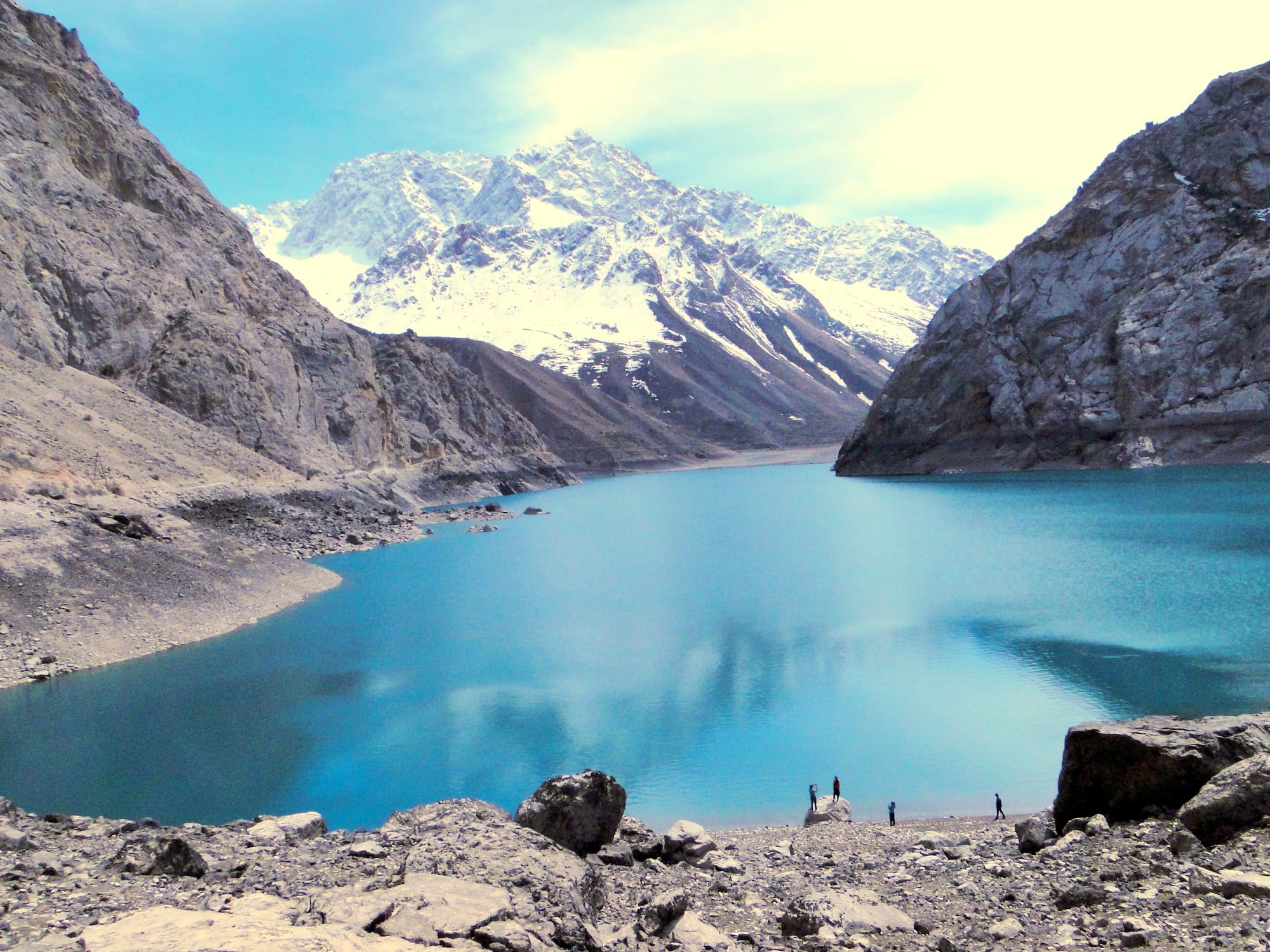
A turquoise lake between grey rocky slopes with a snow-covered mountain behind and a few small figures on the shore

Tajikistan

Khujand & the North

One of the Seven Lakes, also called the Marguzor lakes, in the Fann Mountains near Penjikent. (Шухрат Саъдиев / Wikimedia Commons · CC BY-SA 4.0)

Sughd, Tajikistan's northern region, stretching from the Fergana Valley and the Syr Darya at Khujand south over the Turkestan range to the Zarafshan valley and the Fann Mountains around Penjikent. It is the country's most industrial region, with its oldest towns, Sogdian ruins and the lakes of the Fann.

Explore Khujand & the North

History

Sughd takes its name from Sogdiana, the land of the Sogdians, the Iranian-speaking merchants of the Silk Road. Human settlement here is very old: Sarazm, near Penjikent, was a farming and metal-working town from the 4th millennium BC. In 329 BC Alexander the Great founded Alexandria Eschate, "the furthest", on the Syr Darya, and the site is traditionally identified with Khujand. Istaravshan grew as a town of Ustrushana, a principality whose capital lay near today's Shahriston.

Penjikent was a prosperous Sogdian city from the 5th century AD until the Arab conquest in the early 8th; its last ruler, Devashtich, retreated to a mountain fortress, where letters on leather and wood — the Mount Mugh documents — were found in the early 1930s. Rudaki, the father of Persian poetry, was born at Panjrud near by in the 9th century. In 1219–1220 Timur Malik, governor of Khujand, led a stubborn but unsuccessful defence of the city against the Mongols.

Later the region was contested between Bukhara and Kokand before Russia took Khujand in 1866. It was joined to the Tajik republic in 1929 and, as Leninabad from 1936 to 1991, became its most industrial province, with mining and uranium processing. The Leninabad elite ran Soviet Tajikistan for decades, but during the 1992–97 civil war power shifted to Kulob rather than Khujand.

Culture & Customs

Northerners see themselves as the country's most urban and educated people, and Khujand has a strong sense of being Tajikistan's second capital. The Fergana towns share much with neighbouring Uzbekistan: many families speak both Tajik and Uzbek, and Uzbeks are a large minority in Khujand and the valley districts.

Istaravshan is one of Central Asia's oldest towns of commerce and crafts. Penjikent honours Rudaki, whose mausoleum stands at Panjrud, and remembers its Sogdian past. In the upper Yaghnob valley, communities speak Yaghnobi, a language considered a direct descendant of Sogdian or closely related to it.

Religion is Sunni Islam, practised under the same state controls as elsewhere, and shrines such as Sheikh Muslihiddin's mausoleum in Khujand draw a steady flow of visitors. Weddings, Nowruz and Independence Day are marked with music and feasting, and the Khujand bazaar is the social centre as much as the market.

Daily Life

Sughd has about 3 million people, more than a quarter of the national total. Khujand, with about 180,000, is a city on both banks of the Syr Darya. Istaravshan, Isfara, Kanibadam, Buston and Penjikent are the other main towns, and villages line the irrigated edge of the Fergana Valley.

The economy mixes farming — cotton, apricots, grapes and wheat — with textiles, food processing, and mining for gold, coal, non-ferrous and rare metals. Trade with Uzbekistan has grown since relations warmed in 2018. As everywhere in Tajikistan, a large share of working-age men spend much of the year in Russia.

The day starts early at the bazaar, lunch is the main meal, and evenings bring families to the Syr Darya embankment in Khujand. Summer heat, winter power cuts and jobs are the everyday concerns, and the Kyrgyz border around Isfara remains a source of worry after the recent clashes.

Food

The north eats the Fergana table shared with Uzbekistan. Oshi palov is the dish of every celebration. Sambusa from the tandoor, manti and shashlik fill the chaikhonas, and non, the round flatbread, is served with almost every meal.

Fruit is the region's glory. Isfara has long been praised for its orchards, especially its almonds, and the valley produces apricots, grapes, melons, pomegranates, peaches and cherries, much of it dried for winter. In the Fann villages the diet is simpler: bread, dairy, potatoes, mutton and dried mulberries.

Green tea is served everywhere, with bowls of dried fruit, nuts and sweets. Chalop, a chilled mixture of yoghurt, dill, coriander and vegetables, is both a drink and a light dish in summer.

Attractions & Natural Wonders

Khujand has a reconstructed fortress holding the Sughd historical museum, the Panjshanbe bazaar, one of Central Asia's largest covered markets, facing the Sheikh Muslihiddin mausoleum across the main square, and a riverside with long views along the Syr Darya. East of the city the Kayrakkum reservoir, renamed the "Tajik Sea" in 2016, fills a stretch of the Syr Darya.

Istaravshan, to the south-west, has the Mug-Teppa citadel hill and the blue-domed Kok Gumbaz mosque, alongside other old buildings. Near Shahriston, the ruins of Bunjikat, capital of Ustrushana, are being excavated.

In the south, ancient Penjikent's walls, temples and houses stand on a terrace above the modern town; many of its Sogdian wall paintings are now in the Hermitage and in the National Museum of Antiquities in Dushanbe. Sarazm lies 15 kilometres west, and Rudaki's mausoleum is up the valley at Panjrud.

The Fann Mountains fill the south of the region. The Seven Lakes, Haft Kul, climb the Shinga valley, each a different shade of blue-green. Further east, Iskanderkul lies about 23 kilometres off the Dushanbe–Khujand road, with a 43-metre waterfall near by, and the Kulikalon and Alaudin lakes are reached on multi-day treks.

Cities in Khujand & the North

Planning basics

Budget

Khujand has a fair range of hotels and is about as cheap as Dushanbe. Istaravshan and Penjikent have a few small hotels and guesthouses, and the Fann Mountains run on village homestays and tented camps. Costs rise with a hired driver for the Seven Lakes and Iskanderkul, or with a guide and pack donkeys for longer treks.

Daily Budget Midrange
USD 70–140 (Khujand hotel, restaurants, a hired driver into the Fann)
Daily Budget Shoestring
USD 25–50 (guesthouse or homestay, bazaar food, shared taxis)

Carry cash for the Fann villages; ATMs exist in Khujand and Penjikent but not in the mountains.

Safety

Sughd is calm and street crime is low. The Isfara area on the Kyrgyz border saw deadly clashes in 2021 and 2022 and remain sensitive. In the Fann the hazards are altitude, loose scree, river crossings and rockfall, and the Anzob tunnel has long been notorious for poor lighting, water and fumes.

Avoid the Kyrgyz border areas around Isfara, carry a passport, and trek the Fann with a map, water treatment and warm clothing. Check current official travel advice before travelling.

Climate

The Fergana side around Khujand is dry and continental, with hot summers and cold, sometimes snowy winters. The Zarafshan valley around Penjikent is a little milder. The Fann Mountains are cool in summer, cold at night, and snowbound from late autumn to spring, when the upper lakes freeze and trails close.

Summer
hot in Khujand, often 35°C or more; warm days and cool nights in the Fann and at the Seven Lakes
Winter
cold in Khujand, around or below freezing; heavy snow and closed passes in the mountains

Transportation

Khujand has an airport with flights to Dushanbe and Russia, and the Dushanbe–Khujand road crosses two high passes through the Anzob and Shahriston tunnels in a long day by shared taxi. Penjikent is reached from Ayni along the Zarafshan valley, and from Samarkand across the Uzbek border. The Seven Lakes road and the Iskanderkul turn-off are rough and slow.

The Penjikent–Samarkand border crossing makes a natural link between Tajikistan and Uzbekistan; check that it is open before planning around it.

Best Time to Visit

June to September for the Fann Mountains, the Seven Lakes and Iskanderkul, when the trails and passes are open. April to May and September to October suit Khujand, Istaravshan and Penjikent, with fruit in the bazaars and milder heat; Nowruz in March is celebrated widely.