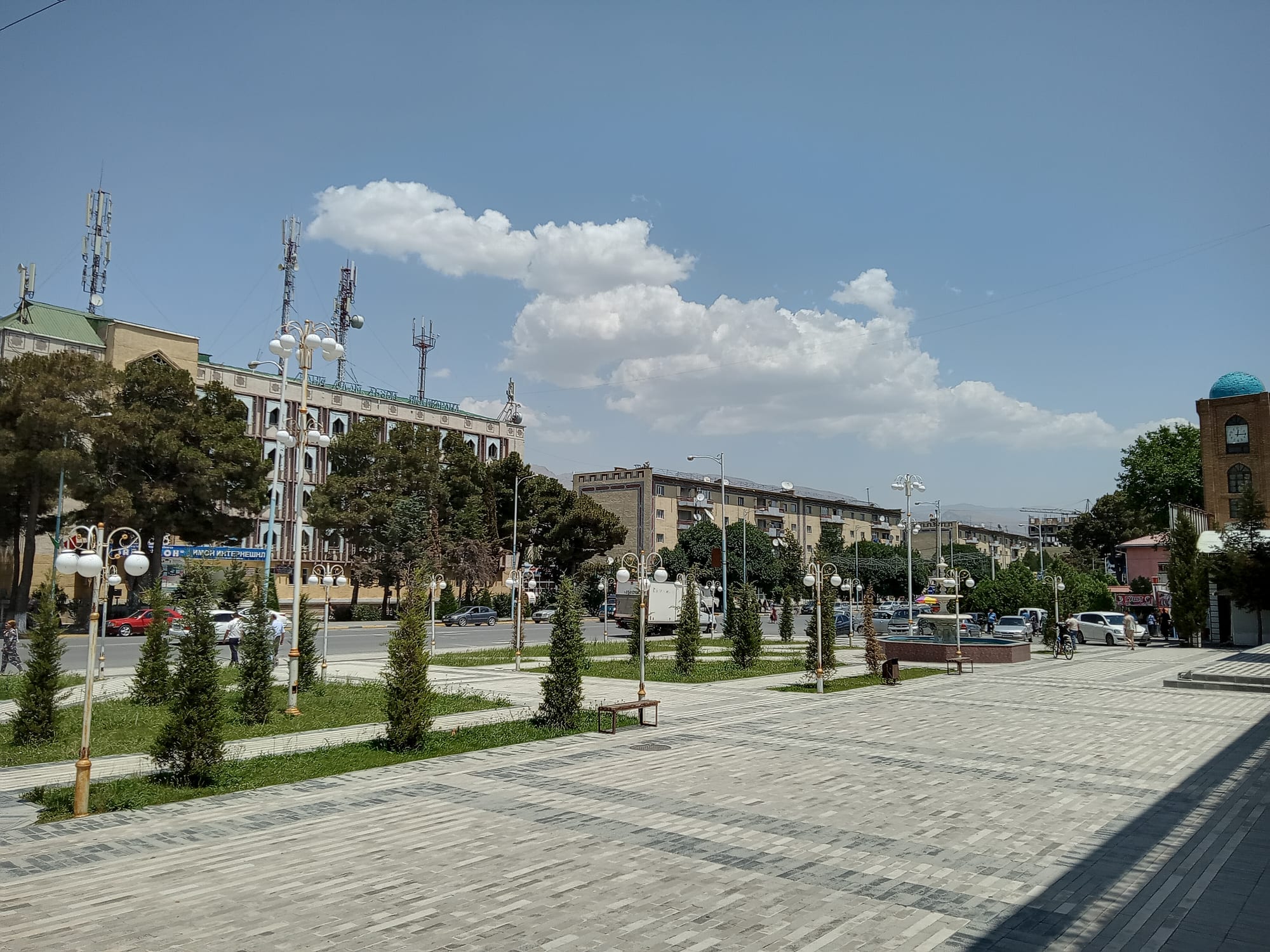
A paved town square with young conifers, street lamps and low buildings, with a blue-domed tower on the right under white clouds

Khujand & the North, Tajikistan

Panjakent

The centre of Panjakent in the Zarafshan valley. (Quatchenerlo / Wikimedia Commons · CC BY-SA 4.0)

A town in the Zarafshan valley of northern Tajikistan, close to the Uzbek border and a short drive from Samarkand. On the terrace above it stand the excavated walls of a Sogdian city famous for its wall paintings, the prehistoric settlement of Sarazm lies downstream, and the road east leads up to the Seven Lakes and the Fann Mountains.

Neighbourhoods

  • The town centre
    • First-time visitors
    • Close to transport
    • Local life

    A square, a main avenue and a few blocks of shops, offices, hotels and cafés make up the middle of town. Everything a visitor needs is here, and the shared taxis for the valley and the border leave from near by.

    Open in Maps
  • The bazaar quarter
    • Best for food
    • Shopping
    • Local life

    The market and the lanes around it handle the fruit, vegetables and livestock of the Zarafshan valley, with bread ovens, tea houses and small workshops. Mornings are the busy time, and it empties by mid-afternoon.

    Open in Maps
  • The old terrace above the town
    • Historic district
    • Views
    • Quiet

    The bluff east of the centre carries the excavated ruins of the Sogdian city and gives long views over the valley and the river. It is open ground with little shade, and quiet apart from visitors to the site.

    Open in Maps
  • The valley villages
    • Quiet and residential
    • Homestays
    • Walks

    Orchards, vineyards and walled houses spread along the Zarafshan and up the side valleys towards the mountains, where guesthouses and homestays take walkers heading for the lakes.

    Open in Maps

Things to do

Ancient sites

  • Ancient Panjikentlandmark

    The excavated walls, streets, temples and houses of a Sogdian city abandoned in the 8th century, whose painted interiors are among the great finds of Central Asian archaeology; most of the paintings are now in museums in Dushanbe and St Petersburg.

    Open in Maps
  • Sarazmlandmark

    A UNESCO World Heritage Site about 15 kilometres west, where a farming and metalworking settlement of the 4th and 3rd millennia BC has been excavated and roofed over.

    Open in Maps
  • Rudaki Museummuseum

    The town's museum of regional history, named after the Persian poet born in the valley, holding archaeological finds from Sarazm and the Sogdian city alongside ethnographic displays.

    Open in Maps

Markets and town life

  • The central bazaarmarket

    The valley's market, selling apricots, apples, grapes and melons in season, along with nuts, dairy, meat, cloth and household goods.

    Open in Maps

Short trips into the mountains

  • The Seven Lakespark

    A chain of lakes, the Marguzor lakes, stepping up the Shing valley south-east of the town, each a different shade of blue and green, with villages and homestays along the road.

    Open in Maps
  • Fann Mountainstrail

    The range south and east of the valley, with lakes, passes and peaks over 5,000 metres, the main trekking area of Tajikistan.

    Open in Maps
  • Iskanderkulpark

    A glacial lake at about 2,200 metres on the northern slopes of the Gissar Range, named after Alexander the Great and reached on a long drive around the mountains.

    Open in Maps
  • Panjrudlandmark

    A village up the valley with the mausoleum of Rudaki, the poet regarded as the father of Persian poetry, who was born there.

    Open in Maps

Seasonal events

  • NowruzMarch

    The Persian new year, celebrated across the valley with sumanak cooked overnight, music, sport and visiting.

  • Ramadan and Eidvaries with the lunar calendar

    The fasting month is kept in the valley villages, and the festival ending it brings prayers and long family meals.

  • The fruit harvestlate summer and autumn

    Apricots, grapes and apples are picked and laid out to dry on rooftops and in courtyards across the Zarafshan valley.

Eat and drink

Long-standing places and food districts in Panjakent. Hours, ratings and directions come from your maps app, always current.

Markets and food streets

  • The central bazaarmarket

    Tandoor bread, sambusa, dried apricots, walnuts and qurut, with the valley's fruit piled up through the summer and autumn.

    Open in Maps
  • Chaikhonas in the centrecafe

    Tea houses around the main street serve green tea, shurbo, plov and sambusa on raised platforms shaded by vines.

    Open in Maps
  • Village homestay tablesrestaurant

    In the side valleys most meals are eaten with families — soup, bread, potatoes, dairy, fruit and tea, with plov for guests.

    Open in Maps

Experience Panjakent

History

The terrace above the modern town carries the remains of a Sogdian city that flourished from the 5th century AD as one of the trading towns of the Zarafshan valley, with a citadel, temples, a market street and richly painted houses. Its wall paintings, showing feasts, epic battles and gods, are among the most important finds of Central Asian archaeology and have shaped what is known of Sogdian religion and daily life.

The city's end came with the Arab conquest of the early 8th century. Its last ruler, Devashtich, withdrew to a mountain fortress on Mount Mugh, where a cache of documents on leather, wood and paper was found — the main written source for the Sogdian world. The site was abandoned soon afterwards, which is why so much survived, and excavation has continued for decades. Further down the valley, Sarazm had been a farming and metalworking settlement thousands of years earlier, trading in lapis, tin and copper.

The valley later belonged to the emirate of Bukhara, and the modern town grew as a district centre under Russian and then Soviet rule, with schools, a museum and farms producing fruit and tobacco. Soviet border-drawing left Panjakent inside Tajikistan while its natural market, Samarkand, lay in Uzbekistan; the crossing was closed for long periods after 1991, and cross-border travel eased as relations between the two countries improved from 2016. Sarazm was inscribed as a UNESCO World Heritage Site in 2010, the first in Tajikistan.

Culture & Customs

This is a valley of villages, and life follows farming, family and the seasons. People are Tajik-speaking and largely Sunni Muslim, with mosques in each village, and the customs of the Zarafshan share much with those of Samarkand, a short distance away: the same dishes, the same wedding music, and families with relatives on both sides of the border.

The valley is proud of its literary past. Rudaki, the poet of the 9th and 10th centuries who is regarded as the father of Persian poetry, was born at Panjrud up the valley, and his mausoleum there is a place of visits, while the town's museum carries his name. The Sogdian heritage is also claimed as local history, and copies of the wall paintings appear in public buildings.

Higher in the mountains, in the Yaghnob valley east of here, communities speak Yaghnobi, a language considered a direct descendant of or close relative to Sogdian, and their survival is a matter of national pride. Hospitality in the villages is unstinting: walkers are offered tea and food and often a bed, and refusing entirely is harder than accepting. Nowruz in March is the great festival, and weddings, with long tables and the doira drum, are the main social events of the year.

Daily Life

Panjakent has some 52,000 residents, with many more in the district's villages along the Zarafshan and its side valleys, so the town functions as a market and administrative centre for a largely rural population. Buildings are low, courtyards are walled, and orchards and vineyards begin at the edge of the streets.

The economy is farming and trade. Apricots, apples, grapes, potatoes and vegetables are grown on irrigated terraces, livestock is kept on the pastures above, and produce is sold in the bazaar or trucked to Khujand and across the border. Small-scale mining and quarrying operate in the district, tourism provides seasonal income through guesthouses, drivers and guides, and, as everywhere in the country, money sent home from relatives working in Russia supports many households.

The day begins early, with the bazaar busiest soon after dawn; in summer work pauses in the worst heat and the evenings bring people out to the square and the tea houses. Roads, irrigation water, winter electricity supply and the shortage of local work are the standing concerns, and the state of the border crossing matters to traders and to families with relatives in Uzbekistan.

Food

The Zarafshan table is close to that of Samarkand. Oshi palav, rice cooked with mutton, carrot and onion in a kazan, is the dish of weddings and guests. Qurutob, torn flaky fatir bread soaked in a sauce of dissolved qurut and topped with onion and herbs, is eaten by hand from a shared bowl, and shurbo, a fatty mutton and vegetable soup, is the everyday winter meal.

Bread is central: non baked in tandoors in every village, stamped in the middle and never set down face first, along with fatir made in layers with butter or oil. Sambusa from the tandoor, manti, laghmon noodles and shashlik grilled over coals are the usual restaurant dishes, and in the mountain villages the diet is simpler — bread, dairy, potatoes, mutton, eggs and dried fruit.

Fruit is the valley's pride. Apricots, apples, grapes, cherries, mulberries and melons are eaten fresh in season and dried on rooftops for the winter, along with walnuts and almonds; dried mulberries, sometimes ground into flour, are a staple in the high villages. Chakka, strained sour milk with herbs, is spread on bread, chalop is drunk cold in summer, and green tea is poured all day with bowls of dried fruit and sweets set out for guests.

Planning tools

Budget

Panjakent is cheap. Small hotels and guesthouses in town cost little, homestays in the mountain villages include meals, and bazaar food is inexpensive. The main costs are transport: a hired car for the Seven Lakes or Iskanderkul, and guides or pack animals for longer treks in the Fann.

Daily Budget Midrange
USD 70–140 (best hotel in town or a comfortable guesthouse, restaurant meals, a hired driver into the mountains)
Daily Budget Shoestring
USD 25–45 (guesthouse or homestay, bazaar food, shared taxis)

Change money and draw somoni before leaving for the mountains, where there are no cash machines and homestays are paid in cash.

Best Time to Visit

June to September for the Seven Lakes, Iskanderkul and trekking in the Fann, when the passes and trails are open. April to May and late September to October suit the town, the ruins and the orchards, with blossom or fruit in the valley; Nowruz in March is widely celebrated. Winter is cold, with snow closing the higher roads.

Suggested Number of Days

A day or two is enough for the town and the archaeological sites beside it. Four to six allow the lakes and valleys behind it, and longer for multi-day treks in the mountains.

First Visit
1–2 days
With Surroundings
4–6 days

Transportation

The town is small enough to cross on foot, and shared taxis and minibuses handle everything else, leaving from stands near the bazaar for the border, for Ayni and Khujand, and up the side valleys when they fill. Roads to the Seven Lakes and Iskanderkul are rough and slow, and a hired 4x4 is the usual way to reach them.

Start long journeys in the morning, since shared cars become scarce later in the day, and allow far more time than the distances suggest on mountain roads.

Airport & Station Connections

The nearest large city is Samarkand in Uzbekistan, a short drive away through the border crossing west of town, which makes Panjakent a common entry or exit point for travellers moving between the two countries. From within Tajikistan, shared cars run down the Zarafshan valley from Ayni on the Dushanbe–Khujand road, roughly two hours, with Dushanbe five to six hours away over the passes.

Walkability

The centre is flat, small and easily covered on foot, with the square, bazaar and museum within a few hundred metres of each other. The ruins on the terrace are a walk of a couple of kilometres from the centre, uphill and exposed to the sun, and Sarazm and the mountain valleys need a vehicle. Pavements are uneven and streets unlit at night.

Safety

The town is quiet and street crime is rare, with routine police checks near the border. The main risks are in the mountains: altitude, loose scree, river crossings, rockfall and fast weather changes, with rescue services and medical care a long way off. Roads in the valleys are narrow, and rockfall and landslides are common after rain.

Carry a passport at all times near the border, trek with a guide or at least a map, water treatment and warm clothing, and tell someone the planned route. Check current official travel advice before travelling.

Climate

The Zarafshan valley is milder than the Fergana lowlands, with warm dry summers and cold winters, and the mountains behind it are far colder. Most precipitation falls between November and April, as snow higher up, and the high lakes freeze in winter.

Summer
warm and dry, usually 28–34°C by day in the town, cooler in the side valleys and cold at night in the mountains
Winter
cold, around 0–6°C by day with frost at night, and heavy snow on the passes

Local Customs

The valley is traditional and hospitable. Modest dress is expected, shoulders and knees covered, and a headscarf for women at mosques and shrines. Shoes come off at the door of a house, guests are served first and pressed to eat more, and tea is poured for others before oneself. Many households take in walkers, and payment and expectations are best agreed plainly at the start.

Ask before photographing people, especially women and children; alcohol is little seen in the villages, and small gifts or buying fruit and dairy from families are appreciated.

Common Payment Methods

The currency is the Tajik somoni and the valley runs on cash. A couple of banks and cash machines operate in the town, but they cannot be relied on and there are none in the mountains, so money is best drawn in Khujand or Dushanbe. US dollars are the easiest currency to exchange, and clean notes are expected.