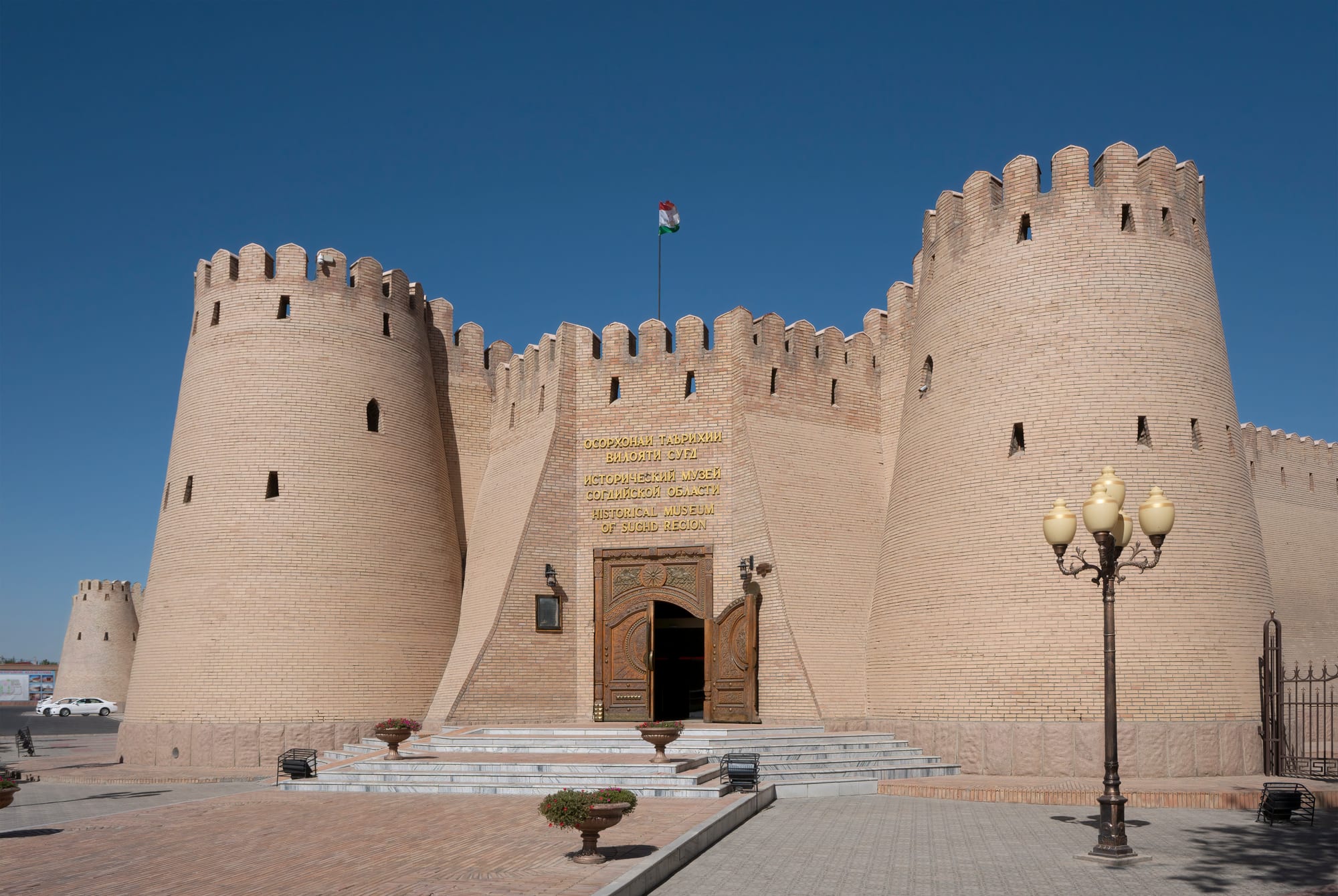
A rebuilt brick fortress gateway with round crenellated towers and a carved wooden door, under a clear blue sky

Khujand & the North, Tajikistan

Khujand

The rebuilt gateway of Khujand Fortress, which houses the Historical Museum of Sughd Region. (Petar Milošević / Wikimedia Commons · CC BY-SA 4.0)

Tajikistan's second city, on both banks of the Syr Darya where the river leaves the Fergana Valley. One of the oldest towns in Central Asia and traditionally identified with the Alexandria founded by Alexander the Great, it combines a rebuilt fortress and the vast Panjshanbe bazaar with Soviet industry, riverside parks and a northern outlook.

Neighbourhoods

  • The old centre and the bazaar
    • First-time visitors
    • Best for food
    • Historic district

    The south bank around the main square holds the Panjshanbe bazaar, the mausoleum and mosque facing it, the fortress and museum, and most of the hotels and restaurants. It is the busiest and most interesting part of the city to walk.

    Open in Maps
  • The Syr Darya embankment
    • Walks
    • Parks
    • Quiet and residential

    Long parks, promenades and cafés line both banks of the wide green river, with bridges linking them. Families come out in the evening, and the views along the water are the city's best.

    Open in Maps
  • The north bank
    • Quiet and residential
    • Local life
    • Budget stays

    Across the bridges lie residential districts, markets, the theatre and the park on the hill above the city. It is calmer than the centre and cheaper for rooms and food.

    Open in Maps
  • The industrial districts
    • Local life
    • Close to transport

    The eastern and western edges hold the silk and textile plants, workshops and warehouses that made the city the country's industrial capital, mixed with apartment blocks and long-distance transport stands.

    Open in Maps

Things to do

Famous landmarks

  • Khujand Fortresslandmark

    A section of the citadel that defended the city from antiquity until the Mongol siege of 1220, rebuilt in 1999 on the corner of the old city wall and now holding the regional historical museum.

    Open in Maps
  • Sheikh Muslihiddin Mausoleumlandmark

    A mausoleum and mosque complex with a tall minaret, facing the bazaar across the main square, built over the grave of Muslihiddin Khujandi, a ruler of the city; the present structure dates from the 16th century.

    Open in Maps
  • Historical Museum of Sughd Regionmuseum

    The provincial museum, founded in 1986 and housed inside the rebuilt fortress, covering the archaeology and history of Sughd from the Sogdian period onwards.

    Open in Maps
  • The Syr Darya embankmentviewpoint

    Promenades, gardens and bridges along one of Central Asia's great rivers as it flows out of the Fergana Valley through the middle of the city.

    Open in Maps

Markets and parks

  • Panjshanbe Bazaarmarket

    One of the largest covered markets in Central Asia, in a pillared hall on the main square opposite the mausoleum, selling fruit, spices, nuts, dairy, meat and cloth.

    Open in Maps
  • The park above the north bankpark

    A hillside park above the north bank, with woods, walks and long views over the city and the valley.

    Open in Maps
  • The riverside parkspark

    Gardens, fountains and shaded walks along both banks, busiest on warm evenings and at weekends.

    Open in Maps

Culture and industry

  • Arbob Cultural Palacelandmark

    A grand 1950s collective-farm palace on the edge of the city, modelled loosely on Peterhof, where the parliament declared Tajikistan's independence in 1991.

    Open in Maps
  • Khujand Airporttransit hub

    The north's airport, in the town of Buston about nine kilometres from the centre, with flights to Dushanbe and to Russia.

    Open in Maps

Short trips from the city

  • Istaravshanlandmark

    One of Central Asia's oldest towns of crafts and trade, about 80 kilometres south-west, with the Mug-Teppa citadel hill and the blue-domed Kok Gumbaz mosque.

    Open in Maps
  • Kayrakkum Reservoirattraction

    A long reservoir on the Syr Darya east of the city, made by a dam finished in 1959 and listed as a Ramsar wetland, with beaches and sanatoriums along its shore.

    Open in Maps
  • Kanibadamattraction

    An old Fergana town to the east known for its almonds and orchards, with madrasas and a bazaar.

    Open in Maps

Seasonal events

  • NowruzMarch

    The Persian new year and the biggest festival of the year, with sumanak cooked overnight, music, wrestling and public gatherings.

  • Ramadan and Eidvaries with the lunar calendar

    The fasting month changes the city's rhythm, and the festival ending it fills the mausoleum square and family houses.

  • Independence DaySeptember

    The national holiday on 9 September, marked with concerts and fireworks, and of particular note in the city where independence was declared.

  • The fruit harvestlate summer and autumn

    Apricots, grapes, melons and pomegranates from the valley orchards fill the bazaar, and families dry fruit and nuts for winter.

Eat and drink

Long-standing places and food districts in Khujand. Hours, ratings and directions come from your maps app, always current.

Markets and food streets

  • Panjshanbe Bazaarmarket

    The city's great market, where bread comes hot from tandoors and the rows are piled with dried apricots, almonds, nuts, spices, qurut and the valley's fruit.

    Open in Maps
  • Chaikhonas around the main squarecafe

    Tea houses near the bazaar and mausoleum serve green tea, sambusa, shurbo and plov on raised platforms, busiest at lunchtime.

    Open in Maps
  • Restaurants along the embankmentneighborhood

    Riverside restaurants and cafés cook shashlik over coals, laghmon and qurutob, and stay busy on summer evenings.

    Open in Maps

Experience Khujand

History

Khujand is one of the oldest cities in Central Asia. Tradition identifies it with Alexandria Eschate, "Alexandria the Furthest", founded by Alexander the Great on the Syr Darya in 329 BC at the edge of the settled world, and archaeology shows a fortified town on the site well before that. Its position where the river leaves the Fergana Valley made it a crossing point and a Silk Road halt between the valley oases and the routes west to Samarkand.

The city's most remembered episode is its defence against the Mongols in 1219–1220, when its governor Timur Malik held out on an island in the river before being overwhelmed; the citadel was destroyed and the town took centuries to recover. Later it was contested between the emirate of Bukhara and the khanate of Kokand, and Russian forces took it in 1866. The railway and cotton trade arrived, and Russian-built quarters grew beside the old town.

In Soviet times, as Leninabad from 1936 to 1991, it became the most industrial province of Tajikistan, with silk and textile mills, food processing and uranium mining and processing in the district around; its elite dominated the republic's politics for decades. The Arbob palace on the city's edge is where the republic's supreme soviet declared independence in 1991. The civil war of the 1990s was fought mainly in the south, but it shifted power away from the north, and the reopening of the Uzbek border in 2018 has since restored some of the city's old role as a trading crossroads.

Culture & Customs

Khujand thinks of itself as Tajikistan's second capital and its most urban place, with a long tradition of education, theatre and literature. It claims the 14th-century Persian poet Kamol Khujandi as its own, and his name is attached to a park, a theatre and a museum in the city. Classical Persian poetry, shashmaqom music and the crafts of the Fergana towns are all cultivated here.

The Fergana setting shows in daily life: many families speak Tajik and Uzbek, Uzbek neighbourhoods and Uzbek cooking are part of the city, and customs, dress and food have as much in common with the towns across the border as with the mountain south. Bright atlas silk, embroidered skullcaps and gold jewellery are worn at weddings, which are the great social events, large and expensive enough to be limited by law.

Religion is Sunni Islam under state supervision. The Sheikh Muslihiddin complex on the main square, with its mosque and minaret, is a focus of visits and Friday prayers, and pilgrims come from across the north. The bazaar is as much a social institution as a market, where people meet, drink tea and exchange news. Nowruz in March is the year's great festival, and Independence Day carries particular weight in the city where independence was proclaimed.

Daily Life

About 180,000 people live in Khujand, with many more in the surrounding districts of the Fergana Valley, which is the most densely populated part of the country. The city sits on both banks of the Syr Darya, linked by bridges, and mixes a compact old centre with Soviet blocks, industrial estates and newer suburbs spreading into the orchards.

The economy is the most diverse in Tajikistan: textiles and silk, food processing, building materials and workshops, along with mining for gold, coal and rare metals in the province, and trade with Uzbekistan through nearby crossings. There is a large university and a teaching hospital. Even so, wages are low and, as everywhere in the country, a great many working-age men spend much of the year in Russia, sending money home.

Days start early, with the bazaar busy from soon after dawn and lunch the main meal; the afternoon heat thins the streets in summer, and evenings bring families to the embankment, the parks and the cafés along the water. Summer heat, winter power cuts, the cost of living and the state of the border with Kyrgyzstan around Isfara are the recurring local concerns.

Food

The northern table is the Fergana table, shared with neighbouring Uzbekistan. Oshi palav is the dish of celebrations, rice cooked with mutton, carrot and onion in a wide kazan, and here it is often made with the plump rice of the valley. Qurutob, flaky fatir bread soaked in a sauce of dissolved qurut and topped with onions, herbs and sometimes meat, is eaten by hand from a shared dish as it is across the country.

Sambusa baked against the wall of a tandoor, manti, laghmon noodles, shurbo soup and shashlik grilled over coals fill the chaikhonas, and non, the stamped round flatbread, is baked in every neighbourhood; Khujand's bread is a point of local pride. Uzbek dishes appear everywhere, along with Russian-era additions such as pelmeni, cutlets and bakery cakes.

Fruit is the region's glory, and the Panjshanbe bazaar is the place to see it: apricots, grapes, melons, peaches, pomegranates and cherries in season, and mountains of dried apricots, raisins, walnuts and almonds the rest of the year, with the almonds of nearby Kanibadam and Isfara particularly prized. Chalop, a chilled mixture of sour milk with dill, coriander and vegetables, is a summer drink and light dish, and green tea is poured continuously with bowls of dried fruit and sweets for guests.

Planning tools

Budget

Khujand costs about the same as Dushanbe and less than most Central Asian capitals. Hotels range from Soviet-era blocks to a few modern places aimed at business travellers, guesthouses are cheap, and food in the bazaar and chaikhonas costs very little. Hiring a car and driver for the mountains or the valley towns is the main extra.

Daily Budget Midrange
USD 70–140 (city hotel, restaurant meals, a hired driver into the Fann or the valley)
Daily Budget Shoestring
USD 25–50 (guesthouse or hostel, bazaar and chaikhona food, minibuses and shared taxis)

Draw somoni in the city before heading into the mountains, where cash machines do not exist, and keep small notes for minibuses and the bazaar.

Best Time to Visit

April to early June and September to October, when the heat is moderate, the orchards are in blossom or in fruit and the bazaar is at its best. Nowruz in March is widely celebrated. July and August are hot and dusty in the valley, though they are the season for the Fann Mountains to the south, and winters are cold and grey with occasional snow.

Suggested Number of Days

One or two days covers the city at a comfortable pace. Three to five allow the valley towns and the mountains to the south, and longer if the city is a first or last stop on a journey between Tajikistan and Uzbekistan.

First Visit
1–2 days
With Surroundings
3–5 days

Transportation

Minibuses and buses run set routes across both banks for a small cash fare, and taxis are cheap and easily found in the centre or booked by phone app. Shared cars for Dushanbe, Istaravshan, Penjikent and the valley towns leave from stands on the edge of the city as they fill.

Bridges and the main avenues are congested at the start and end of the working day; have destinations written in Cyrillic for drivers.

Airport & Station Connections

Khujand airport, in the town of Buston, has flights to Dushanbe and to Russian cities. The road from Dushanbe crosses two high passes through the Anzob and Shahriston tunnels and takes most of a day by shared taxi. Tashkent is a few hours away across the Uzbek border, which is the usual route for travellers combining the two countries, and Penjikent is reached up the Zarafshan valley.

Walkability

The centre is flat and compact: the bazaar, the mausoleum, the fortress and the river are within about a kilometre of each other, and the embankments make long, pleasant walks. Wide avenues and bridges mean some stretches feel exposed, the summer sun is strong in the middle of the day, and crossing between the banks on foot takes a while, so taxis are used for anything further out.

Safety

Khujand is calm and street crime is low, with a visible police presence and routine document checks. The everyday risks are traffic, fast driving and crossing wide roads. The border areas around Isfara to the east saw deadly clashes in 2021 and 2022 and remain sensitive, and photographing officials or security buildings causes trouble.

Carry a passport at all times, keep away from the sensitive border areas around Isfara, avoid photographing officials or security installations, and avoid road travel after dark. Check current official travel advice before travelling.

Climate

A dry continental climate in the Fergana Valley, with long hot summers, short cold winters and brief springs and autumns. Rain falls mostly between November and April, and dust haze is common in the hot months.

Summer
hot and dry, often 33–38°C in the afternoon, with warm nights
Winter
cold, generally minus 3 to 5°C, with frost, some snow and grey days

Local Customs

Northerners see themselves as the country's most urban people, and the city is a little more relaxed than the south, though dress remains modest and shoulders and knees should be covered at the mausoleum and mosques. Greetings are unhurried, with a hand on the heart for elders, shoes come off at the door of a home, and guests are served first and pressed to eat. Many families speak both Tajik and Uzbek.

Ask before photographing people, particularly at the mausoleum; alcohol is sold openly but drunk discreetly, and tipping is not expected beyond rounding up a bill.

Common Payment Methods

The currency is the Tajik somoni. Cash is used for the bazaar, taxis and small guesthouses, while hotels, supermarkets and larger restaurants take cards. Cash machines and exchange booths are easy to find in the centre but not in the mountains, and US dollars are the simplest currency to change; notes should be clean and undamaged.