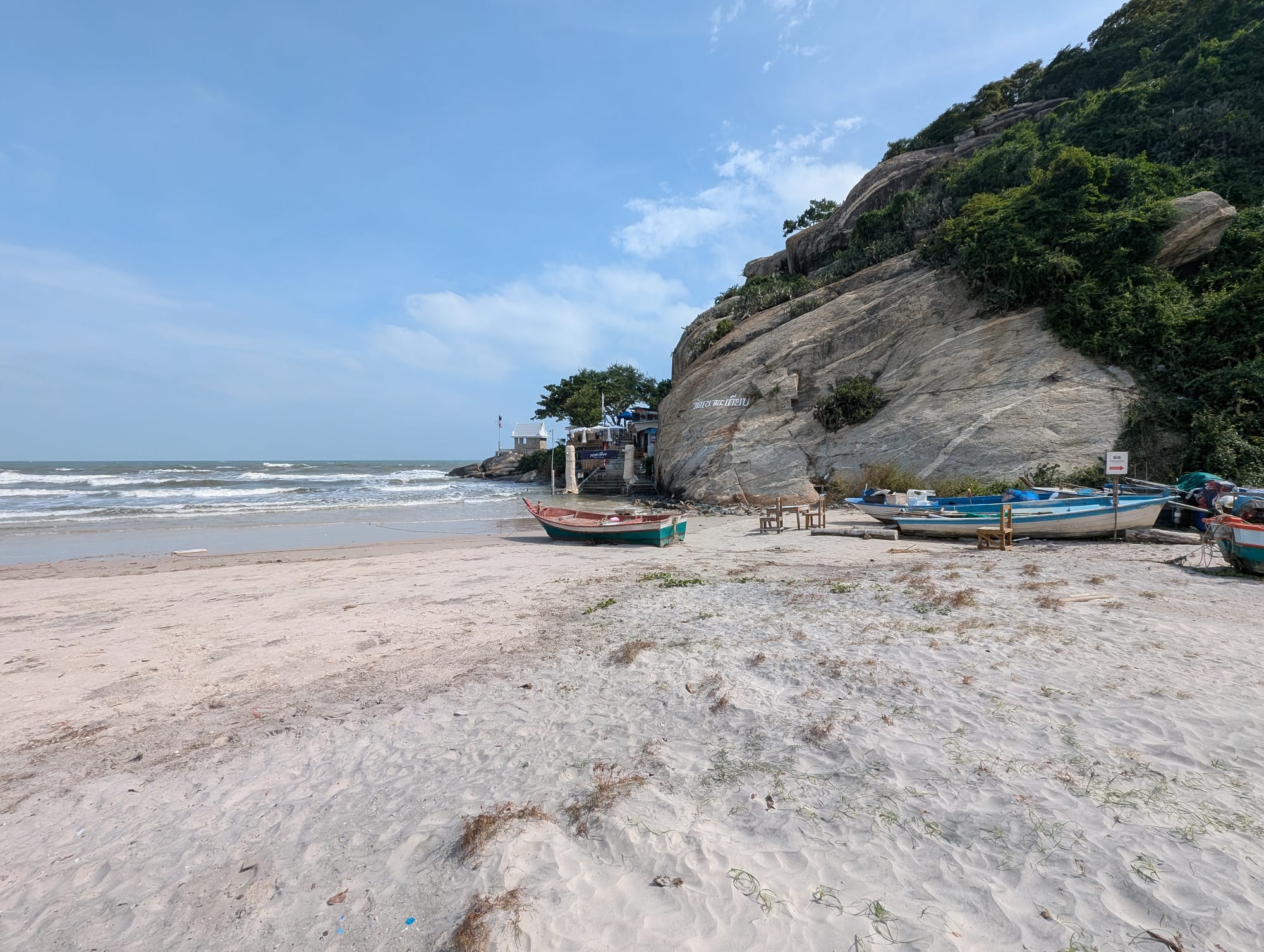
Wooden fishing boats drawn up on pale sand below a large rounded rock headland, with surf breaking along the shore

Kanchanaburi, Hua Hin & the West, Thailand

Hua Hin

Fishing boats on the sand below a rock headland at the southern end of the beach at Hua Hin. (Elmschrat / Wikimedia Commons · CC0)

A seaside town on the Gulf of Thailand about 200 kilometres south of Bangkok, in Prachuap Khiri Khan province. The railway brought the court here in the 1920s, and royal residence, golf courses and a long sandy beach made it Thailand's original beach resort. It remains quieter and more domestic than the southern islands, with night markets, seafood and a wooden railway station of royal pavilions.

Neighbourhoods

  • The town centre and the beach road
    • First-time visitors
    • Best for food
    • Close to public transport

    The grid between the railway line and the sea, where Naresdamri Road runs behind the beach past seafood restaurants built out on piers, and the night market fills Dechanuchit Road after dark. Hotels of every kind stand within a few streets of the sand.

    Open in Maps
  • The northern beachfront
    • Beaches
    • Quiet and residential

    North of the centre towards Klai Kangwon and Cha-am, the shore is lined with large resorts, condominiums and the golf courses that have shaped the town since the 1920s. It is calmer, greener and more spread out than the centre.

    Open in Maps
  • Khao Takiap
    • Beaches
    • Temples
    • Sunsets

    The headland about five kilometres south, with a hillside temple and monkeys above a strip of sand. Small hotels, guesthouses and a fishing village sit at its foot, and the beach here is wider and emptier than in town.

    Open in Maps
  • Inland Hua Hin
    • Local life
    • Markets

    West of the railway the town becomes ordinary Thai suburb — schools, fresh markets, workshops and cheap food, with the big weekend markets and a scattering of vineyards and attractions further out along the Pranburi road.

    Open in Maps

Things to do

Landmarks

  • Hua Hin railway stationlandmark

    A red and cream timber station rebuilt in 1926, often called the most beautiful in Thailand, with a royal waiting pavilion moved here from Sanam Chandra Palace in 1967. Trains now use an elevated station opened in 2023, and the old building is kept as a historic monument.

    Open in Maps
  • Klai Kangwon Palacelandmark

    The seaside palace commissioned by King Prajadhipok in 1926 and completed in 1933, later the primary summer residence of King Bhumibol; its grounds are royal property and access is restricted.

    Open in Maps
  • Khao Takiapviewpoint

    A headland at the southern end of the bay with a temple, a large Buddha image and troops of macaques, giving a long view back along the beach.

    Open in Maps

Beaches and the sea

  • Hua Hin Beachbeach

    A wide strip of pale sand running several kilometres south from the fishing pier, shallow and safe for most of the year, with horses for hire along the sand.

    Open in Maps
  • The fishing pier and Naresdamri Roadattraction

    The old harbour and the lane behind it, where restaurants stand on stilts above the water and boats unload in the early morning.

    Open in Maps

Markets

  • Hua Hin night marketmarket

    Stalls fill Dechanuchit Road in the evening with grilled seafood, noodles, sweets and souvenirs, the town's busiest place after dark.

    Open in Maps
  • Chatchai marketmarket

    The main daytime market in the town centre, under a covered pavilion, selling fruit, fish, curries and breakfast food.

    Open in Maps

Short trips from the town

  • Mrigadayavan Palacelandmark

    A teak summer palace of King Vajiravudh on the shore north of Hua Hin, raised on pillars with long open corridors linking its pavilions to the sea.

    Open in Maps
  • Khao Sam Roi Yot National Parkpark

    A coastal park of limestone peaks, marshes and caves about 45 kilometres south, best known for the light-filled Phraya Nakhon cave and its royal pavilion.

    Open in Maps
  • Kaeng Krachan National Parkpark

    Thailand's largest national park, a forested range on the Myanmar border about 60 kilometres inland, listed as a UNESCO World Heritage Site in 2021 and known for birds, elephants and morning mist over the hills.

    Open in Maps
  • Cha-ambeach

    A longer, plainer beach resort about 25 kilometres north, popular with Thai families and lined with deckchairs and seafood stalls.

    Open in Maps

Seasonal events

  • Hua Hin Jazz Festivalusually June

    An open-air jazz festival on the beachfront, held in the town since 2001 and featuring Thai jazz musicians.

  • SongkranApril

    The Thai new year, with water throwing along the beach road and merit-making at the temples.

  • Loi KrathongNovember

    Decorated floats of banana leaf and candles are set on the sea and on ponds at the November full moon.

Eat and drink

Long-standing places and food districts in Hua Hin. Hours, ratings and directions come from your maps app, always current.

Hua Hin classics

  • Pier seafood restaurantsrestaurant

    Wooden dining rooms on stilts above the water at the old harbour, serving grilled prawns, crab, squid and steamed sea bass with lime and chilli.

    Open in Maps
  • Hua Hin night marketmarket

    Charcoal grills of seafood, pad thai, curries and coconut sweets among the souvenir stalls, the cheapest way to eat well in the centre.

    Open in Maps

Markets and food streets

  • Chatchai marketmarket

    The daytime market, where breakfast rice soup, curries over rice, fruit and freshly landed fish are sold under a covered pavilion.

    Open in Maps
  • Khao Takiap fishing villageneighborhood

    Simple kitchens at the headland cook the day's catch for a local crowd, with tables looking back along the bay.

    Open in Maps
  • Soi 51 and the inland food lanesneighborhood

    Streets west of the railway with Thai kitchens, noodle shops and, increasingly, restaurants serving the town's long-stay European and Scandinavian residents.

    Open in Maps

Experience Hua Hin

History

Hua Hin began as a farming and fishing settlement named Samore Riang, "rows of rocks", after families moved down the coast when a severe drought struck Phetchaburi in the 1830s. The beach was given the name Hua Hin later in the century by Prince Krom Phra Naresworarit, the first member of the royal family to build here. Its transformation came with the railway: the southern line reached the town in November 1911, the state railway's director Prince Purachatra put up the Railway Hotel near the beach in 1921, and Bangkok society followed the train south for the sea air.

The court made it fashionable. Prince Purachatra, who ran the railways, promoted the resort; King Vajiravudh built the teak palace of Mrigadayavan on the shore to the north; and from 1926 King Prajadhipok built Klai Kangwon — "far from worries" — at the northern edge of the town, finished in 1933. He was the last absolute monarch, and the palace stayed in royal use after the revolution of 1932. Golf arrived with the railway too: the course opposite the station was laid out in 1922 and is among the oldest in the country.

The resort slipped from fashion after the Second World War as Thai and foreign travellers went to Pattaya and later Phuket, and for decades it was a quiet town of villas and fishing boats. King Bhumibol's long use of Klai Kangwon as a summer residence kept it in the public eye, and from the 1980s hotel groups, condominiums and golf courses returned. Growth since has been steady rather than explosive, and the town has kept more of its own life than most Thai resorts.

Culture & Customs

The town's identity is bound to the monarchy. Klai Kangwon was a working royal residence for decades, royal portraits hang in shops and offices, and the station's royal pavilion is treated as a monument rather than a curiosity. Visitors are expected to be careful in what they say and photograph near royal property, and Thai lese-majesty law is enforced.

Alongside that is the culture of a Thai resort town. Golf has been part of Hua Hin since the 1920s and there are now many courses inland; a jazz festival on the beach has run for years; and weekend markets, which mix crafts, food and live music, are a local institution. Bangkok families have kept seaside houses here for generations, and their presence gives the town a more domestic feel than the islands.

Hua Hin also has one of Thailand's larger communities of long-stay foreign residents, many of them Scandinavian, British and German retirees, which shows in bakeries, bars and estate agencies along the northern beachfront. The fishing village at the harbour and at Khao Takiap continues much as before, with boats going out at night and Buddhist and Chinese shrines at the water's edge. Local festivals follow the national calendar: Songkran in April, Loi Krathong in November, and temple fairs through the year.

Daily Life

Hua Hin district has about 66,000 registered residents at the last published count, and carries a large seasonal population of Thai weekenders and foreign long-stayers. It is the busiest town in Prachuap Khiri Khan province, though not its capital.

Tourism and property dominate the economy: hotels, resorts, condominium building, golf, restaurants and the services that support retired residents. Fishing continues from the pier and from Khao Takiap, supplying the seafood restaurants and markets, and the district inland grows pineapple, coconut and rubber, with limestone quarries and small factories along the highway. Public projects, including the rebuilt elevated railway through the town, have reshaped the centre in recent years.

The day starts early — markets before dawn, boats in with the catch, exercise on the beach — then slows through the heat before the evening brings people back to the sand and the night market. Local issues include coastal erosion, which has narrowed parts of the beach, water supply in dry years, traffic on the highway through town, and the pressure of condominium building on a shoreline that was until recently low-rise.

Food

Seafood is the foundation. Boats land squid, mackerel, prawns, crab and sea bass, and the restaurants on stilts at the old harbour cook them simply — grilled over charcoal, steamed with lime, chilli and garlic, fried with pepper, or turned into tom yum thale, a sour seafood soup. Pla kapong, the sea bass, and hoi malaeng phu, green mussels, are local staples, and squid is dried in the sun on racks near the fishing village.

The night market is the town's best-known eating place, with charcoal grills, noodle stalls, curry trays and pancake carts, while Chatchai market sells breakfast food — khao tom rice soup, patongo doughnut sticks with warm soya milk, and curries ladled over rice. Inland lanes keep the cheaper local kitchens — boat noodles, khao man kai, som tam and grilled chicken brought down from Isan cooking.

The province's own produce appears everywhere: pineapples from the plantations around Pranburi, coconuts from the coast further south, and palm sugar from Phetchaburi to the north, which sweetens the custards and coconut puddings sold in the markets. Vineyards inland from the town make Thai wine, and the resorts and beach bars serve cocktails, fresh fruit shakes and cold beer along the sand.

Planning tools

Budget

Hua Hin has a wider price range than most Thai beach towns: guesthouses and street food are cheap, while beachfront resorts, golf and the restaurants aimed at long-stay foreigners are not. Weekends and Thai public holidays, when Bangkok families arrive, raise room prices sharply. Transport within the town adds up, since songthaews and taxis are the usual way to reach the beaches south of the centre.

Daily Budget Midrange
USD 65–150 (beach hotel or resort, seafood dinners, a hired car or driver for the parks)
Daily Budget Shoestring
USD 25–45 (guesthouse, night market food, songthaews and a hired bicycle)

Come midweek for lower room rates, and eat at the night market or the inland lanes rather than the beach road.

Best Time to Visit

November to March is dry, sunny and mild, the main season for both Thai and foreign visitors. April and May are hot and humid. Hua Hin sits in a rain shadow, so it stays usable through much of the wet season, with the heaviest rain falling in October and November. Sea conditions are calmest in the cool months.

Suggested Number of Days

Two or three days suit the beach, the markets and the town's royal buildings. Four or five allow the national parks inland and south, and the neighbouring coast. Travellers using Hua Hin as a base for a longer stay often settle in for weeks.

First Visit
2–3 days
With Surroundings
4–5 days

Transportation

The centre is small enough to walk, and green songthaews run along the main road to Khao Takiap and north towards Cha-am. Motorbike taxis, tuk-tuks and taxis fill the gaps, and hired motorbikes and bicycles are common. Trains on the southern line stop at the town station, and buses and minivans run frequently to Bangkok, Phetchaburi and the southern provinces. The national parks need a car or a driver.

Agree a price before getting into a tuk-tuk; the town's fares are notably higher than in most Thai towns.

Airport & Station Connections

Hua Hin lies about 200 kilometres south of Bangkok, three to four hours by bus, minivan or car and a little longer by train on the southern railway. Direct buses run from Suvarnabhumi airport. The town has a small airport towards Cha-am, though scheduled flights have come and gone, and ferries have at times crossed the gulf to Pattaya, though the service has not run continuously.

Walkability

The centre is flat and compact: the station, the market, the night market and the beach road are all within a few blocks, and the beach itself makes a long walk at low tide. Beyond the centre, distances grow, pavements become patchy and traffic is heavy on Phetkasem Road, so most people ride rather than walk to Khao Takiap or the northern resorts.

Safety

Hua Hin is a safe, family-oriented resort with little violent crime. The main risks are road accidents, especially on hired motorbikes, jellyfish in some months, and the monkeys at Khao Takiap, which snatch bags and food and can bite. Petty theft happens in nightlife streets, and rip currents can occur when the sea is rough.

Carry nothing loose near the monkeys at Khao Takiap, wear a helmet on a motorbike, heed beach warnings after storms, and lock valuables away in hotel rooms. Check current official travel advice before travelling.

Climate

Tropical, but among the drier and sunnier parts of the Thai coast because the Tenasserim Hills shelter it from the southwest monsoon. Rain peaks in October and November and falls mostly in short evening storms; sea breezes take the edge off the heat.

Summer
hot and humid from March to May, about 27–35°C, with high humidity and occasional storms
Winter
dry, warm and breezy from November to February, about 21–31°C, the most comfortable season

Local Customs

Hua Hin is closely associated with the monarchy, and respect for the royal family is both a local habit and a matter of law. Temples require covered shoulders and knees and shoes removed; a wai replaces a handshake; heads are not touched and feet are not pointed at people or images. Swimwear belongs on the beach, not in shops or markets. Tipping is not expected, though loose change is often left.

Dress modestly away from the sand, take care with any comment about the monarchy, and ask before photographing people, monks or royal buildings.

Common Payment Methods

The currency is the Thai baht. Cards are accepted at hotels, resorts, supermarkets and most restaurants, but markets, songthaews and small kitchens work in cash, and ATMs are plentiful in the centre. Thai QR-code payment is widespread but usually needs a Thai bank account. Foreign cards are charged a fee at most Thai ATMs.