💰 Budget
Phetchaburi is among the cheapest places to stay in western Thailand, with few foreign visitors and prices set by local trade. Guesthouses and small hotels in the old town are inexpensive, market food costs little, and the main sights charge modest entry fees. The costs that add up are hired transport to Kaeng Krachan and the coast.
- Daily Budget Midrange
- USD 55–120 (town hotel or a resort on the coast, restaurant meals, a hired car or driver for the park)
- Daily Budget Shoestring
- USD 20–40 (guesthouse, market food, songthaews and a hired bicycle)
Buy sweets and palm sugar at the municipal market rather than the roadside stalls on the highway, where prices are set for passing coaches.
📅 Best Time to Visit
November to February is dry, warm and pleasant, and the Phra Nakhon Khiri fair falls in February. March to May is very hot, though it is the season for khao chae. The rains from about May to October are lighter here than in eastern Thailand, and Kaeng Krachan closes parts of its roads and trails during the wettest months.
⏳ Suggested Number of Days
One to two days covers the hill, the old town temples and the cave shrines. About three allow the national park, the coast or the palaces further south as well. The town is also a common stop on the way between Bangkok and the southern beaches.
- First Visit
- 1–2 days
- With Surroundings
- 3 days
🚆 Transportation
The old town is small and best covered on foot or by hired bicycle, with songthaews, motorbike taxis and tuk-tuks for the hill, the caves and the outskirts. Trains on the southern line stop at Phetchaburi station north of the centre, and buses and minivans run to Bangkok, Cha-am, Hua Hin and Ratchaburi. Kaeng Krachan and the coast need a car, a motorbike or a hired driver.
Songthaews and motorbike taxis gather near the market for trips to the palace hill, the cave shrines and the coast.
🛬 Airport & Station Connections
Phetchaburi lies about 160 kilometres south of Bangkok, roughly two to two and a half hours by minivan, bus or car, and a little longer by train from Bangkok's main stations on the southern line. Buses to and from Hua Hin and the south stop here, and the nearest international airport is Bangkok's Suvarnabhumi, about two and a half hours away by road.
🚶 Walkability
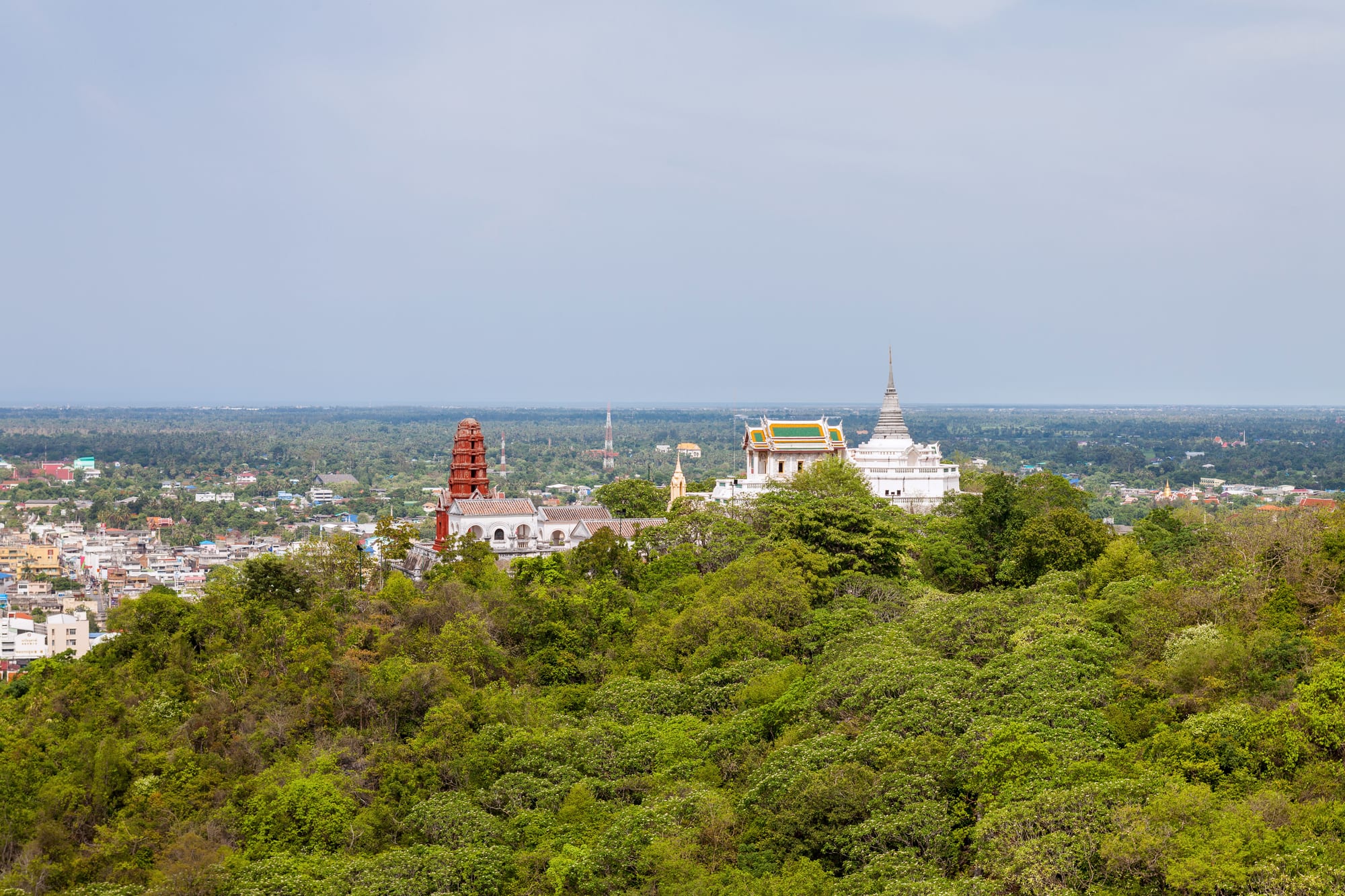
The old town is flat, compact and pleasant to walk: the market, the main temples and the riverside are within a few hundred metres of one another. Khao Wang is a couple of kilometres west, and the cave shrines further still, so a bicycle or a songthaew helps. Pavements are narrow, traffic is light by Thai standards, and the heat rather than the distance is the limiting factor.
🛡️ Safety
Phetchaburi is a quiet town with little crime affecting visitors. The best-known hazard is the macaques on and around Khao Wang, which snatch bags, food and sunglasses and sometimes bite. Otherwise the risks are road accidents on motorbikes, slippery steps in the cave shrines, and the usual care needed in the forest and on the roads in Kaeng Krachan.
Carry no loose food or bags near the monkeys, wear shoes with grip in the caves and on the hill, and keep to marked trails in the national park. Check current official travel advice before travelling.
🌦️ Climate
Tropical, and drier than most of Thailand because the Tenasserim Hills shelter the province. Rain falls mainly between May and November, peaking in October, and the cool season from November to February is dry and comfortable.
- Summer
- hot from March to May, often 33–37°C inland with high humidity and occasional evening storms
- Winter
- dry and warm from November to February, about 20–32°C, with cool mornings
🤝 Local Customs
Phetchaburi is a temple town, and ordinary Thai courtesies matter: covered shoulders and knees in monasteries, shoes removed before entering a hall, no touching of Buddha images, no pointing feet at people or images, and a wai rather than a handshake. Women should not hand things directly to monks. Respect for the monarchy is protected by law, which is worth remembering at the royal palaces. Tipping is not expected.
Dress modestly for the temples and cave shrines, ask before photographing people at prayer, and follow any restrictions on photography inside palace buildings.
💳 Common Payment Methods
The currency is the Thai baht. Cash is the norm in markets, sweet shops and songthaews, and ATMs are easy to find near the market and the main road. Cards work at hotels, supermarkets and larger restaurants. Thai QR-code payment is widespread but usually needs a Thai bank account, and national park entry is paid in cash.