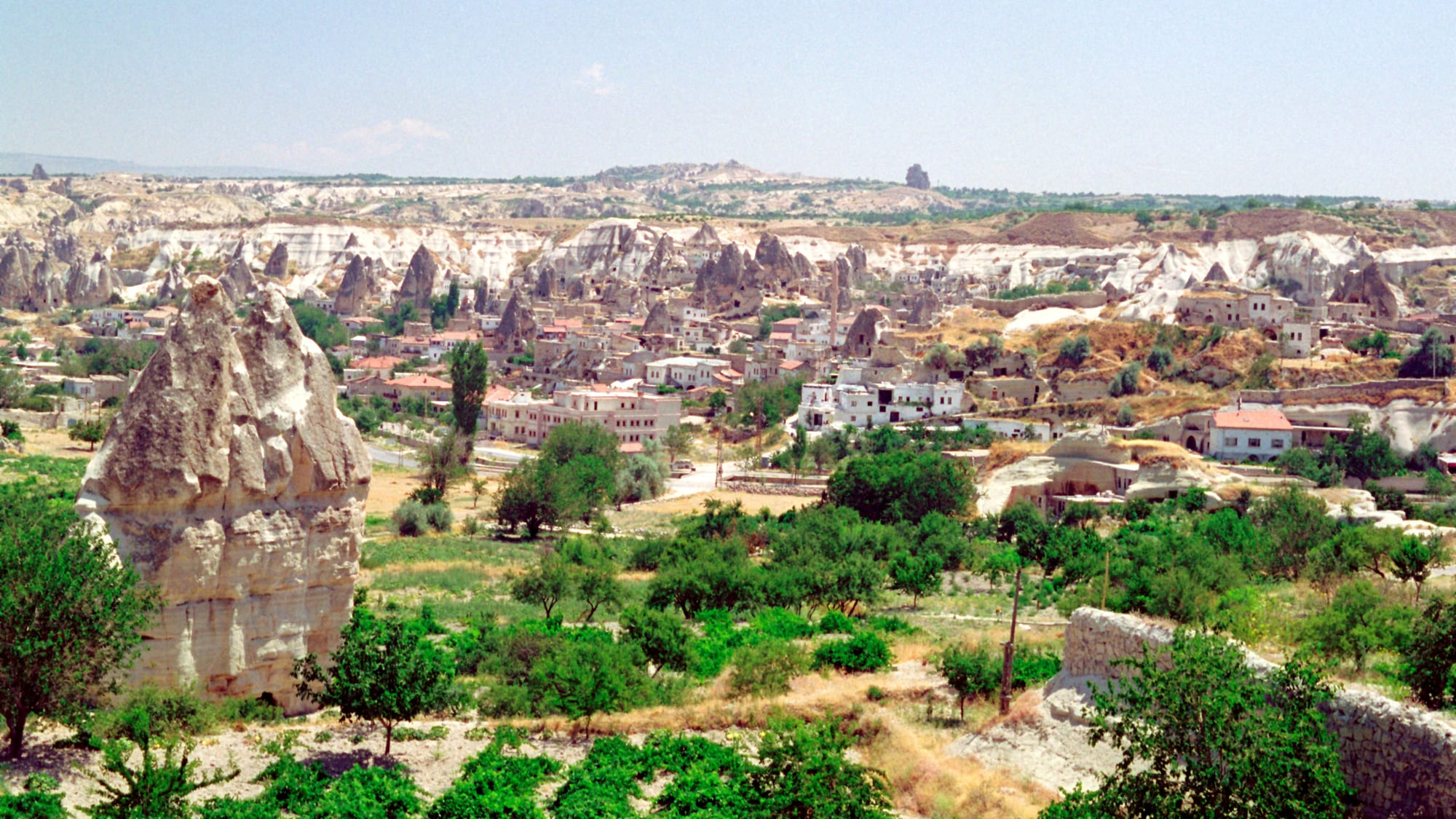
A town of low houses set among pale rock cones and cliffs riddled with cut openings, with orchards and green trees in the foreground

Ankara, Cappadocia & Central Anatolia, Turkey

Göreme

Göreme in its valley of rock cones, Cappadocia. (Carl Campbell from Querétaro, Mexico / Wikimedia Commons · CC BY-SA 2.0)

A small town in Nevşehir province at the centre of Cappadocia, built into a valley of soft volcanic rock where houses, stables and churches have been cut into cones and cliffs for centuries. Its rock-hewn quarters lie within a UNESCO World Heritage Site, and it has become the main base for exploring the valleys, with cave hotels and dawn balloon flights.

Neighbourhoods

  • The village centre
    • First-time visitors
    • Close to public transport
    • Best for food

    The flat ground where the roads meet, with the bus station, travel agencies, restaurants, bars and shops in a few short streets. Almost every tour and transfer starts here, and most of the town's services are within a two-minute walk.

    Open in Maps
  • The cave-hotel slopes
    • Rooms with a view
    • Quiet and residential
    • Sunsets

    The hillsides rising on either side of the centre, where old rock-cut dwellings and carved façades have been turned into cave hotels and guesthouses. The lanes are steep and narrow, often stepped, and the terraces look out over the valley.

    Open in Maps
  • The museum road
    • Walks
    • Historic district

    The road climbing east out of town towards the open-air museum, lined with hotels, campsites and viewpoints, with paths dropping into the valleys on either side. It is the usual way into the rock churches on foot.

    Open in Maps
  • The valley outskirts
    • Quiet and residential
    • Vineyards and orchards

    Where the built-up area thins into gardens, vineyards, pumpkin fields and dovecotes cut into the cliffs, with walking routes leading away into the Rose, Red and Pigeon valleys.

    Open in Maps

Things to do

Rock churches and museums

  • Göreme Open-Air Museummuseum

    A former monastic settlement just outside the town, with rock-cut refectories and a group of churches whose Byzantine wall paintings include the well-preserved Dark Church.

    Open in Maps
  • Göreme National Parkpark

    The protected landscape of valleys, cones and rock settlements around the town, inscribed as a UNESCO World Heritage Site in 1985.

    Open in Maps

Valleys, walks and viewpoints

  • Rose Valley and Red Valleytrail

    Neighbouring valleys north-east of the town whose pink and orange rock holds abandoned churches and dovecotes, with marked paths and a much-used sunset viewpoint.

    Open in Maps
  • Pigeon Valleytrail

    A gorge linking Göreme with Uçhisar, its cliffs pocked with dovecotes cut to collect droppings for the vineyards.

    Open in Maps
  • Love Valleyviewpoint

    A valley west of the town known for its unusually tall and narrow rock cones, visible from the road and reached by a short walk.

    Open in Maps
  • Hot-air ballooning over Cappadociaattraction

    Balloons lift off before dawn from fields around the town when the wind allows, drifting over the valleys — the image most associated with the region.

    Open in Maps

Short trips from the town

  • Uçhisar Castlelandmark

    A tall rock outcrop honeycombed with rooms and tunnels in the neighbouring village, giving the widest view over Cappadocia.

    Open in Maps
  • Çavuşinattraction

    A village a few kilometres north with an abandoned rock quarter below a cliff and a large church dedicated to John the Baptist.

    Open in Maps
  • Paşabağlandmark

    A group of fairy chimneys with unusually thick trunks and sharp points, near the road between Göreme and Avanos.

    Open in Maps
  • Zelve Open-Air Museummuseum

    Three valleys of cave dwellings, churches and a rock-cut mosque, inhabited until the middle of the 20th century.

    Open in Maps
  • Avanosattraction

    A town on the Kızılırmak river north of Göreme, known for pottery worked from the river's red clay.

    Open in Maps
  • Ürgüpattraction

    The larger market town east of Göreme, with Ottoman stone houses, wine producers and the three fairy chimneys known as the Three Beauties.

    Open in Maps
  • Derinkuyu underground citylandmark

    A settlement cut many levels into the rock south of Nevşehir, with ventilation shafts, stables and stone doors that could be rolled shut.

    Open in Maps

Seasonal events

  • Balloon seasonyear-round, best in spring and autumn

    Flights run in the early morning whenever conditions allow, and cancellations for wind or cloud are common, especially in winter.

  • Grape harvestSeptember and October

    The vineyards on the valley floors are picked in early autumn, and Cappadocian wineries in the surrounding towns press the Emir and Kalecik Karası grapes.

  • Hacıbektaş commemorationsummer

    Ceremonies and a large gathering at the shrine of Hacı Bektaş Veli, a central figure for Alevis and Bektashis, in a town north-west of Göreme.

Eat and drink

Long-standing places and food districts in Göreme. Hours, ratings and directions come from your maps app, always current.

Cappadocian classics

  • Testi kebabırestaurant

    Meat and vegetables sealed in a clay pot, cooked slowly in an oven and cracked open at the table — the dish most associated with Cappadocia.

    Open in Maps
  • Cappadocian winerestaurant

    The volcanic soils around Göreme, Ürgüp and Uçhisar grow the white Emir grape, and local wineries also bottle reds such as Kalecik Karası, sold in restaurants and tasting rooms.

    Open in Maps
  • Mantı and home cookingrestaurant

    Tiny meat dumplings under garlic yoghurt and pepper butter, a speciality of nearby Kayseri, served in Göreme alongside stuffed vine leaves and bean stews.

    Open in Maps

Everyday eating

  • The restaurants of the village centreneighborhood

    A short strip of terraces and rooftops serving grills, pide, meze and breakfast spreads, with cafés and a few bars among them.

    Open in Maps
  • Village breakfastrestaurant

    The Turkish spread of cheeses, olives, tomato, cucumber, eggs, honey and bread, served at length and often on a terrace above the valley.

    Open in Maps

Experience Göreme

History

The valleys around Göreme were shaped by volcanoes. Ash from eruptions of Erciyes and its neighbours settled into a soft rock called tuff, which rain and wind cut into cones, ridges and cliffs, and which people found easy to hollow out. Rooms, stores, stables and pigeon houses have been carved here since antiquity, when the district lay in Cappadocia, a satrapy of the Persians and later a Roman province.

Christianity gave the place its monuments. From late Roman times monks and hermits settled in the rock; Basil of Caesarea, from nearby Kayseri, helped shape the monastic life that followed. Between roughly the 9th and 13th centuries communities cut chapels, refectories and whole monasteries into the cliffs and painted them with saints and gospel scenes, work that survives in the churches of the open-air museum. In Byzantine times the site held two adjacent villages, Korama and Matiana; the town was later known as Macan and Avcılar before taking its present name.

For centuries afterwards it was a farming village whose people lived in the same carved rooms, growing grapes, apricots and pumpkins, and keeping pigeons for their droppings to fertilise the vineyards. Some rock houses were abandoned as unsafe in the 20th century and families moved to new blocks. The area was inscribed on the UNESCO World Heritage List in 1985, and from the 1980s backpackers and then balloon operators arrived. Within a generation Göreme turned from a village into the main tourist base of Cappadocia, with the cave houses converted into hotels.

Culture & Customs

Göreme's culture is doubled: a village of a couple of thousand people and an international tourist town in the same streets. Families who farmed the valleys now run hotels, drive minibuses or crew balloons, and many of the businesses are still the same households under new names. Foreign residents, long-staying travellers and seasonal workers from other provinces add to the mix, and English is spoken in the centre while village Turkish is spoken in the lanes above it.

The rock itself is the local subject. People talk about which cones are stable, which caves flood, what may be carved and what may not, and how tourism should be limited inside a World Heritage Site — a live argument as hotels, viewpoints and quad-bike tracks spread. Pigeon houses, wine cellars and storerooms still in use are reminders that the caves were working buildings before they were rooms with a view.

The wider region brings other traditions close: Avanos potters throwing red clay from the Kızılırmak, carpet weaving and the Alevi and Bektashi shrine at Hacıbektaş to the north-west. Hospitality follows Anatolian form — tea first, business afterwards — and religious holidays still empty the streets of local families even at the height of the season.

Daily Life

Around two thousand people live in Göreme, and the number of visitors in a busy week can exceed that many times over. The permanent population is concentrated in the newer housing and the flatter parts of the village, while much of the old rock quarter has become accommodation. Nevşehir, the provincial capital about half an hour away, supplies the hospital, the offices and the big shops.

Work is tourism, almost entirely: hotels, restaurants, agencies, guides, drivers, balloon pilots and crews, horse and quad operators, and the trades that build and maintain cave rooms. Farming continues around the edges — vines, pumpkins grown for their seeds, apricots and potatoes — and some families keep both a business and a field. The year swings hard between a crowded season and a cold, quiet winter, when many staff leave and some hotels shut.

Daily life starts very early. Balloon crews and hotel staff are up well before dawn, breakfast runs late into the morning, the middle of the day is for tours and the valleys, and the centre fills again at night. Water supply, the strain of building inside a protected landscape, rising property prices and the concentration of the local economy in a single industry are the recurring concerns.

Food

Cappadocia cooks slowly and simply. Testi kebabı is the dish visitors meet first: lamb or beef with vegetables sealed inside a clay pot, cooked for hours in an oven and broken open at the table. Beans, chickpeas and bulgur do much of the everyday work, in stews and pilafs, and dried apricots, walnuts and pekmez, a thick grape molasses, fill the store cupboard as they always have.

The surrounding towns supply the best-known specialities. Kayseri gives mantı, tiny dumplings under garlic yoghurt and red-pepper butter, along with pastırma, air-dried beef in a fenugreek crust, and spiced sucuk sausage. Flatbreads baked with minced meat or cheese come out of wood-fired ovens, and gözleme is folded over cheese or potato on a griddle. Breakfast is a long spread of cheeses, olives, tomato, cucumber, honey, clotted cream and eggs, often taken on a terrace above the valley.

Wine is an old local trade. The volcanic soil suits vines, the white Emir grape is grown widely in the district, and reds such as Kalecik Karası are made in Ürgüp, Uçhisar and Avanos; some cellars are cut into the rock. Pumpkin seeds, roasted and salted, are the regional snack, and the sweet course runs to syrup-soaked pastries, semolina helva and dried fruit.

Planning tools

Budget

Göreme is the most expensive place to sleep in Central Anatolia. Cave hotels charge resort prices in season, and a balloon flight is one of the single largest costs of a trip to Turkey. Food, buses and museum entry are ordinary Turkish prices, and walking the valleys costs nothing beyond the site tickets.

Daily Budget Midrange
USD 100–250 (boutique cave hotel, restaurants, a guided tour, plus a balloon flight)
Daily Budget Shoestring
USD 35–60 (hostel or simple cave pension, lokanta meals, local buses, one site ticket)

Allow for a balloon flight to be cancelled by weather and for the cost of a second attempt, and compare the price of a day tour against a hire car if several outlying sites are wanted.

Best Time to Visit

April to June and September to October are the best months, with mild days for walking the valleys and calm mornings for balloon flights. Summer is hot but dry, and pleasant in the evenings. Winter brings snow to the rock cones, which is striking, though flights are cancelled more often and some businesses close.

Suggested Number of Days

Two or three days suit a first stay. Four or five allow the wider region at a slower pace and give room for a weather cancellation. Walking rather than driving between the valleys adds time, as does travelling without a car.

First Visit
2–3 days
With Surroundings
4–5 days

Transportation

The town itself is walked. Local minibuses link Göreme with Ürgüp, Avanos, Uçhisar and Nevşehir through the day, and day tours cover the underground cities and the more distant valleys. Hire cars, scooters and bicycles are available, and taxis wait at the bus station; several valleys are joined to the town by footpaths.

Valley paths are unsigned in places and the rock looks alike in every direction, so a map or downloaded route is worth having before setting out.

Airport & Station Connections

Nevşehir Kapadokya Airport is about 40 kilometres away and Kayseri's airport roughly 70, both with domestic flights and hotel shuttle transfers. Overnight buses run from Istanbul, Ankara, Konya and Izmir to Göreme's small bus station, and Kayseri has several trains a day from Ankara. Air travel across the Middle East has been disrupted since the war that began in February 2026, and schedules at the region's airports can change at short notice.

Walkability

The centre is tiny and everything in it is a few minutes apart on foot, but the town is built on slopes: the lanes to the cave hotels are steep, stepped and often cobbled, and luggage is awkward on them. The open-air museum is a walk of about a kilometre uphill from the centre, and the valley paths beyond are rough, with loose rock and unfenced drops.

Safety

Göreme is a safe, well-policed tourist town. The real risks are outdoors: uneven ground, unlit drops and dead-end paths in the valleys, dehydration in summer and ice in winter, and, rarely, balloon accidents, with licensed operators the norm. Quad bikes and scooters on rough tracks cause a number of injuries each year.

Choose a licensed balloon operator, walk the valleys with a map, water and a torch, and start back well before dusk, which comes quickly in the gorges. Check current official travel advice before travelling.

Climate

Cappadocia sits at around 1,100 metres on the Anatolian plateau, with a dry continental climate. Summer days are hot and nights cool, winters are cold with snow and frost, and spring and autumn are mild with the steadiest mornings for flying.

Summer
hot and dry by day, 28–33°C, with cool nights in the 10s
Winter
cold, typically 2–7°C by day and below freezing at night, with snow lying on the valleys

Local Customs

The town lives on tourism but remains a Central Anatolian village, and the surrounding province is conservative. Modest dress is appreciated away from hotel terraces, and shoulders and heads should be covered in mosques, with shoes left at the door. Bargaining is normal in carpet and pottery shops, not in restaurants. Tea is offered constantly as part of doing business.

Ask before photographing people, balloon crews and farmers at work, do not climb on or remove rock from the cones and churches, and keep noise down in the lanes late at night, where hotels sit among houses.

Common Payment Methods

The currency is the Turkish lira. Cards are widely accepted by hotels, restaurants and tour operators, and balloon flights are usually paid by card or in advance. Cash is useful for minibuses, village shops and small stalls, and ATMs are in the centre of town.