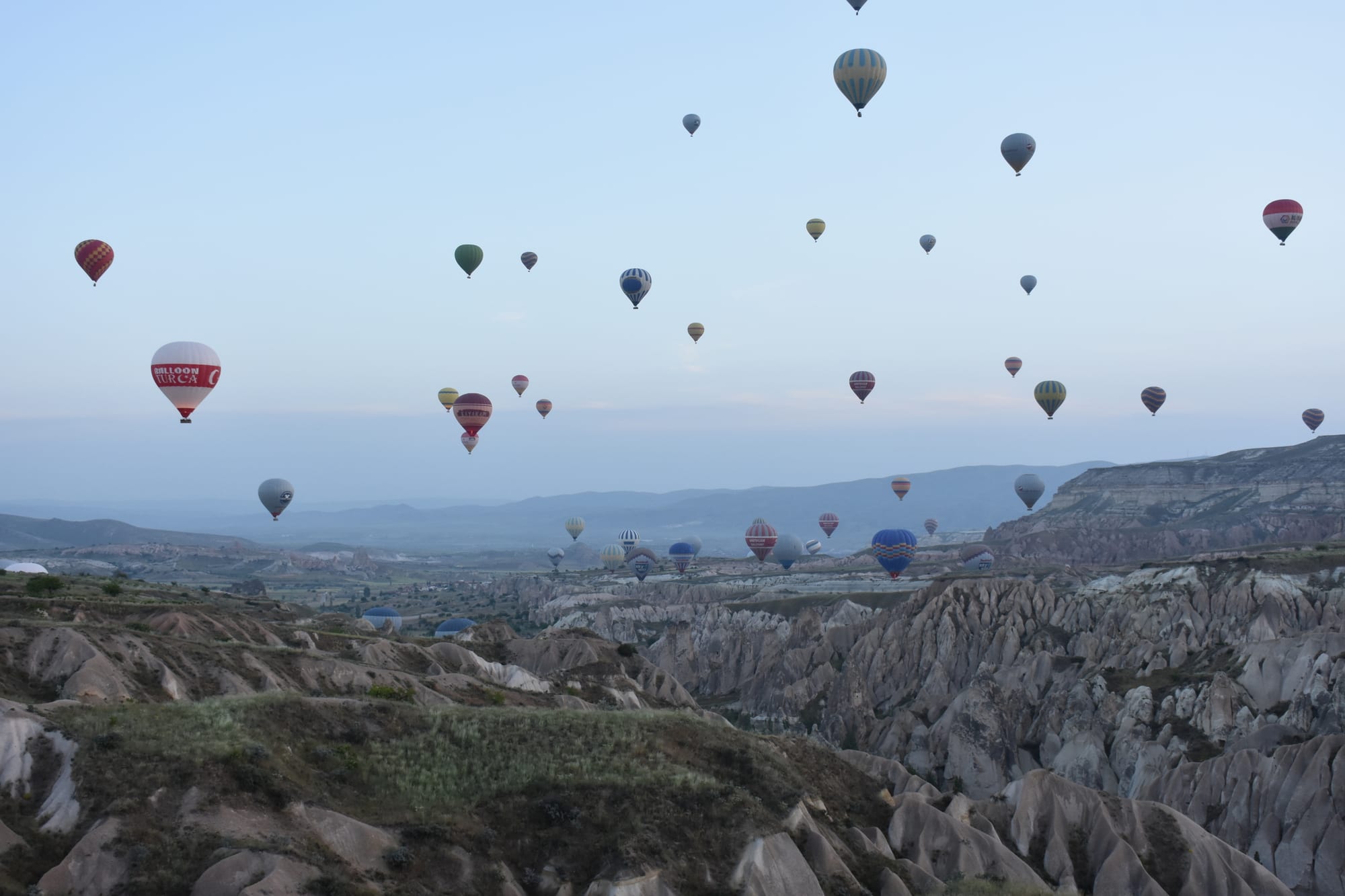
Dozens of hot-air balloons drifting at dawn above a valley of pale eroded rock cones and ridges

Turkey

Balloons over the "fairy chimney" valleys near Göreme in Cappadocia, central Anatolia, where volcanic tuff has weathered into pinnacles and cave dwellings. (MusikAnimal / Wikimedia Commons · CC BY-SA 4.0)

A large country spanning Anatolia and a corner of Europe, officially the Republic of Türkiye — heir to the Byzantine and Ottoman empires, refounded as a secular republic by Atatürk in 1923, a NATO member, and a bridge between Europe and the Middle East governed since the early 2000s by Recep Tayyip Erdoğan and his AK Party.

Explore Turkey

History

Anatolia is one of the cradles of civilisation — the carved pillars of Göbekli Tepe, near Şanlıurfa, raised from around 9600 BC, are the oldest known megaliths in the world, and the site is popularly called the first temple — and later home to the Hittites, Phrygians, Lydians, and the Greek cities of the Aegean coast. It became the wealthy heartland of the Roman and then Byzantine empire, whose capital, Constantinople, stood for over a thousand years.

Turkic peoples moved in from Central Asia from the eleventh century, and the Ottoman dynasty, rising in northwest Anatolia around 1300, took Constantinople in 1453 and built an empire that at its height ran from Hungary to Yemen and Algeria. Its long decline through the nineteenth century ended with defeat in the First World War, the occupation of Istanbul, and a war of independence led by Mustafa Kemal, later Atatürk, who abolished the sultanate and proclaimed the Republic of Turkey in 1923.

Atatürk's reforms were sweeping: a secular state, a Latin alphabet, legal and dress codes modelled on Europe, and votes for women. The later republic saw multi-party democracy interrupted by military coups (1960, 1971, 1980) and a long armed conflict with the Kurdish separatist PKK from 1984; the PKK declared a ceasefire in March 2025 and announced its dissolution that May. Recep Tayyip Erdoğan's AK Party has governed since 2002, with Erdoğan as prime minister, then from 2014 as directly elected president and, after a 2017 referendum, under an executive presidency. His tenure has brought infrastructure and early economic growth, but also a failed coup attempt in 2016, mass purges and jailings, media restrictions, a currency crisis, and the change of the country's official English name to the Republic of Türkiye at the UN in 2022.

  • Turkey: Between Two Continents — The land bridge between Europe and Asia — heart of the Byzantine and Ottoman empires, refounded in 1923 as a secular republic on the ruins of the last of them, and still arguing over the balance between the state, religion, the army and the ballot box

Culture & Customs

Official records register 99.8 per cent of the population as Muslim, and surveys put self-identification at roughly 94 to 98 per cent — mostly Sunni, with Alevis and other Shia making up as much as a tenth of Muslims — but the state is constitutionally secular, and the balance between religious and secular life — headscarves in public institutions, alcohol regulation, the status of religious schools — is a running political fault line, felt differently in cosmopolitan Istanbul, the conservative central "Anatolian tiger" cities, the Alevi and Kurdish southeast, and the Aegean coast.

Hospitality is deeply ingrained: guests are offered tea (çay) endlessly, and refusing food or drink can seem rude. Family ties are strong, respect for elders is shown in greetings and seating, and Ramadan and the two Eids reshape the calendar. Football is a national obsession, with the big Istanbul clubs at its centre.

Turkish coffee culture, with its fortune-telling ritual, is on UNESCO's intangible cultural heritage list, the hamam (bathhouse) is still part of city life, and craft traditions — carpets and kilims, ceramics from İznik and Kütahya, marbled paper (ebru), copperwork — remain alive.

  • Turkey: A Kiss for the Elder's Hand — A Muslim-majority republic built on a secular constitution, where elders are greeted first, a compliment can turn into a gift, the whole country falls silent for one minute each November, and a whirling prayer is on UNESCO's list

Daily Life

Around 86 million people live in Turkey, about 18 per cent of them in Istanbul, with Ankara, İzmir, Bursa, and Antalya the other large cities. The population is young by European standards but the birth rate is falling. The country also hosts one of the world's largest refugee populations: up to 2.3 million registered Syrian refugees as of 2026, down from a peak of more than 3.7 million in 2021, with over half a million having gone home since the Assad government fell in December 2024.

The economy is large and diversified — cars, appliances, textiles, steel, construction, agriculture, and a huge tourism sector — but has been strained for years by very high inflation, a weak lira, and unorthodox monetary policy, which has eroded savings and living standards. The 2023 earthquakes killed 53,537 people across eleven of the affected provinces and forced more than two million residents out of them; whole districts, Nurdağı among them, were condemned to be demolished and rebuilt, and the work in the south-east goes on.

Daily life mixes the modern and the traditional: shopping malls and metro lines alongside weekly street markets, the call to prayer over café terraces, and extended families gathering for long weekend meals.

  • Turkey: A Day Measured in Tea Glasses — Households that have shrunk to around three people in a generation, a working week that still leaves Sunday free, and a national habit of black tea, several small glasses at a time, that tops the world's per-person rankings

Food

Turkish cuisine is one of the world's great regional traditions, built on lamb and beef, wheat and rice, yoghurt, aubergine, and abundant fresh vegetables and herbs. The meal often opens with meze — small cold and hot dishes, from haydari and cacık to stuffed vine leaves and fried liver (Arnavut ciğeri) — followed by grilled meats: the many kinds of kebap (Adana, Urfa, İskender, şiş), köfte meatballs, and pide and lahmacun, the Turkish flatbreads.

Regional specialities run deep: the olive-oil vegetable dishes and seafood of the Aegean, the fiery food and pistachio baklava of Gaziantep, the anchovy dishes of the Black Sea, the çiğ köfte of the southeast, and the mantı (tiny meat dumplings in garlic yoghurt) of the centre. Breakfast (kahvaltı) is a spread of cheeses, olives, eggs, jams, bread, and tea.

Baklava, künefe, milk puddings, and Turkish delight (lokum) are the sweets; çay is drunk all day from tulip glasses; and rakı, the aniseed spirit, is the traditional accompaniment to a long fish-and-meze dinner.

Attractions & Natural Wonders

Istanbul straddles two continents on the Bosphorus, with the Hagia Sophia (a church, then a mosque, a museum, and since 2020 a mosque again), the Blue Mosque, Topkapı Palace, the Basilica Cistern, the Grand and Spice Bazaars, and a skyline of domes and minarets best seen from a ferry.

The Aegean and Mediterranean coasts hold the classical sites — Ephesus, Pergamon, Aphrodisias, Troy, and the ruins along the Lycian Way, which runs past Ölüdeniz and the sunken city at Kekova. Pamukkale's white travertine terraces sit below the ancient spa city of Hierapolis, and inland Cappadocia has its cave churches, underground cities, and balloon-filled dawn skies.

Further east are Mount Nemrut with its giant stone heads, the medieval Armenian capital of Ani beside the closed Armenian border, the lake and island churches around Van, and the biblical landscape below Mount Ararat. Ankara has Atatürk's mausoleum and a strong archaeological museum, and the Gallipoli peninsula on the Dardanelles is a place of pilgrimage for Turks, Australians, and New Zealanders alike.

  • Turkey: Ten Attractions and Natural Wonders — A 1,500-year-old cathedral-turned-mosque-turned-museum-turned-mosque again, hot air balloons drifting over a landscape of wind-carved rock chimneys, and white mineral terraces that look like snow but never melt

Planning basics

Budget

Turkey is good value for visitors with hard currency, as years of lira depreciation have kept local prices low even as inflation runs high. Istanbul and the resort coast are the most expensive; central Anatolia and the east are very cheap. Pensions, guesthouses, and long-distance buses keep costs down.

Daily Budget Midrange
USD 80–170 (mid-range hotel, restaurants, domestic flights, guided sites and a balloon flight)
Daily Budget Shoestring
USD 30–55 (pension or hostel, lokanta meals, buses and trams)

Eat at lokantas (point-and-choose canteens), use the intercity bus network or cheap domestic flights, and carry cash for small towns.

Visa Requirements

Many nationalities enter visa-free for up to 90 days in any 180, among them most EU citizens and British citizens, some of whom may use a national identity card instead of a passport. Others apply online for an e-Visa, usually issued for stays of up to 90 days in any 180. Rules vary by passport and change, so check before travel.

Typical Stay
Up to 90 days in 180, visa-free for many Western passports

Confirm your nationality's current status on the official e-visa site; carry a passport valid for at least 150 days.

Safety

Most of Turkey is safe for visitors, with petty theft, taxi and carpet-shop scams, and traffic the usual concerns. Governments advise against travel to the areas near the Syrian and Iraqi borders (a strip of the southeast) and caution over the wider southeast because of the risk of terrorism; the PKK declared a ceasefire in March 2025 and announced its dissolution that May. Since the regional war began in February 2026, NATO has intercepted Iranian ballistic missiles over Turkish airspace and one came down at Dörtyol in Hatay province in the south. Turkey sits on major fault lines; the February 2023 earthquakes killed more than 53,000 people in the country's south.

Health
Tap water is chlorinated but bottled water is usual; know your hotel's earthquake procedure; the sun is strong on the coast

Check your government's current travel advice before you go; avoid the Syria and Iraq border regions, be firm with touts around major sights, agree taxi fares or insist on the meter, and keep away from any political demonstration.

Climate

Varied. The Aegean and Mediterranean coasts have hot dry summers and mild wet winters; the Black Sea coast is humid and rainy year-round; the central Anatolian plateau has hot summers and cold, snowy winters; and the eastern mountains are severe in winter. Istanbul is temperate and can be humid.

Coast
Hot dry summers, mild winters (Med/Aegean)
Interior
Hot summers, cold snowy winters on the plateau and east

Transportation

Istanbul (two airports) and Ankara are the main hubs, with cheap domestic flights linking dozens of cities. High-speed trains connect Ankara with Istanbul, Konya, and beyond, and a dense, comfortable intercity bus network covers the rest. Istanbul has trams, metro, ferries, and the Marmaray cross-Bosphorus rail line. Flights across the Middle East have been disrupted by the regional war since February 2026, so routings can change.

Fly for long distances, use the overnight buses for shorter hops, and take the ferries in Istanbul to cross the Bosphorus and beat the traffic.

Best Time to Visit

April to June and September to October are ideal for Istanbul, the ancient sites, and Cappadocia — warm, and outside the summer crowds and heat. July and August suit the coast for beaches but are punishing inland. Winter brings skiing in the east and quiet, atmospheric cities.

Events
Ramadan and the two Eids; Istanbul's arts and music festivals (spring–summer); the Mevlana (whirling dervish) commemoration in Konya (December); Republic Day (29 October)

Currency

The currency is the Turkish lira, which has lost much of its value to years of high inflation and began depreciating sharply again in early 2026. Cards are widely accepted in cities and tourist areas; carry cash for markets, small towns, and the east. Prices in tourist zones are sometimes quoted in euros or dollars.

Symbol
₺
Currency Code
TRY — Turkish lira

Language

Turkish, written in the Latin alphabet since Atatürk's reforms, is the official language. Kurdish (mainly Kurmanji) and the related Zaza language are widely spoken in the southeast, and Arabic near the Syrian border. English is common in tourism and among younger urban people but limited elsewhere.

Also Spoken
Kurdish (southeast), Arabic (border areas)
Official Language
Turkish